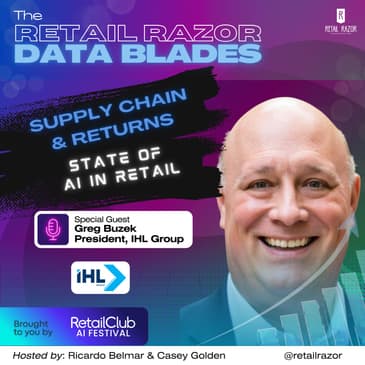



Greg Buzek of IHL Group on RFID, Computer Vision, Edge Computing, and the Returns Opportunity with AI.
Buy Online Pickup In Store (BOPIS) sounds like a solved problem. It’s not. In IHL Group's 2026 Retail Transformation Study, only 18.2% of retailers have optimized BOPIS. The most profitable retailers are a staggering 555% more likely to have it dialed in than the laggards. In the finale of our 3-part AI in Retail miniseries, Greg Buzek, President and Chief AI Orchestrator at IHL Group, joins Ricardo and Casey to unpack the connected supply chain - the unglamorous infrastructure quietly separating retail’s winners from everyone else. This is Season 2, Episode 9.
This is the conclusion of our three-part run with Greg. We started with shelf intelligence. Then we moved to the augmented associate. Now we land on the part of retail that keeps executives up at night: the connected supply chain and returns. If you want to understand why the connected supply chain decides who wins on margin in 2026, start here.
In This Episode, You’ll Learn.
● Why the most profitable retailers are 555% more likely to have buy online pickup in store fully optimized. And why only about 18% of the industry has solved BOPIS.
● How RFID and computer vision became the two technologies separating winners from laggards on inventory accuracy in the connected supply chain.
● Why computer vision now runs on the edge for under $500,. On hardware as simple as a Raspberry Pi tapping into cameras you already own.
● How edge computing ties RFID and computer vision together so you only process what moved.
● Reverse logistics and retail returns. Why a $25 item is often cheaper to give away than to take back.
● Aspirational sizing and the 90%-plus return rate on women’s dresses bought online. And how true fit technology with AI changes the math.
● Return fraud, knockoffs, and how RFID plus computer vision verify whether an item was ever in your connected supply chain.
● The one 2026 priority Greg would give every supply chain leader. Clean data and a single version of the truth.
The Numbers That Matter.
● 555% more likely: profit winners vs. laggards with BOPIS fully optimized.
● 18.2% of retailers have optimized buy online pickup in store.
● 1,600% more likely: leaders using RFID vs. laggards.
● 160x more likely: sales winners (10%+ growth) are using RFID.
● 90%+ return rate on women’s dresses bought online.
● 48% of retail sales are now walk-in, walk-out. The other 52% runs through fulfillment models most retailers haven’t optimized.
Resource Links.
How Retail Leaders Outperform - https://www.ihlservices.com/product/how-retail-leaders-outperform/
Shelf Intelligence Report - https://www.ihlservices.com/product/shelf-intelligence-report-rebuilding-retail-relationships-through-automation/
Adapt or Be Outpaced - https://www.ihlservices.com/product/adapt-or-be-outpaced-tech-imperative-for-retails-midmarket/
Fixing Inventory Distortion - https://www.ihlservices.com/product/fixing-inventory-distortion-whos-winning-whos-failing-whats-working/
Closing the Execution Gap - https://www.ihlservices.com/product/closing-the-execution-gap/
Support Our Sponsors.
This Episode is Brought to You By RetailClub.
Retail Club AI Festival, September 22–24 in Huntington Beach. Join 2,000 retail leaders for a fully outdoor, beachside deep dive into how AI is reshaping retail. Qualified retailers and brands can attend with free tickets and up to $1,250 in travel reimbursement. Head to retailclub.com to learn more. https://retailclub.com/retail-razor-podcast.
Subscribe & Follow.
Don't forget to like and subscribe to The Retail Razor: Data Blades for more episodes on customer experience, retail marketing, AI in retail, and data‑driven transformation!
Subscribe to the Retail Razor Podcast Network: https://retailrazor.com/
Subscribe to our Newsletter: https://retailrazor.substack.com
Subscribe to our YouTube channel: https://go.retailrazor.com/utube
About Our Guest.
Greg Buzek. https://www.linkedin.com/in/gregbuzek/
IHL Group. https://www.ihlservices.com/
RetailROI. https://www.retailroi.org
Greg Buzek is the Founder, President and Principal Analyst of IHL Group, one of the most respected retail technology research firms in the world. IHL's annual Retail Transformation Study is the largest survey of retail technology leaders in the industry, covering more than 400 brands across every retail segment. Greg is also the founder of Retail Orphan Initiative (Retail ROI), which this week surpassed $6 million in total grants to help children around the world through the industry's Super Saturday campaign.
Noted by RIS News as one of the Top 10 Influentials in Retail and the National Retail Federation as one of “The List of People Shaping Retail’s Future“, he has a Masters Degree in Business Administration (MBA) from The Ohio State University, and 30 years of experience in retail market analysis, business planning, product development, and consulting with Fortune 500 companies. He is also a member of the Top 100 Retail Influencers from RETHINK Retail.
Chapters.
(00:00) Teaser
(00:46) Show Intro
(04:05) Welcome Back, Greg Buzek!
(07:09) Inventory Accuracy Tech Stack
(10:01) Computer Vision Goes Edge
(15:18) Returns and Reverse Logistics
(20:50) Return Fraud and Smart Mirrors
(26:04) 2026 Priorities Clean Data
(29:35) Show Close
About your Hosts.
Helping you cut through the clutter in retail data insights:
Ricardo Belmar is an NRF Top Retail Voice for 2025 and a RETHINK Retail Top Retail Expert from 2021 – 2026. Thinkers 360 has named him a Top 10 Thought Leader in Retail, a Top 25 Thought Leader in AGI and Careers, a Top 50 Thought Leader in Agentic AIand Management, and a Top 100 Thought Leader in Digital Transformation and Transformation. Thinkers 360 also named him a Top Digital Voice for 2024 and 2025. He is an advisory council member at George Mason University’s Center for Retail Transformationand the Retail Cloud Alliance. He was most recently the partner marketing leader for retail & consumer goods in the Americas at Microsoft.
Casey Golden, is the North America Leader for Retail & Consumer Goods at CI&T, and CEO of Luxlock. She is a RETHINK Retail Top Retail Expert from 2023 - 2026, and Retail Cloud Alliance advisory council member. After a career on the fashion and supply chain technology side of the business, Casey is obsessed with the customer relationship between the brand and the consumer and is slaying franken-stacks and building retail tech!
Episode Music.
Includes music provided by imunobeats.com, featuring Tech Lore from the album Beat Hype, written by Heston Mimms, published by Imuno.
Highlights.
[00:15:28] - Yeah. So where AI is coming into play as a is an associate tool at the point of return. And that that even starts now more…
[00:04:53] - So I I think the most striking data is the fact that the leading retailers have just expanded their pie, so to speak, in terms…
[00:07:16] - Yeah. The biggest the the two biggest technologies that we're seeing are related to actually inventory accuracy more than…
Transcript.
S2E9 IHL Part 3 – The Connected Supply Chain
[00:00:00]
[00:00:00] Teaser
[00:00:01] Ricardo Belmar: One number from the new IHL Group retail study. Profit winners? 555% more likely than their competitors to have buy online pickup in store fully optimized.
[00:00:12] Casey Golden: That's not a small competitive advantage. That's a single biggest capability gap in the whole study, and only 18% of retailers across the industry have actually solved for it.
[00:00:25] Ricardo Belmar: Today on the "Data Blades" podcast, Greg Buzek of IHL on the connected supply chain, why returns are the next AI battleground, and the infrastructure decision quietly separating winners from everybody else.
[00:00:46] Show Intro
[00:00:46] Ricardo Belmar: Welcome retail data junkies to season 2 episode 9 of the Retail Razor Data Blades Show, the podcast that slices through complex retail research to bring you sharp, actionable insights you can use today.
[00:00:58] I'm Ricardo [00:01:00] Belmar.
[00:01:00] Casey Golden: And I'm Casey Golden.
[00:01:01] This is part three of our AI in Retail miniseries with Greg Buzek of IHL. We've covered shelf intelligence and the augmented associate. If you missed those episodes, stop here, go back, and catch episodes seven and eight, then come back for today's conclusion. We'll wait.
[00:01:21] Because today we're getting into the part of retail that really keeps executives up at night, supply chain and returns.
[00:01:30] Ricardo Belmar: And the headline number from IHL's twenty twenty-six retail transformation study on this is absolutely staggering. Profit winners are, get this, five hundred and fifty-five percent more likely than profit laggards to be fully optimized for buy online pickup in store. That's not a marginal gap. That's like the single largest capability difference between winners and laggards in the whole study.
[00:01:56] Casey Golden: And only 18.2% of retailers [00:02:00] across the entire industry are fully optimized for BOPIS. Only about a third are optimized for local delivery, so there is a massive execution gap on fulfillment models that retailers have already publicly committed to.
[00:02:17] Ricardo Belmar: Today, we're walking through what's separating the leaders from everyone else, RFID, computer vision, edge compute, returns, how they handle tariffs, and goes on and on. And as you'd expect at this point in the series, there's one thing that keeps showing up as the deciding factor, but I won't spoil it just yet.
[00:02:35] In fact, before we dive in, let me tell you about our sponsor, RetailClub. Join two thousand retail leaders at the Retail Club AI Festival, September twenty-second to twenty-fourth in Huntington Beach. Dive deep into how AI is reshaping retail while soaking up the sun at a fully outdoor beachside venue.
[00:02:53] Decision-makers from retailers and brands can attend with free tickets and up to twelve hundred and fifty dollars in travel reimbursement. [00:03:00] Head to retailclub.com/retail-razor-podcast to learn more and get your ticket today.
[00:03:07] Thank you to Retail Club for helping us bring you this podcast and all the shows in the Retail Razor Podcast Network.
[00:03:13] Casey Golden: Before we dive in with Greg, we have a simple ask for you. Call it the audience tax. If you are enjoying the show, please hit us with a five-star rating and drop a short review on Apple Podcasts, Spotify, Goodpods, or wherever you're listening.
[00:03:31] Ricardo Belmar: And don't forget to like and subscribe on our YouTube channel so you never miss an episode. Really helps us grow the show.
[00:03:37] Casey Golden: And remember to check out the other shows in the Retail Razor Podcast Network: The Retail Razor Show, Retail Transformers, and Blade to Greatness. If you haven't already, you'll find them all in your favorite podcasts app or on your favorite YouTube channel.
[00:03:55] Ricardo Belmar: So let's raise our Data Blades and welcome back Greg Buzek, president and founder of [00:04:00] IHL Group, to the show for the third and final part of our AI in Retail miniseries.
[00:04:05]
[00:04:05] Welcome Back, Greg Buzek!
[00:04:11] Ricardo Belmar: Welcome back to the Retail Razor Data Blades Show, Greg. Excited to close out this three-part series with you today and focus on a topic that really keeps retail executives up at night, supply chain and returns.
[00:04:23] Greg Buzek: Yeah.
[00:04:23] Ricardo Belmar: it's everyone's favorite topic to hate. your 2026 data is showing there's a gap, right, between retailers who've cracked this problem and those who haven't, and that gap is just getting enormous. So I
[00:04:36] Greg Buzek: Yeah.
[00:04:36] Ricardo Belmar: get into this with you. It's great to have you here today.
[00:04:38] Greg Buzek: Yeah, my pleasure. It's great to be back.
[00:04:40] Casey Golden: And I'm espe-especially ex-excited to hear from you on what's causing this gap. I think the answer is going to surprise a lot of retailers because I don't think it's what we expect.
[00:04:51] Ricardo Belmar: Let's jump in.
[00:04:52] Greg Buzek: Yeah, so I, I think the most striking data is the fact that the leading retailers have just expanded their pie, [00:05:00] so to speak, in terms of the number of distribution points that they have, and then they're actually optimizing those distribution points for margin, just like you would traditionally at the store level.
[00:05:11] I mean, what we've seen is the people that are the highest profit retailers are literally almost six times more likely to have optimized their buy online pickup in store process. And they realize that that is a huge opportunity, whether it's click or collect or BOPUS, however it works based on the chain. The ability to optimize that for margin is returning tremendous dividends. And we see the most profitable retailers are focused on these alternative channels for things, and that extends even further, not just getting the product to the customer, but when you're dealing with returns on the back end optimizing that reverse logistics as well. Each of these areas is margin loss if you don't do it correctly. So for instance, on the, the buy online pickup in store, [00:06:00] your associates are doing the work the consumers used to do. And so you've got to optimize that pick and getting things ready so that there's minimal amount of labor. And so having the technologies and the tools in place to find those items very, very quickly, get them staged and ready to go that's of-of-often the difference between profitability and, and loss in a lot of retailers.
[00:06:23] Ricardo Belmar: you're seeing between winners and laggards in this area?
[00:06:27] Greg Buzek: Yeah. So five hundred and fifty-five percent in terms of they're more likely to have optimized it,
[00:06:33] Ricardo Belmar: Mm.
[00:06:34] Greg Buzek: But it, it's also not only that, but they're doing twice as much of it.
[00:06:39] Ricardo Belmar: Oh,
[00:06:41] Greg Buzek: So it's like you know, two to three times,
[00:06:44] Ricardo Belmar: Mm-hmm.
[00:06:45] Greg Buzek: as much. So generally, overall, there's only about 18% of retailers who have optimized these channels, and so the ones that are winning are the ones that are doing that.
[00:06:55] They're ki- they're ca- recapturing this margin loss in all of these different [00:07:00] areas. And it's not just theft where you're having margin loss that you've got margin loss in these distribution areas if you don't optimize those processes.
[00:07:09] Inventory Accuracy Tech Stack
[00:07:09] Casey Golden: What does the data show about which technologies are separating the laggards on fulfillment
[00:07:16] Greg Buzek: biggest, the, the
[00:07:17] Casey Golden: and leader?
[00:07:18] Greg Buzek: that we're seeing are related to actually inventory accuracy more than anything else, so it's RFID and computer vision. And then it's getting more and more into like AI robotics automating that entire process. So it's, it's kind of taking humans out of the loop of counting merchandise and putting more humans in the loop of getting the merchandise on the shelf when you have scarce labor there.
[00:07:43] But RFID, what we found is the, the leaders were s- you know, 1,600% more likely to be using RFID than the, the, the laggers were.
[00:07:56] Ricardo Belmar: Wow.
[00:07:56] Greg Buzek: That was a clear separator. We, we talk about AI [00:08:00] and all these tools and having clean data, well, RFID is one of those tools for clean data.
[00:08:05] Ricardo Belmar: get the
[00:08:05] Greg Buzek: And when you think of it for the benefits of buy online pickup in store or ship from store or local delivery, you've got the product and where it is in the store,
[00:08:15] Ricardo Belmar: Hmm.
[00:08:16] Greg Buzek: through, through cycle counts there is critical.
[00:08:19] Ricardo Belmar: Yeah.
[00:08:20] Greg Buzek: and particularly if you're in high, high theft categories like health and beauty and other, in, in those kind of things where it's like, "Do we even have it? Can I take this order? Do we even have it?" That ability to see that is, is really a, a- an advantage over others.
[00:08:37] Ricardo Belmar: Yeah, yeah. You can't deliver, you can't fulfill what you don't have.
[00:08:41] Greg Buzek: Right. So if you think, if you think of it as, as, as like hey, I, I wanna do a click and collect or a local delivery order, You know, you, you... That retailer at that time is telling you, you can, they can deliver it within a certain amount of period of time. Let's say it's, "Hey, you could have it today or at a window at 4:00 today." [00:09:00] If they don't know they've got it, they've got a real mess on their hands, and they're gonna lose the margin completely on that order for things like that. And so that's what the winners do differently, is they've, they've em- embedded the technologies to allow them to optimize these different journeys that are not just there.
[00:09:19] I mean, 'cause only about 48% of, of total retail sales now are the customer walking in and walking out with a product. The rest of it is coming from all of these different models where I've ordered it on my phone to pick up. Now, this includes restaurants in there, so it might be a little skewed, but it's certainly, that's about a 50/50 for fashion now.
[00:09:41] where it's like groceries where it's not quite at that level yet. But if you look at it overall, it's, it's about 48% transactions are now walk-in store, which means 52% are in this other area that you haven't optimized in most cases, and that is often the clear separation,[00:10:00]
[00:10:00] Ricardo Belmar: Yeah.
[00:10:00] Greg Buzek: things there, so.
[00:10:01] Computer Vision Goes Edge
[00:10:01] Casey Golden: I'd love to just double-click on computer vision. It was all the rage like during the pandemic, I mean, but it was seemed really hard to get approved. And then I didn't hear about it for a little while, and now I'm starting to-- It's coming up in, in daily conversations as if it's always been there. What am I missing?
[00:10:25] Greg Buzek: Well, there's-- computer vision has a wide variety of use cases. So it's if we look at it from the supply chain it's complementary to RFID. RFID doesn't do as well with metals and liquids and things like that, where computer vision doesn't have that problem. But computer vision can't see behind things, and so you use the two together to get the most accurate picture of what's going on. but computer vision in theft is the big area. So I mean, we've, we've had quite a bit a change due to administration [00:11:00] differences and the ability to prosecute in many areas where we saw a lot of theft during the pandemic and late in the pandemic there. I, I always point out, I s- I tell people, "If you really wanna know what's going on in retail stores, go to the APEX Loss Prevention Summit in Nashville in, in this late summer, early Septem- or late September this year." Because it's, it's like the AA meeting for retailers, and you really hear what's going on, inside of retailers. But where we're seeing it used is a lot for loss prevention and, and we're actually doing a webinar on this. But the impact of using facial recognition, not, not from a privacy standpoint, but to find the bad guys, and also realizing that those bad guys, they visited six different stores. The normal consumer doesn't go to six of your stores, but you can find those people if you leverage that technology. And, and it is dramatic in terms of the impact [00:12:00] on the losses and the reduction of losses because that organized retail crime chain or the guys that are have a team and they stake out the stores in different place and they're gonna fake a slip and fall type of situation, you're able to sniff that out using that, those kind of technologies for loss prevention. Where it's been used the most in loss prevention is in the area of self-checkout and trying to find theft there. But it has use cases all over the place. And one of the things that has happened Casey, most recently is individual use cases run on the edge rather than having to have this cloud or large format things there.
[00:12:43] Now, you can literally run it on a point-of-sale terminal. You can run it on a Raspberry Pi in some cases, some of these models that are optimized for just that use case. So now you're sub $500 for the hardware to run computer vision on the, the [00:13:00] processing device, tapping into your existing cameras. That, that cost differential is, is opening the door to so many more uses of what's going on.
[00:13:09] Casey Golden: Interesting.
[00:13:10] Ricardo Belmar: How is edge computing tied into this?
[00:13:13] Greg Buzek: So you can't process computer vision anywhere but the device itself or on the edge, you know, and that edge might be the access point or it may be in the back of the store. So edge computing is huge when it comes to all of these technologies because e- even RFID, for instance, you only care about what's moved.
[00:13:34] Ricardo Belmar: Mm.
[00:13:35] Greg Buzek: you get that first initial thing, if it hasn't moved, you're not, you're not changing the account. So how do you process through everything that you're reading and realize, oh, these are the 10 that moved since the last read? Those are the, those are the things that move upstream, so you've got to process that at the edge as well.
[00:13:56] Ricardo Belmar: So let me ask you then, so how, how does this [00:14:00] char-- how would you characterize th-these areas? So they got the edge computing, computer vision, RFID. How would you characterize this in terms of how much better off are the winners from the laggards because they've been-- they've have these enabling technologies?
[00:14:12] Greg Buzek: Right. Right. Yeah. And, and, and it's just the how they align, these technologies align to that optimization type of thing. So the, the guys that, that are using RFID today, they're 92% more likely to be optimized for those journeys for those non-walk-in retail situations. And like I said earlier, if you've got one size dress but it's in the dressing room and you You can't find it.
[00:14:38] You're gonna lose all the margin on the transaction and the labor it's taking somebody to find that item
[00:14:43] Ricardo Belmar: Right.
[00:14:43] Greg Buzek: throughout your store, and that's why it becomes such a critical technology. It's also a, a great loss prevention tool as well. Although you're not gonna use RFID to stop anybody from stealing stuff, it does allow you to know, hey, we don't [00:15:00] see this anymore, so it gives us a window to check the security cameras as to when we lost this item.
[00:15:05] Ricardo Belmar: because you saw it move.
[00:15:07] Greg Buzek: exactly, 'cause it's, it's not, it's not there in the read anymore. And so it, it greatly narrows the, the, the use case to, to find, to find things.
[00:15:17] Ricardo Belmar: Okay.
[00:15:18] Returns and Reverse Logistics
[00:15:18] Ricardo Belmar: So let's look at returns specifically then. So what, what
[00:15:22] Greg Buzek: Yeah.
[00:15:22] Ricardo Belmar: telling you about about reverse logistics? How is AI changing this part of the supply chain?
[00:15:28] Greg Buzek: so where AI's coming into play as a, as an associate tool at the point of return, and it... That, that even starts now more online, for the returns, even where you would normally take something to to a store. What many retailers are realizing that if the item sells for less than $25, in a lot of cases it's more efficient for them to just allow the consumer to keep the item than it is to go through the reverse logistics process to take it back in, pay for that labor, put it in a box and send it [00:16:00]somewhere type of thing. If they're selling it for $25, their actual cost of that item is probably $7, $8 and everything else is in the transportation of items going, going back and forth. So they look at it and say, "You know what? It's gonna cost me $8 to ship this thing back. It only costs me $7. You keep it." Okay? So that's, that's one step that they're doing. But then if it is gonna come back into your supply chain, where does it go? Does it, does it go back into store inventory? Do I have to do any evaluation of it? If somebody's saying it's, you know, it's an outfit and it's just the wrong size, I can take that and put it right back in the store inventory if we carry that item at the store. The second piece of it is, is does that have to be evaluated? Like, you know, if you're talking about electronics, there are open box rules where you can't sell something for the same, same price there. Does that have to be tested first? Is that tested here in the store or is that tested locally?
[00:16:59] [00:17:00] What's the policy per item? And the ability for that to be a snap decision and where the associate knows exactly where that item goes for maximized profitability. That's a big deal, does it go directly back to the manufacturer? Does it go back to a warehouse? there are businesses now where you can just buy returns. You just buy y- un- sight unseen hey, I want to get a pallet of returns, and you hope you've got something that you can resell for a profit. People are making businesses out of that. Type of thing. So but the, the smartest retailers are optimizing that entire return logistics process there because you're not making any money. So it's how, how do you just lose the least amount of money in that reverse logistics process? And it's generally cost five times the cost of logistics to get something to a store than to get it back to where it came from. And the smartest retailers have gotten to the point where their systems where that is now the [00:18:00] leverage point. And when you're dealing with anywhere from eighteen to twenty percent of items being returned, in fashion it's way higher. It could be as high as sixty to seventy percent. Women's dresses have a return rate of over ninety percent that are purchased online. It's just an absolutely astounding number because we've got all these aspirational sizing. So where AI comes into play there is--
[00:18:27] Casey Golden: that is the best phrase I've ever heard.
[00:18:29] Greg Buzek: Oh,
[00:18:30] Casey Golden: Aspirational sizing. You've never heard that term before?.
[00:18:33] No vanity sizing, but aspirational never.
[00:18:38] Greg Buzek: aspirational si- is the same thing. But we've trained the customer that, that, "Hey, you're a smaller size at our store." Well, that's a disaster for online purchases, you know, for returns. So
[00:18:49] Casey Golden: My God, that could... Right, yeah, I just had to do a whole three zip.
[00:18:53] Greg Buzek: man. That, that whole op-opportunity is I'm gonna be that size smaller, you know, coming [00:19:00] soon.
[00:19:00] Casey Golden: Well, now there's nothing to wear, right? I mean, I just did a whole bunch of returns three people.
[00:19:04] Greg Buzek: They've got a-- they've got something that was
[00:19:06] Casey Golden: I'm like...
[00:19:07] Greg Buzek: as a gift or whatever. It's one size smaller than they really are, and they keep it in a closet because someday I'm gonna fit into that item, that someday it's gonna fit.
[00:19:17] Casey Golden: Oh, I had...
[00:19:17] Greg Buzek: So you've got a whole
[00:19:18] Casey Golden: Yeah, I have two beautiful, I have two beautiful dresses that are like every summer they get hung out on top of the closet because like one day I'm gonna get one night in it
[00:19:31] Greg Buzek: funny story. I bought... Years ago, I got to go to Pebble Beach for some event, and I bought the golf shirt knowing it was too small for me, and I finally lost the weight to wear the sh- I... You know, it was a ridiculously priced golf sho- shirt from the, you know, the pro shop. finally got to wear it. I got to wear it one time because it got destroyed. You know, I don't know if I spilled something on it or I went to iron it, and it just put a big [00:20:00] hole in it
[00:20:00] Ricardo Belmar: no
[00:20:01] Greg Buzek: or whatever. It was just like, "Ugh." But all done it. We've all done it, you know? And because we've trained the consumer, whether it's vanity sizes or aspirational sizes, particularly in women's clothing, it's an absolute disaster.
[00:20:15] Ricardo Belmar: Yeah.
[00:20:16] Greg Buzek: and people are losing their shirts if they're not optimizing that return process because the typical shopper today buys two or buys three, returns two In, in that environment. So true fit technology with AI is a huge opportunity, and then changing return policies to where if you don't use the true fit, you're paying for the return. those can be, uh, it's a little gutsy to do that, but,
[00:20:43] Ricardo Belmar: Yeah.
[00:20:44] Greg Buzek: those are, those are things that the smartest retailers are deploying to not lose those margins.
[00:20:49] Ricardo Belmar: Yeah.
[00:20:50] Return Fraud and Smart Mirrors
[00:20:50] Ricardo Belmar: So h-how do how, how do RFID and computer vision factor into this side of the equation like it did for enabling the inventory management?
[00:20:58] Greg Buzek: Yeah. So well, a [00:21:00] lot of different, a lot of different ways. I- is this a knockoff?
[00:21:04] Ricardo Belmar: Mm.
[00:21:04] Greg Buzek: this literally a product that's ever been in our supply chain? You see it more with packaged goods somebody will steal something from Target and try to return it to Walmart,
[00:21:13] Ricardo Belmar: Mm.
[00:21:14] Greg Buzek: vice, or vice versa. But you're seeing it a lot in, in fashion and luxury goods where the duplicates or the knockoffs are being returned and they simply just steal the tag or they try to, they try to do all kinds of different things to to push that back. The, There's a funny anecdote you know, when you think of loss prevention overall. There was the I think it was Sensormatic. They took people with backpacks, and in the backpacks were RFID readers, and they went to this black, black store, so to speak, black ops store. it was under a barber shop in in Brooklyn. And what they found is there was an entire Macy's store worth of merchandise stolen underneath the store, and they found it with [00:22:00]RFID. So these technologies are being used to recover margin in a lot of different, in a lot of different ways. And and what's fascinating when you-- when it comes to returns, there's the return fraud piece of it, but it's also the, "Hey, can I get this?
[00:22:14] If it is legit, it is a product that we offer, can I get this back into to sales automatically? if so, m-maybe I carry it, but I don't carry it at this store. Can I get this in a situation where the next order that comes in online, I'm shipping from here, from this store, so that I'm not shipping it to a warehouse and then shipping it out, so I'm only doing one of the, of the shipping opportunities there?" So that's, that's a way in which RFID in particular is being used there. We're also seeing RFID being used for the sizing mirrors there. So at NRF, I saw one vendor that has, you, you take the products into the dressing room and the RFID will take a virtual picture of-- It, it [00:23:00] basically creates a virtual picture of that into a smart mirror and shows you what this looks on you.
[00:23:05] And then as a result of this, it's like, "Oh, this one's a little too tight. This is a little too big.
[00:23:09] Ricardo Belmar: Mm-hmm.
[00:23:10] Greg Buzek: want an associate to bring you another one?"
[00:23:12] Ricardo Belmar: Right.
[00:23:12] Greg Buzek: matches that and it actually alerts,
[00:23:14] Ricardo Belmar: Right.
[00:23:15] Greg Buzek: the associate there.
[00:23:16] Ricardo Belmar: Yeah.
[00:23:17] Greg Buzek: so that's, that's fashion. But when it comes to the returns side of things, it's, it's do we, do we put it back into inventory?
[00:23:28] Are we cataloging that back into inventory? Did-- Was this bought at our store? Is, was it ever in our supply chain? The thing about RFID is there's a unique item number to each thing, so you can actually match it up with computer vision and say, "Hey, we've got a tag that says it's one thing. Does it match what the source pr-product is, for it?"
[00:23:49] So all of those are different use cases for RFID in particular. It is, it is... RFID is the second most powerful technology we've seen deployed [00:24:00] in retailers. The first was that had the highest impact on, on returns. On, on sorry, on retail returns, not return of merchandise, but just overall return on investment.
[00:24:11] Ricardo Belmar: yeah.
[00:24:12] Greg Buzek: The second that was RFID. The first one was tablets for managers to get them out from behind a, a back wall and to be able to do more things on the store. That's the only technology that was ever more compelling from a return on investment than RFID.
[00:24:27] Ricardo Belmar: Yeah. And do you see a big a big gap in terms of, you know, when you look at winners versus laggards in having done this? Hmm.
[00:24:33] Greg Buzek: Yeah, no, without, without question the the winners when it comes to leveraging, uh, RFID, so the sales winners, the people that grew their sales ten percent or more were, were literally a hundred and sixty times more likely to be using RFID. You know, and overall, there's only about twenty percent of the market that uses it you know, but those winners are far more likely to be-- to [00:25:00] using it.
[00:25:00] Ricardo Belmar: clear
[00:25:00] Greg Buzek: now we're seeing RFID for checkout, particularly in fashion. It's just so, so easy,
[00:25:05] Ricardo Belmar: Yeah.
[00:25:06] Greg Buzek: and, and being used most often in fast fashion type of categories, where you just ring up the entire basket immediately through that.
[00:25:15] Ricardo Belmar: Yeah
[00:25:16] Greg Buzek: and then last, like I said, loss prevention on the, "Hey, we knew where this product was at this point in time." One of the things, you know, that made that such a overnight success after being a technology that was twenty-five years old was simply the ability and the, and the ability to store the individual item information in the databases.
[00:25:35] Ricardo Belmar: Mm-hmm.
[00:25:37] Greg Buzek: to support that,
[00:25:38] Ricardo Belmar: Yeah.
[00:25:38] Greg Buzek: because you've got exponential increase now in the number-- the amount of storage per SKU because now every item has gotta be stored. And so that, that was a big limitation, and now the compute is there
[00:25:52] Ricardo Belmar: The
[00:25:52] Greg Buzek: to do that, particularly as we've gotten more concerned with sourcing, where did it come from? How did, how did we have it? You know, [00:26:00] return fraud, all of that All those different use cases.
[00:26:03] Ricardo Belmar: Right.
[00:26:04] 2026 Priorities Clean Data
[00:26:04] Ricardo Belmar: So Greg, what's the one thing you would tell a supply chain leader to prioritize right now for the, for the second half of 2026?
[00:26:12] Greg Buzek: Well, there's been no greater heroes, I think, in our, in our retail environment than the supply chain people the last several years. I, I say it's kind of like, you know, you're trying to run a, a NASCAR race and there's a bomb on, on turn three. You know, we just took that out because of COVID. Okay, now let's go-- uh, we'll reroute through the concession stand.
[00:26:33] Now there's a riot at the concession stand. You know, we got to do this. Oh, now we got tariffs. Okay. You know, and, and it's a continual process. I don't know if I can give them one answer as to what technology to deploy because it's going to be dependent on where you are today. All I can tell you is RFID and computer vision have been the two technologies that move the needle the [00:27:00]most if you take it down to the technology level. But you may have more remedial things to do, or you may already been using those technologies. What we've seen is it's, it's generally a, hey, we, we need to get to a single version of the truth of our data as to what we're using, one system of, of record, whether that's an order management system or whatever. Then we layer on the RFID and the computer vision to make sure that's, that's accurate. And then as we optimize those customer journeys related to the supply chain, that piece becomes a third. Then I think in parallel, we start doing the reverse logistics and then the, the, the distribution optimization of trucks and things like that. Those are areas where margin is being lost today that is being replaced. So everybody's at a different stage. There is a logical step through this.
[00:27:54] Ricardo Belmar: Mm-hmm.
[00:27:55] Greg Buzek: two technologies that we track, though, are RFID and computer vision that are... [00:28:00] and, and order management. Those are the three technologies that are separating the winners from the losers the greatest as they go through.
[00:28:07] And then those tweaks now being the reverse logistics process things for those people that are already performing with the RFID and the computer vision and all that front-loading supply chain, and they've optimized that, now that reverse supply chain, is the, is the key area. So that would, that would be my primary recommendation is find out where you are in the chain. But it really comes down to that clean data. Do you have good data to begin with? Do you have a single version of the truth so you can work from there and then build?
[00:28:40] Casey Golden: Greg, thanks again for joining us today for this three-part series on three very important topics. It's a fantastic topic on connecting store associates for the win, supply chain. Very much appreciate.
[00:28:55] Greg Buzek: pleasure. It's great to be with you guys as always. Thanks for the opportunity.[00:29:00]
[00:29:00] Ricardo Belmar: Thanks again, Greg. This has been such an eye-opening series and s- so incredibly well-backed by all the research data that you have, which I, I hope everybody's been taking notes as they've been listening and watching this, these three episodes. We covered a lot, all the-- going all the way back to shelf intelligence in the first one, and as Casey mentioned, automating associates, and now our, our supply chain and returns discussion.
[00:29:23] I mean, AI has a massive impact when it's done right and with the right foundation, as you've highlighted multiple times here. I, I just can't thank you enough for all the, all the details.
[00:29:32] Greg Buzek: pleasure. Thank you
[00:29:34] Casey Golden: We're a wrap!
[00:29:35]
[00:29:35] Show Close
[00:29:41] Casey Golden: Loved this episode? Drop us a five-star rating and review on Apple Podcasts, Spotify, or Goodpods. And if you're watching on YouTube, like and subscribe before you go.
[00:29:52] I'm Casey Golden.
[00:29:53] Ricardo Belmar: Follow us on LinkedIn, Bluesky, Threads, and Instagram, and subscribe to our Substack for highlights and bonus [00:30:00] content. For transcripts and guest info, visit retailrazor.com.
[00:30:03] I'm Ricardo Belmar.
[00:30:04] Casey Golden: Thanks for joining us on the Retail Razor Data Blades, part of the Retail Razor Podcast Network.
[00:30:11] Ricardo Belmar: Until next time, stay sharp, be data-driven, and harness AI.
[00:30:15] This is the Retail Razor Data Blades!