
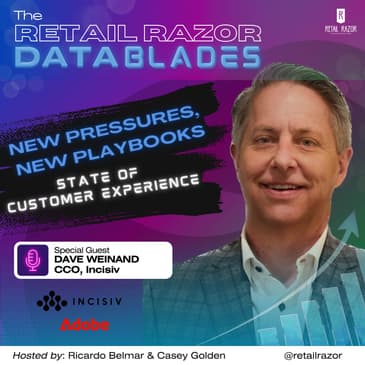



S2E4 The Truth About Retail Customer Experience - What Adobe + Incisiv Discovered
In this episode of The Retail Razor: Data Blades, Ricardo and Casey kick off a three‑part series with Dave Weinand, Chief Customer Officer at Incisiv, to unpack the latest Adobe + Incisiv State of Customer Experience in Retail and Consumer Goods research. Consumer expectations are rising faster than most retail marketing teams can respond. The gap between what shoppers want and what brands deliver is widening.
Dave breaks down:
why customer experience continues to lag despite massive investment,
why traditional marketing playbooks are failing, and
how CMOs are shifting toward revenue‑driven metrics like CLV and loyalty.
The conversation explores the operational pressures shaping retail marketing, including frictionless checkout, page speed, unified data, and the rise of technical marketers. Plus, a preview of episodes to come diving into how Generative AI and agentic commerce will change the game for marketers.
This episode is a must‑listen for retail leaders navigating the future of customer experience, AI‑driven marketing, and the organizational changes required to keep up with today’s customer experience.
What We Cover
Why only 12% of retailers personalize more than 75% of the journey
How consumer expectations are outpacing retail marketing execution
Why friction kills: checkout steps, page speed, and new KPI dashboards
The shift from vanity metrics to revenue‑driven KPIs
How marketing now owns more of the customer experience
The rise of technical marketers and data‑driven roles
Why unified data is the foundation for AI readiness
Best Buy & Sephora as examples of customer‑journey‑based org models
Resource Links
State of Personalized Experience in Consumer Goods in an AI-Driven World - Report
https://business.adobe.com/resources/sdk/state-of-cx-consumer-goods.html
State of Customer Experience in Retail in an AI-Driven World - Report
https://business.adobe.com/resources/sdk/state-of-cx-retail.html
Subscribe & Follow
Don't forget to like and subscribe to The Retail Razor: Data Blades for more episodes on customer experience, retail marketing, AI in retail, and data‑driven transformation!
Subscribe to the Retail Razor Podcast Network: https://retailrazor.com/
Subscribe to our Newsletter: https://retailrazor.substack.com
Subscribe to our YouTube channel: https://go.retailrazor.com/utube
About Our Guest
Dave Weinand, https://www.linkedin.com/in/david-weinand-a62538/
Chief Customer Officer, Incisiv, https://www.incisiv.com
David Weinand is the Co-Founder and Chief Customer Officer of Incisiv, Inc. – a research and insights firm focused on helping retailers and brands navigate digital transformation across online, store, and supply chain functions. Weinand leads customer success for the firm and manages research and benchmarking projects with its largest clients. In addition, he manages relationships with the retail community. Prior to that, Weinand was SVP of the technology division of EnsembleIQ and led strategic direction and sales programming of their four media properties, including Hospitality Technology, RIS News, Apparel, and Consumer Goods Technology. In addition, Weinand launched and built the EIQ technology group’s research division - EKN Research.
Chapters
(00:00) Teaser
(00:27) Show Intro
(02:52) Welcome Dave Weinand!
(04:26) Why Personalization Still Lags Behind Rising Customer Expectations
(07:48) Friction Kills: Checkout Steps, Page Speed & the New KPI Dashboard
(09:11) From Vanity Metrics to Revenue: CLV, Loyalty & Board-Level Accountability
(11:08) Marketing Owns More of the Journey: Org Structure, New Skills & Technical Marketers
(15:11) Is Consumer Behavior Outpacing Execution? Agile Testing, Autonomy & Speed
(17:13) Why Customer-Journey Org Models Are Hard (and How Best Buy & Sephora Did It)
(20:01) Data Readiness Before AI Readiness: Unifying Silos as the Catalyst
(23:02) Wrap-Up, Where to Find the Study & Subscribe/Follow
(23:42) Show Close
About your Hosts
Helping you cut through the clutter in retail data insights:
Ricardo Belmar is an NRF Top Retail Voice for 2025 and a RETHINK Retail Top Retail Expert from 2021 – 2026. Thinkers 360 has named him a Top 10 Thought Leader in Retail and AGI, a Top 50 Thought Leader in Management, Careers, and Transformation, and a Top 100 Thought Leader in Agentic AI and Digital Transformation. Thinkers 360 also named him a Top Digital Voice for 2024 and 2025. He is an advisory council member at George Mason University’s Center for Retail Transformation and the Retail Cloud Alliance. He was most recently the partner marketing leader for retail & consumer goods in the Americas at Microsoft
Casey Golden, is the North America Leader for Retail & Consumer Goods at CI&T, and CEO of Luxlock. She is a RETHINK Retail Top Retail Expert from 2023 - 2026, and Retail Cloud Alliance advisory council member. After a career on the fashion and supply chain technology side of the business, Casey is obsessed with the customer relationship between the brand and the consumer and is slaying franken-stacks and building retail tech!
Music
Includes music provided by imunobeats.com, featuring Tech Lore from the album Beat Hype, written by Heston Mimms, published by Imuno.
Highlights
[00:18:10] - You have the way that they budget, and those budgets will have to be kind of looked at differently. And then as we've been…
[00:04:35] - So, Dave, research highlights that despite heavy investment, only 12% of retail organizations have personalized more than 75 of…
Transcript
S2E4 Incisiv & Adobe State of Customer Experience, Part 1
[00:00:00] Teaser
[00:00:00]
[00:00:01] Ricardo Belmar: What happens when consumer expectations rise faster than marketing teams can keep up?
[00:00:07] Casey Golden: Incisiv and Adobe's latest State of Customer Experience in Retail and Consumer Goods Research shows a widening gap between what shoppers want, and what brands deliver.
[00:00:20] Ricardo Belmar: Today we're breaking down why the old marketing playbooks are failing and what marketing leaders need to do next.
[00:00:27] Show Intro
[00:00:35] Ricardo Belmar: Welcome to Season Two, Episode Four, retail data junkies! This is the Retail Razor Data Blades, the podcast that slices through complex retail research to deliver sharp, actionable insights you can use today.
[00:00:48] I'm Ricardo Belmar.
[00:00:49] Casey Golden: And I am Casey Golden, resident data junkie. Today we're kicking off with a new three-part series with our friends at Incisiv and Adobe, focused on [00:01:00] data-driven marketing in what's becoming an AI-driven world.
[00:01:03] Ricardo Belmar: Well, Casey, it feels like every marketing leader I talk to is under more pressure than ever. Consumers want personalization in real time. And who doesn't? Boards want measurable revenue impact, naturally. And the old playbooks, well, they just aren't cutting it anymore.
[00:01:18] Casey Golden: No, exactly. And the research from Adobe and Incisiv really drives this home. Only a small percentage of retail and CPG organizations are personalizing most of the customer journey. That gap between expectation and reality is huge.
[00:01:36] Ricardo Belmar: Which is why today's episode is all about those new pressures that CMOs face and how marketing teams are rethinking their operating models. In fact, Incisiv and Adobe recently released two research reports, you were just alluding to, about the State of Customer experience, in both retail and consumer goods, in an AI driven world.
[00:01:57] So to help us unpack what's really [00:02:00] happening and what the research tells us, we've got Dave Weinand from Incisiv joining us to kick off the series today.
[00:02:05] Casey Golden: But before we dive in, a quick favor. If you enjoy the show, hit us with a five star rating and drop a short review on Apple Podcasts, Spotify, Good pods or, wherever you're listening. And don't forget to like and subscribe on our YouTube channel, my favorite channel, so you never miss an episode.
[00:02:25] Ricardo Belmar: Plus check out the other shows in the Retail Razor Podcast Network, The Retail Razor Show, Retail Transformers, and Blade to Greatness. You'll find them all in your favorite podcast app and of course on our YouTube channel.
[00:02:37] Casey Golden: Now let's raise our Data Blades and welcome Dave Weinand, co-founder and Chief Customer Officer of Incisiv to the show.
[00:02:47]
[00:02:52] Welcome Dave Weinand!
[00:02:52] Ricardo Belmar: Welcome to the Retail Razor Data Blades Show, Dave. We are excited to kick off this three part series with you and dig into the insights from [00:03:00] the Adobe Incisiv research on the State of Customer Experience in Retail and Consumer Goods. I I almost can't believe it's taken this long to get you on the show, to be honest.
[00:03:09] And our, our Retail Razor Show fans may remember a previous episode from that podcast where another member of the Incisiv team who may remain nameless, joined us for a conversation on unified commerce. Still one of our top 10 episodes. So welcome, Dave.
[00:03:25] Dave Weinand: Well, good, good to good to join and you know, I guess my only objective here today is, is to, is to perform better than my, than my unnamed partner.
[00:03:34] Ricardo Belmar: Of course.
[00:03:35] Casey Golden: It's a good thing none of us are competitive. Right.
[00:03:38] Dave Weinand: Just kidding. I, I, I, I, I don't have the brain power of that particular partner we're talking about, but we'll, we'll, we'll figure it out.
[00:03:45] Casey Golden: Well this is really about the evolving role of marketing in the age of AI. No one can have a conversation about marketing anymore without talking about the impact. The research you and Adobe have put together is really delivering some [00:04:00] actionable insights that I think every retailer and consumer brand marketer can use and something CMOs should be taking notes on.
[00:04:08] Dave Weinand: It, it, it was it was probably one of the most comprehensive studies we've ever done. 'Cause I know we're talking about retail and CPG today, but this, this was, this was nine industries we did. And and it covered I think 10 geographies. So it's one of the biggest studies, and we're actually doing it again in 2026. So we're all
[00:04:25] Ricardo Belmar: Oh, excellent. Excellent.
[00:04:26] Why Personalization Still Lags Behind Rising Customer Expectations
[00:04:29] Ricardo Belmar: All right, well, let's dive into part one of this series and talk about the new pressures around metrics and consumer expectations that marketers have to deal with now. So, Dave, research highlights, that despite heavy investment, only 12% of retail organizations have personalized more than 75% of the customer journey.
[00:04:47] And in CPG it's just 8%. So why are consumer expectations rising so fast, and why are the traditional marketing playbooks just struggling to keep up?
[00:04:56] Dave Weinand: I'll let you tell me. Just kidding. Um, [00:05:00] no, I,
[00:05:00] Casey Golden: I mean, we didn't set their expectations yet, right? Like their expectations far
[00:05:04] Dave Weinand: Well, I mean.
[00:05:05] Ricardo Belmar: Yeah. Right.
[00:05:06] Dave Weinand: it's exactly. Well, and, and, and they're changing so fast because the environment's changing so fast. Right? I mean, you know, we've certainly been talking about it for years and years and years. Whether it's Incisiv or any other, you know, firm out there that, you know, consumers don't experience brand in silos.
[00:05:22] You know, it's, they don't, they don't view their, the experience via a channel, those types of things. They want seamless personalized exp expectations. Then only, it's only getting worse and faster and all those kinda, 'cause there's actually more channels now. We have social and AI and all those other things.
[00:05:38] And then, it it, because these, these, these types of shopping channels are, are proliferating certainly the way that organizations are structured. Is completely different with how consumers are now behaving. So that, that's a big kind of contributing factor to, these, this, this mismatch.
[00:05:53] A good percentage of retailers and brands that there're still kind of operate in kind of the channel specific teams. They have, you know, [00:06:00] fragmented data, disconnected systems, you know. You know, you have digital, you have e-comm, you have marketing and all those kinds of things.
[00:06:06] So, the traditional playbooks just, struggle to keep up and things like mass marketing and, and and, reach and impressions of those kinds of things just aren't holding water, anywhere near like they used to. So that's, that's it. I mean, and, and you gotta think about who's setting the bar out there, right?
[00:06:22] I mean, consumers we've been saying this since 2017. They, they view their best digital experiences regardless of type of companies. So Netflix, you know, Uber, Amazon, those types of things. You know, those are the bars that have been set, so now these others have to kind of strive to reach it.
[00:06:37] Casey Golden: I think that's a good point. I've, been having a lot of conversations with, with brands and their competitor is not, for user experience, is not the competitor that they might hang next to.
[00:06:49] Dave Weinand: Yeah.
[00:06:50] Ricardo Belmar: Yeah,
[00:06:51] Casey Golden: I'm like, it's Uber user experience. It's this user experience. It's not a matter of it being the [00:07:00] same industry at all.
[00:07:01] So I think that your, your report really, it doesn't matter that it's across industry. It's super, super relevant because it's across industry. The so is the consumer. The consumer shops across industry. Their expectations change from one to another.
[00:07:16] Ricardo Belmar: Yeah. Yeah. Consumers don't stand there thinking, oh, what industry am I working with today? It's, you know, they, they just go through life and do things
[00:07:23] Casey Golden: Right.
[00:07:23] Ricardo Belmar: and that's a single expectation for everybody.
[00:07:26] Dave Weinand: No, it's, it's, I I can, I can literally show you a slide from 2017 that exact statement of when we first started Incisiv, when we were trying to build our brand, and we went to New York and did this half day event. And that was literally the, you know, consumers don't, you know, they look at, they look at their overall experience regardless of type of company, brand, et cetera.
[00:07:45] So,
[00:07:46] Ricardo Belmar: Yeah.
[00:07:46] Dave Weinand: anyway.
[00:07:48] Friction Kills: Checkout Steps, Page Speed & the New KPI Dashboard
[00:07:48] Casey Golden: So retail leaders say that 98% of customers abandon carts if checkout takes too many steps. And 92% cite, slow page loads as a deal [00:08:00] breaker. I personally haven't had a slow page load for quite a while. But how do these operational pressures translate into new KPIs? I mean, is this really what we're chasing right now?
[00:08:12] Dave Weinand: yeah. I mean, the question's interesting in the sense that, that, this is kind of crossing over into a bunch of different teams, right? It, it's, yeah, certainly for marketing leaders, there's things they should be looking at and tracking. Looking at, at conversion, daily, hourly abandonment rates, those types of things.
[00:08:29] But, but they need to be working with the e-comm and digital teams, and even IT in many cases to create these kind of dashboards that they can really look and leverage at. And then, to, to what we were talking about earlier, Casey, in the sense that you, you're very happy in the environment you're in with the collaborative environment you work in.
[00:08:46] That has to be kind of true across the board with, with these organizations because because, you know, especially with, as it relates to this question, card abandonment, those types of things that, that spans across several different teams. So to be able [00:09:00] to have that collaborative effort and be able to look at a dashboard to, and, and, and act and, you know, and, and it's all about speed at this, at this day and age, right?
[00:09:09] So be able to react and, and act.
[00:09:11] From Vanity Metrics to Revenue: CLV, Loyalty & Board-Level Accountability
[00:09:11] Ricardo Belmar: It's interesting to me, so how, either on the one hand you have what the marketing teams have to do and kind of react to everything you just described, how their CMO wants them to tackle that. But then there's also how your board and CEO are also kind of demanding measurable revenue impact, right, from all of these marketing tactics and all these mar marketing changes. So how, how does that change the way all the marketing leaders kinda prioritize more customer centric KPIs? Things like lifetime value, how are they measuring loyalty over traditional channel metrics?
[00:09:44] Dave Weinand: Yeah, I mean it, and it's a great point. I mean. And I, and, and you know, we're talking about retail and CPG now, but it's, it's, it's kind of true across the board, even, even the tech world, right? You know, the, the, what, I guess you could call them vanity metrics, I don't know. You know, things like reach and impressions, [00:10:00] things like, influencer penetration.
[00:10:01] Those are just thing, those are just they're nice and all, but they're just not gonna hold water in today's, in today's environment value metrics. You know, everything you pointed out, like lifetime value and, and, and loyalty and those types of things. So you know, the, the way that marketers need.
[00:10:17] So what does that mean? So marketers have to look at at, at much more specific data than they've ever had to look at and being tied to to revenue numbers. In some ways it's, it's it can be liberating in the sense that, you know, you have real impact. And, you know and in other ways it's could be very stressful, right?
[00:10:36] Because, you know, some marketing, some marketers aren't used to being able to act under those environments. You know, the creative types, the ones that are really focused on the brand, those types of things. And I know. In, in many organizations there are different roles for those different types of activities, but at the, at the C-suite level, you have to be able to kind of be a jack of all trades and I, and I think retailers and brands have gotten [00:11:00] pretty good in terms of putting the right people in place, but there's still that, that disconnect in terms of how they've always been measured versus what the future holds.
[00:11:08] Marketing Owns More of the Journey: Org Structure, New Skills & Technical Marketers
[00:11:08] Casey Golden: Yeah, your research shows that 95% of retail marketing leaders are expected to go. Expected to directly contribute to revenue, which I love this, right? Um, I mean, they've just too much of grow at all costs in the industry in general. I mean, retail's never really got to play that way, but 79% say marketing owns more of the customer experience.
[00:11:35] How is this reshaping the role of marketing teams and frankly, the org structure? Because I only contributed marketing to owning the customer experience on e-commerce because it was pay to play.
[00:11:50] Dave Weinand: Mm-hmm.
[00:11:51] Casey Golden: It's simple math, X amount of traffic equals X amount of conversion, equals X amount of transactions, [00:12:00] whatever. But I never considered them really part of the experience, customer experience because 80% of retail's in store and like they don't do anything to drive traffic in the store.
[00:12:11] Dave Weinand: Oh, is that your
[00:12:12] Ricardo Belmar: Ah,
[00:12:12] Casey Golden: That's my opinion. Because they just couldn't measure it as well. Right. So then it was just like, if you can't measure it, you can't change it. So I just, everything focused on
[00:12:23] Dave Weinand: you know, from, from an omnichannel perspective, you know, there are tools that are allowing much better measurement of, especially with because if, if you think about, how much is being driven by, by, mobile and, and those types of things. And most of, most of shop, most shopping journeys are, they start, at the mobile device or maybe in some cases on the social channels these days.
[00:12:46] If, if you're one of the utes out there, which. I can attest, I'm not. But but you know, as we've been talking about, I mean, marketing was a cost center, right? And that was kind of the, the, the, the, where it [00:13:00] sat for years and, and now it's revenue engine. And so, where, where it can kind of all bring together from e-comm into store and all those kinds of things is, is the way it's looked at. Right. If they own the full dis the full buyer journey from discovery through retention, then then the, it can be, you know, then you couple things. You have a a, when you do it, when you look at it that way, it's a more unified data set. So therefore you can see patterns easily. You can, you can have attribution more easily, those types of things.
[00:13:28] So that's, that's that's one key thing. And, and but the other thing that we haven't really touched on is. Well we, we have, but just the idea that marketers need to understand different disciplines now,
[00:13:39] Ricardo Belmar: Mm-hmm.
[00:13:40] Dave Weinand: know, things like data science.
[00:13:41] Ricardo Belmar: New roles.
[00:13:42] Dave Weinand: Things like, like psychology, behavioral psychology or those kind.
[00:13:45] I mean, the creative storytelling thing is, is great, but you have to under, you have to, you have to use data to tell the story versus, just being a storyteller. So I, I, we, we, we like to say, and I think the data in the study backs it up, is kind of the, [00:14:00] the art of marketing has kind of been equally blended with the science of marketing.
[00:14:04] And so skill sets will need to adapt.
[00:14:06] Ricardo Belmar: What, what other kinds of roles do you think are, are, are popping up now as that evolves?
[00:14:11] Dave Weinand: Well, this, I, this idea of technical marketing is, is is a role that certainly is, is, is popping up. And, being, this, this, marketers that, that that can do SQL in or, you know queries or do ab testing or do predictive modeling, those types of things, that's, that's gonna be a more valuable role.
[00:14:30] Certainly as AI proliferates, and I know that's a topic of one of our other sessions, but as AI proliferates that ability to to really leverage AI and make it hum, you know, I think we've, we're getting to the point where asking it a simple question is not, is not going to give you the answers or the knowledge you need.
[00:14:49] You really need to be able to work it, you need to train it, you need to be able to you know, give it an understanding of what you want from your brand and what you, and, and from those perspectives [00:15:00] it, that that can be a role in and of itself.
[00:15:02] Ricardo Belmar: Hmm.
[00:15:02] Dave Weinand: So, translating data into action, so technical marketers, those types of things, I think will be a, a, a, a bigger role.
[00:15:11] Ricardo Belmar: Yeah.
[00:15:11] Is Consumer Behavior Outpacing Execution? Agile Testing, Autonomy & Speed
[00:15:11] Casey Golden: Do you think consumer behavior is outpacing marketing execution?
[00:15:15] Dave Weinand: I dunno. What do you think?
[00:15:19] Casey Golden: I mean, do you think that this is, I mean, obviously, I mean, we can say it, but then at the same time, you know, I think a lot of people are with family and, you know, I've had to fix, my uncle's mobile phone like seven times today and change settings and like, you know, we were shopping and he was gonna buy something like, wait, let me look at the price online. And I'm like, it's, you know, $8 more expensive in store. So what does the data tell us? Like our, we think it
[00:15:51] Dave Weinand: No, it, it, it's absolutely, it's, it's, it's, it's outpacing, I mean, well, I think all you have to look at [00:16:00] is. Think about how retailers plan or any, any business plans, you know, customers are changing behaviors on a dime or they hear they, they experience some amazing experience, a digital experience or an in-store experience.
[00:16:15] And that will change what their expectations are for an organization to catch up, they'll have to plan it, they'll have to get the people in place, they'll have to implement the new capabilities. And that's months. So it, it, it's. It's just the law of nature in the sense that, you know, customers can, you know, their behavior can completely outstrip their ability for retailers to react.
[00:16:37] So, I mean, and you can't really blame a retailer for that. They're, you know, they're big organizations. But there are some things they can do. You can have smaller teams that, they give them more autonomous decision making. You can you can kind of have a, a, a, a practice of ongoing testing versus these big, these big, large campaigns that, that, let's, let's check in three months what the results are. Have it, you know, these shorter, quicker [00:17:00] types of things. So, and then of course, AI is enabling all of that to, to happen more quickly, more, more easily, those types of things. It's just, it's just, you have to have the, you have to have the capabilities internally to be able to really leverage that.
[00:17:13] Why Customer-Journey Org Models Are Hard (and How Best Buy & Sephora Did It)
[00:17:13] Ricardo Belmar: Yeah, so I, I wanna dig into a bit more on, on some of what you're saying here regarding the, the organization, how the retailer as, as an org, right? Tackles this if for, from the research you found that like 10% of retailers are actually structured around the customer journey, even though double that say that that's their ideal.
[00:17:32] And CPG, 33% said organizing by customer segment is the ideal, but only 20% are managing to do it. So where's the misalignment coming from? What, what, what's, what's holding them back?
[00:17:43] Dave Weinand: First of all, I'm just kinda surprised that their figures were even that low, that only like 20% said that's the ideal. But, but it, it, it comes down to, you know, a, I think most organizations want to be customer centric, but we all know that restructuring re organizing is [00:18:00]very difficult inside of an organization.
[00:18:01] You have. You know, decades of organizational muscle, memory that you have to, or connective tissue that you have to kind of unwind as it were. You have the way that they budget and those budgets will have to be kind of looked at differently. And then as we've been talking about in this whole session is kind of what are the, what are the success metrics that, that you have to follow to be able to to be able to really think this way?
[00:18:24] So it's the, some of it's, some of it's organizational, some of course some of it's political. There are. You know, the people that are in senior roles most likely have been, especially in retail, they've been in the same kind of either the same company or they've, they've moved up, but, but they did it that way back in the day and it was successful.
[00:18:39] So wanted to do it here at
[00:18:40] Ricardo Belmar: Yeah. Yeah.
[00:18:41] Dave Weinand: But I, I will point out that there are a couple of good examples of what that, of, of companies that have, that have done this. I mean, what one is Best Buy, right. It was, oh, Best Buy, these guys were dying in the vine and they were five years ago, right?
[00:18:57] But what they did is they, they you know, they [00:19:00] reorganized from product categories to customer's journey stages. So their teams are focused on things like discovery and shopping, purchase and discovery, those types of things. And they've also, they, they took out, they took out the channel specific p and ls and their, their, their metrics are around CLV lifetime value.
[00:19:16] So, I mean, if you think about that, that's, they were, they're consumer electronics. I mean, we're Circuit City, you know, it's a tough segment. You know, I joke, I joke with my family that the, the only thing that's come down in price in the last five years are TVs, um. You can get 85 inch TV for like 800 bucks now.
[00:19:34] It's crazy. Um, and, and the, the other example is Sephora, right? And they, they, they, they, their buyer jour, their buyer journey is, is a beauty journey, right? And they're looking at discovery, inspiration, and, and, and trial and education, those types of things. So. So what we, I have two girls so I know what is now the beauty in insider program is, is what they've used as their kind of organizing principle.
[00:19:55] So it can be done and it can be done successfully. 'cause both these companies have done pretty [00:20:00] well in a tough environment.
[00:20:01] Data Readiness Before AI Readiness: Unifying Silos as the Catalyst
[00:20:01] Casey Golden: As we discussed, new pressures demand new playbooks, but none of this transformation is possible without strong data foundations. Dave, how do you see data readiness becoming the next big constraint for marketing leaders? Do you think AI readiness is going to solve this specific, like, is this how we're gonna get to good data?
[00:20:25] Dave Weinand: it's actually the other way around.
[00:20:27] Casey Golden: Oh.
[00:20:28] Dave Weinand: Because, because you have to have your data in place in order for AI to really hum. So you know, so, and you know, we, we, we were floating around some research earlier this year and we didn't really end up doing it, but it was something we really wanted to do, which was, getting your data in order, your data, your house in order, in order to really prepare the, the organization for, you know, for leveraging AI in a, in a complete way. Cause, you know, from, from that report is like 60% of retailers said that a lot of their data is still in silos. [00:21:00] So in order for. I mean, for organizationally and the, and the, and the role of marketing to really hum you.
[00:21:08] Yes. You have to get that data in place and unified and those types of things. And then, and then that will help it. I mean, you can use AI for, for like very specific applications, but then, then you have the same issue you have with everything else we've been talking about. Everything's in silos,
[00:21:22] Ricardo Belmar: Yeah.
[00:21:23] Casey Golden: Well, I feel like we've been talking about like unified data and getting, breaking down these silos and how important it is for like a decade now and no, nothing, it hasn't
[00:21:32] Dave Weinand: I know. I know, I know.
[00:21:33] Casey Golden: it hasn't really gotten done, right. It keeps getting pushed down in the priority list regardless of it's, it's on everybody's priority list, but it it just of other things. Other projects go over, over time, over budget, something else comes up that has to take precedence that's more urgent and it keeps getting down. Is ai, the AI urgency or pull, is that what's [00:22:00] finally gonna fix this and get these projects across the finish line regardless if they use it for marketing or they use it
[00:22:06] Dave Weinand: Yeah. Yeah. No, it's a great question. And I, I would, I would
[00:22:09] Casey Golden: solutions with unified clean doc.
[00:22:12] Dave Weinand: I would say with as, as fast as things are moving, I would, I would say yes. Uh, and also I think there's, there's advancements in technology that enable it. 'cause you, you know, why do you think Snowflake and Databricks have become
[00:22:24] Ricardo Belmar: Hmm. Yeah, right. Exactly. Exactly. Yeah.
[00:22:28] Dave Weinand: yeah, so
[00:22:31] Ricardo Belmar: yeah. Yeah.
[00:22:32] Dave Weinand: yeah, so tho those organizations exist to the unified data across organizations. And so the reason they're sitting it so pretty and have done so well is because you know, technology like ai. But you know, to your point, I think. There, there has to be a catalyst to get this done and, and, and, and it looks like AI is that catalyst.
[00:22:52] Um, yeah.
[00:22:54] Ricardo Belmar: Yeah. Yeah. Well, that's a good setup for next episode
[00:22:58] Dave Weinand: Absolutely.
[00:22:59] Ricardo Belmar: where we'll [00:23:00] dig into that data challenge a little bit more, a little bit more.
[00:23:02] Wrap-Up, Where to Find the Study & Subscribe/Follow
[00:23:11] Ricardo Belmar: So, Dave, this has been a great discussion. Thanks for sharing insights from Incisiv's research today. I'm looking forward to parts two and three. We will have links to the research for the audience in the show notes.
[00:23:14] Casey Golden: Yeah.
[00:23:14] Dave Weinand: To be here. Thanks so much.
[00:23:16] Casey Golden: Thanks again, Dave. I mean, we really love the fact that, I mean, you can just drop some stats, give us the numbers, we got things to do math with here. It's not just all talk. We got numbers to back it up and I'm excited for everybody else to
[00:23:29] Dave Weinand: Yeah, the study's available, I think, I think we have it on the Adobe site instead of the Incisiv site. But it's available and, and ready for, ready for viewing and reading.
[00:23:37] Casey Golden: perfect. Well, I'm looking forward to part two. So Ricardo, I'd say this episode is a wrap.
[00:23:42]
[00:23:42] Show Close
[00:23:48] Casey Golden: Loved this episode. Drop us a five star rating and review on Apple Podcasts, Spotify, or Good pods and hit subscribe so you never miss an update. If you're watching on YouTube, like and [00:24:00] subscribe before you go.
[00:24:01] I'm Casey Golden.
[00:24:02] Ricardo Belmar: Follow Retail Razor on LinkedIn, Blue Sky, Threads, and Instagram, and subscribe to our Substack for highlights and bonus content in your inbox. For transcripts and guest info, head to retailrazor.com. Data Blades is part of the Retail Razor Podcast Network, the number one indie podcast network for retail.
[00:24:20] I'm Ricardo Belmar.
[00:24:21] Casey Golden: Thanks for joining us.
[00:24:22] Ricardo Belmar: Until next time, Stay Sharp, Be data-driven and Harness AI!
[00:24:26] This is The Retail Razor: Data Blades.