


S2E5 The Truth About Customer Data Silos and What It Takes to Fix Them
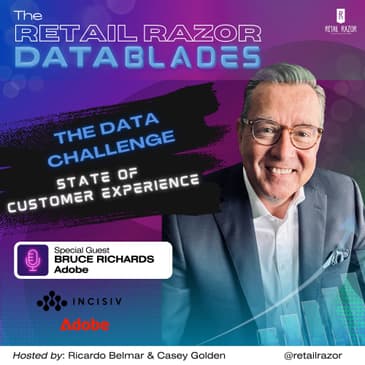
In this episode of Data Blades, Ricardo Belmar and Casey Golden speak with Bruce Richards. He is the Global Industry Strategy and Marketing Lead at Adobe. Together, they explore the biggest barrier in modern marketing: retail data readiness .
Many brands invest heavily in AI and personalization. Yet most still cannot use their data in real time. Research from Adobe and Incisiv reveals a hard truth. Poor retail data readiness creates many problems. Customer data silos slow progress. Fragmented identity systems make things worse. These issues stop retailers and CPG brands from scaling AI in retail marketing.
Bruce explains why dashboards create a false sense of maturity. He also shows how identity fragmentation harms customer experience. He describes what an AI‑ready data foundation truly requires. This includes unified customer profiles and real‑time behavioral signals. Strong built‑in governance is essential. This episode offers a practical roadmap for leaders. We show how to solve your retail data readiness before scaling AI.
Listeners also learn why retailers and CPGs face opposite data challenges. Bruce explains why culture change matters more than technology. Our discussion also covers experimentation and agentic workflows. These forces will shape the future of retail marketing.
What You’ll Learn
Why retail data readiness is the #1 blocker to AI‑driven customer experience
How customer data silos create inconsistent journeys and wasted spend
Why most brands overestimate their maturity, and how to close the activation gap
What an AI‑ready data foundation requires (unified profiles, real‑time signals, governance, activation)
How retailers and CPGs face opposite data problems, and how each can solve them
Why shifting from intuition‑first to evidence‑first decision making is essential
How experimentation culture accelerates learning and improves AI in retail marketing
The role of GenAI and agentic workflows in scaling personalization
Resource Links
Adobe & Incisiv research reports mentioned in this episode:
State of Personalized Experience in Consumer Goods in an AI-Driven World
https://business.adobe.com/resources/sdk/state-of-cx-consumer-goods.html
State of Customer Experience in Retail in an AI-Driven World
https://business.adobe.com/resources/sdk/state-of-cx-retail.html
Subscribe & Follow
Don't forget to like and subscribe to The Retail Razor: Data Blades! Get more episodes on customer experience, retail marketing, AI in retail, and data‑driven transformation!
Subscribe to the Retail Razor Podcast Network: https://retailrazor.com/
Subscribe to our Newsletter: https://retailrazor.substack.com
Subscribe to our YouTube channel: https://go.retailrazor.com/utube
About Our Guest
Bruce Richards. https://www.linkedin.com/in/brucefrichards/
Global Industry Strategy & Marketing Lead – Retail & Consumer Goods, Adobe.
Bruce Richards joined Adobe in 2018. Today he leads Global Industry Strategy for Retail & Consumer Goods with a bold, future-forward vision. With over 25 years of executive experience across Retail and Consumer Goods, Bruce is a driving force behind Adobe’s industry direction. Bruce helps brands innovate, adapt, and win in an environment where consumer expectations evolve by the minute.
A specialist in customer experience, digital transformation, and modern marketing, Bruce partners closely with Adobe’s clients. He designs standout strategies and builds the solution ecosystems that bring them to life. His career spans leadership roles in marketing, consulting, and customer advisory. He has led client services teams supporting some of the world’s most iconic brands, including Macy’s, Estée Lauder, Bloomingdale’s, Beiersdorf, CVS/pharmacy, and Hanesbrands.
Chapters
(00:00) Teaser
(00:26) Show Intro
(02:34) Introduction - Welcome Bruce Richards
(03:26) Data Readiness: The Biggest Barrier
(04:20) The Activation Gap & Maturity Illusion
(05:40) Identity Fragmentation & Customer Experience
(08:15) What an AI-Ready Data Foundation Looks Like
(10:39) Retail vs. CPG: Different Data Challenges
(12:47) Culture, Org Change & Shared Data Ownership
(16:09) From Intuition to Evidence-First Decision Making
(17:25) The Power of Experimentation Culture
(18:47) AI at Scale: Gen AI & Agentic Workflows
(20:35) Wrap-Up
(21:10) Show Close
About your Hosts
Helping you cut through the clutter in retail data insights:
Ricardo Belmar is an NRF Top Retail Voice for 2025 and a RETHINK Retail Top Retail Expert from 2021 – 2026. Thinkers 360 has named him a Top 10 Thought Leader in Retail and AGI, a Top 50 Thought Leader in Management, Careers, and Transformation, and a Top 100 Thought Leader in Agentic AI and Digital Transformation. Thinkers 360 also named him a Top Digital Voice for 2024 and 2025. He is an advisory council member at George Mason University’s Center for Retail Transformation and the Retail Cloud Alliance. He was most recently the partner marketing leader for retail & consumer goods in the Americas at Microsoft.
Casey Golden, is the North America Leader for Retail & Consumer Goods at CI&T, and CEO of Luxlock. She is a RETHINK Retail Top Retail Expert from 2023 - 2026, and Retail Cloud Alliance advisory council member. After a career on the fashion and supply chain technology side of the business, Casey is obsessed with the customer relationship between the brand and the consumer and is slaying franken-stacks and building retail tech!
Music
Includes music provided by imunobeats.com, featuring Tech Lore from the album Beat Hype, written by Heston Mimms, published by Imuno.
Highlight Clips
[00:03:11] - Retail data has been junk for decades. So it's finally happening. AI is forcing us to have some good data.
[00:05:21] - The dashboards look great, but the business can't act in the moment. And that's really the summary of what's going on.
Transcript
S2E5 Incisiv-Adobe - The Data Challenge
[00:00:00] Teaser
[00:00:00]
[00:00:01] Ricardo Belmar: How can brands personalize at scale when most of their customer data is still trapped in silos?
[00:00:08] Casey Golden: The Incisiv and Adobe State of Customer Experience in Retail and Consumer Goods Report reveals that data, not strategy, is the biggest barrier to modern marketing.
[00:00:20] Ricardo Belmar: Today we unpack why data readiness is the real unlock for AI driven experiences.
[00:00:26] Show Intro
[00:00:34] Ricardo Belmar: Welcome to Season Two, Episode Five, retail data junkies. This is the Retail Razor Data Blades, the podcast that slices through complex retail research to deliver sharp, actionable insights you can use today.
[00:00:47] I'm Ricardo Belmar.
[00:00:48] Casey Golden: And I am Casey Golden. Your resident data junkie.
[00:00:52] Ricardo Belmar: Casey, last time we talked about the new pressures on marketing leaders, but here's the thing, even if you've got the right playbook, as you [00:01:00] know, none of it works without the right data foundation.
[00:01:03] Casey Golden: Right. The research shows that most organizations think their data is mature, but in reality, so much of their customer data is still stuck in silos. Without clean, connected data personalization and AI just can't deliver on it.
[00:01:19] Ricardo Belmar: That's why today we're focusing on the data challenge, why it's the number one barrier to modern marketing and what it takes to build an AI ready foundation. And to dig into this, we're once again looking at Incisiv and Adobe's recently released research reports on the State of Customer Experience in an AI driven world for both retail and consumer goods. Today we're bringing in Bruce Richards from Adobe to help us figure out how to tackle the data challenge.
[00:01:45] Casey Golden: I can't wait. But before we dive in, we have one quick ask for our audience. If you enjoy the show, hit us with a five star rating and drop a short review on Apple Podcasts, Spotify good pods, or wherever you're listening. [00:02:00] Don't forget to like and subscribe on our YouTube channel so you never miss an episode.
[00:02:04] It really helps us grow the show.
[00:02:07] Ricardo Belmar: Plus check out the other shows in the Retail Razor Podcast Network, The Retail Razor Show, Retail transformers, and Blade to Greatness. You'll find them all in your favorite podcast app and on our YouTube channel.
[00:02:18] Casey Golden: Now let's raise our Data Blades and welcome Bruce Richards, Global Industry Strategy and Marketing Lead for Retail and Consumer Goods at Adobe to the show.
[00:02:28]
[00:02:34] Introduction - Welcome Bruce Richards
[00:02:34] Ricardo Belmar: Welcome to The Retail Razor Data Blade Show, Bruce! We are excited to have you join the show and continue our conversation on the amazing insights from the State of Customer Experience in Retail and Consumer Goods research that you and Incisiv have put together. Can't wait to dig into part two today.
[00:02:49] Bruce Richards: Yeah, me too. I know Dave set us up pretty well on part one, so, excited to go to part two. So let's go.
[00:02:56] Casey Golden: Ah, we are digging in deep to the data challenges for [00:03:00] marketing today, and of course, how many times have we heard in every discussion about AI that you can't expect strong results from AI without a solid data foundation. And retail data's been junk for decades, so it's finally happening. AI is forcing us to have some good data.
[00:03:23] Ricardo Belmar: Exactly. Exactly.
[00:03:24] Bruce Richards: Yes, it is.
[00:03:26] Data Readiness: The Biggest Barrier
[00:03:26] Ricardo Belmar: So Bruce research shows that 60% of retail customer data is still stuck in silos, and only 3% of CPG organizations have fully integrated data. Why is this data readiness now the single biggest barrier to modern marketing?
[00:03:40] Bruce Richards: Sad, right. Look, data is the biggest barrier because everything that modern marketing wants to do, personalization, realtime journeys, AI, that depends on connected, trusted data. And in retail, the problem is too much data in too many systems. [00:04:00] And in consumer goods or CPG, it's too little direct data fragmented across brands and markets.
[00:04:05] So two very different problems. And until that's fixed, every advanced tool journey, orchestration, CDPs AI, they end up sitting on shaky ground. So you can buy great tech, but without data readiness, it's never gonna reach its full potential.
[00:04:19] Ricardo Belmar: Yeah.
[00:04:20] The Activation Gap & Maturity Illusion
[00:04:20] Casey Golden: Brands often believe their data is mature. But their activation gap shows that they can't act on the data in real time.
[00:04:28] Bruce Richards: Mm-hmm.
[00:04:30] Casey Golden: What do you feel is driving this disconnect between what they think they have and what they actually have and what they could have?
[00:04:37] Bruce Richards: So most brands built their data stacks on reporting, you know, how are we doing right? And they didn't, they didn't build it. They didn't build it for live decision making, so they can analyze last quarter perfectly, but they can't change an offer or pause an ad or adjust a journey while a consumer is still engaged with the brand.
[00:04:57] So the issues are that the [00:05:00] data isn't wired back into channels for decisioning and governance of that data is really fuzzy. So teams default to slow batch campaigns instead of, you know, actions or the ability to react to the consumer in the moment. There's this, what you were saying was they think it's what I call it a maturity illusion.
[00:05:21] The dashboards look great, but the business can't act in the moment. And that's really the summary of what's going on. It all, yeah, your dashboards look awesome. You could, I could see what you did last week and last month and last year, but how do we use this information to look forward?
[00:05:35] Casey Golden: Yeah, what are we doing next week or by, or the
[00:05:37] Ricardo Belmar: It's some something the dashboard can tell you. Yeah. Yeah.
[00:05:40] Identity Fragmentation & Customer Experience
[00:05:46] Ricardo Belmar: And I guess there also seems to be some, what it's called fragmentation, right around identity in retail, you know, lack of, of strong, robust first party data in CPG. And it all kind of creates this inconsistent, disconnected customer experience, doesn't it?
[00:05:55] Bruce Richards: Yeah, and it's a big problem because we know that more than anything else, [00:06:00] consumers are buying experiences. They're looking at the experience over the product. So in retail, it's a big problem because one customer could look like four different people across the web and app and email and point of sale.
[00:06:15] Casey Golden: I'm about.
[00:06:16] Bruce Richards: Given day. Right. And, and those four, those four people that you look like today, you can be four different people tomorrow. Well, so the result is that, a retailer is retargeting someone for some, with something that they just bought. Right. How frustrating is that in, in the overall experience?
[00:06:33] Or you can send conflicting messages in different channels, so the experience in retail becomes a challenge. And in consumer goods, or CPG brands, they barely saw the end consumer until recently. So the experience have, experiences have always been. Generic, if you will, and they're disconnected across houses of brands that don't obviously speak to one another, which what amiss, right?
[00:06:55] You've got these huge companies with tons of brands and often the same [00:07:00]consumer is buying all of those brands and those brands aren't talking to each other, in both worlds, the customer experience is the same. The brand doesn't seem to remember me or know me, and that's fundamentally an identity and a data problem.
[00:07:12] It's not really a media or a creative problem, it's just, it comes back to how much do you know about the people who are engaging with your brands?
[00:07:19] Casey Golden: How much are you using the data that I already gave you and I've given you for 20 years?
[00:07:23] Bruce Richards: Yeah.
[00:07:24] Casey Golden: Get with the program!.
[00:07:26] Bruce Richards: How many times are ask for the same information?
[00:07:28] Casey Golden: Yeah, exactly. It's just, there's, there's so much opportunity here when it comes to where we can get with personalization. And I'm a big proponent for one-to-one. Anything else is like a recipe and it's really just not about me. 'cause there is nobody like me. So I don't like to be into a persona and good luck finding one for me.
[00:07:51] Depends I'm shopping. I have a different different brands, because I'm this person over here and I will drop cash like crazy [00:08:00] and over here I am cheap
[00:08:02] Yeah. Yeah.
[00:08:04] Ricardo Belmar: Yeah.
[00:08:04] Casey Golden: I.
[00:08:06] Bruce Richards: You're the first one. You're the first one searching, searching for XX brand promo code while still open. Right.
[00:08:13] Casey Golden: Right.
[00:08:15] What an AI-Ready Data Foundation Looks Like
[00:08:15] Casey Golden: Your study highlights low confidence in journey orchestration platforms like next best action technologies and data clean rooms. What does an AI ready data foundation really look like?
[00:08:32] Bruce Richards: Oh
[00:08:34] Casey Golden: Like we know our messes right. We know how much better they are today than they were yesterday, but what should they be looking at to be ready?
[00:08:44] Bruce Richards: Look I think continuous, continuously evolving, but I think what it looks like today is, I'll say four things that work together. The first one is a meaningful unified profile. And I'm not talking about just a list of ideas, [00:09:00] but a view that connects identity and attributes and key events. How is that consumer actually performing with your brand?
[00:09:07] The second would be, up-to-date behavioral signals, so streaming or near real time so that the system reacts to what just happened, not what happened last month, right? It becomes instantaneous. The third would be built-in governance and consent, and this is all about policy and purpose and consent that's embedded from the start and not bolted on later.
[00:09:32] Later. It doesn't come. Oh, by the way, do you consent to all this or you know you've got it. Yeah, after the fact, it's not gonna work. It's gotta be.
[00:09:39] Casey Golden: Away or this box is not going away.
[00:09:41] Bruce Richards: Right. Right. And then I think the fourth one is tightly linking into the activation channels. I talked about how, you could look like four different people in four different channels.
[00:09:52] So how are you activating across all of them consistently? So, email, web, app, stores, call centers, media platforms. How do you look the [00:10:00] same across all of those, so tightly linking them together and when those are in place. I said earlier how you can invest in good tech, but without the data foundation they're not gonna be at their best.
[00:10:10] With those in place, your journey tools, your next best action logic, your clean rooms, your AI, they stop being these isolated pilots and they work together as one system. So that's what it looks like today. I think as more and more organizations scale the AI foundations that they need, that could maybe take on a little bit of a different life.
[00:10:32] But I think those four key foundations will probably stay and just take on slightly
[00:10:36] Ricardo Belmar: Yeah. Yeah.
[00:10:38] Casey Golden: think that that's solid and
[00:10:39] Retail vs. CPG: Different Data Challenges
[00:10:39] Ricardo Belmar: yeah. And I, I want to come back to something you, you just touched on earlier about differences between retailers and, and, and CPGs. Because on the one hand we can say re, retailers seem to have a lot more data now and are becoming data rich, but, but it's still siloed. And then you have CPGs where, you know, you mentioned up until recently they didn't have as much data and now they're maybe growing at a massive rate of, [00:11:00] of data collection.
[00:11:01] So you can kind of contrast a little bit for us that the differences and challenges between the two.
[00:11:05] Bruce Richards: Yeah, I mean, I work in both worlds, so what I see is that retail and consumer goods or CPGs are coming at the same goal. They're just doing it from opposite directions, and so retail's challenge is abundance. They have tons of transactional and behavioral data, but it's scattered across all of those different areas that we talked about that create those different identities, for people in one.
[00:11:29] The work there is to stitch and simplify and govern. What they already have. And most people look at retail from the outside in and say they've been playing the data game for quite a while. And they have, it's, the question is, how well have they been doing it? And in this world of AI, have they done it well enough to support that?
[00:11:47] And then. CPGs or Consumer Goods challenge is building the dataset. And I know you look, we don't wanna go back five years and talk about COVID, but in many ways that's what the CPG scenario is laying on. It's [00:12:00] when COVID hit consumers went directly to branded sites and started looking for information.
[00:12:04] They never did that before. You know where, why are my products on the shelves? Do you have alternatives to the things that you sold out of? And that's when the building of the dataset happened. And historically, retailers owned the consumer relationship. Now CPGs are using direct to consumer sites and interactions, and I don't, and when I say direct to consumer, that's not always owning the transaction.
[00:12:25] It could just be a level of engagement. I'm there looking for information about your brand loyalty QR codes and retail partnerships to gradually see. The consumer directly and the pressure is on them to do that quicker than they have been. So they're both trying to arrive at the same destination, which is a connected and consented view of the consumer that they can actually take action on.
[00:12:47] Culture, Org Change & Shared Data Ownership
[00:12:47] Casey Golden: Where do you see this level of personalization and AI interacting within the org chart [00:13:00] or like the tech stack? Like where is this all fitting? Because a lot of these platforms, like it's not all encompassing. There has to be, where do you, how do you see this kind of coming together to be in one spot to have all of that real time behavioral governance.
[00:13:16] Customer identity, where is this? Uh, and like, where does it live in your mind,
[00:13:22] Bruce Richards: I mean,
[00:13:23] Casey Golden: because a lot of companies don't even
[00:13:24] Bruce Richards: hard part. It's the hard part isn't the tech, it's the culture. Right. I, you know, so I think where does it live versus how does it manifest? I think first it's that cultural shift that has to come from the top down. And that means that means senior management needs to say, this is who we are as an organization now.
[00:13:43] And that requires what I view as three key shifts. Organizations overall, we talk a lot about marketing in the context of this series because that is very much the focus, but it, this extends beyond marketing. And they have to go from a channel led group [00:14:00] of teams and KPIs to a customer led outcomes.
[00:14:03] And we always, how long have we been talking about customer centric? Consumer centric? This is a tipping point. Right now, today that shift has to happen culturally. I think the second thing is you have to move away from who owns the data, to everyone taking a shared responsibility for using it.
[00:14:20] And that becomes across marketing data and IT, and anyone else that you wanna put in that mix. So that's actually really critical. It's a shared responsibility for using it. And that's where senior leadership says, we as an organization are gonna become a customer-centric or a consumer-centric org, and this is how we're going to do it.
[00:14:41] And then, I think the last one is moving away from these big infrequent campaigns, particularly in consumer goods. Retailers tend to be more promotional, so they have more campaigns, hitting consumer's eyes and ears with more frequency, but moving away from infrequent campaigns to this [00:15:00] continuous learning and adjustment within the marketing mix. And retailers and CPGs that push these shifts are the ones that are actually getting value from their data. They're not just talking about it, they're doing it today. So I think that's top down with some really cultural shifts that are important
[00:15:15] Ricardo Belmar: Yeah. Yeah. Well, well, speaking of cultural shifts and organizational shifts, I wanna highlight something from the research I think is, is relevant here. Is in the research that showed that 73% of retail leaders and 71% of CPG leaders feel they have strategic influence, I guess coming from all of this data they have access to, but, what has to happen to make that actionable is it's one thing for them to believe they have access, and it's one thing to believe they can exert influence around that data, but is it really actionable yet?
[00:15:47] Bruce Richards: I think it's getting there, it's I think that we're seeing it actionable and coming to life in key organizations, but, look, those leaders, those marketing leaders are ones that are now being looked to, to drive [00:16:00] results from a revenue perspective. So if they're not able to act on it, then they have to be the ones to speak up and say, here's what I need to do that, right?
[00:16:09] From Intuition to Evidence-First Decision Making
[00:16:09] Casey Golden: How do organizations move from intuition first decision making to evidence first decision making when we've been literally running the business off our head and doing a pretty great job at it for a very long time.
[00:16:24] Bruce Richards: Well, that move is actually one of the ways to answer Ricardo's previous question.
[00:16:28] Ricardo Belmar: That's right.
[00:16:29] Bruce Richards: You know, moving from intuition to evidence first, look, I think first you, you don't kill intuition. You just aim it towards the evidence. You know, um, organizations have to agree on smaller sets of shared metrics that everyone cares about.
[00:16:45] I talked about that cultural shift. What is everyone going to care about and ultimately invest in? They need to make data part of decision making and not a side check, right? It's, we have, I talked about dashboards and all of those things, they [00:17:00] look pretty, but if you can't use that information to move forward, you're missing the boat.
[00:17:04] And then I think lastly, organizations have to approve tests and not fully locked in plans. So over time, people that see evidence backed decisions are going, that they're gonna perform better, they're gonna get on board. So culture naturally shifts towards evidence first without losing the value of the experience.
[00:17:25] The Power of Experimentation Culture
[00:17:25] Ricardo Belmar: How, how important is it to have an experimentation culture at work here to get to that goal?
[00:17:31] Bruce Richards: Oh, incredibly important because what that does is it turns data from a rear view mirror. Here's how we did, to a steering wheel. It's kind of like, here's how we're gonna use data to move forward, and this, that, that's a consistent theme in what we've been talking about. Small, constant tests.
[00:17:47] They reduce the fear of people being wrong. Right, because there's always a test coming up right after it. So it's like, okay, that wouldn't end well, but we're gonna learn from this one. So the fear of being wrong gets mitigated. They create a steady stream of learning that organizations can [00:18:00]act on.
[00:18:00] And they give AI clear feedback on what actually works. There's this, playing into the organizational sensibilities and that dashboard and what's been working. But then how do you feed the AI engines that are gonna help you improve those dashboards going forward?
[00:18:16] So brands that bake experimentation into normal operations. They just move faster. They learn faster, they create a lot more value out of their data and AI investments. And one of the things that we're seeing in both retail and consumer goods is these, this concept of agile pods and they're building teams around pools of value and using those pools of value to test and learn and share amongst one another to figure out how they move forward.
[00:18:44] And you'll use everything at their disposal in a more impactful way.
[00:18:47] AI at Scale: Gen AI & Agentic Workflows
[00:18:47] Casey Golden: So once organizations build this data foundation, the next frontier is AI at scale.
[00:18:55] Bruce Richards: Yeah.
[00:18:55] Casey Golden: How do you see Gen AI and agentic workflows, [00:19:00] not just transforming marketing's role in the very near future, but the future? Like as the industry? What does that look like to you?
[00:19:11] Bruce Richards: I think putting that question in the context of this part of the series, which is data, once the data foundation is built and solid AI stops being the toy on the side. And that's very much been the mentality to date is let's play with this and see what it can do for us. And then all of a sudden, the lights went off and I'll say over this last holiday season where everybody went, oh my God, I have to move quickly.
[00:19:33] This is no longer a toy. I need to make this real. So Gen AI speeds up content variations, localizations, testing at scale that humans can't touch, right? It can do things very, very quickly. Agents start handling the day-to-day decisioning, within guardrails. Things like budget tuning journey tweaks next best offers next part of the journey.
[00:19:59] So [00:20:00] marketing's role shifts from just running campaigns, which is what many of them do today, to designing and steering the system that delivers the brand in real time. So in many ways, marketing's role becomes much bigger and more exciting because they're focusing less on the mundane tasks and more on how do I drive this forward?
[00:20:19] So I come back to that phrase I used earlier, less rear view mirror, more steering wheel. And that's what marketers become. And, that's an exciting evolution for me when I look at, look at what marketing teams can be
[00:20:31] Ricardo Belmar: yeah.
[00:20:32] Casey Golden: I think that's great. I think that's a great analogy.
[00:20:35] Wrap-Up
[00:20:35] Ricardo Belmar: Yeah. That's a great evolution. Well, Bruce, this has been a really fun, practical kind of discussion around getting the data foundation right. Thanks for sharing all of these insights from the Incisiv and Adobe research today. Of course, we'll have links to all of the, the research items in the show notes so everybody can download and dig in deeper.
[00:20:52] Thanks again for, for being with us today.
[00:20:53] Bruce Richards: Thank you. Looking forward to the next one.
[00:20:56] Casey Golden: Yes. Thanks again Bruce. I know I can't wait for part three of the series and we'll [00:21:00] have Dave back with you for that one.
[00:21:02] Bruce Richards: Great, looking forward to it!
[00:21:04] Casey Golden: This is a wrap.
[00:21:06] Ricardo Belmar: It Is.
[00:21:07] Bruce Richards: Thanks, guys!
[00:21:08] Casey Golden: Thank you!
[00:21:10]
[00:21:10] Show Close
[00:21:15] Casey Golden: Loved this episode. Drop us a five star rating and review on Apple Podcasts, Spotify, or Good pods and hit subscribe so you never miss an update. If you're watching on YouTube, like and subscribe before you go.
[00:21:28] I'm Casey Golden.
[00:21:30] Ricardo Belmar: Follow Retail Razor on LinkedIn, Blue Sky, Threads, and Instagram, and subscribe to our Substack for highlights and bonus content in your inbox. For transcripts and guest info, head to retailrazor.com.
[00:21:41] Data Blades is part of the Retail Razor Podcast Network, the number one indie podcast network for retail.
[00:21:47] I'm Ricardo Belmar.
[00:21:48] Casey Golden: Thanks for joining us.
[00:21:50] Ricardo Belmar: Until next time, Stay Sharp, Be data-driven and Harness AI!
[00:21:53] This is The Retail Razor: Data Blades.