
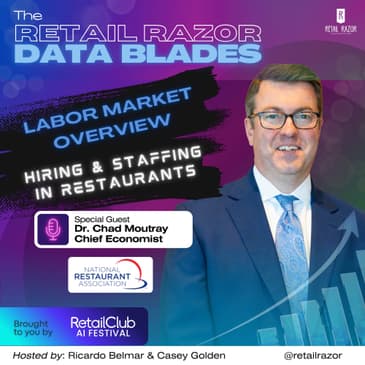



NRA Chief Economist Dr. Chad Moutray on the 2026 restaurant labor market, 122% turnover, and the price of running a shift short.
One missing employee can cost a restaurant $3,000 to $5,000 in lost sales over three months. That's just one shocking stat from the National Restaurant Association's new 2026 Hiring & Staffing report. And it's why we built a three-part mini-series around the restaurant labor market in 2026. This is Season 2, Episode 10.
In Part 1, NRA Chief Economist Dr. Chad Moutray joins Ricardo Belmar and Casey Golden to read the restaurant labor market in real time. This episode was recorded days after fresh JOLTS and monthly jobs data in June. The labor market has cooled from the Great Resignation into what economists now call the Great Stay, and restaurant staffing looks easier on paper. Understaffing fell from 78% of operators in 2021 to 22% in 2025. Chad explains why that 22% still bleeds real money. He tells us how a single empty shift cuts sales 7 to 8% per meal period. And also why a 122% turnover rate means the average restaurant replaces its entire staff every year.
What you'll learn in this episode.
Where the restaurant labor market stands after the latest jobs data. (48,000 restaurant jobs added in May, 220,000 over 12 months).
Why job openings outnumbering the unemployed is a structural signal. And what shrinking demographics mean for restaurant staffing over the next decade.
The true cost of understaffing. Hundreds of dollars per shift, $3K to $5K per missing frontline worker. And the morale spiral that follows.
Why half of Americans got their first job in a restaurant. And what that training ground teaches.
How technology cuts hiring from weeks to days without touching the high-touch service that keeps guests coming back.
Part 2 covers employee engagement and retention, including how long a new hire takes to become net positive. Subscribe so you don't miss it.
Resource Links.
HIRING & STAFFING How Onboarding, Managers, & Technology Drive Restaurant ROI.https://www.restaurant.org/research-and-media/research/research-reports/research-insight-workforce-hiring-staffing/
State of the Restaurant Industry 2026. https://restaurant.org/research-and-media/research/research-reports/state-of-the-industry/
Support Our Sponsor.
This Episode is Brought to You By RetailClub.
Retail Club AI Festival, September 22–24 in Huntington Beach. Join 2,000 retail leaders for a fully outdoor, beachside deep dive into how AI is reshaping retail. Qualified retailers and brands can attend with free tickets and up to $1,250 in travel reimbursement. Head to retailclub.com to learn more. https://retailclub.com/retail-razor-podcast
Subscribe & Follow.
Don't forget to like and subscribe to The Retail Razor: Data Blades for more episodes on customer experience, retail marketing, AI in retail, and data‑driven transformation!
Subscribe to the Retail Razor Podcast Network: https://retailrazor.com/
Subscribe to our Newsletter: https://retailrazor.substack.com
Subscribe to our YouTube channel: https://go.retailrazor.com/utube
About Our Guest.
Dr Chad Moutray, Ph.D., CBE, https://www.linkedin.com/in/chadmoutray/
Chief Economist & Sr Vice President of Industry Research & Knowledge
National Restaurant Association, https://www.restaurant.org/
Chad Moutray is senior vice president for research & knowledge and chief economist at the National Restaurant Association, where he leads economic analysis, data-driven insights, and thought leadership for business leaders in the restaurant and foodservice industry. A recognized expert on economic trends, he frequently shares his perspectives through professional presentations, media interviews, and industry reports.
Dr. Moutray is an adjunct professor at George Washington University, where he teaches econometrics in the M.S. in the applied economics program. He has held leadership roles in several professional organizations, including serving as chair of the Conference of Business Economists and as a board member of the National Association for Business Economics. He is also a past president and chairman of the National Economists Club, the Washington, D.C. chapter of NABE. In 2026, he will begin serving on the board of trustees of the John Leland Center for Theological Studies in Arlington, VA.
Chapters.
00:00 Teaser
00:37 Show Intro
03:02 Welcome, Dr Chad Moutray!
04:24 Labor Market Snapshot
06:34 Seasonality and Consumer Demand
08:20 Restaurants as Training Ground
09:09 Why Hospitality Skills Matter
13:29 Understaffing Trends Today
15:08 Turnover and Onboarding Reality
16:45 True Cost of Empty Shifts
18:31 Tech That Speeds Hiring
20:01 Service as Competitive Edge
20:56 Key Takeaways and Demographics
24:11 Show Close
About your Hosts.
Helping you cut through the clutter in retail data insights:
Ricardo Belmar is an NRF Top Retail Voice for 2025 and a RETHINK Retail Top Retail Expert from 2021 – 2026. Thinkers 360 has named him a Top 10 Thought Leader in Retail, a Top 25 Thought Leader in AGI and Careers, a Top 50 Thought Leader in Agentic AIand Management, and a Top 100 Thought Leader in Digital Transformation and Transformation. Thinkers 360 also named him a Top Digital Voice for 2024 and 2025. He is an advisory council member at George Mason University’s Center for Retail Transformationand the Retail Cloud Alliance. He was most recently the partner marketing leader for retail & consumer goods in the Americas at Microsoft.
Casey Golden, is the North America Leader for Retail & Consumer Goods at CI&T, and CEO of Luxlock. She is a RETHINK Retail Top Retail Expert from 2023 - 2026, and Retail Cloud Alliance advisory council member. After a career on the fashion and supply chain technology side of the business, Casey is obsessed with the customer relationship between the brand and the consumer and is slaying franken-stacks and building retail tech!
Episode Music.
Includes music provided by imunobeats.com, featuring Tech Lore from the album Beat Hype, written by Heston Mimms, published by Imuno.
Highlight Clips.
[00:13:53] - So yeah. So 22% is the lowest we've seen since the pandemic. So that was encouraging. And and you hear that when you talk to…
[00:16:52] - Well, you've all been into restaurants where they have tables, but they're not being utilized because they don't have enough…
[00:04:43] - Well, we've seen some cooling in the labor market really over much of the last year. Right? That means, obviously, the labor…
Transcript.
S2E10 NRA State of Staffing & Hiring in Restaurants, Part 1
[00:00:00] Teaser
[00:00:00]
[00:00:01] Ricardo Belmar: One missing employee can cost a restaurant $5,000 in three months.
[00:00:07] Casey Golden: The labor market's cooling, but the cost of an empty shift is definitely not.
[00:00:11] Ricardo Belmar: We sat down with the National Restaurant Association's chief economist, Dr. Chad Moutray, to break down the latest jobs data, what it means for restaurants, and what understaffing is really costing operators right now.
[00:00:23] Casey Golden: The numbers might change how you build your next schedule. Stick around and watch to see how much a short shift is costing you.
[00:00:37] Show Intro
[00:00:37] Ricardo Belmar: Welcome back to season two of the Data Blades podcast, part of the Retail Razor Podcast Network, where we cut through the noise and get to the numbers that move your business forward.
[00:00:46] I'm Ricardo Belmar.
[00:00:48] Casey Golden: And I'm Casey Golden.
[00:00:49] Today, it's episode 10, and we're kicking off with a three-part miniseries on hiring and staffing in restaurants, built on the National Restaurant Association's brand-new [00:01:00] 2026 report, "Hiring and Staffing: How Onboarding Managers and Technology Drive Restaurant ROI." And we brought the perfect guest to break it down.
[00:01:10] Ricardo Belmar: That's right. We are joined by Dr. Chad Moutray, the Chief Economist and Senior Vice President of Industry Research and Knowledge at the National Restaurant Association.
[00:01:20] Casey Golden: In this first episode, we're reading the room, the labor market right now, fresh off this week's job data at the time we're recording. So, what does it really cost a restaurant to run a shift short?
[00:01:36] The answers are going to surprise you.
[00:01:39] Ricardo Belmar: That's right.
[00:01:40] So before we bring Chad in, a quick word about the folks who make this show and the Retail Razor Podcast Network possible, Retail Club. Join 2,000 retail leaders at the Retail Club AI Festival, September 22nd to 24th in Huntington Beach, where you'll dive deep into how AI is reshaping retail, all while soaking up the sun at a fully [00:02:00] outdoor beachside venue.
[00:02:02] Decision-makers from retailers and brands can attend with free tickets and up to $1,250 in travel reimbursement. Head to retailclub.com/retail-razor-podcast to learn more and get your ticket today. Be sure to join me and Casey this fall at Retail Club for the best conversations on how AI impacts your customer experience and every operational part of your business.
[00:02:24] Hope you'll join us!
[00:02:25] Casey Golden: Quick favor before we dig in.
[00:02:27] If Data Blades helps you run a sharper business, hit Like, Subscribe, and leave us a Five-star rating and review on Apple Podcasts, Spotify, Goodpods, and YouTube. It only takes 10 seconds, and it helps more operators find the show.
[00:02:41] Ricardo Belmar: All right, with that out of the way, let's get into it.
[00:02:44] Here's part one of our deep dive into how hiring and staffing impact your restaurant business with Dr. Chad Mutrie, Chief Economist and SVP of Industry Research and Knowledge at the National Restaurant Association.
[00:02:56]
[00:03:02] Welcome, Dr Chad Moutray!
[00:03:02] Ricardo Belmar: Dr. Chad Moutray, welcome to the Data Blades podcast. We are thrilled to have you join us today to cover the first in a three-part series of topics that really dives into a theme we've been carrying through all of our shows on the Retail Razor Podcast Network lately, and that's how whether in hospitality, retail, all these customer service-driven industries, they all run on people regardless of the technology you deploy to support them.
[00:03:28] Casey Golden: Today we're talking through a new research insight report that NRA recently published, "Hiring and Staffing: How Onboarding Managers and Technology Drive Restaurant ROI," together with fresh government data to take a detailed look at where the labor market stands in today's environment and the operational costs that restaurants have to cope with.
[00:03:51] Chad, before we dive in, why don't you give us a quick rundown of your role at the National Restaurant Association [00:04:00] and your background?
[00:04:00] Chad Moutray: Well, first, thanks for having me on. This is, this is exciting. I'm looking forward to the conversation. I'm Chad Moutray. I'm the Senior Vice President for Research and Chief Economist at the National Restaurant Association, and obviously we're the largest trade association really dedicated to people who like to go out to eat, which I'm sure is both of you.
[00:04:18] Ricardo Belmar: No doubt.
[00:04:19] Casey Golden: I got dinner plans tonight
[00:04:21] Ricardo Belmar: There you go. All right, well then let's let's dive in.
[00:04:24] Labor Market Snapshot
[00:04:24] Ricardo Belmar: So w- we happen to be recording this, I think just not too many days after a fresh Jolts report and then monthly job numbers were released. So Chad, why don't you set things up for us here, give us kind of a, a, a view of what the labor market's telling you right now, and what does it mean specifically for restaurants and food service?
[00:04:43] Chad Moutray: Well, we've seen some cooling in the labor market really over much of the last year, right? That means obviously the labor market has softened from where it was. We were pretty traditionally getting around a hundred fifty thousand to two hundred thousand jobs, kind of settled off a little bit lower this year.
[00:04:58] Go back a couple months that [00:05:00] we were really worried about me- whether we were gonna have a jobs kind of recession, right?
[00:05:04] And I think some of the more recent data points have suggested that much like we kind of sometimes forget from time to time, the US economy and the labor market are actually more resilient than we give it credit for.
[00:05:15] And so, overall we are seeing-- we have transitioned from the great resignation, right? Which is where we were two, three years ago, where we were just looking for breathing bodies to come in and apply for our jobs, to where we are now, which is affectionately called the great stay, right? Where people don't typically quit their job if they're anxious about the economy, and that's really where we are now.
[00:05:35] And yet you're still seeing pretty solid job postings. So if you're referring to the job openings data we actually flipped in the, in the most recent data point. We actually have more job openings than the unemployed really for the first time really in since, since last year. And overall in, in the, in the, the jobs numbers that we got last week we had a really solid jobs number, right?
[00:05:57] Forty-eight thousand workers were added in the restaurant [00:06:00] sector in the month of May, two hundred and twenty thousand over the last twelve months. And so yes, we have a lot of challenges, but it really speaks to, again, to my comment earlier, the economy and the labor market are, are much more resilient than we, we give it credit for.
[00:06:14] And I think those worries we were having about the jobs recession, right? A couple, couple months ago, I think some of those have been abated a bit. That puts the Fed in a d- difficult position, which we could talk about if you want. But from a labor market standpoint I think it's, it's, it's a s- it's an encouraging sign.
[00:06:30] Doesn't mean we won't see some weaknesses ahead, but I think for right now it's, it's pretty decent.
[00:06:34] Seasonality and Consumer Demand
[00:06:34] Ricardo Belmar: Yeah, and, and I'm curious, do you think any of that is coming just because of the seasonality? We're, we're going in-- we're into summer which you would think-- I, I guess I would think that, you know, in, in restaurant hospitality, there's-- would typically expect to be a little bit of a hiring surge for the seasonality of people going on vacation, going out more.
[00:06:51] Do you think that's impacting the numbers and, and helping things a bit?
[00:06:54] Casey Golden: Kids out of college,
[00:06:56] Chad Moutray: I think, I think we certainly see-- always see an [00:07:00] increase in over the summer, right? There's a lot of seasonal hiring for travel and tourism. This is obviously a bigger year for that given the World Cup and America two fifty and a lot of those things. And so perhaps explains some of the jump we had in May.
[00:07:14] But it doesn't explain why really the last three months, right, March, April, and May were pretty solid, right? And so
[00:07:21] Ricardo Belmar: Okay.
[00:07:21] Chad Moutray: I think, what I've been-- what I take out a lot of these numbers is that, yes, the consumer is very stressed. We're seeing a lot of pain points, especially where gas prices are.
[00:07:31] But one of the things that comes out in our surveys pretty clearly is that, yeah, you might not be taking that vacation, you might be putting off that big purchase, but at the end of the day, you're gonna go out and celebrate and spend time with friends, and and you get tired of doing dishes, right?
[00:07:46] And so we've seen that, that restaurants and going out to eat is really one of the top discretionary spends out there. And so I think that has helped given us some of that resilience. And it's, it's not just us. [00:08:00] Lei-leisure and hospitality really the lead the job numbers in, in May. Again, some of that could have been that summer travel.
[00:08:06] That was seventy thousand, we were forty-eight. And so you see a little bit probably of both that ramp up to summer, but I think also just this resilience we're seeing from again, people prioritizing going out to eat.
[00:08:17] Ricardo Belmar: Yeah. Yeah, that makes sense. Makes sense.
[00:08:20] Restaurants as Training Ground
[00:08:20] Ricardo Belmar: My, my son's back from college and, and he got a job working in a restaurant kitchen, so he's one of those.
[00:08:26] Chad Moutray: Well, we know, we know that half of all Americans, including myself, got their first job at a restaurant. So we, we are, we see ourselves as America's training ground for a lot of people again, including myself. And if you include anyone with any experience in a restaurant, that's two-thirds of all Americans got their, have worked at some point in a restaurant. And so, that's a pretty astounding number, and it really speaks to why we are such an important sector in the economy. But also I think thinking that training ground, you know, think of all the skills you and now your son have m- have learned, right? And about, [00:09:00] dealing with customers and, and, dealing with stressful pos- conditions, et cetera.
[00:09:04] And I think those skills I think kinda carry us throughout our lifetime.
[00:09:08] Casey Golden: I agree.
[00:09:09] Why Hospitality Skills Matter
[00:09:13] Casey Golden: Why, why do you think that this matters, having so many adults like work-- have, that have worked in the industry and having it as their first job? Does this impact like how you think operators should think about the labor pool?
[00:09:28] Chad Moutray: I think keep in mind we're in the hospitality business, right? You, you noted that earlier, I think when you were talking about just in general some of the other industries that are out there. W- Dealing with customers, right? Dealing with sometimes frustrating customers, dealing with te- team members who might be frustrating, dealing with stressful positions during those, those rush hour moments. I think those types of skills are ones that you can only really get in, in some of these jobs. And it's not just restaurants. I think you probably could get that perhaps with retail or some other sectors as [00:10:00] well. But I think that tho- tho- those are important really to deal with how do you deal with other people, right?
[00:10:06] Those kind of soft skills of communication and dealing with other people and, and maybe frustrating people I think those are skills that I think, again, carry us throughout the lifetime. That's that, that's of course are the soft skills. I think in, in general, you, you probably, if you worked in a restaurant, you probably still like cooking or you like, waiting on peop-- you whatever you did in that restaurant, maybe or a bartender.
[00:10:27] So I think some of those other skills that are a little bit more harder skills are also true, but I think those soft skills really matter. And I think one of the things that I worry about as an economist is that fewer young people are getting jobs, right, in, in, in high school, maybe ear- their early college career, and maybe they're losing out on some of those soft skills that, that maybe you or I might have gotten when we were teenagers.
[00:10:49] Casey Golden: Yeah. There's this expectation that you graduate from college and you should be making, 150, $200,000 a year. I'm like, "Dude, we got... We were lucky if we got 35K [00:11:00]with a degree. Are you insane?"
[00:11:02] Chad Moutray: Yeah, that's true. There, there, there has to be a re- a realistic number there, right?
[00:11:07] Casey Golden: Yeah. But I always said if I needed to go out and hire six people in the next month, I wouldn't be going through a whole bunch of resumes necessarily. I would go and book reservations at a handful of restaurants, and I'd pluck a handful of servers, because they are just so on their toes,
[00:11:28] Ricardo Belmar: Right
[00:11:28] Chad Moutray: yeah.
[00:11:28] Casey Golden: so good on their feet.
[00:11:30] There's that hustle, there's just being able to be quick. I just feel like not questioning, not asking questions, just make that executive decision, get through it, move on to the next thing in such a nice way. You know, it does take a lot of experience
[00:11:50] Chad Moutray: You can be frustrated but have a smile on your face, right? As you'll be, taking care of people. I think you want-- Another thing that comes out, and I did-- I should have said it earlier, is one of those soft skills, showing up on time and, and having a strong work ethic, right? I think [00:12:00] those are also things that you learn in that early kind of restaurant environment that again, carry through with you throughout your career as well
[00:12:07] Casey Golden: I worked in a restaurant in a couple, like three restaurants. And it was really like I, I just was, I was obsessed with understanding why people buy, right? And so I wanted to understand why people go to a fancy restaurant, why people go to an Applebee's, why what is the country club environment.
[00:12:28] And it was like kind of like just like obsessive research. And it was so interesting how literally I'd rather be busy and breaking a sweat at Applebee's with 10 tops
[00:12:42] Chad Moutray: Yeah
[00:12:43] Casey Golden: to be in the country club so bored with only like three tables.
[00:12:49] Chad Moutray: Well, we t- when we talk about restaurants, the restaurant is-- this sector is very complex, right? It's very different, right? And I think we have to think of ourselves as why are you going out to eat, right? If I'm [00:13:00] going out today for lunch, I might just wanna, order it on my app and go pick it up and never really talk to a human being, right?
[00:13:06] Whereas if I'm going out to celebrate Father's Day or Mother's Day or birthdays or what other big, graduations, those I wanna be waited on. I wanna have a great meal. I wanna have a great time. And those occasions matter. The experience matters, right? And, and I think that we have to look at it that way.
[00:13:23] And again, in the hospitality business, that experience really matters, right? And that's why people are gonna keep coming back.
[00:13:29] Understaffing Trends Today
[00:13:29] Casey Golden: Yeah, JOLTS is really a story about open jobs.
[00:13:33] You know, this, this report shows understaffing dropped from 78% of operators in 2021 to 22% in 2025
[00:13:46] Chad Moutray: Yes
[00:13:46] Casey Golden: the understaffing problem actually been solved or has it just changed shape?
[00:13:53] Chad Moutray: So yeah, so 22% is the lowest we've seen since the pandemic, so that was encouraging. And, and you hear that when you talk to operators, [00:14:00] it's easier to hire today than it would've been six months ago, a year ago, or whatever, right? Again, go back to my breathing bodies kind of comment from earlier, right in the great resignation.
[00:14:11] That doesn't mean it's not hard to still hire, right? If you're looking for a great manager or a great chef, you've heard, seen a lot of stories about how difficult it is to find dishwashers, right? Or some, some of those roles as well. And so I, I, I think that, that that's really, even 22% is still a challenge, right?
[00:14:27] The last thing you want to have is any understaffing, right? And so we haven't really solved it. Part of the, part of the advantage is the labor market has cooled, and that has certainly... And people aren't quitting as much, so you're not seeing as much churn. And so that has helped the overall situation, but it hasn't solved it, right?
[00:14:44] And I think that's why one of the things that comes out in this report is that, the last thing you want to have is be understaffed, right? Because that really is going to affect overall employee morale. It's going to affect your ability to take care of your customers. You're going to have lost sales, right?
[00:14:58] And so there's a huge [00:15:00] ROI there to that. And I think that that, that's, that's the, that's really the lesson of this paper, is that yes, understaffing is less of a problem, but it's still a problem.
[00:15:08] Casey Golden:
[00:15:08] Turnover and Onboarding Reality
[00:15:08] Casey Golden: One of the quotes that really got me or stats that got me is 952,000 hires and 937,000 separations each month.
[00:15:22] Ricardo Belmar: Wow
[00:15:23] Casey Golden: These people must be like masters of onboarding. Like this is just...
[00:15:27] Chad Moutray: Yeah.
[00:15:28] Casey Golden: That's, that just sounds exhausting
[00:15:30] Chad Moutray: when, well, when you think of the restaurant sector in general, the, the, the overall turnover rate is 122%. That's the average for the industry, right? Which means, which means every year you're hiring... you're basically replacing your staff,
[00:15:44] Ricardo Belmar: Yeah. Everyone. Yeah.
[00:15:46] Chad Moutray: right?
[00:15:46] Hopefully, you're keeping your managers and you're keeping a lot of other folks, but that means you're constantly hiring, you're constantly ramping up new people, and I think that's, that's a large part of why so many restaurants have really started embracing technology to speed that up [00:16:00]because, the last thing you want is to hire someone and they last a week or so, and then you gotta hire someone again, right?
[00:16:04] So finding ways that you can hire the right people in an efficient way to avoid understaffing, to be able to really staff up in a way that, again, you're gonna keep customers coming back, and they're not gonna see kind of those, those cracks in, in overall service.
[00:16:20] Ricardo Belmar: Yeah. Yeah, I mean, I guess, so we, we can put a number on it, I, I think, right? 'Cause in your report if I remember correctly, there's examples where just being down a single team member in, in the restaurant can cost hundreds of dollars per shift. I think there was a Taco John's example of just one missing frontline worker like that could, could result in 3 to $5,000 over three months, uh, of just missed sales, right?
[00:16:41] And other examples of losing 7 to
[00:16:42] Yeah
[00:16:43] 8% per meal period.
[00:16:45] True Cost of Empty Shifts
[00:16:50] Ricardo Belmar: So how would, would you say an operator needs to think about the true cost of that, empty or partially empty shift?
[00:16:52] Chad Moutray: Well, you've all been into restaurants where, they have tables, but they're not being utilized, right? Because they don't have enough staff, right? And that, that's, that's [00:17:00]essentially what we're talking about here, is that you're down a, a, a waiter or waitress, right? You can't... You-- There's tables you can't wait on, right?
[00:17:06] Because there's only so many that a, a waiter or waitress can handle, right? Perhaps there's n- someone missing in the kitchen, right? And that slows down service, right? Maybe it's slow enough that you have to sh- turn off third-party delivery, or you've got to turn off other parts of, of your overall operations, right?
[00:17:22] Again, because the last thing you want is angry customers, right? Sure. And so that costs, right? And so you, it's, you know, to your number. That could cost hundreds of dollars per shift, right, in terms of lost sales. Over time, it could cost thousands of dollars, right? And I think that really came out really, really strongly in the report in terms of lost sales.
[00:17:40] But it's more than that, right? If there's only so long you can work short-staffed, right? So a-a-after a while, it's going to impact not just your customers, but it's also going to impact your employees. You're going to see lower employee morale, and that's going to i-increase that overall tur- turnover, right?
[00:17:54] And so I think that's really where, where we're... You know, yes, understaffing is less of a problem than it [00:18:00] was, but it's still a problem, and it can have, it can add up really quickly if, if it if it persists.
[00:18:05] Casey Golden: Beyond lost sales, the report ties understaffing to higher stress and turnover, more overtime and slower service. Consistency in service quality requires adequate staffing. Full takeaway from this report, it, it is in your face and it is just, it is a blatant fact by the time, you, you read through this.
[00:18:31] Tech That Speeds Hiring
[00:18:31] Casey Golden: Are... There really aren't any shortcuts, are there? I
[00:18:37] Chad Moutray: there are shortcuts maybe to staffing, right? And
[00:18:39] Casey Golden: right?
[00:18:39] Chad Moutray: you know, we can deal into-- we can talk about, how a lot of companies are using technology to speed up the hiring process, right? Where... And we, we, we've done a couple of reports now. The first research insight I did was really talking about how technology was used to really speed up, right?
[00:18:54] So go back to the old manual days where you're reading resumes or applications, right? That could, that could [00:19:00] take several weeks, right? For you to find that right person. And we've seen using technology, and some of those technology tools are using chat, you, you're, you're applying at three o'clock in the morning, but there's a chatbot that's helping you guide you through the way.
[00:19:12] It's screening, are you, whether you're really, really a good candidate or not. And then, those even do some scheduling, right? Some, you know, employee scheduling. They can help with overall orientation. So there's a lot of things that technology can do that's, can speed that process up.
[00:19:25] And we've, we've heard again from several restaurants that they've been able to speed that up to just a matter of a few days, right? And so I think that helps because it helps solve that understaffing issue, right? I think the other, the other aspect of that is we- you can also use data to see, like if you have a number of restaurants, which one of those restaurants is really struggling when it comes to staffing.
[00:19:47] And you can, you know, devote some additional resources perhaps to making sure that they can, have the staff that they need or maybe, maybe really post in a, in a way to use some of those human resources tools to get more resources to, to the [00:20:00] overall hiring process.
[00:20:01] Service as Competitive Edge
[00:20:01] Casey Golden: Yeah, there really is it's just hospitality is high touch and people are the product, aren't they? Like
[00:20:07] Ricardo Belmar: Yeah
[00:20:09] Chad Moutray: That, that's the reason you come into a restaurant. You want the food, right? Uh, but you also want to be waited on. You want the overall experience. And I think especially in this time when there's just so much competition out there, right? Not only for talent, but also in the restaurant business itself, how can you set yourself apart?
[00:20:26] And it's often those people that set it apart. You come in because you like that waiter or waitress or bartender, or you love the food or whatever else it might be, and I think that's what keeps people coming back.
[00:20:35] Ricardo Belmar: Yeah, that, that service element of it can really be a differentiator from one restaurant to another, right? Helping a customer decide, "Well, which one do I wanna go to today?"
[00:20:43] Chad Moutray: Yeah, yeah. And you've seen a lot more restaurants that have really doubled down on the basics of making sure they are providing a great service and great experience. And I think that that's how they're set, separating themselves from the rest of the competition
[00:20:54] Ricardo Belmar: Yeah, no, definitely. Definitely.
[00:20:56] Key Takeaways and Demographics
[00:20:56] Ricardo Belmar: Chad, maybe to close this out here, this episode for part one [00:21:00]here, what, what would you say is the, the, the one labor market reality you would want any of our listeners and viewers of this episode to take away from what we've talked about?
[00:21:08] Chad Moutray: Well, number one, I think as you guys said, understaffing is-- there's a cost to that, right? So I think that, that, that kind of speaks really throughout the report. I think the other one that if you're gonna go back to talking about the JOLTS report, I made a comment about how we have more job openings than the unemployed really in this, in this la-latest, latest thing.
[00:21:27] That, that's a structural issue in my view, right? Demographics are not our friend, right? And I, I, I think we're gonna see really tight labor markets for here for the next, you know, several years or next decade or more, right? I think as we turn-- we start getting into having net negative population, right?
[00:21:45] Which we've never... I mean, that's a new thing. Europe and other countries have it, we're gonna have it now. And more baby, more baby boomers are retiring. Eventually, those of us from Gen X will retire. Fertility rates are at an all-time low, right? So demographics are not our friend. And so I think that's gonna keep labor markets [00:22:00] tight, and it's gonna mean that staffing is gonna be more-- continue to be a challenge.
[00:22:04] Understaffing is gonna continue to be a challenge, and that's why we need to really have resources out there that can help you kind of address that.
[00:22:11] Casey Golden: Well, Chad, this
[00:22:12] Chad Moutray: address that. That was, that was pretty negative. I'm sorry about that.
[00:22:15] Ricardo Belmar: No, but you know, it, it's a, it's a good cautionary tale kind of thing is to take
[00:22:19] Casey Golden: It is.
[00:22:20] Ricardo Belmar: Yeah
[00:22:20] Casey Golden: You know, these are the things that, sometimes we miss, and we kinda have to take a beat and, and think about different industries because at the end of the day, it's all connected. You
[00:22:32] Chad Moutray: Yeah
[00:22:33] Casey Golden: know? It's all intertwined from the labor market to commerce to economics.
[00:22:40] Chad Moutray: Yeah
[00:22:40] Casey Golden: it's all, it's all intertwined. But a lot of times it's so easy for us to have tunnel vision, right? So it is nice to have, those moments that make you just kinda stop in your tracks and think. And I think that this conversation definitely was thought-provoking gave us a good idea on where we stand in the market today and the challenges that brings restaurant [00:23:00] operators to the business.
[00:23:01] We just put a hard number on what an empty shift really costs.
[00:23:05] Ricardo Belmar: Yeah. Yeah
[00:23:07] Chad Moutray: that's true
[00:23:08] Casey Golden: but finding people is only half the battle. I know we're already looking forward to part two of this series. So Chad, thank you so much for joining us today.
[00:23:17] Chad Moutray: Thank you
[00:23:18] Ricardo Belmar: And Chad, if anyone wants to dig deeper into the data and learn more maybe from that report and other research insights you've published, how, how should they reach out to you and the National Restaurant Association for more details?
[00:23:28] Chad Moutray: You can go onto www.restaurant.org. And you can also follow me on LinkedIn or Twitter.
[00:23:35] Ricardo Belmar: All right, perfect. I'll also have links to the report in the show notes. So next time in part two, we'll, we'll flip the question of once you have those people in the door and you've gone through that hiring process, how do you keep them? We hinted at that, I think earlier when you made the comment about the turnover rates, right?
[00:23:49] So we'll get into the surprising math of how long a new hire takes to pay off for a restaurant operator and what they should do in those first 90 days to hang on to those special team [00:24:00]members. So I know I'm looking forward to it.
[00:24:04] Casey Golden: Well, that's all folks
[00:24:05]
[00:24:11] Show Close
[00:24:11] Casey Golden: Love this episode? Drop us a five-star rating and review on Apple Podcasts, Spotify, or Goodpods. And if you're watching on YouTube, Like and Subscribe before you go.
[00:24:21] I'm Casey Golden.
[00:24:22] Ricardo Belmar: Follow us on LinkedIn, Bluesky, Threads, and Instagram and subscribe to our Substack for highlights and bonus content. For transcripts and guest info, visit retailrazor.com.
[00:24:32] I'm Ricardo Belmar.
[00:24:33] Casey Golden: Thanks for joining us on the Retail Razor Podcast Network.
[00:24:37] Ricardo Belmar: Until next time, stay sharp, be data-driven, and harness AI.
[00:24:41] This is the Retail Razor: Data Blades!