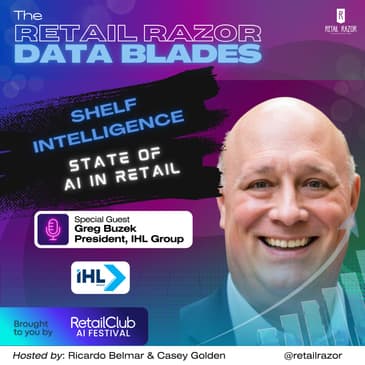


Every retailer says they're investing in shelf intelligence. Cameras, smart shelves, electronic shelf labels, computer vision, RFID, autonomous robots. The investment list has been the same for three years running. So why are only 9.1% of retailers actually running current computer vision, and only 12.2% running current ESLs?
In this episode of Data Blades, Ricardo Belmar and Casey Golden sit down with Greg Buzek, President and Founder of IHL Group, to unpack the brand-new 2026 Retail Transformation Study: How Retail Leaders Outperform. It's the largest annual survey of retail technology leaders in the industry, and Greg's team interviewed more than 400 brands to build it.
The data tells a story the industry hasn't fully reckoned with yet. Shelf intelligence applications in retail are not a hardware problem. The cameras are everywhere. The ESLs are on the shelves. The RFID tags are in the boxes. What's missing is the network, the edge compute, and the architectural roadmap to actually turn all of that hardware into intelligence.
Greg walks through every layer of the modern shelf intelligence stack, the order he'd deploy it in if he were sitting in a retail CIO's chair this year, and the specific ROI numbers that separate the retailers winning at shelf intelligence from the ones still talking about it.
In This Episode, You’ll Learn:
- What shelf intelligence actually means in 2026 and why the definition has expanded beyond "the manager walking the aisles"
- Why the network is the deciding factor for every shelf intelligence deployment, regardless of which sensors you choose
- How RFID sales winners outperform peers by 6.5x, and why Walmart is now tagging items under a dollar
- Why computer vision deployment is still under 10% across retail, and the hidden reason most pilots stall
- The controversial story behind electronic shelf labels, COVID, and the union pushback that's happening right now
- How facial recognition reduces theft by 74%, and the cultural reasons it has not gone mainstream in the US
- Why 80% of grocery SKUs sell less than one unit a week, and what that means for shelf intelligence and assortment strategy
- Greg's recommended deployment order for retail CIOs: network first, then edge, then ESLs, then RFID, then computer vision
Resource Links
How Retail Leaders Outperform - https://www.ihlservices.com/product/how-retail-leaders-outperform/
Shelf Intelligence Report - https://www.ihlservices.com/product/shelf-intelligence-report-rebuilding-retail-relationships-through-automation/
Adapt or Be Outpaced - https://www.ihlservices.com/product/adapt-or-be-outpaced-tech-imperative-for-retails-midmarket/
Fixing Inventory Distortion - https://www.ihlservices.com/product/fixing-inventory-distortion-whos-winning-whos-failing-whats-working/
Closing the Execution Gap - https://www.ihlservices.com/product/closing-the-execution-gap/
Support Our Sponsors
This Episode is Brought to You By RetailClub.
Join 2,000 retail leaders at RetailClub AI Festival, September 22–24 in Huntington Beach. Dive deep into how AI is reshaping retail while soaking up the sun at a fully outdoor, beachside venue. Decision-makers from retailers and brands can attend with free tickets and up to $1,250 in travel reimbursement. Head to retailclub.com to learn more. https://retailclub.com/retail-razor-podcast
Subscribe & Follow
Don't forget to like and subscribe to The Retail Razor: Data Blades for more episodes on customer experience, retail marketing, AI in retail, and data‑driven transformation!
Subscribe to the Retail Razor Podcast Network: https://retailrazor.com/
Subscribe to our Newsletter: https://retailrazor.substack.com
Subscribe to our YouTube channel: https://go.retailrazor.com/utube
About Our Guests
Greg Buzek. https://www.linkedin.com/in/gregbuzek/
IHL Group. https://www.ihlservices.com/
RetailROI. https://www.retailroi.org
Greg Buzek is the Founder, President and Principal Analyst of IHL Group, one of the most respected retail technology research firms in the world. IHL's annual Retail Transformation Study is the largest survey of retail technology leaders in the industry, covering more than 400 brands across every retail segment. Greg is also the founder of Retail Orphan Initiative (Retail ROI), which this week surpassed $6 million in total grants to help children around the world through the industry's Super Saturday campaign.
Noted by RIS News as one of the Top 10 Influentials in Retail and the National Retail Federation as one of “The List of People Shaping Retail’s Future“, he has a Masters Degree in Business Administration (MBA) from The Ohio State University, and 30 years of experience in retail market analysis, business planning, product development, and consulting with Fortune 500 companies. He is also a member of the Top 100 Retail Influencers from RETHINK Retail.
Chapters
(00:00) Teaser
(00:46) Show Intro
(03:45) Welcome Greg Buzek!
(06:04) What Shelf Intelligence Means
(08:51) ESLs and Union Pushback
(09:38) RFID Wins for Inventory
(13:14) Computer Vision and Robots
(16:00) Facial Recognition Debate
(19:22) ROI and Winner Benchmarks
(23:31) Customer Expectations and Stockouts
(26:11) Inventory Accuracy Crisis
(26:50) Shelf Intelligence Value
(29:44) Fashion Returns Problem
(32:18) Grocery SKU Overload
(37:56) Vendor Managed Compliance
(40:16) Butter Stock Club
(41:46) CIO Roadmap to Scale
(47:46) Show Close
About your Hosts
Helping you cut through the clutter in retail data insights:
Ricardo Belmar is an NRF Top Retail Voice for 2025 and a RETHINK Retail Top Retail Expert from 2021 – 2026. Thinkers 360 has named him a Top 10 Thought Leader in Retail, a Top 25 Thought Leader in AGI and Careers, a Top 50 Thought Leader in Agentic AIand Management, and a Top 100 Thought Leader in Digital Transformation and Transformation. Thinkers 360 also named him a Top Digital Voice for 2024 and 2025. He is an advisory council member at George Mason University’s Center for Retail Transformationand the Retail Cloud Alliance. He was most recently the partner marketing leader for retail & consumer goods in the Americas at Microsoft.
Casey Golden, is the North America Leader for Retail & Consumer Goods at CI&T, and CEO of Luxlock. She is a RETHINK Retail Top Retail Expert from 2023 - 2026, and Retail Cloud Alliance advisory council member. After a career on the fashion and supply chain technology side of the business, Casey is obsessed with the customer relationship between the brand and the consumer and is slaying franken-stacks and building retail tech!
Music
Includes music provided by imunobeats.com, featuring Tech Lore from the album Beat Hype, written by Heston Mimms, published by Imuno.
- [00:00:19] - Only 9.1% of retailers have current computer vision deployed. The hardware is everywhere. The intelligence isn't.
- [00:20:44] - RFID is other than handheld devices for managers, we've never seen a technology with a stronger alignment with the people that…
- [00:42:19] - For those, the order in which I would deal for most is likely shelf labels first, and then RFID second, computer vision third.…
Every retailer says they're investing in shelf
intelligence, cameras, smart shelves, ESLs, computer vision.
Casey Golden:But IHL just dropped a number that should make every retail
CIO, COO, and CFO very uncomfortable.
Only nine point one percent of retailers have current computer vision deployed.
The hardware is everywhere.
The intelligence isn't.
Ricardo Belmar:In this episode of Data Blades, Greg Buzek of IHL joins us to
explain the whole tech stack, RFID, smart shelves, cameras, plus why the
network underneath the shelf is the thing nobody's really talking about and why
it may be the only thing that matters.
Welcome to season two, episode seven, retail data junkies.
This is the Retail Razor Data Blades, the podcast that slices through complex
retail research to bring you sharp, actionable insights you can use today.
I'm Ricardo Belmar.
Casey Golden:And I'm Casey Golden.
Today, we're kicking off a new three-part AI in retail series.
We're super excited about this.
We're partnering with the team at IHL Group on three episodes built
around 2026 Retail Transformation Study, How Retail Leaders Outperform.
Which, if you weren't aware, is the largest annual survey of retail
technology leaders in the industry.
Ricardo Belmar:And to take us through the data, we've got one of the most respected
analysts in the space and good friend of the show, Greg Buzek, president, founder,
and chief AI orchestrator of IHL Group.
Casey Golden:In today's episode, we're talking about shelf intelligence, cameras,
ESLs, computer vision, smart shelves.
The technologies that have been on every retailer's
investment list for three years.
Ricardo Belmar:And here's the wrinkle in the data, though.
Every retailer says they want this stack, but almost none have built the tech
stack underneath to actually run it.
Only nine point one percent have current computer vision, and only twelve
point two percent have current ESLs.
So today, we're digging into why that gap exists and what it's costing
the retailers who don't close it.
But before we dive in, let me tell you about our Retail Razor Podcast
Network sponsor, Retail Club.
Join two thousand retail leaders at the Retail Club AI Festival,
September twenty-second to twenty-four in Huntington Beach.
Dive deep into how AI is reshaping retail while soaking up the sun at
a fully outdoor beachside venue.
Decision-makers from retailers and brands can attend with free tickets
and up to twelve hundred and fifty dollars in travel reimbursement.
Head to retailclub.com/retail-razor-podcast to
learn more and get your ticket today.
Thank you, Retail Club, for helping us bring you this podcast
and all the podcasts in the Retail Razor Podcast Network.
Casey Golden:Now, we also have a quick favor to ask you, our audience.
If you enjoy the show, hit us with a five-star rating and review.
Please drop those short reviews on Apple Podcasts, Spotify, Goodpods,
or wherever you're listening.
And don't forget to like and subscribe to our YouTube channel
so you never miss an episode.
Ricardo Belmar:And check out the other shows in the Retail Razor Podcast Network,
the Retail Razor Show, the OG, Retail Transformers, and Blade to Greatness.
You'll find them all in your favorite podcast app and our YouTube channel.
Casey Golden:Now, let's kick off part one of this three-part series
and welcome Greg Buzek, president and founder of IHL Group, to the show!
Ricardo Belmar:Welcome to the Retail Razor Data Blades Show, Greg.
We're excited to kick off this three-part series with you, dig into some of
the AI and retail insights that you and the IHL team have been gathering,
analyzing for months or almost a year or two now, just about, you've
been really digging into this data.
It's kind of hard for me to believe it's taken us this long to get you on
the show and to have this discussion.
Greg Buzek:It's really surprising.
Ricardo Belmar:know, after everyone-- it's like this is
made for you, and the work you're
Greg Buzek:Yeah, da-data blades for
Ricardo Belmar:Exactly.
Exactly.
So some of our Retail Razor Show fans may remember you from previous episodes
where a completely different topic, we were talking about retail ROI and
all the great work helping children around the world happening there.
But today, we're really diving in on the data around AI in retail.
It's great to have you here, Greg.
Greg Buzek:Yeah.
Well, hey, it's great to be with you, Ricardo and Casey.
Hey, just real quick, one Retail ROI thing that's gonna be exciting is
literally this week we will send out our grant that surpasses six million dollars
total for the organization through Super Saturday, and people come into that.
So we're real excited about that.
Casey Golden:Congratulations.
Ricardo Belmar:That is fantastic.
Excellent!
Casey Golden:And what a great way to kick off this Ai in Retail series by talking
about a topic that is getting more and more attention these days as store ops
moves to a m- a mode where everything is booming data-led and data-centric.
An area where retail tech investment is having a massive impact.
And of course, we're talking about shelf intelligence.
And you've got a recently published study, your 2026 Retail Transformation study
that we're gonna be diving into today.
Greg Buzek:Yeah, the study, we looked at over four hundred brands
through interviews there, and shelf intelligence was a big part of that.
Not only do we have that as part of the core study how winners outperform,
how retail leaders outperform, but we actually have separate shelf intelligence
reports that breaks this down into great detail just for this as well.
Ricardo Belmar:Fantastic.
So let's dive into to this series.
This is part one, and let's really talk about what's happening with
shelf intelligence in stores.
So, Greg what does it actually mean for a retail store in two thousand
twenty-six to be implementing and deploying shelf intelligence?
What does that tech stack actually look like?
Greg Buzek:Well, shelf intelligence traditionally has just been the
manager walking around and looking what's empty ty- sort of thing.
However, you know, particularly in the last several years with COVID in
particular, and then launching into everything from tariffs to wars and other
things, we've had all these disruptions that have occurred in the supply chain.
And really when you add to that the level of theft that has been happening
at stores in certain regions the-- just knowing what you have on the shelf
has become all the more critical, as well as the rise in alternate channels
than just walking in the store and picking something off the shelf.
When you're fulfilling from the store for a local delivery or a buy online
and pickup in store or a ship from the warehouse there, or even ship,
ship store to store, you need to know what you got, and you need to
know when those trucks are coming in.
So shelf intelligence has become all the more important in terms of profitability.
And some of the tools now have... are, are necessary because, like you said the
rise in shrink, you think you have it, but you don't really know that you have
it unless you're able to verify that.
And and so you can lose a lot of time and a lot of margin with labor
walking around a store trying to find something that's supposed to be there.
Ricardo Belmar:So, so what are some of the different tools you're seeing
now that you're finding from recent studies that are actually-- that
retailers are putting into stores that are helping them win this battle?
Greg Buzek:Yeah, it's a variety of different technologies.
The most consistent technologies are computer vision and RFID that
we're seeing as well as electronic shelf labels that, that help with
the pricing side of the equation.
But then we're now seeing autonomous robots that are being
used and all of that requires increased networking and bandwidth.
So there's like a level at which you do all these things, where you've got
to have the, the compute at the store level, in most cases, to sort through the
data because the amount of data that's being processed, but then you got to
have the network that can support that as well, both the-- in the local LAN
as well as the WAN for things there.
And everybody's got a different view.
I mean, there are robots that go up and down the stores where they
process all that video and all that data in the robot itself.
There are others that do it on the edge, and so they're pumping that
over the local network To process.
And then there are others that are doing it in the cloud, which
is the most network intense.
So those are some of the different technologies that are
being deployed, and, and each situation's a little bit different.
One that's becoming more and more controversial right now
is electronic shelf labels.
You know, it's funny during COVID, when you couldn't get people to
work at, at the stores the unions didn't push back at shelf labels.
And after twenty years of holding electronic shelf labels back,
they didn't push back on that.
And so all these retailers have deployed them, and they have them
now, and that allows them to do price, price changes as necessary., Most
any retailer I know is doing price, price changes at-- in the evening.
They're just not pumping them down in real time there.
But but the unions are now pushing back on those technologies, saying,
"Oh, they're just changing it during the day or customer to customer type
of thing." And so that's the one that's got some controversy to it.
Uh, RFID is another one of those technologies that for twenty-five
years started to grow, started to grow.
But once COVID happened and we went to this proliferation of jour-- of journeys
for customers, knowing what you have and where it is specifically in the
store became all the more important.
And that is one of the most compelling from a financial return technologies
that we've seen, particularly for all those other journeys that have
a store fulfillment process to them.
Because knowing where it is and how-- and specifically that size eight dress
is sitting in a dressing room rather than on a shelf, and you're shipping
it from your store, the margin's gone if you can't find it, it's not on the
rack, and you're just walking around.
You've just paid somebody for an hour's worth of work that should've
taken three minutes, and the end result of that is you don't have it.
Even further, knowing you actually have it in the store when the
transaction is occurring is all the more important as well.
Casey Golden:I don't know how many times, I couldn't possibly count, that I've
offered to go in the back stockroom of a shoe department to look for the last pair
Greg Buzek:Yeah.
Casey Golden:They won't let me.
Greg Buzek:Yeah.
It's, uh, it's really funny.
That is one of the areas where RFID and even visual camera handheld
intelligence is great, you know.
Because RFID can say, "Hey, it's right here But you can actually hold up a
camera scan that's got an engine where you just hold up the camera and they
say, "Oh, it's that box right over there," that specific box that it's
looking for, for that, for the shoes.
Macy's was like one of the first ones to deploy RFID in that back room for
shoes, and I think they saw close to fifty percent uptick in sales
Casey Golden:wouldn't doubt it.
They were a terrible offender on my end.
Greg Buzek:Yeah, exactly.
So they, they knew where that was, and they were one of the first
ones to deploy RFID at this level.
But it's become-- It's gone down all the way, at Walmart now,
down to items under a dollar that they're tagging with RFID tags.
Just to, because you, like you said, you're fulfilling from
store stock, you need to know where that stuff is at all times
Ricardo Belmar:yeah, you gotta know the whole accurate inventory.
Yeah.
How much of what you're seeing here is based on computer vision versus
RFID or are you starting to see a combination of the two in the best cases?
Greg Buzek:Yeah, RFID is more popular.
It's still relatively low.
Overall, it's it's about twenty percent of retailers overall
that are, are running RFID today.
You see it more in fashion.
And in fashion you actually see it through checkout as well.
So you've got Uniqlo and Zara and others doing the RFID checkout.
The beauty of that is you don't have as much interference
with RFID in that environment.
And when you are dealing with color and size, knowing which specific item
you have is all the more important and where that is in the store.
You see, you're seeing it more now, though, in the mass merchants
and the consumer packaged goods.
This is another one of these technologies that's a twenty, you know, twenty-five
year, overnight sensation so to speak.
In the sense that Walmart pushed RFID in the supply chain quite a bit in
the early 2000s, and and it really didn't go anywhere until we got to
COVID and then all of a sudden, as we started shipping from store and local
delivery and everything else, the use case became very, very apparent.
And further, as we saw the rise in theft happening at the stores, that real-time
nature of knowing I actually do have this, has become all the more critical.
And so when you think of that, RFID is one there.
And then the computer vision is, is being added.
It, it's mostly been added as an anti-theft component at self-checkout.
That's what people think of mostly.
But it's also being used at the shelves and looking at the shelves
and, and optimizing the shelves.
And that's everything from computer vision as just simply a, a picture.
There are some solutions where they just take a picture every eight feet
And they upload the pictures to actual, you know, real video that they're,
that they're either using their CCTV cameras for or the robots that are going
through the store do that The adoption and the acceptance of the autonomous
robots has, has been greatly enhanced in the last two years with, uh, what
we've seen at Sam's and other locations where people are just getting used to.
I think Schnucks Market with the Simbe Ta-Tally was one of the first ones.
But we now have robots as a service that are now being deployed where
you don't necessarily need the robot every day, all day, but maybe three
times a week you might wanna have the robot come through the store.
So they just literally bring it in, set it up, and, you know, program
it, and it just goes through things.
So a lot of this has to do with compliance, not only shelf compliance
in terms of space planning, but also the fact that you, particularly in
mass merchants and supermarkets, you've got trade dollars that are coming
down if you have an end cap that has on it what it's supposed to have.
So the ability to monitor those compliance for trade dollars is,
is usually the, the situation, the difference between being profitable or
not profitable for a lot of retailers.
And supermarkets, I always laugh.
Everybody thinks supermarkets, it's about location, location, location,
and about where people shop.
And it's like, really?
Yeah, yes and no, but actually most retailers make their money from the
packaged goods companies and the brands that are selling through that, which kind
of leads us into this whole retail media networks component of things as well.
So when you have that real-time data about inventory, now you can
actually plug that into what you're doing with the media networks for
what you're pushing at the stores.
There are some studies that show, like in fast food, for instance based on how
much you have of any particular menu item, if you just add a little animation,
like a little smoke coming off the burger type thing, you can increase the sales
of those items by twenty-five percent.
And so when you start factoring that in with your data being accurate at the
store level, those can be incredible top-line movers in the profitability.
Casey Golden:Where are, where would you say we are so far?
I mean, how many retailers are using computer vision?
Greg Buzek:It's only, it's less than 10% overall that are using computer vision.
And this is another one of those that gets to be a little controversial in
the sense that is the computer vision looking at that person and storing
their information or their image, or is it just looking for behaviors?
How does that work?
There are all different methods, and each, each vendor has their own.
Those that focus on Europe, everything's anonymized there.
But we're seeing more and more.
In fact, our next one of our next webinars is gonna be on the value
of facial recognition, and not only for, for loss preven- for
theft, but also for slip and falls.
And what you're realizing is by building these, this network of data, you actually
see these people come into other stores that are, you know, going on slip and
falls, and they're, creating fraud.
But what's interesting when you use it for loss prevention is when
that comes in, it's like, "Hey, wait, that person's in the database
for theft for something else."
It's like n-now we can be proactive to prevent that theft
from happening, or we could alert authorities if it was big enough to
to challenge them as they come in.
And that, that becomes a, a privacy thing.
And the, the data is incredible though when you do it.
74% reduction in your theft rates when you use facial recognition to find
the two or three percent of the people that are, that are stealing versus
the ninety-seven percent that are not.
And that's a cultural thing.
In China, it's just over there, it's accepted and it's everywhere.
And here in the States it's accepted or not accepted.
Casey Golden:Yeah.
I mean, a few
Greg Buzek:I don't care.
I'm gonna be-- I'm honest, I don't care,
Casey Golden:few bad actors kind of ruin it for everyone.
I really don't want to be surveilled while I'm shopping.
Greg Buzek:Yeah.
Yeah.
Well, let's look at it this way.
Another way is r-red light cameras, you
Ricardo Belmar:Yeah.
Casey Golden:Yeah, I'm not a fan of that either.
If you
Greg Buzek:with red light cameras are all of us that run red lights, you know.
Or speed, you know.
Ricardo Belmar:Yeah.
Casey Golden:Yes, I g-
Greg Buzek:And so it's the same there.
The only people that really have a problem with facial recognitions are the people
that are doing something wrong, you
Casey Golden:Yeah.
I mean, I can s- I can see both sides for sure.
But it is having that data, big impact, but definitely has to have a
thoughtful strategy on compliance and purpose and how they're communicating
that to customers, for sure.
Greg Buzek:Yeah, and I think the, uh, the vendors need to do a better
job and the retailers would need to do a better job of when it's comes
to facial recognition, explaining how the technology actually works.
It's just like when your, you know, Your phone is not using a picture of your face.
It's using measurements that come together that, that produce that.
So, it-- where they may have video that stores somebody coming in and
they can pull up that video based on the characteristics of that person.
It is not a, a like they do in the movies where, oh, I got all these
faces going and then, you know.
And that's, that's the one.
That's, that's not how, that's not how this works.
It's too-- that's too, uh, process-intensive.
It works by taking these algorithms and, and your face is put in, in it,
and those measurements are done, and they're in a a range, and that's what
allows it to work, and so it's just-- it's data, not your actual face.
Casey Golden:What does the data show about the business cases?
When retailers invest in shelf intelligence, what
do they expect to get back?
I mean, if you're going in for an initial deployment, what does
that ROI calculation look like?
What's that business impact?
Greg Buzek:Yeah, the return can range everywhere from three months up to about
twelve to fourteen months, depending on the segment and depending on the business
model of the vendor that is deploying it.
And I think that's been one of the challenges that have held back some
of these technologies for a long time.
That traditional hey, you pay for it all up front type of
thing it's held people back.
The most ideal aspect of things is at least in the pilot stages or
early stages, "Hey, I, I'll pay you as we see results of your solution,"
is what the retailer wants to do.
But that typically when they do see the results coming in, and it's like a revenue
share based on the results is how it's paid for, they quickly move to a no.
If it's working really good, they change that very, very quickly to,
"Hey, I'll just pay the license fee, uh, now," and cap that because
when the technology really, really works it's a win-win for everybody.
And and we're seeing it.
We're seeing it with these technologies.
RFID is other than handheld devices for managers.
We've never seen a technology with a stronger alignment with the people that
are actually winning in their sales growth of greater than ten percent.
So we, we define winners as those who increase their sales by ten percent a
year or their profits ten percent a year.
And RFID, the sales winners are over six and a half times more
likely to be using RFID technology.
Computer vision is another one of those.
It's a little less.
It's in the two to three timers range, but still extremely strong
results when, when that's done.
But like I said, you can't just put these technologies in by themselves.
You have to have the network, you have to have the edge devices to process that.
So for instance, like RFID, you don't care other than the tag is still there.
Ricardo Belmar:mm-hmm
Greg Buzek:You don't need to process that.
Other than the tag is still there.
You need to process what's moves, and if that's moved, where has it moved to?
So how do you sort through a read that has, ten thousand items in it and you
only care about the fifty that have moved?
Where does that processing get done?
And does it get done in the device?
Does it get done in the a-access point?
Does it get done at an edge server?
Every retailer looks at that differently, and that, that is a calculation that
you have to take into consideration.
As well, do you-- would you want just a handheld where somebody has to be
consistent in what they're doing?
They make the first time they do a really great job, and the second time
they're just kind of doing one of these, just keep kind of giving it away.
Or do you want to have perpetual RFID?
We've done some case studies where it's, it's less than three months, the, the
perpetual RFID return because you know exactly where the product is in the
store, and thus you've saved all that labor in finding it, where it's not good
enough that you knew where it was Sunday.
Do you know where it is right now?
And you can find, oh, somebody put it back on the wrong rack in, in that environment.
So, every, every use case is different, every retailer is different, and
you've got to work through those calculations, but the data for
all of these is extremely strong.
And even shelf labels now with the tariffs, the tariffs
are on, the tariffs off.
We can get the merchandise, can't get the merchandise.
There's a blockage, there.
There's a drought in the Panama Canal, so you know, there's the Strait of Hormuz.
All-- You've got all of these different things that are at play and the
ability to change those prices in real time to take advantage of that.
And I want to say real time, once again, overnight, to take advantage
of what's going on is a big, big deal.
Ricardo Belmar:Yeah.
Yeah.
Are there-- Do you have a sense from the data, like what are people expecting?
What are their top expectations?
Is it-- Are they trying to see improvements in customer satisfaction?
Is it just the inventory accuracy?
Are they looking for a tie to revenue?
All the above?
Greg Buzek:Yeah.
Yeah, that customer satisfaction's always gonna be number one.
Just that the fact that they can have on the shelf what the customer wants
to buy when they want to buy it.
That's number one.
Because th- literally that is the single biggest criteria
that retailers get measured on.
You go-- I mean, let, let's face it, it's too easy to buy online now.
You go to stores because you expect that store to have what
you wanna buy when you go there.
And we've done some research with Amazon Prime members who actually
go to physical stores to shop.
And so basically, I think it was at the time seventy-four percent of US
households had Amazon Prime at the time, but that's over ninety percent
of those with incomes over $100,000.
And those people go to stores because they expect you to have it, and if
you don't, they just whip out the phone and buy it with express delivery
there, and they often don't look at that retailer again for that item.
And that becomes a death spiral if you don't, if you don't have it.
So that customer satisfaction piece is critical.
So that's number one.
But it's also lowering the labor cost, lowering the actual cost of operations.
How much are you wasting in safety stock because you don't
know what's on the shelves?
I mean, my joke has always been for people, if it says limited supply on
the website, don't even bother going to the store because they don't know.
They d- they, they just literally do not know
Ricardo Belmar:yeah.
Greg Buzek:that's what it is.
Ricardo Belmar:code word for we have no idea.
Greg Buzek:Yeah, and the chance is there.
But even then I'll give you.
I was at a home improvement retailer, and I had to get... We had our roof
repaired, and we've got dogs a-and, they try to get all the nails up, but I
wanted to buy one of those, the magnetic sweepers to get all the nails up.
It said they had fifteen in stock.
I go there, there's none on the shelf.
And the guy goes, "There's-- they're here somewhere. They're here somewhere.
They're up on a shelf somewhere."
Ricardo Belmar:Mm.
Greg Buzek:And he didn't have the ability to like, like ScanIt has got a, an image
the image thing that you could just, you just hold it up and it just lights up
and says it's that one right over there.
Didn't have the ability to do it.
So they're in stock, said fifteen, I left without it
Casey Golden:I would have stood there and be like, "I'll wait."
Greg Buzek:Yeah, I went to the, I went to the other competitor.
I went to the other competitor
Casey Golden:It just sounds like a training moment.
Greg Buzek:Yeah.
Or I've been... Laptops.
I mean, my goodness, where I'm spending two grand, and it says it's in stock
and the associate can't find it.
And you spent fifteen, twenty minutes to do that, and you just, you whip out
the phone and says, "I, I'm not dealing with this. I'm just gonna order it
where I know I can get it delivered." So it's an existential, existential threat
to not have accurate inventory there.
But just the cost of each one of these interactions.
That guy spent fifteen minutes going around for something
that was like a $20 item
Casey Golden:Right.
Greg Buzek:That around the store, and he never did find it.
And so that's those are the challenges that this really starts to address.
But at the end of the day, it's lowering costs and it's, it's better information.
And then more and more importantly particularly in the branded merchandise,
is that shelf intelligence to be able to sell that data back to the brands.
Because that's one of the things that that, you know, your big brands that are
selling stuff through retailers, they generally do not have that intelligence
at the shelf level, at the store level.
And understanding, "Hey, our sales are down." Well, are your sales down because
the-- it's not being presented properly?
Is the sales down because you don't have it?
What, what are the sales down?
And this gives them that ability to se-sell that data back to those brands.
Casey Golden:I'm becoming a, a bigger and bigger fan and frustrated,
for buy online and pick up in store
Greg Buzek:Mm-hmm.
Casey Golden:pick out online and have a basket ready for me when I
come in- and come into the store and schedule that because I'm getting
very frustrated shopping online.
It, it's great to be able to make one trip a week into the city to go and make a
return of like all this random stuff that I was like so did not like from Amazon.
But I'm being disappointed and disappointed more by low-quality
products that maybe were a little bit overpriced, right?
Or I thought it was a really good deal and it was like too good to be true a deal.
And now I'm finding that like I just want to go ahead and set up that day
when I'm going into the city and just hit four stores to run those errands,
but I want my basket waiting for me.
These are the things I want.
I don't care where you get them.
Just get them there by like Thursday, and I'll be in there like day
after tomorrow, and then I'll go through my basket and decide like
what I want and what I don't want.
And I feel like that would just be such a service to the in-store associates
because otherwise I'm just like asking them to hang out with me for 20 minutes
to go look and find things I have like the web browser up because I
don't know what this stuff is called.
I'm like I thought this was cute, and this was cute, and this was cute." And
they're like, "Oh, I don't have this.
Oh, I don't have this." I'm like, why can't we just have that visibility, right?
And I guess it all kind of come back, comes back down into this.
Greg Buzek:Yeah.
Casey Golden:This problem so that we can solve a completely different problem.
Greg Buzek:The issue that you're facing or explaining there is why do
airlines over, oversell their seats?
Casey Golden:I have no clue.
Why?
Greg Buzek:they do it because people don't show up or they, the people
Casey Golden:Who doesn't show up for a flight?
I never have i.
Greg Buzek:the time.
All the time.
And it's more that somebody didn't make the connection, so they're not
on the flight, so they o-oversell it.
And that, that is the issue.
The problem with to do what you do... Now, so the typical female shopper
right now buying clothes online will buy three and return two because
the sign the sizing issues and aspirational sizes and one, right?
And you don't, you don't know what it is.
And, and now some of the, the retailers are pushing back on that.
If you wanted to do that at the store level, now they've actually held inventory
that they could sell for you to show up.
And if you don't show up, they've just taken inventory
out of sales process for that.
So it gets very, very difficult, particularly for clothing, when you only
have so many of a particular size or particular color to be able to do that.
There are these true fit technologies now that are in play that have greatly
reduced returns as a result of that.
But we're still sitting at about ninety percent returns for
e-commerce on women's dresses.
It's incredible
Casey Golden:We
Greg Buzek:how inefficient
Casey Golden:we have a vanity sizing issue in the United States, and, I,
I have no business being a size extra small at Free People when I have other
things from two years ago, same shirt, that's a medium, and now I'm extra small.
It's not my fault, and I shouldn't be punished.
That's their fault.
Ricardo Belmar:Yeah.
Greg Buzek:That, that's the whole, that's the whole thing
in, in fashion in particular.
We have done that to the industry.
It's just the same way we didn't-- you know, you could look at it in
terms of offshoring our manufacturing.
We've done this ourselves.
We created this problem that we're dealing with today.
And with the rise of e-commerce, this returns issue, we caused the
problem by aspirational sizing, that there's no consistency whatsoever.
And that's what-- that's why I think there's some wisdom in the, the guys
like Steve Jobs that just, would always wear the black turtleneck and blue jeans.
That's all they had.
That's all they got because
Casey Golden:Men's sizing
Ricardo Belmar:Yeah.
Solves so many
Greg Buzek:they never had to worry.
They just get it.
This is what I'm wearing every single day.
I'm not using any brainpower on that
Casey Golden:So you guys didn't have to worry that much in the first place.
A 34 is a 34, a 32 is a 32, a 52 is a 52, or a 42 is a 42.
You guys' sizing has been so consistent over 100 years.
Greg Buzek:Yeah.
Casey Golden:I know an 88-year-old whose suits are still the exact same size.
Ricardo Belmar:Yeah.
Greg Buzek:Yeah.
Exactly.
Exactly.
But I mean, that's the big issue with fashion.
The the issue with other items could... It's just a, a plain velocity thing.
The stat that blew my mind and I was at a grocery event when I heard this.
It says eighty percent of the SKUs in a grocery store sell less than one a week.
Casey Golden:That's
Greg Buzek:you figure... Yeah.
And it was mind-blowing to learn that.
And so when you go to shelf intelligence you literally go on, "Okay, which of these
things do we need to keep on the shelves? Which of these things you know, you
need to have this on the shelf. We don't sell it very often, but when we do, that
person's spending three hundred dollars because they're, they're buying this."
You've got to work through all of that data.
But, 'cause at the same time, you've got this incredible increase with
buy on store, pick up in store, click and collect for groceries.
You need space for that.
Ricardo Belmar:Yeah.
Greg Buzek:You can create that space by taking some items off the shelves.
It, you know, for people that travel internationally, when you see a
US supermarket, you're just like dumbfounded by the number of brands
and the number of choices per category that are literally on the shelves.
It's there's so much there.
So you, you've got this remodeling and these store format changes that
are occurring rapidly, and these technologies we're talking about shelf,
Shelf intelligence is enabling some of those changes to occur because that
intelligence is there on, on which items you really need to have in stock,
which items can you still s- still have, but they're not on display.
They're in back and they're in a, in a format that if somebody asks for it, you
could pull it from the back or it could be part of an e-commerce order there.
But I think gone are the days where I think it used to be the joke when I was at
NCR that, that Meijer Stores had to have in stock what Mrs. Wexner had on her, Les
Wexner's mom, had on her shopping list.
Whatever she bought, they could never run out of, uh, every item
that was on that shopping list.
Casey Golden:take-- I mean, the neighborhood should just kind of
take all of our grocery lists, right?
Like, when I want to make cookies, I want you to have flour, but I do not keep flour
in my house because I barely ever use it.
I just buy it, make the cookies, and throw the rest away.
Sorry.
Ricardo Belmar:But that's, you know, a big part of-- to, for me that I find
al-always an interesting thing that I would think shelf intelligence can
create an edge here is that with grocery, because of what you just said, right?
If eighty percent of the items don't sell more than one a week, I mean, the first
thought that occurs to me is there's a lot of specialty items in most supermarkets,
which are things on the shelf that...
A-and I buy a lot of these specialty things, but when I do, they're
usually the kind of thing that whether it's a liquid in a jar or something
that comes in a, like a tub or a container, it lasts a long time.
It's-- Most of these are things that I-- you'd never need to buy on a weekly basis.
You maybe are buying one a month,
Greg Buzek:Yeah.
Ricardo Belmar:or maybe even less frequently.
So, but you're right that when I do need it, I expect that there's gonna
be one there on the shelf, Right.
But
Greg Buzek:Like vanilla extract.
Vanilla extract, you know, you, you expect them to have it.
They may not have to have ten of
Casey Golden:should be in stock.
Greg Buzek:Yeah.
Ricardo Belmar:Yeah.
Greg Buzek:Well,
They may not need ten different varieties of the vanilla extract,
Casey Golden:Right.
Greg Buzek:On the front-facing piece of that, if it frees up, "Hey, I've got
a shelf now where I can put the whole orders in the back there," or I can do
these micro-fulfillment centers, which are robotic fulfillment centers in the back
that can manage can manage those orders.
And we're seeing that more and more often.
Ricardo Belmar:Yeah, I'm
Casey Golden:really
Greg Buzek:with the rise of drone delivery too, you gotta
have a place to stage those things
And stuff.
I mean, even Sam's came out with a announcement this week saying they
have delivery in less than an hour.
Ricardo Belmar:Right.
Greg Buzek:For Sam-- I mean, what are you bringing?
You br-bring a whole pickup truck delivered to your
house in less than an hour
Ricardo Belmar:Yeah, that's impressive.
But there are a lot of these things where I always
Casey Golden:animal.
Ricardo Belmar:Especially with the MFC ID, I mean, all these
items that I buy that infrequently at a grocery store, I know ahead
of time when I'm gonna get them.
So why isn't there an ability with it, whoever my favorite grocery
store is, that I should be able to say, I'm going to go shopping, but
here's my list of 10 things that I know are the ones that are oddballs."
Just have them ready in a pickup area in the store when I get
there if I send it ahead, right?
Just those 10.
I can-- I'll still go pick all the produce and all everything
else, don't worry about that.
But all these shelf items that I buy once in a blue moon, I
need to know that it's there.
So why can't I just send those items ahead and they're staged and ready for me?
Don't even have to be out on a shelf, right?
There can be a robot picking them in a back room somewhere that's
just pre-bagged and ready for me to pick up to take to a checkout, along
Casey Golden:Or just making-- Or just pulling like your top like, 500 customers
that shop on the most frequently and putting that as the part of the list.
That these items must stay in stock because our customers
come in getting them.
I--
Ricardo Belmar:the most common.
Casey Golden:Because they're, kind of the most common.
I would Having a product sell less than, 80% sell less than once a week, like I--
to me, that means like our assortment's too big, our assortment is off.
We are so missing the mark.
That's what it would read to me, not coming from grocery, that the
whole thing needs to be re-assorted.
But understanding those, that data and understanding the what that data says,
I mean, I have to say, like I would have never, I would have never guessed that.
Um,
Greg Buzek:I think one
Casey Golden:my gosh, you're all fired.
Greg Buzek:Yeah, I'm st- I
Casey Golden:failing.
Greg Buzek:Another technology that plays in here is computerated ordering.
And when you're able to do that and able to enforce that across things
like vendor-managed inventory, that is a big issue when it comes to grocery.
So for instance, your Coke and Pepsi, they're the ones that are handling the
inventory when it comes to those products.
Mondelez handling their stuff, you know, ice cream vendors
that are handling their stuff.
It's traditionally been keep the shelves full regardless of whether or
not you have what's in stock, in stock.
You just move, hey, if it's ice cream and we're out of vanilla, and
I'm supposed to have five lanes of vanilla and instead I fill it in with
strawberry and make it look full.
But I don't have enough vanilla, all of a sudden I start losing sales.
And because the vendor's managing that and the retailer doesn't know,
they're losing sales as a result of it.
And by forcing the computer-aided inventory and the space planning
compliance now to those vendor-managed inventories, they're seeing a twenty
percent increase in profitability in those categories because the right
product is in the right shelf, or if they don't have it, they don't have it,
so they're ordering the right amount.
All of that stuff starts to flow.
And, this is the crazy part, Cas- Casey, if you're coming from the fashion
side, in the grocery side the goal is to sell through their inventory four
times before they gotta pay for it.
Okay?
So they wanna sell four weeks of inventory of that item before they paid for
the first week, before the first week inventory that they've got to pay for it.
That's how tight the margins are.
And when you have a vendor-managed inventory situation that becomes
a big problem if they're not being held to the compliance of things.
Casey Golden:It's all about inventory control, isn't it?
Greg Buzek:Yeah.
Yeah.
The customer's entire perception is whether or not you have things in stock.
Ricardo Belmar:yeah.
Greg Buzek:And they may not like the ambiance as much, but they always have it.
They may like another store because the people are nicer,
but this one always has what I
Ricardo Belmar:Yeah.
Mm-hmm.
Yeah.
It's the most important factor.
Greg Buzek:the Maslow's hierarchy of needs, that's number one when it comes to
Casey Golden:It's so funny.
We have this butter that I don't know, everybody I know, like we all eat
the same butter, and i- it's only at Whole Food... It's at Whole Foods.
It's-- I, I feel like somebody just never marked it up, or it's like
been priced wrong for 10 years.
But it's limit four per customer, and so we all know the delivery
schedule at which Whole Foods on when it's restocked, so we can all
go get our four cubes of like butter.
Ricardo Belmar:It's
Greg Buzek:Are you calling each other going, "Hey, are you going
Casey Golden:calling each other.
Greg Buzek:get your... Hey, hey, can you pick me up a couple extra?"
Casey Golden:I mean, one of my friends, every time she comes over, she brings me
four bricks of butter because she lives right next to O- one of the Whole Foods.
Greg Buzek:Wow.
Casey Golden:Like super random, but like customers, like sometimes
like we know where inventory is.
We know the day that it gets filled.
I'm only allowed to have four.
Like we've got a little call tree going "Oh, there's some butter over here.
Do you want me to pick you up like four bricks or two?
I'll share." "I don't need butter right now, but it's here, so
does anybody else need butter?"
Greg Buzek:I'm gonna have to get with you offline on this butter here, you know,
Ricardo Belmar:missing out.
Greg Buzek:I'm not in this this club.
Ricardo Belmar:Yep you're not in the inner butter circle.
Casey Golden:like, come on, just like text message us.
Greg Buzek:I need more butter.
Ricardo Belmar:So, so Greg with this, everything we've talked about here on
shelf intelligence, what's the single most important decision you would say
to a retail CIO that they need to make this year to go from, let's say pilot
to scale with shelf intelligence?
Greg Buzek:Yeah, I think you've got to determine, your format.
It's-- I, I can't say one technology in and of itself is your solution.
The, the one that crosses everything is your network there,
and then edge would be next.
And then you can decide whether it's cameras, whether it's RFID,
whether it's shelf labels for those.
The order in which I would do them for most is likely shelf labels first and
then RFID second, computer vision third.
And that's just simply because of the returns that you get from that.
The, Whereas the shelf labels, the fact that you, you now know
what your upcoming costs are gonna be, it's sort of like gas prices.
You can change those prices very quickly because your input costs are there
because you got tariffs or, or whatever.
That's too compelling to not change.
That's a drop right to the bottom line in terms of that pricing.
And then I would say RFID.
Because the, uh, RFID is more consistent across more categories that
you have than the computer vision.
So where RFID can see things that are stacked on top of each other
there, it can be used as a checkout technology, it can be used to find
where in a store something is.
Computer vision can do great when it's looking at theft or when it's
looking at the front of, of shelves to see what's in stock or not.
It doesn't do well for the things that are behind the things that
are f-front-facing on the shelf.
So you, you don't get as accurate of an inventory when you do it that way.
The real solution is really a combination of the two for most for most places.
And some are using weight-weighted shelves and others to do things, but...
But that would be the order of the-- it would be the network, the
processing, and then I would say for most it's gonna be the shelf labels,
RFID, and then computer vision last.
Unless you're in a really high-theft environment where the facial recognition
type of piece is so critical.
I mean, we know, we know in the, the height of the theft that was
happening in San Francisco, I know of a drugstore that was losing ten percent
of same-store sales after spending forty times their national average on
physical guards because of the loss.
In that case, in that case theft is an existential threat to overall survival
for the company, and they pulled out.
They just pulled out of the region.
They said, "Can't afford to have stores here."
And so that would be an extenuating circumstance where they would, they
would put that over another technology.
But generally, if you're talking about a grocery store type of environment, you're
usually looking at shelf labels first because that has a direct labor component
savings or a labor reutilization area.
Not-- Your labor instead of doing changing prices, which you think about it, how much
value is there in changing the price, the price labels somebody physically doing
that compared to doing a co-- a, a profit center like they're making more prepared
foods and using that labor in that way.
Or just making sure the stuff is on the shelf in the first place.
That is a far more valuable use of human labor than it is
changing the price tags per se.
It also automatically, because the price is coming from the same database that's
ringing up at the front, the price that's on the shelf matches the price
that's gonna ring up on the scanner.
Whereas when you're physically putting shelf tags on there,
you're never quite sure type thing.
So there's a lot of losses
that occur because the prices were wrong or we didn't get around to putting
the shelf tags on that sort of thing.
So that's, that's a big one.
But RFID, because of just the rise in these multi-channel sales that
are occurring and just knowing you have the product at the store level.
So we're seeing overall eighty-nine percent of all orders
are fulfilled from a store.
And so, uh, that RFID is, is really helpful, and then it works all
the way through the supply chain.
You can use it for, tracking, traceability, all those sort of things.
Ricardo Belmar:Okay I think the-- my most interesting bit, there
are lots of great points there.
I think it's most interesting that, you put upgrading the network first, that you
can actually handle all of these things.
Now, because it's been a while since we've seen so much data-intensive
technology going into the store that needs to be supported, so
that's an excellent point to watch
Greg Buzek:we're seeing it in AI tools right now where, vendors are so compute
limited that they're slowing down.
Just can't use their models now, even though everybody wants to use them.
It's the same same thing happening with the, the network at the stores.
You start putting all of these different touch points in there, and
the network simply can't handle it.
And that all affects customer experience, number one, and then associate what
associates think of working there and the tools that you can give them, so.
Ricardo Belmar:Yep, and that's so true.
Greg, thank you for joining us today and kicking off the
series with this incredible topic around shelf intelligence.
I think we have a few hints in there on what's to come in the
next two parts of the series.
I think we've got some things coming up on store associate tools and
supply chain and returns, and we kind of touched on all of those.
So looking forward to those coming up.
Greg Buzek:Yep.
Thank you.
Casey Golden:Greg, as we wrap up part one, if anyone would like to follow up
with you to dig deeper with IHL's help, what's the best way for them to reach out?
Greg Buzek:So e- the easiest way is on our website, ihlservices.com, and
just say, "Contact us," or you can find me at Greg Buzek on LinkedIn
at Greg Buzek and find me there.
Casey Golden:Great.
And you guys, if you're not already following Greg, you need
to be following Greg on LinkedIn.
Greg Buzek:Thank you.
Casey Golden:again, thanks Greg.
We'll be looking forward to part two on in-store associate tools.
So Ricardo, I'd say this episode is a wrap.
Loved this episode?
Drop us a five-star rating and review on Apple Podcasts, Spotify, or Goodpods.
And if you're watching on YouTube, like and subscribe before you go.
I'm Casey Golden.
Ricardo Belmar:Follow us on LinkedIn, Bluesky, Threads, and Instagram.
And subscribe to our Substack for highlights and bonus content.
For transcripts and guest info, visit retailrazor.com.
I'm Ricardo Belmar.
Casey Golden:Thanks for joining us on the Retail Razor Data Blades, part
of the Retail Razor Podcast Network.
Ricardo Belmar:Until next time, stay sharp, be data-driven, and harness AI.
This is the Retail Razor Data Blades.