
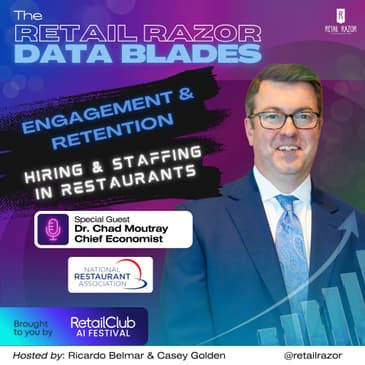


A new restaurant hire costs you money until roughly day 32. For a manager, it’s 72. If they walk before that, you didn’t just lose a person, you lost the investment. In Part 2 of our Hiring & Staffing series, Dr. Chad Moutray, Chief Economist at the National Restaurant Association, breaks down the numbers behind restaurant employee retention - when a new hire becomes “net positive,” why the first 90 days decide everything, and how one weak manager can pull a whole team out the door.
We get into the 31.8-day math for hourly staff, the 72.2-day math for managers, and why restaurant manager retention is the highest-leverage bet an operator on a tight budget can make.
What you'll learn in this episode:
- What “net positive” really means, and the day a hire starts paying off
- The 31.8 vs 72.2-day gap between hourly staff and managers
- Why the first 30 to 90 days is the highest-turnover window
- The leadership traits that drive restaurant employee retention
- Where to invest first when the budget is tight (hint: onboarding)
- A scavenger-hunt onboarding idea one operator actually uses
Next episode: we close the series on how technology is reshaping restaurant hiring and training, without replacing the human touch that makes hospitality work.
Resource Links
HIRING & STAFFING How Onboarding, Managers, & Technology Drive Restaurant ROI.https://www.restaurant.org/research-and-media/research/research-reports/research-insight-workforce-hiring-staffing/
State of the Restaurant Industry 2026. https://restaurant.org/research-and-media/research/research-reports/state-of-the-industry/
Support Our Sponsor
This Episode is Brought to You By RetailClub.
Retail Club AI Festival, September 22–24 in Huntington Beach. Join 2,000 retail leaders for a fully outdoor, beachside deep dive into how AI is reshaping retail. Qualified retailers and brands can attend with free tickets and up to $1,250 in travel reimbursement. Head to retailclub.com to learn more. https://retailclub.com/retail-razor-podcast
Subscribe & Follow
Don't forget to like and subscribe to The Retail Razor: Data Blades for more episodes on customer experience, retail marketing, AI in retail, and data‑driven transformation!
Subscribe to the Retail Razor Podcast Network: https://retailrazor.com/
Subscribe to our Newsletter: https://retailrazor.substack.com
Subscribe to our YouTube channel: https://go.retailrazor.com/utube
About Our Guest
Dr Chad Moutray, Ph.D., CBE, https://www.linkedin.com/in/chadmoutray/
Chief Economist & Sr Vice President of Industry Research & Knowledge
National Restaurant Association, https://www.restaurant.org/
Chad Moutray is senior vice president for research & knowledge and chief economist at the National Restaurant Association, where he leads economic analysis, data-driven insights, and thought leadership for business leaders in the restaurant and foodservice industry. A recognized expert on economic trends, he frequently shares his perspectives through professional presentations, media interviews, and industry reports.
Dr. Moutray is an adjunct professor at George Washington University, where he teaches econometrics in the M.S. in the applied economics program. He has held leadership roles in several professional organizations, including serving as chair of the Conference of Business Economists and as a board member of the National Association for Business Economics. He is also a past president and chairman of the National Economists Club, the Washington, D.C. chapter of NABE. In 2026, he will begin serving on the board of trustees of the John Leland Center for Theological Studies in Arlington, VA.
Chapters
(00:00) Teaser
(00:30) Show Intro
(02:41) Welcome Back, Dr Chad Moutray!
(03:47) What Net Positive Means
(05:28) The 32 and 72 Day Math
(07:00) Managers Make or Break Teams
(08:41) Surviving the First 90 Days
(10:14) Leadership Traits That Retain
(12:33) Where to Invest First
(13:26) Onboarding Ideas and Scavenger Hunt
(15:01) Show Close
About your Hosts
Helping you cut through the clutter in retail data insights:
Ricardo Belmar is an NRF Top Retail Voice for 2025 and a RETHINK Retail Top Retail Expert from 2021 – 2026. Thinkers 360 has named him a Top 10 Thought Leader in Retail, a Top 25 Thought Leader in AGI and Careers, a Top 50 Thought Leader in Agentic AIand Management, and a Top 100 Thought Leader in Digital Transformation and Transformation. Thinkers 360 also named him a Top Digital Voice for 2024 and 2025. He is an advisory council member at George Mason University’s Center for Retail Transformationand the Retail Cloud Alliance. He was most recently the partner marketing leader for retail & consumer goods in the Americas at Microsoft.
Casey Golden, is the North America Leader for Retail & Consumer Goods at CI&T, and CEO of Luxlock. She is a RETHINK Retail Top Retail Expert from 2023 - 2026, and Retail Cloud Alliance advisory council member. After a career on the fashion and supply chain technology side of the business, Casey is obsessed with the customer relationship between the brand and the consumer and is slaying franken-stacks and building retail tech!
Music
Includes music provided by imunobeats.com, featuring Tech Lore from the album Beat Hype, written by Heston Mimms, published by Imuno.
- [00:08:53] - The key here, and this is true of all retention, so this is not necessarily even restaurant specific. You've got to have a…
- [00:05:29] - So the report suggests an hourly hits net positive at thirty one point eight days. Yeah. Managers at seventy two point two…
- [00:04:03] - Well, think of all that it takes when you're hiring a new employee. Right? You you've got to go out and post the position.…
A new hire costs you money until day 32.
For a manager, 72 days.
Ricardo Belmar:Here's something most restaurant operators never calculate.
Casey Golden:So what happens when someone quits before they pay off?
Ricardo Belmar:We asked the National Restaurant Association's chief
economist, Dr. Chad Moutray, how restaurants keep their best people
long enough to matter and why the answer starts in those first 90 days.
Casey Golden:Stick around and watch the full episode to learn how!
Ricardo Belmar:Welcome back to season two of the Data Blades Podcast, part of
the Retail Razor Podcast Network, where we cut through the noise and get to the
numbers that move your business forward.
I'm Ricardo Belmar.
Casey Golden:And I'm Casey Golden.
Welcome to episode 11, part two of our three-part hiring and staffing miniseries.
Ricardo Belmar:If you caught episode one, you know the labor market's shifting,
and an empty shift gets expensive fast.
So today we flip it.
Once you've got great people, how do you keep them?
Casey Golden:Back with us today is Dr. Chad Moutray, chief economist
and senior vice president of industry research and knowledge at the
National Restaurant Association.
Ricardo Belmar:This episode is all about engagement and retention,
and a number that surprised us and will almost certainly surprise all
of you in our audience, how long a new hire actually takes to pay off.
So before we bring Chad in, a quick word about the folks who make this
show and the Retail Razor Podcast Network possible, RetailClub.
Join 2,000 retail leaders at the Retail Club AI Festival, September 22nd to
24th in Huntington Beach, where you'll dive deep into how AI is reshaping
retail while soaking up the sun at a fully outdoor beachside venue.
Decision-makers from retailers and brands can attend with free tickets and
up to $1,250 in travel reimbursement.
Head to retailclub.com/retail-razor-podcast
to learn more
Casey and I will be there for the best conversations on how AI impacts
your customer experience and every operational part of your business.
I hope you'll join us.
Casey Golden:And if you're getting value from this series, do us a quick
favor, Like, Subscribe, and drop us a five-star rating and review on YouTube,
Apple Podcasts, Spotify, and Goodpods.
It only takes a fraction of a second, and it helps more operators find the show.
Ricardo Belmar:All right.
With that out of the way, let's get into it.
Here's part two of our deep dive into how to keep and engage your
recently hired staff with Dr. Chad Moutray, Chief Economist and SVP of
Industry Research and Knowledge at the National Restaurant Association.
Chad Mutray, welcome back to the Data Blades Podcast.
We're thrilled to have you back with us today for the second in our
three-part series on hiring and staffing in restaurants based on your recent
research insight report, Hiring and Staffing: How Onboarding, Managers,
and Technology Drive Restaurant ROI.
Casey Golden:Today we're tackling an important challenge for restaurant
operators, keeping your employees engaged and retaining them.
Because once you get them, the cost of turning them over is too high,
and you really wanna keep them.
Maybe not for a 20-year career, but they gotta last a week.
So Chad, last episode you gave us the rundown on your role at the National
Restaurant Association as chief economist, and head of industry research.
So rather than ask you a repeat of everything we've already covered, why
don't we just dive into today's topic?
Dr Chad Moutray:That, that works
Casey Golden:The report introduces this idea of a new hire becoming net positive.
What does a new hire becoming net positive mean?
Can you walk us through, why it matters to the bottom line, and how do we do that?
Dr Chad Moutray:Well, think of all that it takes when you're
hiring a new employee, right?
You- you've gotta go out and post the position.
Maybe you're having to pay In- Indeed or one of those job posting services, right?
You gotta do the interview process.
That's a lot of manager time, right?
To go through all of the interviews and the screening and all that stuff.
Then once you find the right candidate, there's, your orientation
and some kind of, overall process, and there's training, right?
And that can vary from company to company, right?
Maybe there's a lot of mentoring you're doing with other employees or doing some
type of training in general where maybe they're learning different stations.
But you're not… On day one, you're not adding to the bottom line, right?
That's really what this net pro- positive, comment means, right?
You've put a lot of dollars into that overall process.
And so at what point, does that new employee start having that marginal
dollar adding to the bottom line, right?
At what point do they start becoming productive, right?
and the thinking there is, if you lose someone before that point, they were
a quote-unquote, "bad hire," right?
You lost money on them, right?
So when do you start actually making money on that hire, right?
and, that's really this, this understanding or thinking
that, we wanna make sure we at least get them to that point.
I used to ca- I used to call this the magic number, right?
When did-- when is it that someone starts… if it-- You know
they're gonna be golden, right?
They're gonna stick around.
But also, when are they adding to the bottom line?
I think that's really what we mean by net positive.
Casey Golden:So the report suggests an hourly hits net positive at 31.8 days,
Dr Chad Moutray:Yeah
Casey Golden:managers at 72.2 days.
that's not bad
Dr Chad Moutray:And I heard that, again, we did a lot-- We married in, for this
survey, we married a lot of survey data with a lot of, with interviews, right?
And I heard that pretty consistently.
It obviously varied, but roughly a month, and I would even call
that the magic number as well.
If you s- if you can make it around a month, you're probably
gonna stick around, right?
And so that's a, a nice sweet spot.
Maybe it's two weeks, maybe it's a month, but that's really where, what
I heard from a lot of operators.
For managers, though, it takes a lot more time, right?
They've got… You've gotta make sure you're doing a lot of investment.
Again, varying from operator to operator, some of them really, fly the-- from the,
the mount to work with another manager for a while or, it depends on whether
they're coming internal or external.
But really it's more, I heard two to three months, right?
And that's really what that average can suggests.
Sometimes it's even longer than that.
but, again, so that means if a manager leaves you,
Ricardo Belmar:Yeah, what happens then?
Dr Chad Moutray:after 30 days, you've lost money on them.
You've got to go out and hire another manager.
That's a whole-- starts the whole process all over again, right?
And I think that's really what we're getting to with this notion
Ricardo Belmar:Yeah.
Yeah, and I'm, imagining, with that investment, if it, if your average is
taking you two months to get, that payback from hiring a new manager, if you lose
them before that, even after a month, then that's gotta be a much kinda harsher
pain to take, to have to recover from than just having lost one of your regular
staff members, after a couple weeks.
Dr Chad Moutray:And you have to remember the importance of a manager in general, right?
A manager is key, right?
If you're thinking about restaurants that are really humming along, they're
hitting everything out of the park, right?
It's really a strong manager that's in that lead, right?
And the employees follow them, right?
If
Ricardo Belmar:Right
Dr Chad Moutray:have a really weak manager and you've hired the wrong manager,
that can have larger implications for your, even your hourly employees that
are saying, "Okay, this is… I'm out. This is not working for me," right?
And so I think that also speaks to, on the manager side, that you could have
some larger domino effects, I think, from some of your other staff as well.
Casey Golden:Yeah, no, somebody only lasting two or three weeks be hard
pressed to quit on a great manager,
Dr Chad Moutray:Yeah,
Casey Golden:and th- I'd say that's a critical point
Ricardo Belmar:Yeah
Dr Chad Moutray:And if you have a good manager, one, one thing that
came out, people follow them, right?
So in, in many of these, restaurants, maybe you're seeing down the road
that particular restaurant store, is having problems, so they'll
move the manager over there.
then if I work for that person, I want to follow them, right?
So you got to follow… You ha- really good managers
have a huge following, right?
So that's the other part of that.
Ricardo Belmar:Yeah.
Yeah.
What are you finding is the average, tenure for a manager versus
your standard hourly employee?
Dr Chad Moutray:This, managers typically stick around for, at
least one or two years, right?
I think that's, that, that was the typical that I often heard.
Sometimes even longer than that to your 20-year comment
that you made earlier , right?
but largely they're sticking around a few years.
I think that, that's the key, right?
Casey Golden:Yeah, be a bartender at the airport.
Dr Chad Moutray:Yeah,
Casey Golden:You're raking it in.
All they need is a couple delayed flights.
the report flags the first 30 to 90 days as the highest turnover risk window.
What's actually working to keep new people engaged through that stretch?
Dr Chad Moutray:The key here, and this is true of all retention, so this is not
necessarily even restaurant specific, you've got to have a great manager.
They've got to communicate, right?
I think, i- making sure that you- you're feeling heard, right?
You-- if you have suggestions or you're having some issue that you're feeling
heard early on in the process, hopefully you were clearly told about what your
expectations are in this role, right?
I think some of that attention comes that maybe you were sold something
as far as what the job was going to entail, and then you get in there and
it's a little different than that.
but I think it, it really comes down to, to that.
It also comes down to maybe training, cross-training so that,
again, you can fill in other places where, so again, that makes you
feel more needed and more useful.
So I think a lot of it comes down to just what you would think of as
retention strategies for anything.
I used to be chief economist at the National Association of Manufacturers,
and very similar kind of storylines came out, when you think about retention
and how you can improve retention.
it all comes down to some of those really basics.
you often hear that you don't quit the job, you quit your manager, right?
So again, that co- that collaboration I think is key there, and really making
sure that, again, if I'm working for them, I'm gonna enjoy the experience, work--
enjoy working with my co- colleagues and enjoy working with the manager.
Even if it's a stressful position, I think that they're gonna-- you're gonna
get the kind of benefits from that.
Ricardo Belmar:Yeah.
Yeah.
Just staying on this theme of the importance of that, that manager and the,
and kind of the, those, skills and traits that you want that manager to have to help
build that culture, and to lead that team.
what are you finding are some of those leadership qualities that matter so
much that, that really impact retention specifically from the manager?
Dr Chad Moutray:I think it all comes down to communication and setting expectations,
but also helping to really strengthen those, your strongest employees, right?
Nurturing them.
If you think about where managers come from, they often come from working
their way up from, maybe you hear stories about CEOs of restaurant chains
that started as a dishwasher, right?
What is that path, right?
To make sure that I can continue to move up in, in the system, right?
and so I think nurturing those stronger employees, finding new avenues for
them to also have some leadership roles to really work with other employees,
I think those are all helpful.
Strong communication skills, right?
Being able to work under pressure, right?
The last thing you want to do is get into that rush hour and your
manager's kind of losing it, right?
And so I think all of those things are key.
Strong managers also look really at all the numbers, right?
And I think, again, when you're looking at different restaurants, in terms of
the ones that are knocking it out of the park, those managers are hitting on
all of those, all of those key metrics of operations and making sure they're
hitting their sales targets and retention targets and all that kind of stuff.
And I think that, having that holistic view, but also that
personal touch, I think is key.
Yeah.
Ricardo Belmar:Yeah, and I think there's a, a, a line in the report that mentions
how with the-- with good managers, oftentimes y- you hear that, they make
the restaurant environment feel calm when they're not there, which I think
is an interesting one to me because that kind of speaks to the effect they
have even when they're not in the room.
Dr Chad Moutray:Oh, yeah.
Yeah.
y- you want the manager out there, talking to customers, making sure the
customers are happy and doing that.
You don't really… If they're back in the kitchen, it's because
you aren't doing your job.
Maybe.
Ricardo Belmar:Yeah.
Dr Chad Moutray:It might be right.
It might vary.
Ricardo Belmar:speaks to what we talked about last episode about this
being a high-touch environment, right?
Dr Chad Moutray:But, this is a high-touch world where you want to make sure your
customers are happy, and I think when you have really great employees in the
b- in the kitchen and doing customer service, the manager can really focus
on just the big picture and making sure customers are happy and everything's
coming out timely and in a great quality.
Ricardo Belmar:Yeah.
So if you're an operator and your budget might be tight, w- where would you tell me
is the highest return place to invest in?
Is it in around retention?
Is it in onboarding, mentoring, scheduling to provide consistency to the team
members or creating a development path?
Dr Chad Moutray:Can I say all the above?
Um, uh,
Ricardo Belmar:They're all important, right?
They're all important
Dr Chad Moutray:I think number one, investing in some of those
tools early on, I think ori- that orientation, that overall process
and those, what does that look like?
I would often ask operators, "What does your orientation look like," right?
and there's a lot of them that have really great ideas like, going around
and doing some cross-training or, or some things along those lines.
But I think just in general, how are you making sure that your employees
are really scaling up, becoming productive pretty quickly, getting
to know their various colleagues?
and I think all of those strategies that I-- even the ones I talked about earlier
are key to that overall conversation.
Casey Golden:Super discussion, Chad, on how to keep those hard-to-find
hires on your staff engaged.
and really retention isn't easy, but it pays off in the long run, and a little
bit of extra focus to your managers might be your first door to open.
Ricardo Belmar:Yeah.
Where you get the best
Dr Chad Moutray:The word I was searching for a second ago was scavenger hunt.
there was an operator who had a scavenger hunt, and that's how they
introduced new employees to various parts of the operations, was they
Ricardo Belmar:Oh, interesting.
Dr Chad Moutray:over and talk to certain people or find certain things.
And, anyway, that was the example.
My mind
Ricardo Belmar:No, it's a great, it's a great way of gamifying the whole,
Dr Chad Moutray:it
Ricardo Belmar:experience, right?
No, it's super interesting.
Chad, if anyone wants to dig deeper into the data from the report, and
learn more, what's the best way for them to reach out and do that?
Dr Chad Moutray:You can look at the National Restaurant Association's
website, which is www.restaurant.org.
You can always follow me on LinkedIn or X, I should say X instead of Twitter,
Ricardo Belmar:It's always Twitter.
Dr Chad Moutray:or wherever else, 'cause we do a good job of kind
of putting a lot of this stuff up.
Ricardo Belmar:All right, perfect.
So we'll also have links to the report in the show notes.
So next time we're gonna be closing the series out with, what might be the
big one to close out with, and that's how technology is really reshaping
the way restaurants hire and train.
We've hinted, I think a, a few times at where that fits in, but, particularly
how it can speed up the process.
But never really replacing that human touch element that is
what makes hospitality work.
Casey Golden:I can't wait for this one.
Ricardo, I'd say that this episode is a wrap
Ricardo Belmar:It is
Casey Golden:Loved this episode?
Drop us a five-star rating and review on Apple Podcasts, Spotify, or Goodpods.
And if you're watching on YouTube, like and subscribe before you go.
I'm Casey Golden.
Ricardo Belmar:Follow us on LinkedIn, Bluesky, Threads, and Instagram
and subscribe to our Substack for highlights and bonus content.
For transcripts and guest info, visit retailrazor.com.
I'm Ricardo Belmar.
Casey Golden:Thanks for joining us on the Retail Razor Data Blades, part
of the Retail Razor Podcast Network.
Ricardo Belmar:Until next time, stay sharp, be data-driven, and harness AI.
This is the Retail Razor Data Blades!