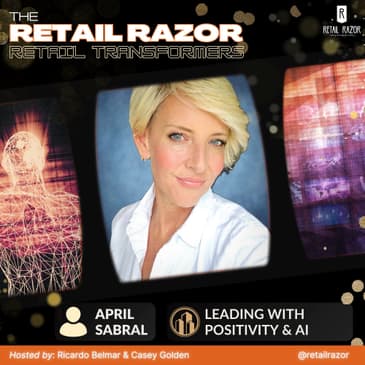



S1E1- Transforming Retail: April Sabral on Mindset and AI
Welcome to the first episode of The Retail Razor: Retail Transformers podcast! Hosts Ricardo Belmar and Casey Golden dive into candid conversations with top innovators, change-makers, and disruptors in the retail industry. In this episode, they welcome April Sabral, a renowned leadership and mindset expert, who shares insights on the power of purpose-driven leadership, building deeper connections, and fostering a positive mindset within teams. The conversation dives deep into embracing AI in retail, building emotional resilience, and fostering a positive workplace culture. April shares insights from her upcoming book, 'Positive Accountability,' and her latest venture, Ask April AI, a coaching and training platform aimed at transforming leadership in retail, hospitality, and service industries.
Whether you're passionate about innovation, leadership, or the future of commerce, this episode offers insights into leading with positivity, mindset, and AI to transform retail. Don't miss out on learning actionable strategies to enhance your leadership skills from one of the industry's most inspiring and transformational leaders!
Subscribe to the Retail Razor Podcast Network: https://bit.ly/RRPNweb
Subscribe to our Newsletter: https://retailrazor.substack.com
Subscribe to our YouTube channel: https://bit.ly/RRShowYouTube
Guest info: April Sabral - https://www.linkedin.com/in/aprilsabral/
April Sabral is a leadership and mindset expert, bestselling author, and founder of Ask April AI, an AI-powered coaching and training platform designed to support retail, hospitality, and service-based business owners. With over 30 years of experience leading teams at iconic global brands such as Starbucks, Gap, Banana Republic, and DAVIDsTEA, April has trained thousands of managers to become confident, people-focused leaders.
Her proven leadership system, The Positive Effect, has been embraced by top brands including Jimmy Choo, Tory Burch, Sunglass Hut, Victoria’s Secret, and Psycho Bunny. Her bestselling book by the same name was named a Top Global Retail Book by the National Retail Federation in 2025 and is featured in the Forbes Leadership Library.
April has the only coaching certification in the retail industry that certifies leaders and coaches to train and license her proven methods, which is launching this fall.
April is also the Executive Director of the Design District Chamber of Commerce in Miami, where she combines her passion for retail with community leadership. She has been named a Rethink Retail Top Global Retail Expert for three consecutive years (2022–2025) and is on a mission to positively impact one million leaders worldwide through practical business tools and mindset transformation.
Learn more at www.AskApril.ai. & www.aprilsabral.com
(00:09:12) Retail Transformer - April Sabral
(00:10:41) Shifts in Retail Leadership
(00:12:12) Importance of Positive Mindset
(00:14:38) Training and Development Strategies
(00:23:54) AI in Retail: Embracing the Future
(00:37:23) Ask April AI: Revolutionizing Leadership Development
(00:41:41) The Role of AI in Retail Training
(00:46:40) Building Technology as a Non-Tech Founder
(00:53:30) Mindset Training in Leadership Development
(00:58:32) Positive Accountability Framework
(01:02:29) Final Thoughts and Upcoming Projects
Meet your hosts, helping you cut through the clutter in retail & retail tech:
Ricardo Belmar is an NRF Top Retail Voices for 2025 and a RETHINK Retail Top Retail Expert from 2021 – 2025. Thinkers 360 has named him a Top 10 Retail, Top 50 Management, & Top 100 Digital Transformation Thought Leader, and a Top Digital Voice for 2024. He is an advisory council member at George Mason University’s Center for Retail Transformation, and is the director partner marketing for retail & consumer goods at Microsoft.
Casey Golden, is the CEO of Luxlock, a RETHINK Retail Top Retail Expert from 2023 - 2025, and Retail Cloud Alliance advisory council member. Obsessed with the customer relationship between the brand and the consumer. Once immersed in fashion & supply chain tech, now slaying Franken-stacks & building retail tech!
Includes music provided by imunobeats.com, featuring Tropikool, from the album Future Beats 2, plus Virtual Apology and New Styles, from the album Shimmer Pop, written by Heston Mimms, published by Imuno.
Preview Clips
[00:00:00] - Preview - April Sabral
Transcript
S1E1 Retail Transformers - April Sabral
[00:00:00] Preview
[00:00:01] April Sabral: And what I mean by that is making and building deeper connections, making sure that the relationships matter. Understanding that how you show up as a leader has a ripple effect on the people around you.
[00:00:16] But I think purpose-driven culture, when you ignite that from within somebody and you create that magic. That is a big shift, I think, and when I work with retailers, the ones that we help create that in the room, they see the ripple effect afterwards.
[00:00:30] connection is so key. If you are not connecting with people and you're just communicating at them, you are not gonna have a team that's brought into what you want them to do. It's just not gonna happen.
[00:00:41] Mindset is a skillset along with other things. So I just think that trend is going to continue because AI can't replace emotional context. It just can't.
[00:00:53] Show Intro
[00:01:01] Ricardo Belmar: Hello, and welcome to our first episode of the Retail Razor: Retail Transformers podcast. The latest podcast in the ever-growing Retail Razor Podcast Network. I'm Ricardo Belmar.
[00:01:12] Casey Golden: And I'm Casey Golden. Welcome Retail Razor fans to the show where we cut through the clutter and bring you the people driving real transformation in retail, the change makers, the innovators, and the disruptors reshaping the industry from the inside out.
[00:01:30] Ricardo Belmar: Yes, this is the podcast where we dive into candid conversations with the people reshaping the world of commerce, from the boardroom to the showroom floor. If you're passionate about innovation, leadership, and the future of commerce, Retail Transformers is the podcast for you.
[00:01:46] Casey Golden: And if this sounds a bit familiar to our loyal Retail Razor audience, well, there's a reason for that. On the Retail Razor Show podcast all the way back in season one. We started a series [00:02:00] called Retail Transformers. Each season we brought you an amazing series of guests that we could all learn from showing us how they have transformed retail or plan to.
[00:02:12] Ricardo Belmar: Well, we learned from that experience that in fact, these were some of the most popular episodes on the show. So we said to ourselves, oh, we should just launch this as a brand new show, and keep bringing you even more incredible retail transformers that are of course more than meets the eye.
[00:02:29] Casey Golden: Ricardo, you are so lucky that you're more than an arm's length away if you think I'm letting you get away with slipping those pop culture references
[00:02:39] Ricardo Belmar: That's what I
[00:02:39] Casey Golden: back into the show. It. This is the one.
[00:02:44] Ricardo Belmar: I get one, huh? All right. All right. I'm gonna, I'm gonna take that as a challenge. You, you watch, I'll find a way to work 'em at least one into each episode one way or another, or, or maybe I'll switch to making them music references or, or song lyrics instead.
[00:02:57] Casey Golden: Okay. I'm not, I'm, I'm okay. Like bring me [00:03:00] some song
[00:03:00] Ricardo Belmar: Okay. All right. It's a challenge. It's a challenge. I'm up for the challenge. I am up for the challenge for that one.
[00:03:04] Casey Golden: but how about we go back to talking about the show.
[00:03:06] Ricardo Belmar: Alright, I would love to. So, in fact, I'd really love to take a moment here and ask everyone listening, or if you're watching us on YouTube to please go check out the other shows in the Retail Razor Podcast Network.
[00:03:18] Hopefully you've already subscribed to the main show, the Retail Razor Show, but if not, don't worry. We'll, we'll forgive you. Just be sure that when you're done listening to this show, and of course hitting that subscribe button, you also go and subscribe to the Retail Razor Show. You'll be so glad you did.
[00:03:33] Casey Golden: And don't stop there. Check out Blade to Greatness for the best leadership skills and career tips you could ever ask for in retail. Straight from the best leaders in the business, including our guest for today on the show. So you see we're already cross pollinating from show to show.
[00:03:50] Ricardo Belmar: Oh yeah, and then go give Data Blades a listen, where you'll get deep, practical insights into customer experience tactics you can use based on real world [00:04:00] research at the point of sale. If you're a data junkie like Casey here, then you absolutely want to check out Data Blades.
[00:04:06] Casey Golden: A hundred percent. So that brings us to four shows, right?
[00:04:12] Ricardo Belmar: Yeah. Yeah, it does amazing, isn't it? Did you ever think we'd be producing four shows when we started Retail Razor Show back in 2021?
[00:04:18] Casey Golden: No, I definitely didn't. Frankly, if you even told me then that I'd even be part of a regular YouTube series, I would've laughed at you, or even been the person to initiate that.
[00:04:31] Ricardo Belmar: That's right. That's right.
[00:04:34] Casey Golden: Honestly, you could go back to our original show on Clubhouse. If anybody remember Clubhouse and I wouldn't have expected we'd be expanding that into all of these podcasts in less than four years.
[00:04:47] Ricardo Belmar: I have to agree there. This has been quite the wild of ride, but very exciting. I can't express just how much I love hearing the feedback though from, loyal listeners to the shows on how much they learn and take away from each episode. I'm always so impressed to hear [00:05:00] how much of an impact, all of these podcasts are having, and I really love to see that happen.
[00:05:04] Casey Golden: Yeah. , And I think this show is really going to make an impact too. I love how this will give so many people the opportunity to give back to the industry and share their knowledge and wisdom. And most of all, I can't wait to see reactions from our audience about some of the more unexpected guests we'll have this season.
[00:05:24] Ricardo Belmar: That is so true. Of course we'll also have some, I guess I would say expected guests two, won't we?
[00:05:30] Casey Golden: Way to drop a hint there. But yes, we are asking many of our previous retail transformers to come back on the show and update us on all the new and amazing work they've been doing since their first appearance.
[00:05:45] Ricardo Belmar: Those will be a really special treat.
[00:05:46] Casey Golden: So in anticipation of that, this might be the best time to ask our audience to please consider giving us a five star rating and drop a quick review on Apple Podcasts, Spotify, YouTube, or Goodpods, if [00:06:00] you like the show. We really appreciate your support.
[00:06:03] Ricardo Belmar: That's right. So, okay. Let's talk about our first retail transformer this episode, someone who is no stranger to the whole podcast network. We mentioned before she was one of our special guests on multiple episodes of Blade to Greatness, sharing three incredible leadership traits that every retail leader needs to master.
[00:06:22] But not only that, she was also our very first retail transformer in season one of The Retail Razor Show.
[00:06:28] Casey Golden: Yeah, so it's only natural that we would invite her to be our first guest on this new dedicated Retail Transformers show. And best of all, she has been very busy with new, exceptional work that we're going to be hearing more about today.
[00:06:47] Ricardo Belmar: That's right. So of course we are talking about April Sabral. April is a leadership and mindset expert, bestselling author of multiple books, and founder of the brand new [00:07:00] Ask April AI, an AI powered coaching and training platform designed to support retail, hospitality, and service-based business owners. With over 30 years of experience leading teams at iconic global brands such as, lemme look at, check out the list Starbucks Gap, Banana Republic, Davidstea, April has trained thousands of managers to become confident people focused leaders.
[00:07:23] Casey Golden: Her proven leadership system, the Positive Effect has been embraced by top brands including Jimmy Choo, Tory Burch, Sunglass Hut, Victoria's Secret and Psycho Bunny. Her bestselling book by the same name was ranked a top global retail book by the National Retail Federation in 2025 and is featured in the Forbes Leadership Library.
[00:07:48] Ricardo Belmar: And we mentioned April's been very busy since her first appearance on the show. So not only is she launching the new Ask April AI, but she's also has the only coaching certification in the retail industry that certifies [00:08:00] leaders and coaches to train and license her proven methods. And that is launching this fall.
[00:08:05] Casey Golden: We did say she's quite busy, didn't we? April is also the executive director of the Design District Chamber of Commerce in Miami, where she combines her passion for retail with community leadership. She is a fellow Rethink Retail Top Retail Expert and has been named for three consecutive years, 2022, to 2025, and she's on a mission to positively impact 1 million leaders worldwide through practical business tools and mindset transformation.
[00:08:38] Ricardo Belmar: Wow. Talk about more than meets the eye. That is what transformation's all about.
[00:08:44] Casey Golden: Absolutely. And yes, I did catch that you worked your favorite phrase in.
[00:08:49] Ricardo Belmar: I did, I threw it in there. Okay. Okay, so why don't we go straight to our conversation with April then before I get myself into deeper trouble before the next [00:09:00] episode.
[00:09:00] Casey Golden: I like that idea. So here's our fantastic discussion with Retail Transformer, April Sabral, multi-book author, leadership coach, and founder of Ask April AI.
[00:09:12]
[00:09:12] Retail Transformer - April Sabral
[00:09:19] Casey Golden: Welcome to the first episode of our Retail Transformer show. April, always an incredible pleasure to have you here with us.
[00:09:28] April Sabral: I am so excited. I can't believe it. I'm here again. I love your show and I'm, I'm really, really happy to be here today.
[00:09:36] Ricardo Belmar: Well, and this is a particularly special one for us, too, April, 'cause you may or may not realize, but you were our very first Retail Transformer on The Retail Razor Show way back in our season one, episode nine, which if I remember correctly, is all the way back in May of 2022. So just over three years ago.
[00:09:56] And so it's so perfectly fitting that you're now helping us launch the new [00:10:00] series on, on this theme with the first episode of the series. So thanks for being here with us.
[00:10:04] April Sabral: Oh, wow. I did not know that. That's epic.
[00:10:08] Ricardo Belmar: Exactly. Exactly.
[00:10:10] Casey Golden: It was a different world. And of course, you're no stranger to other shows since you joined us for the first season of our Blade to Greatness series.
[00:10:18] Ricardo Belmar: That's right.
[00:10:19] Casey Golden: In fact, that's, that's partly why you're here, isn't it? You have such a rich history of training retail leaders, plus now multiple books making a real impact, starting with The Positive Effect, then Incurable Positivity, and so much more to help leaders understand why being positive is so powerful when leading store teams.
[00:10:40] April Sabral: Thank you.
[00:10:41] Shifts in Retail Leadership
[00:10:41] Casey Golden: You've seen the retail landscape evolve significantly over your 25 years at companies like Starbucks, Apple, Banana Republic. What are some of the most fundamental shifts in team leadership that you've observed?
[00:10:55] April Sabral: Yeah, it's interesting. It's such a good question, this question, what are shifts, [00:11:00] right versus change? I love the word shift because I think shift is about like slight changes can make a big impact. I'm a big believer in that. And I think one of the biggest shifts I've seen over time, which I think was always there, but more walking away from transactional leadership and going towards transformational leadership.
[00:11:20] And what I mean by that is making and building deeper connections, making sure that the relationships matter. Understanding that how you show up as a leader has a ripple effect on the people around you. And you know, back in the day when I was growing up in retail, I did fortunately get a lot of personal development and professional development back then from Gap, Apple, and Starbucks back in the day before the e-comm boom and all the money was in people. And so then I saw it go away from people. And I think right now it's coming back around. You know, you cannot cut development, like cutting development is a [00:12:00] false economy.
[00:12:00] That's what I, I read that term lately and I, and I was like, that is so good because
[00:12:06] Ricardo Belmar: I like that.
[00:12:07] April Sabral: money and you're not saving money, you're actually killing your business. It's the decisions we make as leaders.
[00:12:12] Importance of Positive Mindset
[00:12:12] April Sabral: So I think just that and then really honing those skills in positive mindset.
[00:12:18] People are so interested now in mindset practices, you know how to manifest. All of that comes along with leadership when you're leading a business and how to make sure that, that you are being responsible for that. And teaching others, like back in the day, people didn't talk about positive mindset or teaching other people the skills on their team.
[00:12:40] They would just say, you're being negative, you're being, you know, you're being not so nice, or you're not being good at what you do. And I think that's evolved. So skillset and mindset is very important now.
[00:12:51] Casey Golden: I think that's great. And I like the, I like your use of responsibility. I do feel like very strongly that the industry has a responsibility to its people. We need them [00:13:00] to get that foundational experience to lead us into the future.
[00:13:05] April Sabral: We do, and excuse me, I've got a frog in my throat. It always happens when you get on camera, right? You're like, I was fine and
[00:13:10] Ricardo Belmar: That's right.
[00:13:11] April Sabral: and, but, I also think purpose-driven culture over command and control. Like you know, before it was like, do this, do that. Command and control, like operational execution. I mean, I grew up in the Gap world of execution, which is amazing 'cause it taught me a lot.
[00:13:26] But I think purpose-driven culture, when you ignite that from within somebody and you create that magic. That is a big shift, I think, and when I work with retailers, the ones that we help create that in the room, they see the ripple effect afterwards. I had somebody call me the other day and they said sales went up like a couple weeks after.
[00:13:44] We don't know if it was your training 'cause it's really hard to quantify training and development. I think that's why companies cut it faster, because it's not like a ROI but it kind of is, they were like, we, it's the training. You know, people [00:14:00] are letting go of
[00:14:00] Casey Golden: If sales down suspicion that it be very easy to make attribution.
[00:14:06] April Sabral: know. But you know, when I'm trying to talk to people about that, one of the things we talk about the shift is instead of saying ROI as well on things we say ROC, which is return on compensation. So you are paying people all of this money and are you getting the return on compensation that you want versus the ROI return of investment on training because when people are trained and skilled up and more positive, they do perform better.
[00:14:34] So we like to talk about that and educate, you know, our partners on that.
[00:14:38] Training and Development Strategies
[00:14:38] Casey Golden: Do you have, like, do you have an example recently or like working with a brand that you can share?
[00:14:43] April Sabral: Yeah, yeah, yeah, for sure. So, like most recently you would've seen it posted on LinkedIn probably is we went to Tory Birch and we trained the store manager, field leadership team in the management conference. And that was really powerful. That was focused on mindset. A lot [00:15:00] of it in that training was from The Positive Effect, but it was from Incurable Positivity because they really wanted their team to have best practices on how to lead positively and shift other people's mindsets and take on accountability and, and not have that blame game, right?
[00:15:17] Like, oh, the company's asking me to do this. They're not giving me the resources for this. Complaining about everything that's going wrong, that's not great for any business. So we really. Worked on the change management matrix and like that mindset and giving them the tools. And the other thing that I've learned in the last five years of doing this is standing there lecturing at somebody does not work.
[00:15:42] So we have really honed the facilitation game of getting 200 people in a room to actually engage with about 50 people throughout the whole four hours of workshop with different people. And what that does is build collaboration. There's somebody, you know, in LA that's never met the person in [00:16:00] New York and probably
[00:16:01] may not conference that big, but we have these activities that get them to actually have self-reflection.
[00:16:07] And so that's really powerful. And I could see the shift, the ripple, like after we left the room and beyond. So that was a really good example of like these
[00:16:15] frameworks and their focus, what they wanted us to work on versus you know, performance management skills and. I don't know how to give somebody feedback.
[00:16:24] It was really about positivity.
[00:16:26] Casey Golden: It's really a great point. You know, store managers, a lot of times they kind of live on an island which is them and HQ. I remember, I, I, God, it was like a lifetime ago, but I would have a, a biweekly call in that all store managers would essentially call in during the afternoon for some type of topic or conversation.
[00:16:50] It was almost like a lunch and learn. But it did bring at least like all store managers in and we did have an opportunity for open discussion. I've never even thought about [00:17:00] that as something that I did actually find a lot of value in because I didn't feel like I was alone. I felt like I was part of a, this larger team.
[00:17:10] April Sabral: Yeah, which is that that purpose driven culture. When you can create that alignment among many people and give them that vision and, and create that power from within, you will ignite your team's performance. There is nothing better than that if you're thinking about productivity. And how to drive more sales like legit.
[00:17:32] Like you, you have people, you have to invest in them. And that's why I love that term of cutting development is a false economy, you know?
[00:17:39] Ricardo Belmar: Yeah. Yeah. Yeah. So it, teamwork, I, I guess, is, is pretty central to all the coaching skills and, and things that you do in, in these sessions. Are there one or two really actionable techniques that you, you could tell leaders right now is they should immediately implement to really build that better teamwork environment?
[00:17:59] April Sabral: [00:18:00] Yeah, I think so. There's, I was just working in New York right last week when I was there for The Lead conference and the day prior I was with one of my independent clients and I was standing there and I was, it sounds really basic. This is gonna sound so basic. But it's not because it's the small things, the fundamental things of building connection with people that really matter.
[00:18:21] And I was watching a daily huddle and it was so great to be back on the shop floor because I haven't done it for a while, and just speaking at your team, like de delivering a download of information in the morning of what's gotta get done. And then you say, oh, does anybody have any to say? And everybody walks away and you're like, oh, that went well.
[00:18:40] Well actually it didn't, nobody had anything to say.
[00:18:44] So one thing I asked him to do was, instead of just downloading information and telling them what's going on for the day, is to start their team meeting with asking them, and this is a Ron Thurston thing, right? What's one thing you're proud of?
[00:18:58] Right asking that [00:19:00] question or what's one thing you're grateful for today and get everybody to share. What that does is it gets everybody in a positive emotional attractor and it opens up their brainwaves and it's scientifically proven that you get people talking and now they're open and they're in a place of gratitude.
[00:19:17] So that's one thing. And then the second thing is. Bring what you are trying to get people to get into conversations in everyday meetings by saying, okay, we're gonna talk about, you know, our vision statement or our latest or one of the service models or something that you feel like, oh my God, why aren't my team getting this?
[00:19:39] I never see them doing it. Bring it into a meeting and say, okay, so who wants to talk about, you know, step one of the vision statement and like, how are we gonna do it today? How are we gonna embody this today? That's bringing personal development into professional development, and I don't see that enough when we're in the conferences.
[00:19:57] We teach the framework. Then [00:20:00] I share a story about it, and then the next step is we get them into groups, like small groups, and they have to start with what are they grateful for, and then what did they just learn from me? And then how are they gonna apply it? These are the three steps,
[00:20:13] and that's an easy formula to shift culture, right?
[00:20:17] Casey Golden: Yeah, I
[00:20:18] mean, it has to be intentional. Being positive is intentional. If you ask anybody who has a positive outlook on life they choose it and they make that intentional.
[00:20:29] Ricardo Belmar: Yeah, and it, and it, and one thing too, and it is from from those three steps, I think is so important. It gets everyone communicating with each other and that extra, and of course, you, your, your team isn't gonna function if they're not communicating with each other in the first place. So I, I do think it's a, a, a critical piece that you're really reinforcing in that method by getting everyone talking to each other.
[00:20:49] April Sabral: Well, yeah, leaders think they have to say everything and then they have, they think they have to fill, fill the silence, and they actually
[00:20:54] don't. I used to be on conference calls, I'd ask a question, 30 people, and I'd say, I'm really [00:21:00] good with silence, so I'm gonna just ask it again until somebody.
[00:21:04] Ricardo Belmar: So someone says something.
[00:21:05] April Sabral: It's kind of like last week when we, we were at The Lead, right?
[00:21:07] Like Julia and, and Paul, they said, okay, who wants to stand up and offer up something? And I was like, they picked me. Of course they did, because then I started the conversation. So one person starts and then everybody starts. So
[00:21:18] connection is so key. If you are not connecting with people and you're just communicating at them, you are not gonna have a team that's brought into what
[00:21:27] you want them to do.
[00:21:28] It's just not gonna happen. So you really have to ask questions and what questions like, really think about that. I get asked all the day, all, all the time, like, what questions should I be asking? I'm like, ask chat, GPT. You've got a.
[00:21:44] Casey Golden: Yeah, accountability is crucial. How do you define positive accountability and how does it differ from more traditional approaches to holding teams responsible? Let's say somebody in our audience right now is going to go ask Chat [00:22:00] GPT, but really about that. Where does that North Star for them on positive accountability?
[00:22:07] April Sabral: I think positive anything and specifically positive accountability means that everybody knows what it is. Because when you feel uncertain about things, you feel uneasy about things. We all do. We're going into a situation and we're not sure about what it's gonna be like or how it's how it's gonna play out, and we can feel uneasy the more that we provide clarity.
[00:22:32] Which is clear expectations, the better people are gonna feel, which is gonna activate not less fight or flight in their brain and actually put them in a positive space. So I always say, you know, when I'm in a training or I'm talking to leaders about accountability, and it's specifically positive accountability, ask 10 people on your team what accountability means and see what they say and they give you 10 different answers. So then I'm like, well that's interesting [00:23:00] because if we know certainty and clear expectations creates positive work experiences and places, then wouldn't you want to have a definition of accountability that everybody's clear on. So whenever anybody asks me, I say accountability is a nine step framework.
[00:23:17] That when you actually adopt, it gets everybody clear and working in tandem to achieve the goals. It is a nine step framework, and that's what I say. And then if you know that and you know the steps, then you've got a positive framework for accountability. And number one, being set in clear expectations.
[00:23:35] That's the one that everybody misses. So if we know set clear expectations is the first step of accountability, then we need to set a clear expectation of what accountability is. Does that make sense?
[00:23:47] Casey Golden: Yeah, I, it makes perfect sense and I think that's a great place for people to start.
[00:23:54] AI in Retail: Embracing the Future
[00:23:54] Casey Golden: We're seeing a lot of anxiety around AI in the workplace. Something like 89% [00:24:00] reportedly are worried about job displacement. I'm not a self-checkout kind of gal, but unlike Ricardo, how can leaders throwing you under the bus
[00:24:12] Ricardo Belmar: Yeah.
[00:24:13] Yeah.
[00:24:14] Casey Golden: how can leaders in these industries adopt AI with a positive mindset and, and help their teams to do the same and.
[00:24:23] You know, really release that anxiety.
[00:24:26] April Sabral: I think we have to normalize the conversation around it. Just like we do a product launch, just like we do a promotional launch, just like we do when we're building a new division, whatever it is, we need to bring it into conversation. It can't be an afterthought, you know? You are correct about that percentage.
[00:24:45] 'cause I was doing a talk in Miami recently and studying the percentage and then how many Google searches? There are every 30 seconds about improving my aI skills. It was like 730 million. It was [00:25:00] ridiculous. Probably more than that. Billion. I can't read the numbers. The. But then when you add work on top at work, it actually nearly doubles.
[00:25:08] So this is a real fear that's in people's minds. So if you are not dealing with change, we know change is, again, uncertainty. People are gonna get resistant to it. So I think you have to bring it in. And number one, share your vision about how you see AI in your company improving their role. Maybe reducing some workload from some people, because again, if you are not normalizing that conversation about it, you're avoiding it.
[00:25:37] And I don't think that's good for anybody. The number one step in our change matrix is vision. If you don't share a vision, people are confused. If you don't talk about how AI is going to be working in your company, 'cause you are gonna bring it in, it's not going away, then you are not sharing a vision.
[00:25:56] People are gonna be confused. Right. And if you're not tooling them up with the [00:26:00]skills, they're gonna feel frustrated. So you have to really talk about and bring it in and, and we've done that in our organization. 'cause we're a content company, we're a training company, but we build a lot of content, right?
[00:26:11] Video training and all of that. And we call it meloria. It's really funny. It means, it means positivity in Latin. So we've given her a name, which. Yeah. So we talk about, Hey, did you like, literally, I get text messages from Rena on my team and she's like, did you talk to meloria about that? And I'm like, oh, yeah, right.
[00:26:28] Let's talk to Maori about it. And last night I was on the plane landing and I was having this thought, and I was like, meloria's, like there now, she's our ally, she's our team player. And then I was like, oh, I should go ask, Ask April actually. Why don't I just ask my own AI version? So then I've started doing that. And she built me a whole freaking go to market strategy on something that we're launching soon. And I was like, that was brilliant. that would've taken me like five advisors, three weeks reaching out on LinkedIn, trying to find people. So I think you've got to [00:27:00] reframe it as an assistant and, and not a replacement.
[00:27:03] It will replace some jobs. Let's be real. It will. It will. And we need to be talking about that so that we can upskill people that may be displaced into other roles.
[00:27:13] Ricardo Belmar: Mm-hmm.
[00:27:14] Casey Golden: Yeah, I mean, retail is just notorious for obscene amounts of admin work that probably shouldn't have, shouldn't exist today for the last 15 years.
[00:27:25] April Sabral: yeah
[00:27:26] Casey Golden: So, I mean, I think with that comes new productivity and putting people in magic spots, right? Letting them focus on the magic areas versus seen amount of spreadsheets and paperwork that's out there. I think you can't just talk about it. I think you have to demo it, right?
[00:27:44] Like you have demonstrate using it. Like I've been in offsites with executives where they have been spending way too long trying to figure out their OKRs and their strategy, and then I just open up the laptop and I'm like, okay, well let's all talk to her. I'm like, [00:28:00] let's have conversation. Then it goes like this. By the end of the meeting, they're like, whoa, we got our OKRs in 20 minutes. I'm yeah.
[00:28:07] Ricardo Belmar: Yeah. yeah.
[00:28:08] April Sabral: You know,
[00:28:08] a hundred percent.
[00:28:10] Casey Golden: You know, that's a great point. I challenge all of our listeners right now to upgrade to a paid version.
[00:28:19] April Sabral: Yeah.
[00:28:19] Casey Golden: I think that that might, that right there is, don't just try it on the free level. It's like a 30 x
[00:28:27] Ricardo Belmar: But it's, it's the difference between looking at it and thinking about it versus embracing and actually leveraging and taking advantage of the results you get from it.
[00:28:36] Casey Golden: Yeah, and, it's very different.
[00:28:37] Ricardo Belmar: yeah. Yeah. No, a absolutely. I mean, and I think that's, and you meant, you said it April, it's one of those things where you, you can't, I think there's a habit or a tendency often in retail that when there are these unknown things or unclear things to just ignore them and maybe they'll go away.
[00:28:50] But the fact is they don't go away, right? They just build and build. And the AI tools is one of those where if leaders don't embrace it and actually in a [00:29:00] structured way, kind of figure out how are we going to incorporate this into everything we do? Everyone else under them is gonna do it for them, but it's not going to be coordinated.
[00:29:08] It'll be, everyone will find their own way to do it, and it's gonna be very disjointed and you're not gonna get all the benefits that, that you could get.
[00:29:15] You know, so, so it's definitely an integration problem from that sense. I mean, is is there a particular piece of advice you give leaders who are grappling with this whole, how do I incorporate AI in this way that you're telling everyone, this is where you should start.
[00:29:28] April Sabral: Yeah, talk to AI and tell it that you're grappling with it, how to integrate it and get it to give you a plan
[00:29:35] Ricardo Belmar: Yeah.
[00:29:36] April Sabral: to start just talking to it and upskilling yourself. There is tons of free courses. Now, there are tons of webinars. We're a training company. We a hundred percent believe that when you are trained and you have the knowledge, you will be able to embrace and accept it faster because knowledge gives you confidence.
[00:29:52] So I think fear is a real thing around this. Your team is feeling fearful. You have no [00:30:00] option But to uplevel your skills as their leader and get educated on this. So, you know, I think just training and upskilling. So if you are looking at your next 30 days and you don't have an AI workshop or some kind of masterclass that you can do on, LinkedIn learning or whatever, there's tons of stuff out there.
[00:30:20] Just Google it. I actually feel like I wanna do an AI like masterclass on LinkedIn because honestly, last week people just kept coming up to me and I felt like I was a prompt architect. Like legit. I was like, I'm gonna a new job about to appear a prompt architect, because humans don't generally ask a lot of questions.
[00:30:41] They think more about themselves than anybody else. We just do. It's human nature, so we don't know how to engage with somebody that's not giving us something back. But when you start engaging with it, it starts to help you be better at your job. That's when you start getting the buy-in, 'cause you're like, wow, that's making me look better, sound better, [00:31:00] easier, like. Wow. I could progress if I've got this skill now. So yeah, I was just, last week I was, I was walking, people were just walking up to me and saying, somebody has this question.
[00:31:13] Casey Golden: That is great. Yeah. I just mentioned last week that AI and like Chat GPT and these, and like a Claude or or Gemini is a micromanager's dream. It's a skill. It is a skill that needs to be refined, especially since typically leaders, great leaders they overly communicate, but they do build those dreams and expectations.
[00:31:40] But in my opinion, like a great leader gives you enough rope to hang yourself with it and that you can't do that to Chat GPT. You have to micromanage that prompt to be so specific to what you needed to do. What role you need [00:32:00] to take it, it to take on and really define the outcome. And I say like, it's like working with an in like an intern
[00:32:07] April Sabral: It is!
[00:32:08] Casey Golden: All day and like literally working with an intern all day because I have to explain everything and it is a skill that has to be developed, right?
[00:32:18] Because that's not a great skill of mine. I hate being micromanaged, but at the same time. That is the success in AI is being able to hone in that skill to say, listen, I may not enjoy doing it, but it's mandatory skill that I work on this and continue to develop this because I'm going to be able to get what I want, but I'm also gonna be able to learn what else I can have that I didn't realize.
[00:32:45] April Sabral: and I'm gonna reframe the
[00:32:46] micromanaging piece to, you're not micromanaging an intern, you're training an intern, right? You're,
[00:32:51] Ricardo Belmar: Hmm.
[00:32:52] April Sabral: You're, training somebody and when you're training somebody, you can guess what, Redirect. [00:33:00] Reframe, ask another question. If they didn't get it coach them. If they didn't get, like what you said, ask them to ask you more clarifying questions so that you can be clear in what you're asking.
[00:33:11] So I think if you reframe it for train your training, your assistant, then it becomes fun. Because literally it's like you say one thing like you said, and then it gives you an answer and you're like, oh no, now you get stuck. No. If that was a human standing in front of you, you'd be like, okay, I must have not been clear.
[00:33:27] Let me give you some more information or, or if you wanna ask me questions to clarify what I'm actually a lead, then can you ask me some questions? But we, that's the skill that we teach leaders that they don't have. They walk around making assumption
[00:33:39] Ricardo Belmar: Yeah.
[00:33:40] April Sabral: making all day.
[00:33:43] Ricardo Belmar: Yeah. Well, I think, I think a lot of people have an inherent and not so much a fear, but maybe a, a lack of ability to iterate on things. And, and this is such an iterative process, right? And that's what you learn. And I think, I like how you say that you're training it in that sense, because you really are right.
[00:33:58] You're, you're starting with [00:34:00] a problem you wanna solve. And like any problem solving technique, the AI is great at helping you do that. But, it also needs a little bit of help from you in understanding what exactly is the problem you're trying to solve. And the only way you do that is by giving it more information, asking more questions, and keep repeating and iterating over until it finally comes out with what you were looking for.
[00:34:20] But I think maybe some of the, the disservice a lot of the early hype did is, is create this notion that you're gonna ask one thing and get all the answers you want. And that, and that's not really how it works. Right? And, and if you think about it when do we ever solve problems that way? In these, in these business areas?
[00:34:35] When have we ever solve one by just saying one thing and getting an answer and, okay, we're done. Let's move on to the next one. Everything we do right, always has iteration to it, and we always have to dig and go a little deeper and expand most of the time because we haven't defined the problem well enough to get to that solution, and you do a lot of these steps to better define it, and it's no different with doing the prompting with AI because the AI needs a good understanding of what you're trying to [00:35:00] do so that it can give you a result that is gonna satisfy
[00:35:03] Casey Golden: Yeah, and I think it's important to note that like in order to have like successful training, there needs to be some level of a culture of learning because just because you train me today doesn't mean I've had anybody's had a moment to sit with it. To test it. I started putting my Monday mornings and afternoon essentially into learning.
[00:35:28] I'm going to try new tools, I'm going to watch some YouTube videos, and it's very structured of what do I wanna learn? What tools can I use? Let me try to create an agent. Let me, let me kind of like double click in this area so that I can like, not feel, I can feel like I'm not, not doing my job, but I feel like I'm gonna be able to 10 x if I can make sure that I have time to absorb all of this stuff that's coming in [00:36:00] that's new or everything that I wanted to essentially like, you know, is being reiterated into practice and allowing that space for your team members to just sit with it, try, learn where you're, you are holding them accountable to engage and act, but really don't have that result, right? Especially in retail, there's always a fire drill every day, inboxes, traffic, sales quotas, and we also often don't provide that space to absorb and to learn and test
[00:36:39] April Sabral: Well, if you go back to the beginning of the first question you asked me about like what shifted in leadership, it's like past life, it was like I would ask, what did you sell today? Today I would say, how can I support you grow today?
[00:36:53] Ricardo Belmar: Mm-hmm.
[00:36:53] April Sabral: that's a different question. Not that I'm not gonna ask, what did you sell?
[00:36:57] Because we've all gotta make sales. But if [00:37:00] you just focus on that and the past review, you are not creating a supportive growth environment. If you say to somebody, how can I support you grow today? That's a really powerful question and and that opens up dialogue for strengthening the skillset for the future.
[00:37:16] Always in improvement mode versus just looking back all the time.
[00:37:21] Ricardo Belmar: Yeah, that's so true. That's so true.
[00:37:23] Ask April AI: Revolutionizing Leadership Development
[00:37:23] Ricardo Belmar: So April, since we're diving into the AI question and how to best use it is probably a good time to ask you for more details on the Ask April AI that you're about to launch.
[00:37:35] Um, What, can you tell us a little bit more about how, as, as a platform that's going to make leadership development more relevant, maybe more personalized and and how it helps leaders address all the challenges they're facing, whether it's in retail, hospitality, other service businesses.
[00:37:50] April Sabral: Yeah, yeah, yeah. We're really excited because when we built retailU six years ago, we, we were, we built micro learning four minute videos when everybody was still doing [00:38:00] 12 to 15 minute videos. And so we kind of innovated then and how, I feel like it's shifting now is attention is currency, right? We all know that shorts is the way to go if you want to get people's attention.
[00:38:15] So we've been able to take the courses. Which are the longer call, they're four minute videos. They're not really long, but they are
[00:38:22] kind of long now. I'd like to get somebody to watch it and use an AI version of me and kind of like consolidate all of that and give you a mini podcast style AI version of me.
[00:38:32] Having a conversation with somebody else, which is awesome. And it goes through all the frameworks in a very podcast style learning because everybody listens to podcast. Podcast, we're on one right now, right? They blew up after the pandemic. They were always there, but now they're really, really prevalent on how people learn.
[00:38:48] And so that's been really awesome to kind of use AI. Version of me and somebody else to have this conversation about the frameworks and bring it into real life and have discussions and debates about it. [00:39:00] And I listened to them. I'm like, whoa, that was really good. Like that was our concept. So that's one piece of it is like innovating the learning styles and distilling it down to more micro sized on demand, but giving you the frameworks that work.
[00:39:13] Number one. Also. Giving you contextualized prompts. So we talked about like people don't know what questions to ask. I see that all the time. So I know all the questions that people ask because they ask me all the time in trainings. We've trained thousands of leaders at this point. So we have the most commonly asked questions and challenges, and so we give you those contextual prompts so that they're there and you can have a conversation with me, the AI version of me, to get the answers that you need, and it will reference all the books.
[00:39:44] It will reference a course, it will reference a podcast. It will point you in the direction because at this point we have so much content that we've built that we have this massive library. So it will point you in the direction so that you can get that deeper learning.
[00:39:57] So that's really exciting.
[00:39:59] And then [00:40:00] what I've really recognized over the last five years is the smaller businesses that really couldn't afford to have me come in and do a workshop or didn't have the headcount to do it, need different way to get access to our content. And so we've built a program specifically for them and coming down the line, they will be able to kind of build their own content and, and AI driven course creation on the platform because if their stuff is in Google Drive, it's on Canva, it's everywhere. It's like when we go to do an audit business, the on on onboarding and the expectations, we can't train that in the small businesses because they haven't set them.
[00:40:36] So we have to help em set them. So we're gonna. Help 'em with that and then, you know, have an AI tool that creates and generates SOPs and all that kind of stuff. So I'm really excited about where this is gonna go. It's gonna be a very affordable subscription because we want to make it affordable, but we also are now, which I think makes this very different training and certifying coaches.
[00:40:56] So you come into the AI platform to get your [00:41:00] micro learning. All the courses from retailU, hospitalityU, the positive effects sell on you all in one banner now, because they were all in different banners. So they're all in one hub and now you can actually get a coach on demand to train your managers for you using the content so you don't have to.
[00:41:19] And that, that's just been a massive learning in the last four years of working with owners. And they can't really train the managers ' cause they don't have the skills. So we'll do it for you so that you can get back to running your business and, and doing the magic. Stay in the magic lane that you are in.
[00:41:35] You have to go through the program because it starts at the top. I truly believe that. But we are going to give you additional support.
[00:41:41] The Role of AI in Retail Training
[00:41:49] April Sabral: So Ask April AI is a learning hub for location-based. Bricks and mortar with these features in it. And it's, I'm really excited. I think it's gonna, I think it's gonna be, well, it, it's good timing.
[00:41:53] I think,
[00:41:54] Ricardo Belmar: Mm-hmm. Yeah. Yeah.
[00:41:57] Casey Golden: great. I mean, with any great like trainer, like even [00:42:00] like fitness personal trainer you can't just go to the personal trainer once and call it good for the quarter.
[00:42:05] Ricardo Belmar: Yeah.
[00:42:06] Right. It's an
[00:42:07] Casey Golden: reinforced and it's ongoing and it's a conscious decision that you're making on a regular basis. So, you know, trust the process to get you to where you want.
[00:42:16] April Sabral: We will also, yeah, we, we trained it on all of, all of the books and all the content, so I'm training her
[00:42:22] all the time. Like just yesterday we were going to an event in New York and a friend of mine, he's a tech founder, and he was like, I don't know, have my elevator pitch. What am I gonna say? Because you know, you know Casey, you like show up, you're like, what do you say you do when you do 50 million things, right? So I was like, why don't you just chat GPT it like ask. And then I was like, hold on, let's ask April AI.
[00:42:43] Let's ask chat, GPT, and let's ask April. AI. And the difference was really, really powerful. And because I say that because you sometimes, well, why would somebody sign up for Ask April AI when I've got Chat GPT.
[00:42:55] Ask April aI actually gave him the positive reframe on his mindset that [00:43:00] he needed going into the event versus just the salesy elevator pitch.
[00:43:05] It actually asked you to reframe, take a deep breath, meditate, like all the incurable positivity practices as well as a pitch, and I was like, whoa, that was really good.
[00:43:14] Ricardo Belmar: Yeah. it's great. 'cause it sounds like you, you really get I think you know, when, when it comes to anything related to training, you, you go through a training and you remember some portion of it, right? But as time passes, if you're not continuously using what you learn from that training, you start to forget bits and pieces of it and the amount that you retain gets smaller and smaller.
[00:43:33] But if you have something like Ask April AI, you can just, you're gonna keep asking it or tell me again how I do this or what, how, how's, what's the best way I can do this? And you ask all the questions. It's like constantly being refreshed in the training, which, which just seems like an amazing tool for any leader to have that way.
[00:43:47] April Sabral: Yeah. And the frameworks we use are so simple, right? That like a three step acronym. Use this when you have this conversation. That's why they're so powerful. 'Cause they're very applied learning. 'cause they're grounded in retail ops, right?
[00:43:57] We don't have time to have these long, [00:44:00] fluffy conversations.
[00:44:01] We had to get people inspired, get them moving, and then give them, have a three, three step. You know, I was raised in Gap and Starbucks acronyms were the life. We had acronyms for everything, and so I think that's powerful. The acronyms and the frameworks that it pulls up now because we've trained it on them all.
[00:44:19] It's really cool.
[00:44:20] Mm-hmm.
[00:44:21] Ricardo Belmar: Yeah. Yeah. Is, is this, do, do you see something like Ask April AI helping retailers, you know, put the labor back in their stores in a sense? You know, we, we, we all still talk about how there is still an issue with having enough labor in, in stores, right? Having a large enough store team. Do you see AI tools like Ask April, AI helping leaders kind of compensate for that and, and either because they're better developing the team members they have and they're enabling to do more of the, I'm gonna say the more high.
[00:44:49] A high value tasks rather than a lot of tedious things that, you know, can consume all your time, but you don't get a lot to show for it afterwards.
[00:44:57] April Sabral: Oh yeah, a hundred percent. Like just [00:45:00] creating strategy documents and monthly plans and to-do lists and all of that stuff. If you could just say it to somebody and ask them to do it for you, like your little intern. It just saved you a whole lot of time. I just created a task list yesterday for my team. I was like, this is what I'm trying to do.
[00:45:17] This is what I wanna focus on. Can you create a task list? And then which one out of my team, what should I be doing? What should they be doing? It just gave me a priority list. That was like two minutes before we'd be having a discussion. Somebody would be disagreeing with me. I'd be afraid to tell them what I want to say.
[00:45:32] There'd be all this other complexity going on to make things longer, so it will save it. And I think. It's not about cutting hours from the stores. It's about cutting hours from the support functions. Or reframing what they're doing so that the labor can go into the stores. Like if I was in a retailer right now, I'd be looking at where we can save in labor hours total company to fuel the store experience.
[00:45:58] Not to cut from it, [00:46:00] but the experience of the human connection is so essential. We know that from experience, you can't get rid of that. Robots are never gonna replace humans in that perspective. They will replace stocking and things like that, but not from an experiential place. So yeah, I do think that it's gonna help.
[00:46:18] I. If you are smart and you're embracing it and you're learning it and you're looking at ways to integrate it into these tasks, there should be like an AI task force kind of cross-functional that's kind of looking at how you can implement things and save costs as a total group, and then where does that money go to fuel growth, right?
[00:46:38] Ricardo Belmar: Mm-hmm. Yeah, absolutely.
[00:46:40] Building Technology as a Non-Tech Founder
[00:46:40] Casey Golden: So. You've built some tech. Let's talk about building technology. April. At some point I will have a tell all book. I have a title. I just need to make sure that the results support the title, so I'm not ready yet. Like many female founders, what's the [00:47:00] reality been for you and your project? Building tech, what's been tough? What have you learned? What did you not expect? Any big surprises?
[00:47:08] April Sabral: Yeah, I think you should write the book on this. So you were like one of the first people I called a couple of weeks ago. I was like, oh my God! How do I chat somebody.
[00:47:17] Casey Golden: Question at all.
[00:47:17] April Sabral: I think one of the toughest things is if you are not having a tech background, and then you're going to build a technology is you don't know what to ask. It's kind of like you're not a mechanic. This is the only way I can describe it. And you have car and you take it in to get an oil change.
[00:47:35] 'cause you have this commitment to make sure that it's, you know, taken care of. And when it's there, the mechanic says, oh yeah, and X, Y, and Z has to be done. And you're looking at your car up there and you're like, well, I have to get it back. And I don't know if he's telling me the truth. But I have to, I have to give him the money 'cause he is now got my car hostage.
[00:47:52] So, okay, here's more money and fix X, Y, and Z. Even though I only came in for an oil change. And I feel like that's the experience of [00:48:00] building a tech It's like you go into it like, oh, I'm just gonna do this oil change. I've got my plan, I've got my goals, I've got my strategy. And all of a sudden as you are in it, you're like, whoa, hold on a second.
[00:48:12] This needs to be done. That needs to be done and it costs more money and, and you don't really know what to do because now you are in it and you've got you, you are focused on getting to the finish line and you want this product to come out 'cause you know how much it's gonna help people. So I feel like that has been a massive learn going backwards I think I would've taken some classes or called somebody or prepared myself for that as opposed to just going cold turkey. But a lot of people just go into it with an idea that they wanna build something. Find a developer and you don't know if that developer's, a good mechanic, a a skilled mechanic, got an attitude mechanic.
[00:48:49] You, you don't know, right? There's all these components and I'm really good at managing, leading people. I gotta say this really challenged my leadership skills in [00:49:00] another way. Like it did not work, what was working, managing my team in the other areas of the business because I don't have that skillset. So again, not knowing what to follow up on, not knowing the questions to ask. And so you were really helpful 'cause I was like, oh my God, what questions should I be asking? So yeah, I had to hire the developer and then bring somebody else in to do an assessment and then kind of get it back on track. And so that was just so emotional.
[00:49:27] That was just stressful, emotional, like I've been challenged in more ways this year than any being a tech founder, I thought being an entrepreneur was hard. Being a tech founder, it was like it will build your resilience like no other. So I think that, that's a big lesson. I think one of the hardest things as well is just funding as well.
[00:49:46] It's you know, these things cost money and you go into it with all good intention, wanting to do it, but they, there does come a point where you're like, how do we get funded in an easier way that's not so complex to bring our things to market? So I think, [00:50:00] yeah, those, those two have been the massive big challenges.
[00:50:03] Mm-hmm.
[00:50:04] Interesting.
[00:50:05] Casey Golden: Yeah. I think, I mean, it took me like, I think every, I think every tech founder definitely on like the, the female founder side, because I think there is. You have a lot of business operators and subject matter experts that have gone into tech to solve specific problems where they, they have the operating experience and the vision and the relationships in the industry, but they do lack that hands-on technical experience of building a product.
[00:50:32] Product. And it's, it's not you know, there's a ton of people moving from retail to go be a software developer at Meta, right? Like, that's just, that's a career path. They're not even the same schools that we would attend for a career in retail for a career in computer science. Right. I think, I, I think every female founder's threw at least one version of their software away, like.
[00:50:57] April Sabral: I can relate to that.
[00:50:58] Casey Golden: Whether or not it was, [00:51:00] or it, the code was noodle or just really wasn't able to, you know, every, every engineer wants to rebuild anyway
[00:51:10] April Sabral: So.
[00:51:10] Casey Golden: when they their on a platform.
[00:51:12] April Sabral: That's so true. It's like, hold on a second. Why can't you just help me get this one to the next step? So one thing I have learned and thankfully with AI is how to code. Like I, this is a big surprise for me. Never thought I would learn that and love it, but it's problem solving, right? So I'm a problem solver, so I love that mind game of doing it.
[00:51:34] And so I've learned to code and I've quite, I've impressed myself in the last week. I was like, whoa, I didn't know I could do that. But we have AI.
[00:51:41] Casey Golden: So much easier. I wish I would've, like I have 25 years of French. I wish I had 25 years of Java. I would be so much more successful. And there's no rolling the R right? Like it. Makes [00:52:00] so much more logical sense to learn the language to code. Especially if you're an Excel junkie, like most people in retail are, we are like the royalty of if and then statements. But, but yes, you know, I think I probably spent the first, you know, I probably spent a solid two years just learning how to communicate and manage engineers and, and be able to set out with a project and a sprint to get the results that I wanted with the same team by my side at the end as well. It is definitely a skillset.
[00:52:33] So congratulations, you're making it to the other side.
[00:52:36] April Sabral: I am because I have so much resilience. I remember once a bo like one of my bosses back in the day, he said, you are like a pit bull dressed up like a fairy. I'm like, mm, yeah, I don't really, but when I wanna get something done, it's gonna get done. Like it's, and that's the operater in me, let, let's get it done.
[00:52:55] So, um, but yeah, I'm excited and yeah, I, I actually do love [00:53:00] the whole nerdy side of the coding. I mean, I was building courses and online sites and funnels and all of that. Like I, I, I've done that for six years now. And so this whole coding side, I was like, Ooh, that's what that does. Oh. And then I'm like, oh, how can I add this and how can I add that?
[00:53:17] So it's been, yeah, that's been really cool. And I think I'm so grateful now to be in the era of building technology in ai. Honestly, it just makes it so much easier, you know? Mm-hmm.
[00:53:28] Casey Golden: that's great.
[00:53:29] Mindset Training in Leadership Development
[00:53:29] Casey Golden: Looking ahead, what is one key trend in leadership development that you believe will be essential for the success in retail, hospitality, beauty industries, over the next three to five years?
[00:53:42] April Sabral: Yeah. One trend in leadership development. Okay. That's a great question. I think mindset training is going to continue to be part of it, i've been saying this for a
[00:53:53] long time, but I was raised by an American hippie mother in the UK that got me into personal development [00:54:00] early in my twenties, right?
[00:54:01] Manifesting laws of the universe, all of this kooky stuff. However, as a metaphysical student and practitioner of understanding like how the brain works, what you think about comes about and rewiring your neurons and all of that stuff. That cannot be ignored now in leadership, I think, because you can go into a room and learn how to connect, but if you don't have the skills to learn, to teach people how to deal with their negativity and their negative mindset and their anxiety.
[00:54:32] It's gonna be tough to drive those results, especially when AI is taking away all of the mundane jobs and the task master jobs. So you are gonna have to really become versed and skilled in how to deal with humans. You can't hide behind the tasks anymore, which means you're going to have to have those skills on how to reframe people's [00:55:00] mindsets through this massive change that we're going through. That was really surprising to me when we went to Tory Burch and we did a four hour session. They were like, just, you know, just focus on, you know, positivity, mindset, self-accountability, teaching our leaders how to help their teams do that.
[00:55:16] When people are complaining, help them to reframe it, not just tell them to stop complaining 'cause that doesn't work. 'cause what you resist persists. So it's not about risking negativity, it's about learning how to shift it and showing people it is a skillset. Mindset is a skillset along with other things.
[00:55:34] So I just think that trend is going to continue because AI can't replace emotional context. It just can't.
[00:55:42] Ricardo Belmar: Mm-hmm. Yeah. Yeah.
[00:55:45] Casey Golden: Now I hear a lot of people, you know, especially over the last five years we've gone, the retail's gone through a lot. The world's gone through a lot. And there's been a large emphasis on " wartime CEOs," right? I think that [00:56:00] almost every single manager right now needs to be able to have that point of reflection to say , how am I going to inspire and lead my team through all of this uncertainty?
[00:56:15] And I think this is a moment where leadership, where you work. Is more important than even what your hours are, how much you're getting paid, what the perks are. It's like we are at a time with rapid change and so much uncertainty in the media, in retail. What is going on with retail and technology and with this AI that it really comes down to who people want to be in the, the ship with.
[00:56:50] You know,
[00:56:50] Ricardo Belmar: Mm-hmm.
[00:56:51] April Sabral: that's why.
[00:56:51] Casey Golden: I feel comfortable that I'm gonna bet on this. I have somebody who inspires me, I believe in, they're not gonna leave me behind. I'm safe as [00:57:00] long as I engage and I participate and they're here for me. And having that safety in your leadership, if you can't find it in the industry.
[00:57:08] April Sabral: Yeah. Emotional resilience, adaptive mindset, and learning agility. These are the three competencies that I truly believe are going to continue to become very, very important.
[00:57:21] Ricardo Belmar: Yeah, I agree a hundred percent. It's gonna be so, so critical to, to be there. I think. like you said earlier, when, when things shift versus change, sometimes it's easy to miss the shift if you don't have someone leading who's actually. Embracing the shift and incorporating into all the things that you do and bringing everyone with them.
[00:57:40] And if you're not doing that, then of course people will feel like they're being left behind and then that reduces the positivity. Right? I think the, so many of the things that you talk about April, you, you don't have that positive mindset, then the people aren't gonna do the things that they need to be doing.
[00:57:57] They're not gonna do the things that make them feel confident [00:58:00] about it, make them feel fulfilled with it and, and enjoy what they're doing. And we all know that when those things don't happen, you don't produce anything.
[00:58:07] April Sabral: Yeah, you're either causing resistance to yourself or lowering resistance as a leader every day. That that's, that's it, really. cause leadership is influence, nothing more, nothing less. That's all it is. There's a, there's a, that's a easy, high level synopsis of what is it?
[00:58:22] So you are causing resistance or you are lowering resistance.
[00:58:26] That's it at the end of the day.
[00:58:28] Right. To, to
[00:58:29] Ricardo Belmar: No, that's a great way to put it.
[00:58:30] April Sabral: Yeah.
[00:58:30] Ricardo Belmar: Yeah.
[00:58:31] April Sabral: Mm-hmm.
[00:58:31] Positive Accountability Framework
[00:58:31] Ricardo Belmar: So you, you have a new book coming out this fall. We, we've touched on it a a couple of times or hinted at it, Positive Accountability. Is there any kind of a sneak peek into some of the core principles in this book that you can talk about?
[00:58:44] April Sabral: Yeah. It takes the nine step framework that we've been teaching. And it breaks it down into more robust chapters. And I think one of them is the step that always. I love training this[00:59:00] step. And actually when I was at The Lead, there was a tech team there from Canada that I trained four years ago, and one of the leaders was there at, at the show and he said, you know, we had two other trainers that came in after he said, but yesterday I just used that step for the accountability framework.
[00:59:16] And he was like, and it works every time. He is it's the one thing I remember from you. And I'm like, Hey, one thing that, that's just golden, but it's the step that says, share mutual consequences in advance. And that step is such a powerful step because if you set your clear expectations and you have them repeat back to you, and then you share mutual consequences in advance so that if they don't meet the expectations, they've actually agreed on what happens next.
[00:59:49] There's no awkwardness or gotcha kind of conversations trying to trick you into like catching you do the wrong thing because you already knew what was coming when you [01:00:00] agreed that you understood the expectations. And that simply sounds like if you don't get this done, you won't be able to do X, Y, and Z.
[01:00:08] Can we agree on that? And in a store environment, that's if you don't make the sales goals, which we are asking you to do. I will not be able to give you the hours. Are you clear on that in advance so that when your hours may get cut, you understand why that's happening? That one step, that 32nd conversation changes everything.
[01:00:33] Because when that is missing and you just say, here's a goal, and then they don't make it, and then you go and tell them, I'm cutting your hours, you've caused at resistance again in the
[01:00:44] Ricardo Belmar: Mm-hmm.
[01:00:45] April Sabral: they're
[01:00:45] so confused. They're like, well, why are you doing that?
[01:00:48] Ricardo Belmar: Where did this come from? Yeah.
[01:00:49] April Sabral: you didn't tell them in advance.
[01:00:51] So consequences, whenever you use that word, it makes people get itchy. 'cause they're like, well, that's not a positive word. I'm like, it's actually really positive. It happened to me twice in my [01:01:00] career where somebody sat me down and said, Hey. The expectation is this, and if you don't meet it, you won't be able to get this.
[01:01:09] And it changed my life. I, I got promoted because I was aware of something I was doing was gonna hold me back. And it was my decision to learn to do it better, to shift what I was doing, to get more knowledge, to seek out people that could help me or just to make a decision to do something differently.
[01:01:28] But had they not sat me down and told me that I. I would've never progressed because I would've never known why. And this is one of the most powerful steps. People get fired because they don't know what the consequences were in advance if they didn't meet this expectation. So that's the step that I think is just so powerful, and we really go into that with examples.
[01:01:50] And break that down. There is nine steps. This is just one of them. There is nine. But one, it, it resonates every time because I run into people and they're like, oh, that, that [01:02:00] really changed the way that I work with my team. We're having honest conversations, you know? We know in, they know in advance. So when it doesn't happen I'm like, well, you kind of agreed to it.
[01:02:10] You told me that you understood. So now you're having a follow up on the expectations not being met in a different way, in a positive way. That's transparent. So I'm really excited for leaders to learn that because that can make a huge ripple effect in a team and in an organization when everybody starts to adopt that
[01:02:29] Final Thoughts and Upcoming Projects
[01:02:29] Casey Golden: Well, you've got a new book coming out, so I think now is the time in the, in the wake of that for everybody to go snag a copy of Positive Effect. Drill into that nine step positivity wheel and download it free at aprilsabral.com. We'll add a link to our comments and our Substack.
[01:02:51] Ricardo Belmar: Yeah. And April, this has been a fantastic discussion. We, we can't thank you enough for joining us today and sharing your incredible positivity, your rich [01:03:00] retail history, and all the leadership skills and trainings that we've talked about today. I mean, I know I can't wait for the new book later this year, and I just can't thank you enough for helping us launch this new series.
[01:03:09] April Sabral: Well, thank you. I, I feel like whenever you launch one now, I need to be part of the launch plan because this
[01:03:14] Ricardo Belmar: right.
[01:03:14] That's right. That's right.
[01:03:17] April Sabral: awesome. Well, congrats and congrats on your new series and I can't wait to listen to more.
[01:03:22] Casey Golden: Well, congratulations to you. You've been doing a lot of work and I'm excited to see the launch of your new book and Ask April AI. So, thank you so much April. We so much of, after this conversation, I think all of our audience is feeling a little bit more inspired to lead and learn. So thank you for joining us and sharing your positive outlook on retail.
[01:03:46] April Sabral: Thank you.
[01:03:46] Casey Golden: Well, Ricardo, I'd say that means our first episode of Retail Transformers is a wrap.
[01:03:51] Ricardo Belmar: It is.
[01:03:52] April Sabral: All right. Awesome.
[01:03:53]
[01:04:01] Casey Golden: If you enjoyed our show, we have a simple ask for you. Please consider giving us a five star rating and review on Apple Podcast, Spotify, or Goodpods.
[01:04:11] Remember to smash that subscribe button in your favorite podcast player if you haven't already, and like and subscribe to our YouTube channel so you don't miss an episode.
[01:04:22] I'm Casey Golden.
[01:04:23] Ricardo Belmar: Please follow us and share your feedback at Retail Razor on LinkedIn, Bluesky, Threads and Instagram.
[01:04:30] And if you want to preview highlights and transcripts from each episode right in your email inbox, please subscribe to our substack newsletter. I'm Ricardo Belmar.
[01:04:39] Casey Golden: Thanks for joining us.
[01:04:40] Ricardo Belmar: Until next time, keep transforming retail and stay sharp.
[01:04:44] This is The Retail Razor: Retail Transformers!
[01:04:47]