
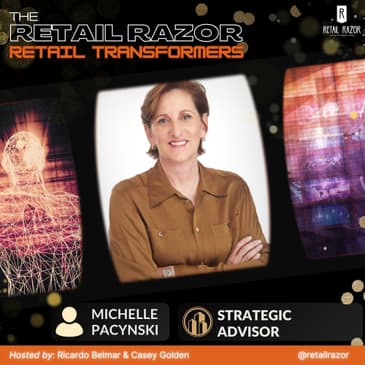



S2E1 Ulta Beauty’s $2B Digital Transformation: Michelle Pacynski Reveals the Retail Innovation Playbook
In this season‑opening episode of The Retail Razor: Retail Transformers, Ricardo and Casey sit down with Michelle Pacynski, former VP of Innovation and Consumer Technology at Ulta Beauty, to unpack one of the most compelling retail transformation journeys in modern retail.
Michelle shares how Ulta scaled its digital business from $125M to over $2B, built a mobile‑first strategy before the rest of the industry caught up. And she created an innovation team that ultimately became the company’s AI Center of Excellence.
This conversation is a masterclass in retail transformation and innovation, AI adoption, startup collaboration, and the leadership mindset required to build what’s next.
What We Cover:
How Ulta built a mobile‑first digital experience before it was mainstream
Why infrastructure, fulfillment, and omnichannel foundations matter more than hype
The real story behind GlamLab, virtual try‑on, and beauty tech adoption
How to evaluate retail tech startups and build a risk‑reward experimentation model
Why innovation teams should sit inside the business, not IT
The future of search, video commerce, and agentic AI in retail
Why retailers must embrace experimentation to stay competitive
The mindset shift leaders need to drive meaningful retail transformation
If you care about the future of retail transformation, leadership, startup innovation, and agentic AI in the beauty industry, this is an essential listen.
Subscribe
Subscribe to The Retail Razor: Retail Transformers for more episodes featuring retail innovators, disruptors, and bold thinkers reshaping commerce.
Subscribe to the Retail Razor Podcast Network: https://retailrazor.com/
Subscribe to our Newsletter: https://retailrazor.substack.com
Subscribe to our YouTube channel: https://go.retailrazor.com/utube
Guest info:
Michelle Pacynski, Senior Digital Executive | Digital Transformation | Futurist | Innovation | Board Member | Strategic Advisor. https://www.linkedin.com/in/michelle-pacynski/
A high performing, visionary leader, Michelle Pacynski shapes – and reshapes – the retail industry with leading innovations and designing new ways to discover and shop. For over six years, she founded and led a team of global digital innovators, overseeing work that connects digital and physical shopping journeys with leading technology to create differentiated, relevant guest experiences. She also championed the creation of a corporate venture fund, Prisma Ventures (™) to accelerate innovation by forming strategic partnerships with the startup community. She’s currently a strategic advisor for several tech startups and while overseeing Prisma Ventures (™) she deployed over 50% of the $20M fund to some 12 early-stage startups over 3 years.
Recently named one of the Top 25 Leaders to Watch in 2025 by CommerceNext, Michelle is currently a Strategic Advisor with iVantedge Advisors, LLC a company she founded specializing in guiding innovative technology startups through pivotal growth stages. She helps tech founders navigate complex challenges, drive product-market fit, and positions them for long-term success in dynamic, fast-paced markets.
Chapters:
(00:00:00) Preview Teaser
(00:00:38) Show Intro
(00:04:19) Introduction and Welcome Michelle Pacynski
(00:05:05) Michelle's Retail Journey
(00:06:15) Transforming Ulta's Digital Business
(00:09:29) Mobile First Strategy
(00:12:25) Building a Native App
(00:15:00) Innovation and Experimentation
(00:29:53) Virtual Try-On and Gamification
(00:34:54) Challenges in Retail Tech
(00:39:13) Strategic Partnerships and Innovation
(00:40:43) Experimentation and Quick Wins
(00:43:59) Future of Retail Innovation
(00:45:13) Interactive Commerce and Video
(00:49:26) Heads-Up Displays and AR
(00:52:34) AI and Practical Applications
(00:59:33) Recognition and Personal Reflections
(01:02:50) Mindset Shifts for Retailers
(01:04:51) Closing Thoughts and Contact Information
(01:07:15) Show Close
Meet your hosts
Helping you stay sharp, be bold, and transform retail!
Ricardo Belmar is an NRF Top Retail Voice for 2025 and a RETHINK Retail Top Retail Expert from 2021 – 2026. Thinkers 360 has named him a a Top 10 Thought Leader in Retail and AGI, a Top 50 Thought Leader in Management, Careers, and Transformation, and a Top 100 Thought Leader in Agentic AI and Digital Transformation. Thinkers 360 also named him a Top Digital Voice for 2024 and 2025. He is an advisory council member at George Mason University’s Center for Retail Transformation and the Retail Cloud Alliance. He was most recently the partner marketing leader for retail & consumer goods in the Americas at Microsoft.
Casey Golden, is the North America Leader for Retail & Consumer Goods at CI&T. She is a RETHINK Retail Top Retail Expert from 2023 - 2026, and Retail Cloud Alliance advisory council member. Obsessed with the customer relationship between the brand and the consumer. Once immersed in fashion & supply chain tech, now slaying Franken-stacks & building retail tech. She is also the Founder of Luxlock, a cross-channel customer experience management platform.
Includes music provided by imunobeats.com, featuring Tropikool, from the album Future Beats 2, plus Virtual Apology and New Styles, from the album Shimmer Pop, written by Heston Mimms, published by Imuno.
Highlight Clips
[00:17:54] - And then back in the day, a real simple thing, still see it today is, and then I'll pause, is if you were shopping on the brand…
[00:00:16] - She didn't just ride the wave of retail transformation. She helped shape it, weaving AI, AR, and XR into the shopping journey,…
Transcript
Not long ago, Ulta Beauty's digital business was
a fraction of what it is today.
Then Michelle Pacynski stepped in, building teams, launching bold Innovations
and creating a $20 million venture fund to bring startups into the mix.
Casey Golden:She didn't just ride the wave of retail transformation.
She helped shape it.
Weaving AI, AR, and XR into the shopping journey, redefining omnichannel.
Ricardo Belmar:Now Michelle's making bold predictions about the future of
retail, and trust me, they'll make you rethink everything you thought you knew
about search, e-commerce, and innovation.
Welcome to the Season two premier of The Retail Razor: Retail Transformers podcast.
Part of the Number One Indie Podcast Network for Retail.
A top 20 Retail Management show on Apple Podcasts, the Number One Indie Careers
Podcast of the Week and Month on Goodpods and a 2025 Instant Hit on Spotify,
where this show's more popular than 52% of other new shows debuting in 2025.
This is the show where we bring you candid conversations with the crazy ones, the
misfits, the rebels, the bold thinkers, and the disruptors that see things
differently to shape the future of retail.
Casey Golden:And I'm Casey Golden.
Welcome Retail Razor fans.
If you're passionate about innovation, leadership, and
the future of commerce, Retail Transformers is the podcast for you.
And wow, do we have an amazing episode to kick off the season!
Ricardo Belmar:Yes, we do.
Today, Casey and I are thrilled to sit down with one of the
most visionary leaders in retail innovation, Michelle Pacynski.
And if you're not familiar with Michelle, just keep listening.
You're in for a string of aha moments.
Casey Golden:Michelle is a senior digital executive, futurist and strategic
advisor who's been reshaping the way we shop for more than two decades.
At Ulta Beauty, she helped scale the digital business from $125 million
to over $2 billion in revenue.
Leading the charge on omnichannel transformation and creating
experiences that connect the digital and physical worlds.
Ricardo Belmar:She also founded Prisma Ventures, Ulta's $20 million Corporate
Venture Fund, where she deployed more than half of that capital into
early stage startups, accelerating innovation across AI, AR, XR, and beyond.
Today she continues to guide founders through her own firm, iVantedge
Advisors, helping startups navigate growth and achieve product market fit.
Casey Golden:Michelle's impact has been recognized across the industry.
She's been named one of Commerce Next's Top 25 leaders to watch in 2025, honored
by brand innovators and glossy for her work in omnichannel and emerging
technology and awarded Retail Partner of the Year by Vendors in Partnership.
She's also a member of Rethink Retail's Global Retail Leaders Advisory, shaping
the future trajectory of the industry.
Ricardo Belmar:She is not just a leader.
She's a true collaborator and thought partner regularly speaking
at conferences, joining panels, and sharing insights on podcasts.
Today, we'll dive into her journey, her bold predictions for the future of retail
and the advice she has for both brands and founders navigating transformation.
Casey Golden:But before we dive in, a quick ask for all of you listening and
watching if you're enjoying the show.
And if you came back for season two, then you got to be enjoying it.
So why not hit us with a five star rating, or a four, always room for improvement!
Drop a short review on Apple Podcast, spotify, Goodpods,
or wherever you're listening.
Ricardo Belmar:And like and subscribe on our YouTube channel.
So you never miss an episode.
And if you haven't already, take a few minutes to check out and subscribe to
the other shows in the Retail Razor Podcast Network, the Retail Razor Show,
Blade to Greatness and Data Blades.
You'll find them all on your favorite podcast app and on our YouTube channel.
Casey Golden:All right.
With that said, let's jump into our incredible conversation with our latest
Retail Transformer, Michelle Pacynski.
Ricardo Belmar:Michelle, welcome to the Retail Transformers podcast.
I'm always excited when we have someone on the show with such a
rich retail career leading, driving innovation, both large brands as well
as helping working with startups.
I honestly can't wait to dive into your retail journey, leadership
philosophy, and all the amazing things that you've been doing.
Casey Golden:Well, thanks very much for having me.
I'm really super excited to be here and can't wait to get chatting.
Right.
Thrilled to have you here today with us.
You've led innovation, the creation of a startup fund, and for so many
years led the digital evolution in e-commerce of some pretty
well established retail brands.
So let's just jump in and have you give our audience a quick
rundown of your background.
Fabulous.
So most recently I was with Ulta Beauty.
I was with Ulta Beauty for about close to 13 years.
Left Ulta Beauty at the beginning of 2025 to kinda hang out in
the startup community more so.
But I have been in retail for a bit.
And at Ulta I had two roles.
Part of my, like the first half of my time at Ulta, I led consumer technology.
That would be store systems, marketing, digital channels, our mobile apps focused
on that for about half of my time at Ulta.
And then the other half I founded and led a digital innovation team.
Prior to Ulta, I was the CIO for a home furnishings retailer, and, you know, a
number of other retailers before that.
But you, for the most part, much of my career has been technology centric.
I'm a technologist at heart ma, old math major.
And I have typically, I, I've really leveraged technology across
all disciplines of the business.
But in the past, I would say good 15 years or so, the focus has really been
applying technology for guest or cons, like customer centric experiences.
Ricardo Belmar:Okay great.
that's what we love to hear.
So let's dive in a little bit more into your time at Ulta.
I find this so much of what you did there to be fascinating.
I remember from some of our previous discussion, I think in terms of
Ulta's digital business, when you first took on those roles, it
was somewhere around 125 million.
I think that, obviously grew to well over 2 billion in revenue.
If you look back on that, what would you consider some of the more pivotal
transformation decisions that kind of fueled the growth you were able to create
with that, and any particular lessons that other retailers can take from that?
Casey Golden:A couple of things.
I would say, I think in 2012 when I joined Ulta and I was brought in
by, friends of mine who I'd worked with previously, the focus was on
digital and growing the channel to, the target was 10% of total revenue.
It really wasn't where it needed to be.
And, you know, in 20 12, 1 of the things that was, was really great
about Ulta, still true today, is it's very entrepreneurial.
But in 2012, the digital channels were very immature for the size
company that it was at the time.
So you really had an opportunity to make a difference, be very
self-sufficient, move quickly.
And you know, for the most part, we had the ability to do what we
needed to do to grow the channel.
A number of us that kind of came in at that time.
And so a couple of things that we immediately focused on.
One, the overall infrastructure of a digital channel, I think
you really can't ignore.
So one of the things I really spent a lot of time on was just
the physical infrastructure.
And by that I mean, network layers and ensuring that they
were configured to really support aggressive growth over the years.
And it was a growth coming through organic channels, just opening
new stores in new areas, but then, ultimately through increased
marketing and outreach digitally.
So we anticipated like dramatic growth and therefore the platform itself had to
be ready for, dramatic traffic increases.
So all layers of the physical infrastructure, for the most
part, those were, that was one of the places that I focused and
then expanded and built that out.
One, like a little example of that is a content delivery network.
Now, having been in, like overseeing digital channels for a long time,
you might think like in 2012 there was no content delivery network.
That's kind of unusual,
think I was still like one of the few people, like on Twitter still.
Yeah.
You
you know, and so it's a little interesting that like ultimately
if you want a site to perform well, you really need to have a lot of your content
out on the edge, being able to be served up in a really, expeditious manner.
And so simple things like that.
I mean, frankly, very low hanging fruit that if you had, as I had had
a, like overseeing digital channels previously, it's kind of here are the
things that need to be there in order to really sustain dramatic growth.
So infrastructure for sure.
That, you know, I focused a lot on that.
The other thing that we did is we went through a, at the time we went through
a complete site redesign and kind of transformation around 20 12, 20 13.
Subsequently, Ulta did that again.
But at that point in time we specifically, one of the things
that we knew was coming was mobile.
Everybody was mu using mobile devices, less on the desktop.
And so one of the things that we implemented was a mobile first archite.
So a response of web design, giving a nod to the fact that people
were gonna be on their phones.
I mean, most of the people were.
And then we looked at the, like the device base in the US.
This is changing and has changed over the years, but in the US
most people are on iPhones.
We prioritized the different browsers.
So we had a mobile first experience and experience that could be adaptive to the
type of mobile device that you were on.
Believe it or not, people kind of were doing a little bit of
shopping on small iPads, right?
So we were really cognizant of the mobile formats.
I think that was huge.
And then you know, and then another thing is, is that right?
We began thinking about like in 2013 is when we thought about native mobile
and leveraging common components and functionality, but really thinking
about, devices where people were shopping and ensuring that whatever
that experience is, it fit the type of format that they had in, like either on
their desk and their hand or something.
So I, those would be a couple of the things that I think were, like for sure
helped propel the digital channel is thinking about the infrastructure, of
course, the experience, but you know, really the foresight that it should
be mobile first and, and then, and then backend, that would be maybe the
third area that really required a lot of focus is fulfillment, because at
the time, kind of believe it or not, a little history thing for Ulta in
2012, the digital channel could only be fulfilled by a single physical warehouse.
So that, that's not gonna fly
Ricardo Belmar:no.
Right.
That's right.
Casey Golden:you've got traffic
Ricardo Belmar:That won't scale.
Casey Golden:push delivery closer to the guest.
So opening up fulfillment to be able to fulfill from really the
full footprint of the supply chain logistical capability was huge.
And then, you know, and then creating an omnichannel, strategy where you could
go into the store have an extended, kind of an endless aisle capability
if you didn't see it, it was something that was online you could purchase,
had to have your shipped to your store.
So those would be the things that, again, I mean, again, just kinda,
keeping in mind timeframe 2012
any longer, that seems like right.
It's kinda like a lifetime.
And, those are the things that I think really helped, you
Yeah, I mean it does feel like, um, in certain aspects
of lifetime, other ways, it's like yesterday, but the world has changed.
The consumer behaviors changed so much since then.
And I mean, you're really at.
The early days for mobile back in the mid two, two thousands, right?
2012, 2015 even.
Um, how, what was your approach in like building that experience when it wasn't
at the level of volume we're looking at today, but it was, it was more about,
you'd had to get a lot of people on board to say we're building for this.
That doesn't really, we don't really know what it is.
We just know that it's going to be the future and it's going to be big.
I'd say that a lot of brands are probably, and a lot of leaders are
having this conversation and struggle with agentic and AI right now too.
Right?
Like, when is it too late?
One can say that it's never too late, but when is it like, not too early, right?
Where you can get those experimental, processes and operations to, to
support you in that vision and where you feel the business is going.
Um, because you also played a role in like community building before, like we had
this like massive social media presence and commu social community as well.
Right.
So, well, a couple of things, right?
One, I did mention, right?
I'm, I'm a technologist.
I love technology, but you know, I certainly have learned that you,
you don't do tech for tech's sake.
Like applying technology strategically to really help it, kind of see
it is a, as a strategic weapon, I like to think of it and really
applying it to advance your business.
I'm a huge advocate for I do, I, I did found and lead an
innovation team, so I love tech.
I love to think about the future.
How to, like what's coming, what's applicable.
I think, the big thing I used to regularly, say at Ulta
is balancing risk reward.
If you're doing a small experiment and it's only affecting, maybe the
audience because as an experiment is 5,000 customers, something like that.
Or you've filtered the experience right to a subset.
It's not the millions that are coming to the digital channel or walking
through every single, single store.
It's a subset, then the risk factor goes down because it's a smaller audience.
It's not that there isn't risk there, but you, if you really hone in on what's
the risk, what's the reward, you're gonna do something quickly, figure it
out, and then determine if it works.
How large is the prize and then go after it.
I think kinda keeping that front and center, what's the risk?
And and again, minimizing risk where appropriate.
Honestly, for me it's like, what have you got to lose?
But loss itself.
So not trying these things just does not make, like for
me, it doesn't make any sense.
And so in 2012, like, really in 2013, a lot of the conversation was.
Do you build a native app or like why build a native app?
It was native app versus mobile web.
And I mean, things have moved so quickly.
I don't know how many people remember M Webs.
Right.
Specific mobile sites rather than what we implemented, a responsive web design.
But the native app, at the time we did, it was a bit of a leap of faith.
Faith.
Yeah.
we built the native apps.
The approach was the basics.
Browse and shop.
Initially, previously I kinda mentioned we were, when we thought about mobile,
we looked at what's our install base.
We knew that people were on iPhones.
We prioritized an iPhone, but we did ha like build both a, an iOS and
Android native app experience, we got the baseline out there, right?
Prioritizing iOS, but then, for sure, having Android, because it makes it
a lot easier to market to people.
? If you don't have to tailor the communication, e even
whatever the percentage is.
I mean, at the time we were probably 90% iPhone, you know, of, of, the
people within, and I don't think it was just unique to Ulta, but in re, like
in the US most people had an iPhone.
That said you don't wanna send out a communication and then people on
an Android device, it cuts them out.
So the strategy for sure was prioritize one, but, make sure to build for both.
And then ultimately what we did was oftentimes the native app
would mirror what we were doing.
Ricardo Belmar:Mm-hmm.
Casey Golden:Online, a lot.
Whatever we were doing online, in desktop or mobile, we then would bring down to
the native apps until eventually, right.
The features there was parody.
I mean, this is kind of sad to say, but we used to call it, like, we'd
have initiatives for mobile app parody, making sure that they had the same
rich capability, and then when we got to that point, we could pivot and take
advantage of what's unique on the mobile device and constantly ask ourselves
what's unique on the mobile device?
You have a camera, right?
You have specific gestures that you can implement on the different
environments that you're building for.
So how do you then create experiences that are really sticky?
They're only available on the native app, and eventually then you can drive.
You know, native, or mobile app promotions only, so forth and so on.
And the way to build up the downloads, right, is to leverage all of your
channels, promote it in store leverage the loyalty program, which we did to
incentivize people, give them points if they download and use the native app.
You kind of, again, talk to them in the physical store, talk to
them, in the digital channels.
And then, back in the day, a real simple thing, you still see it today
is, and then I'll pause, is if you were in, if you were shopping on the
brand site and you were in web, right?
There's the little overlay up at the top that says, Hey,
would you like to get the app?
Ricardo Belmar:Mm-hmm.
Casey Golden:And back in 20 13, 20 14, that was
actually like a strategy, right?
Like now it's,
Ricardo Belmar:Yeah.
right.
Casey Golden:we can probably just have that auto coded or something, but,
putting that up there and having that little banner so that you could really
easily get people to use the app, and then the app, generally, I find most
native apps to be the most expeditious way to, you know, convert, right?
The checkout is typically pretty seamless.
And, you know, so there are advantages and then, you know, and candidly, right?
For Ulta the, when you look at the digital, you know, like the digital
business itself, the native app contributes a huge amount to the
overall sales of the digital channel.
So I, it's just, I mean, so the message I would say once again
is not that I'm Right, right.
Adapt, adopt technology early, but in this instance, having a native
app has been huge, for the business because it contributes to, it's
probably about half of the digital
Ricardo Belmar:Wow.
Casey Golden:Yeah, I mean, a lot of people would say oh, nobody's gonna,
there's not enough room on the phones.
Nobody's gonna download
Ricardo Belmar:Yeah.
I remember those
Casey Golden:small percentage, like all these conversations.
And I said, listen, anybody who's any consumer of yours
that's going to download the app.
Has some type of relationship with you that you need to tap into, and
you need to know who those people are.
If you're important enough to make it onto the phone and you make it and you
do, you make it on the home screen, like that is a relevant point of re like a
relationship point that treat them in a different way, treat it as a segment.
Anybody who goes to that level of brand affinity matters.
That and that's fair.
The, and maybe another thing in fairness that perhaps worked, or one
of the reason it really is worked so well for Ulta is because of the, like
because the customers are, loyal.
The loyalty program is such a huge component of Ulta's overall sales,
beauty customers are highly engaged.
So having that and having something that is very efficient, very quick,
obviously, from the beginning, really long before I joined.
The loyalty program has been front and center at all touch points, so the, it's
a real loyal customer to begin with.
Beauty customers are, they're highly engaged in social channels, right?
They're really into the assortment.
And so then having that combined with people that are, really engaged in Ulta
Beauty in that particular brand, the native app, is kind of a no-brainer.
And, and then it's, I think really pushing to see how do you make it different?
Like what's different about it.
It has to be really useful that to your point, right.
They're gonna come back and keep they wanna use it.
And, and another little funny story is, we did actually like something that did not
work is we did actually build a tailored solution at the time for the iPad.
Ricardo Belmar:Hmm
Casey Golden:Because our thought was, well, I mean, if you
remember there were you, you kind of even had to code specifically
for some of these different devices.
And so we created this little interactive, almost like this drag
and drop, like a collage builder of your favorite beauty things.
And then the idea would be that, you could post it and people could shop off of it.
20 13, 20 14, it didn't work.
It might work now, but I mean, it didn't work at all.
And then eventually it became, it was just, it was too much
development right, Developing for all these different channels.
And so we abandoned, right.
We were like, okay, let, let's focus on the handheld that everybody that's
in everybody's pocket and will get rid of at least that development effort.
Ricardo Belmar:Yeah.
Yeah.
I remember so many discussions in that era with retailers that, that always
started with, okay, is do we do an app or do we just stick to mobile web
and looking back, one of the things always strikes me is every, everyone
wanted to focus on where do I, where am I going to reach the majority?
Because, and the argument was always, well, if you focus it on mobile web,
then that's accessible by everyone.
I have to get people to download the app if I focus on the app.
And then immediately that was always following, well, how many retail apps are
people really gonna put on their phone?
Maybe one or two in the places they shop the most.
And I suppose at the time we were, everyone was worried about how much
space these things took up on your phone.
Because of course, if, like you said, if there were, majority of
'em were iPhones and everybody complained at the time, right?
That the lower price points that Apple had didn't have enough storage on the phone.
And in some ways that was an incentivized to get you to keep
upgrading right to the next iPhone.
But eventually though, I think what people learn to realize, you know, it's actually
you can get people to download an app because that actual process of downloading
for an app store is so frictionless.
It's easy.
People will just do it to try something out, and then they
probably will never delete it.
It'll just sit there.
Even if they don't use it, it'll sit there.
So you really, you don't need to focus as much.
I would argue with folks at the time, it's less of a focus on getting them to
take the app as much as what are they gonna do with it once they have it.
And then the discussion was always, well, do we focus on the most loyal customers
who are gonna be more inclined to engage?
Or are we using it as a way to incentivize people to create that loyalty?
And is that a different, is are those like contradictory in the same app?
I remember a lot of discussions of that sort too.
And I remember even at the time, I remember some retailers, like
Target had two mobile apps.
One that was the loyalty program and one that was just for shopping in the app.
And until eventually they consolidated.
But it was because of those arguments that said, you know, we can't really
serve both audiences in the same app.
And,
Casey Golden:yeah.
It's interesting.
You know, like another thing that, that we did is, along the way when
I was in innovation is, in general, I think most most customers are
used to scanning a barcode and every, like, at the time, right?
We all had little barcode scanners we put on our
Ricardo Belmar:Yeah.
Casey Golden:Right.
And now open the camera.
I mean,
Ricardo Belmar:just there.
Casey Golden:easier.
Yeah.
exactly.
But we, at one point, we had this idea, well, we'll, like an innovation,
we'll bring the physical store to life.
We're gonna bring it to life, and we're gonna do so by letting you just, scan
an image of a product and we'll use AI, we'll use computer, computer vision to
recognize the product, and then it's gonna be really so much easier than picking
up the product and finding the barcode.
And, what you what it and it and it, it didn't work.
It didn't work, and it didn't work.
Maybe it'll work eventually, right?
It didn't work because one, how do they know they can just
point their phone at something?
Like the first thing that you realized is it wasn't about the technology.
The technology
Ricardo Belmar:How does the consumer know to do it?
Casey Golden:It's does the consumer know to do it?
And then how do you train that behavior?
How do you get them to actually not pick up, the bottle or whatever, scan the
barcode and, and then when you've got a lot of things packed on the shelf, right?
If they're pointing their camera,
Ricardo Belmar:How
Casey Golden:you know, are they gonna, are they gonna, just the whole
natural behavior of even though people are used to using it to take pictures,
it's not, it was a education process.
We realized, oh, this is really about educating the customer that this is
capable and that you can use your phone to, explore the world, if you will.
Right.
Ricardo Belmar:Right.
Yeah.
Casey Golden:and people were not, in general they were younger
demographic, you know, kind of took to it a little bit more readily, I'll be
honest, but in general, it, it was not a natural behavior for people at all
Ricardo Belmar:Yeah.
How do you decide to go in on those technologies?
So, so thing like, so your example, so things like AR where, where you're
in computer vision or even now, right, with AI and agentic capabilities or
just any kind of XR with all these different multi rally type solutions,
how do you go through that process?
As you lend innovation to those examples, how do you decide that now's the
time to try this, not knowing if the consumer would know how to work with it?
Casey Golden:Yeah.
A couple of things.
One, the innovation team when, you know, I founded that and formed it.
It sat in the business.
So for the first time in my career I did not, you know, I, I, I did not
report into technology, into the CIO.
I reported into the digital business channel.
And I really think that was, you know, that was a, like a a great decision.
And it made all the difference because then, some of the things that we
ultimately wound up doing, acquiring companies, I, I don't think that would've
happened had I been in technology, and so, always centering it around the
business, the business objectives, like anything we did we were, our, our focus
with innovation was customer, you know, so we didn't look at innovation broadly.
What, you know, like automating the warehouse, our focus, we were formed
specifically to focus on, the future of the gu the customer experience,
the future of retail, and what would be relevant for the customer, and
really more impactful and experience.
So I know a lot of people say that, you know, but ultimately grounding everything
to not just the customer, but knowing the business objectives, knowing that, like
personalization people had talked about forever, and understanding that that was
really something that, you know, we wanted to really make significant progress on.
The advancements in AI around 2018, Right.
20 17, 20 18. 'cause AI has been around forever, but you know,
like a lot of it's just changed.
It was great.
Like we focused on things that we knew were going to, like make a
difference for the business and be aligned to business objectives.
We did, we kind of eventually came up with a little bit of a prioritization
process where we would evaluate all the initiatives based on the value
to the business, what was its ability to impact, revenue sales, et cetera.
So business growth drivers, we would evaluate each initiative based on that.
And then we would also always make sure that we had some blend of experimentation,
Ricardo Belmar:Hmm.
Casey Golden:Minimally 10, 15%, something that was.
A little out there, people weren't looking at it yet.
And we would note, is it going to two things?
Do we think it can create a competitive advantage?
We've got it.
Our competitors don't, we're ahead.
And although maybe a smaller component, was it talk, what was the talk value?
Was it talk worthy?
Was there a PR value?
And I would argue that I think, some of the, you know like pub, like some of
the PR or the awards if you will, but the acknowledgement that we received,
most innovative company, and this goes back, like 27, 20 18, kind of on the
cusp of that, some of the things that I'd been doing in my old role, like
virtual try-on and bringing it forward and advancing it through innovation.
I think that being seen as, leveraging technology well.
I think that benefits a company, it might benefit certain demographics, right?
Maybe, you know, again, changing demographics, but I think just
getting exposure and in other words, increasing your brand awareness, right?
So we did look at, I mean, for, there's no doubt if you're gonna do something
and it's cool, new technology and it has an immediate near term business, you
know, like benefit aligned to objectives.
We had a portion of the work that we did that was connected in that way, but then
there were other things that were bets.
Some work, some didn't.
But in the end, you know, what we did is we educated and we, we learned
and drew that technical muscle for the company that, ultimately wound
up being, really a huge advantage.
Can you share an example of how like gamification or experiences
like Glam lab, like helped reshape that engagement and really digging
into what that taught you about, like the budgets and that prioritization.
At this point you're creating new KPIs.
Fair.
Fair.
And it's interesting you say that 'cause I feel like we, we'll
take virtual try on glam lab.
We implemented virtual try-on in 2016, so in my old role we implemented a
virtual try-on experience, light usage.
But, but it was cool.
And it was something that was unique to the native app at the time.
Eventually we migrated that capability to web or to the web and using
the camera in a browser, which is a little bit more, complicated.
But with, with gamification or something like virtual try-on, one of the things
is, is that we really expanded it.
Like what you can, like what you can do specifically in beauty for virtual try-on
is it's very, you know, it, it's something where people want to sample, they wanna
try things on, they wanna swatch things.
So, you know, virtually if you're doing that and getting a good idea
of a color and what looks good on you or not, or what you like and favor,
you can try on way more shades, way more efficiently than watching your
arm and then cleaning it up, right.
As an example.
Or take the little q-tip and apply it to your lips or something.
Right.
So you, and then suddenly, like one thing that we recognized is that a
KPI was number of shades tried on.
Ricardo Belmar:Hmm.
Casey Golden:And the more shades tried on right, the more
that people then are really maybe zeroing in on something that they
think, is really gonna work for them.
So the conversion factor, was much higher.
But even rather than focusing on the fact that yes, conversion is gonna be three
times better if they've gone through a virtual try on experience, is we would
regularly publicly report on shades tried on, because it's a level of engagement.
They're more engaged in that type of an experience.
They're spending a little bit of a longer time, playing and, and, and
once again, the assortment is playful.
I think that, that ultimately Glam lab was initially a fun tool that served
a purpose for people to really hone in on, try a lot of different things, find
something that they liked and buy it.
And then again, like with anything which I feel like, is so true in the
startup world, a little bit of luck.
Frankly, c we saw in innovation as an opportunity because glam lab, a bit of
a stepchild of an experience, not all.
In order to get all your products into an experience like that,
they have to be calibrated,
Ricardo Belmar:Yeah.
Casey Golden:On the, all the different skin tones.
So there's a physical component of that.
And like at the time COVID hit, we probably had about 30% of
our color, cosmetics assortment available to be tried on.
And when COVID hit, we were like, okay, great.
Can we use, a lot of the beauty, like the beauty associates in the
store who are now at home, can we
Ricardo Belmar:Oh yeah.
Yeah.
Casey Golden:Yeah.
And what was great about that is suddenly they,
like during that timeframe, we were able to calibrate all products.
We got all color cosmetics into the application.
People were sitting at home,
Ricardo Belmar:Hmm.
Casey Golden:suddenly they're still able to sample
and experiment beauty at home.
Once again, hey, we took a, like again, we put something into the app that
was fun, that was ahead of its time.
It became super useful in, like in a period of time where stores were closed
and when they opened in beauty sampling still wasn't available, and then it
actually became a tool that we were able to use in the physical store as well, and
where the beauty advisor in the store was using it to help with shade matching, and
then the moment that that occurred, they became, almost disciples of glam lab.
And they promoted it because they felt like, hey.
They helped calibrate product, they had a stake in,
Ricardo Belmar:They were part of it, right?
They were part of the process
Casey Golden:They were a part of
Ricardo Belmar:the development.
Yeah.
Casey Golden:so that, there were different kp the conversion was
still there for something like that.
You know, again, everybody wants to know what's its value et cetera.
But I would say level of engagement, and the metric of shades tried on, became
something that we regularly reported on and we tracked we would track our
progress on keeping current with items, like assortment that was calibrated, ready
to be tried on, and ensure that there was always that, if we were bringing a
new brand online as a part of the setup process, yes, it was set up to go into a
physical store and to be purchased online, but it was also ready to be tried on.
Yeah,
Yeah.
I think it's, coming from the startup world myself in like
the retail tech space there is this.
When people ask oh, well how much value does it bring?
It's well, every single minute that I'm away doing this, just add that to the
calculator because I'm seeing value.
It may not have been be quantifiable yet because retail is just legacies move slow.
Funding in retail space has been a graveyard for decades, right?
We do have a graveyard behind us, um,
Yeah.
because of the, legacy systems that you have to integrate
with the heavy lift it takes to support one brand that it's oh, well
it's only one brand, but I'm like, they're doing over a billion dollars.
Gimme a break.
Right,
How much are you really supposed to be able to bootstrap here?
Um,
Right.
and you've led digital transformations and just, and full
supply chain transformation inside legacy organizations and now advise startups
on, on building that future for retail.
And I always say it's a longer.
It's a longer road than you're gonna expect.
And a lot of stuff's just not gonna make sense.
You're gonna see the founders see the vision but it's, there's a part
of your soul will die along the way when you just see so many challenges
and roadblocks and barriers that just don't make business sense.
What are some of the most common barriers of innovation?
Do you see,
Mm-hmm.
And how can leaders overcome them to future proof their business on
one, on the startup side to see a lot.
And two, on the organizations that these founders are, killing themselves
for, um, to accept them, to bring them in, to partner with them, to,
to buil to embrace this ecosystem of, I feel most of the founders I meet
in retail tech, like they're SMEs.
They're not random.
Ricardo Belmar:Mm-hmm.
Right.
Casey Golden:right.
They've been in corporate, they've led, they had
careers and they found something that they wanted to dig their heels into.
Yeah.
And you know, and, and it's interesting 'cause looking back, right, as far as
like this role of, founding an innovation team and so many, people, startups along
the way, and founders, entrepreneurs that would say, this is really unique
and the way that this has been set up, and being managed is just this is unique.
This is a differentiator for Ulta Beauty.
I do think that, once again, kind of looking back and recognizing that we
had an innovation team, and they, and if you kinda read like a, well, who, who's
right for an innovation team, who are the right people to be in innovation?
And the reality of it is, is that it is the people that are the
most curious and the most curious.
Just questioning, figuring things out.
It's not necessarily about, oh, bring, bring the heaviest tech person in
some, I mean, certainly some of that.
I mean, there's no doubt about the fact of leveraging it, maybe, even again,
understanding algorithms and whatnot.
I mean, you have to have an engineering strength there and build that.
But I do think that just the curiosity, and the fact that, that was my approach,
if you will, lent itself to being open to startups and giving them a
chance and recognizing that, you can actually do so much with so little
and now trying to help startups.
Breakthrough because you're describing it completely, right?
Like now here I am, it's like, oh great, I'm gonna go, like help startups
and help them get recognized and help them get into large companies.
It isn't easy and there still is, particularly with the larger companies,
there still is a leaning towards large names tried and true commercial off the
shelf, if you will, and a preponderance to like spend a lot of money.
Which, which, just, it drives me crazy.
It's.
Ricardo Belmar:Yeah.
Casey Golden:of the millions, you can actually spend nothing near that
and you wind up with a greater solution.
Then the concern goes back to this risk versus reward.
Well, what if it doesn't work?
Well, no one's suggesting that it's your, mission critical application.
You're gonna validate it first.
You're gonna see if it works, and then you're gonna gauge, right,
the level of where are people at the adoption and move into it.
I mean, a little bit of common sense along the way.
So I think it's, like the way to get in.
I do really advocate for having a strategic, I know some founders,
entrepreneurs, they're worried a little bit that depending upon that relationship,
maybe it'll be too overbearing.
Certainly, then that's not your right strategic, um, others, maybe
worry that if they pick a particular brand, other brands are cut out.
Yeah.
Ricardo Belmar:Right.
Casey Golden:One of the approaches that we took was to make sure that
we had, we actually redid some of our contracts to fit innovation.
So that what we would do is maybe we would ask you for a little bit of a head start,
give us a couple of years, you know, then if you wanna go to whoever, go for it.
Because at the end of the day, you want them to be successful.
They're maybe running something right.
That is meaningful and making a meaningful difference in the business, and, and,
and contributing to business value.
So why not let them flourish?
And I will tell you, although once again, I think unique that having,
if you're really gonna make a commitment to the startup having
an investment in them, albeit
Ricardo Belmar:Mm-hmm.
Casey Golden:Kinda, even makes the, like the enterprise, if you will,
feel a little bit more committed to the success of the relationship, and
I don't suggest that that's gonna be, like possible for everyone.
But I do think that, kind of in, in thinking about chatting today,
one of my thoughts was that like, what if you, like give it a try.
You doing an experiment for really not a lot of money.
What in the world have people got to lose?
Particularly when technology is moving so quickly?
Like, I honestly, like, my, my my thought on it is that, I mean
obviously look for companies that are gonna embrace technology, probably
smaller companies are gonna be more nimble and able to do that for sure.
But then really continuing to try and advocate for, try it.
Ricardo Belmar:yeah.
Casey Golden:I mean, in most cases, trying a solution with a startup
is less than an ad budget behind one Instagram post for the month.
Ricardo Belmar:Yeah.
Casey Golden:I mean, it's, I mean, the startups aren't asking for millions of
Ricardo Belmar:Why not try
Casey Golden:generally, you know, they're asking for 50 grand.
And, and then I think the secret, we kinda, like, honestly,
Carter grew into this, is that, and when youre, it really needs to be bounded,
the, whatever the experiment is should be bounded, don't spend a lot if you,
if you, you're unsure because like I say, we were doing initiatives where
we had technical capabilities that the company didn't yet have because
we came through acquisitions, we were building, that we built out the solution,
the per the personalization platform.
We, we built a lot of capabilities that contributed, significantly to the company.
All of the recommendations and things using, current, a ai, et cetera was done.
That said, these experiments need to be quick, get in, get out.
If they worked, they did, but if they work, I think a secret
too is, is that if they work.
Then you really need to partner with the enterprise, like partner
with, what would've been my teams.
And it, you know, at that point in time, begin to think about how do you
bring the enterprise in it's working.
And then if like at that point you kind of finalize where you're
gonna go, the roadmap with it.
And then it's really completely transitioning it to the
enterprise to carry it forward.
And there's much more, buy-in staying power with a solu, with an
experiment like that than, oftentimes we'd build something, we were kind
of, we had the technical expertise and then it stayed in innovation.
And then that comes with a whole nother set of challenges, right?
Where suddenly you, you're beginning to turn into, you're
supporting what you're building and
Ricardo Belmar:Right.
Yeah, yeah.
Yeah.
It's kind of a, a shift for a lot of brands when you're used to working
with those larger tech providers where you're just being given a
solution and then you're just kind of focused on implementing versus the
opportunity with a startup as just as you've been describing you're co
building the solution with the startup.
You're truly partnering with them.
It's almost like a two-way feedback, and how you're going to deploy that and,
and the point you made about, even just a small investment in the startup to
really have some teeth in it, in a sense.
To have some skin in that and, and
Casey Golden:And, and see it as educational, you know, because
at the end of the day, most of the founders, entrepreneurs that I know
really are on the leading edge.
Ricardo Belmar:Yeah.
Casey Golden:You've got a lot
Ricardo Belmar:They're looking forward.
It's about looking forward at, at what you can do.
Um, so on, on that track of, of looking forward.
And one of the things that we talked about before that we, we've touched on.
Some of the things like around that you've said in other areas too about
how search, as we know it, is really changing and, and almost the old way of
thinking of search is becoming obsolete.
And to that effect, right?
That means e-commerce platforms in general have to evolve along with that.
So if you're looking forward, and you were thinking in terms of, what's
the future of retail innovation?
Is there something that you look at that you think it's, whether it's
a technology or a capability that's not getting enough attention yet?
Casey Golden:I was like, wait, maybe, you know, like
maybe you got, you guys go first.
You guys go first now.
Because I'm sure you have, you have a point of view on this as well.
You guys know quite a bit.
The thing that really I kept testing and kept testing, like maybe even
too much was video, live shopping
Ricardo Belmar:Hmm.
Yeah.
Yep.
Yeah, we've talked about that
Casey Golden:even though, I mean, it's like TikTok, you
know, TikTok works, right?
But then brands are going over to TikTok.
It's really another advertising channel, right.
And I think recognizing this, almost, organic growth of sellers, of creators,
Ricardo Belmar:Mm-hmm.
Mm-hmm.
Casey Golden:and recognizing that, people are listening to them or
they're listening to people like them,
Ricardo Belmar:Mm-hmm.
Casey Golden:they're also listening to the, celebrities, right?
I, I think video will have its day.
I mean, I did, I think at the Consumer Electronics Show this year, they
said, or somewhere, like that 2026 was gonna be the year for video and.
And so it's not, that video isn't here, it is here, video's here
and everybody's using creators and influencers, but when does it really
become, more of an interactive commerce experience where they're not just,
going to TikTok, following things, or YouTube or whatever, but the experience
itself is much more three dimensional.
It's much more interactive.
You're, and that is the way that you're shopping,
Ricardo Belmar:Mm-hmm.
Casey Golden:I am right there with you.
I believe in Shopable tv and I don't want a link.
I don't want a QR code.
I want all product
Ricardo Belmar:wanna buy button?
Casey Golden:I don't even wanna buy button.
There's cooler stuff out there.
I've seen startups with cooler stuff out there.
I've seen amazing startups in shoppable television die.
Ricardo Belmar:Hmm?
Casey Golden:Yeah.
And you know, I think there is this huge disconnect between
supply chain technology and media,
Yeah.
I, I agree.
right in there on order processing, digital OMSs, returns,
loyalty, all these components to retailing that need to be embedded.
Not just a, not a shortcut, not a little URL, not a hyperlink, not
affiliate link, not a QR code.
I want the real work to be done and I feel that gentech commerce is going to
get that work done, and I think it's gonna help media more than a agentic
commerce on my prediction I think the value of whatever's gonna be built for
agentic, I think it's what we've been waiting to be built on the other side,
right.
because sex in the city should have been shoppable.
Ghost whispers should have been shoppable like back in the day.
Suits should have been shoppable.
Billions should be shoppable.
Like you
Michelle Pacynski: Generating your own videos.
I hate to say it you know that, but, but at the end of the
day I mean, that is the case.
It's becoming more and more powerful and once again, not to take away
from, humans, creators, et cetera.
Not at all.
You know, that I think that, have your likeliness now, drive
the, the, the beauty hall.
Not necessarily that, although that's obviously coming, right?
But I think just a different way of experiencing and learning.
Well, it's already happening, right?
And for whatever reason, we just, brand sites haven't really figured out how to
kind of transform an experience where people are like, wow, this is really fun.
This is exciting.
There's probably some element of, a different form of a reward.
Some little, I mean, back to your original, like kind of the
conversation about gamification.
Some there, there is, there's a code to be cracked on how does video in the us right?
Maybe other places as well really become like the front door of your experience
and, and, and become this totally new way to engage and, and, and fun to shop.
And I think a part of it is, it has to be, there is an interact, you gotta,
the interactivity component, you gotta light up the community because today I'm
just hanging out on an Amazon website or Ulta or whatever looking at product.
I'm not really bringing my friends along like I might into the physical store.
So there, there are, and you can do that in video, but it's still really right.
It's little comments floating by on the screen.
Yeah.
I'm like, come on, you got it.
I'm like, we can do so much better than this.
But because there
I think is good and yeah.
it's, I don't know, Suits there is a professional wardrobe or behind
it that gets paid that could be monetizing and ranking on how they're, like, how much
product they're actually moving beyond like an influencer on a different channel.
They are professional like wardrobes.
They know their product, they're setting the trends.
Um, they're put, they're dressing these people, right.
And I see it as a, as another monetization strategy, even if
it's like attached to their, you know, legacy career you could say.
Right.
I'm curious, I mean, you're in the startup world, right?
You and, and obviously you know Ricardo, you've seen a lot of
stuff, from anything that I know.
Kind of spending a little bit of time in Silicon Valley, like no one's
abandoned head up, heads up displays.
I think that's another thing.
No one's abandoned that, intelligent eyewear, you know, is, is, they're
continuing to just advance and make that better and better.
And I do think too, like earlier we were talking, does everyone know how
to hand, they hold up their phone, is no, no one's gonna do that.
Right?
So potentially some way through, a heads up display to get information.
Like I think that's real.
I don't know necessarily, right?
Is that the way I'm gonna be shopping?
I still find sometimes it's kinda like it's in my path of vision.
Ricardo Belmar:Mm-hmm.
Yeah.
Casey Golden:well, I was always saying I'm never gonna wear glasses.
Like, why would I ever put glasses on?
Then?
I don't know, I turned like 40 something and I woke up one day and I'm like,
oh my God, now I have to wear glasses.
So I guess, you know, we all end up having to wear glasses anyway.
One way or another.
So now if there's a way that actually they become, again I think there's no
doubt that heads up displays, you know, like, and that type of an once again, like
interactivity and being able to create that on that medium rather than something
in your hand and you're distracted
Ricardo Belmar:Yeah.
Well, and 'cause at the end of the day, or even just the phone, just holding
something is a distraction, right?
So it adds some friction to whatever it is.
And I think you're right, the, in my mind, a lot of the AR capabilities
you see can be done in a phone.
It's al almost just part of the educational process to get used
to the idea of doing this, but not necessarily the modality in which
you're going to do it down the road.
Because walking around holding a phone in front of you seems a little awkward to me.
I don't think that people will do that.
And battery.
Yeah.
yeah.
Casey Golden:My battery more important
Ricardo Belmar:Well, and that's, yeah.
And that's the challenge.
'cause that takes a lot of battery power and if you want it to be a heads
up, hands free, you have very little places to put a battery at that point.
Right.
So that is, there is a technological challenge there to be done, but I think
these, they're all like step functions that kind of help slowly but surely train
consumers along the path to say, here's something you could be doing and it's
gonna get more and more interesting.
But, but I agree with you too that I think video is probably
one of those steps to go through.
You know, I think if we could think of all the sci-fi shows and movies we
see, and it's when we get to the point where everything can be done as a ho
holographic image in front of you, or you just like whole it to your palm
out and you just see a little hologram of what you're looking at and you
can interact with it, that's probably the end goal that you want to get to.
And I'm sure there are technological steps to get us there,
Casey Golden:we're coming into 2026, and like every woman in the across the globe
is still waiting for the Clueless closet.
Um, I don't know how many of them we've invented, but we
still haven't got there yet.
So we've talked about some cool stuff.
The challenges, the risks, the rewards.
Anything you think is just not up, not up to the hype.
That's just really too hype focused
I
overhead.
yeah, I'd probably say, I don't wanna say, I really,
I mean I there's a lot of hype.
I don't wanna say agentic AI, I did, and it's not to say that I think there's hype.
Well, I mean, there's hype, right?
You people almost feel like, we were looking at Gen AI and the
next thing you know, it immediately got replaced with Agentic AI
Ricardo Belmar:Yeah.
Right,
Casey Golden:right.
What happened to generative AI?
Well, it's still there, right?
It's behind agentic.
And I think, I think this sense of, I think there is a sense of urgency.
Okay.
I mean, I think if people aren't, aren't really immersed in AI and leveraging
AI with the its current capabilities, start quickly, get going there.
I mean, you, you really need to, and you need to be educated.
And I think a, a really key component that people are missing is, rather
than, build something, build the tech.
So many people in my network now, there really is beginning
to be this understanding that it's educate your people.
Yeah.
Like, I mean the workforce and getting people to
really, whether they're using them, to your point for everyday tasks,
but understanding how to use them, understanding how to really create right,
the right prompts, I think is important.
So I think the hype, it's like if we could break down the barrier
and really have it be, let's here's a practical application of this,
this is what you need to be doing.
Like, number one, make, make sure that there is a plan, not the credenza
or change management plan, but like how do people actually learn?
Where's the time for them to learn and understand,
How to use some of these tools, how to apply them.
So there is definitely a lot of hype around, like, again,
some of the newer technologies.
You know, and I just feel like, it's not so much like get on the technology,
build something, build an agent.
And more about, what is the right, like, do some
experimentation, bring people along,
And for sure do something.
But don't get really, I guess, distracted by the fact that it's like you need
to, quickly spend a lot of money, spend a lot of money, implement, agents all
over the place or something like that.
I mean, and, and then I kind of feel like, kind of a minor thing, right?
Is that maybe we can be done with, I don't know, you guys, you guys are
in retail, but like digital mirrors?
No, I, I, some, I'm all about like, interactive displays of some type.
But once again, you
want it in my home.
I'm not interested in it in the store.
Honestly, one of the things that we said very
early on in innovation is, we used to have this little, another
little saying, own the home.
Ricardo Belmar:hmm.
Casey Golden:like I was a big proponent of like Oak Labs and I
was like literally getting, I'm like, I don't want it for b2b.
I literally want to sell these integrated into my customer's homes.
This is going in their closet
You know, I and that I would completely agree with
you that that's where it would belong.
Un intrusively.
'cause everyone's like a mirror in your bathroom.
Hold on.
Like unobtrusively, manufacturers that are making them their best at doing that.
And then there's some sort of an open interface where just like,
you know, your automobile, like CarPlay, where we're writing into
Ricardo Belmar:exactly.
Casey Golden:I'm, I'm totally with you.
Ricardo Belmar:Yeah,
Casey Golden:The big mirrors and holographic displays, they create buzz,
particularly holographic displays, but a lot of that stuff in the physical store,
I just, I think that's probably hype.
Yeah.
You've been,
all like the folks out there that maybe are in
that business, but, you know, but
Ricardo Belmar:yeah.
Yeah.
Casey Golden:drop a comment and in, and stand on that soapbox.
That's why we're having these conversations.
Ricardo Belmar:That's right.
That's right.
Well, and it's about, do you know it's about having those technologies
where they're actually going to generate a new capability.
It's something that you couldn't do before and I think maybe
that's what it comes down to.
If you're putting that in the store while you're really doing something
new that you couldn't already do easy, more easily, with less technology or a
different technology, it's a tough one.
Yeah.
Casey Golden:Fair enough.
Which leads you then to the thing that, again, it's like, there is
the, I'm a big fan of private ai.
You know, the concept of BA like private ai totally is the way public AI is great.
a little do you a big, are you a big fan of Black Mirror?
Have you seen a few episodes of
no, no, I
Ricardo Belmar:Hmm.
Casey Golden:Okay.
It's like the Twilight Zone, but for tech.
So every episode is completely not associated to the previous episode.
You should take, dig into some Black Mirror episodes.
I think they're great.
One of them was that you got a little mini you and you essentially had to beat
it into submission and abuse it until it would like, mind you, because it didn't
understand that it was a mini and it was like, I don't know, two inches tall and
it had its own little house that sat on the counter and it made your coffee in
the morning and it managed your calendar and it like it managed your whole life.
And it was a little mini clone of you that was like, I don't know the
size of a Rice Krispy treat dude.
Or a Rice Krispy, right?
Easy enough to bring along, pop in your
Dropping a pocket, right?
Yeah.
I want
your bag, you know, whatever.
The backpack, there it is.
Yeah, I'm like, yeah, I'm down with AI being one of those, like
my little mini me, that is just for me.
Nobody else really has access.
You can control the APIs that are coming into your calendar or to your Spotify,
or to all these different things, and you just have something that is
able to start anticipating your needs
Right.
and and you know, if,
clearing the road, like just clear my path through the
day so I can find more enjoyment.
and if you were able to do things like, whatever scan your
closet tries to, I, I, I don't know.
But I mean, let's say you're getting ready, and you are, I mean, again, kind
of virtual try-on in your own space.
And again, with something that is resident on the device, it's not like
it's somehow people are watching you.
Right.
But that it's, there you are and you're trying on different things there.
And maybe figuring out that, gee, I'd like a little bit of
a deeper shade of lipstick.
You know, easily buy it.
Things of that i, I, that that is the right, like that's the
right implementation for it.
I don't disagree.
Where the mirror really is, is best used rather than you're
in the general public and
you know, to some degree
do that stuff in like public, sometimes it's just like, I
a thing called van.
rush.
Ricardo Belmar:That's right.
That's
Casey Golden:There's like, it's a privacy thing.
It's a rush thing.
It's a, you're interrupting my shopping experience versus they're two.
I feel like they're different experiences.
It's, it's, so things you do at home versus things you do when you're out
shopping in the store and like, why you went to the store or you're purpose
driven or your time constraints, you know, it's a little bit different
when you're at home and trying to procrastinate from doing the dishes, uh,
or in the middle of a closet, a seasonal closet flip, um, it
takes like three, four days.
Yep.
you've been recognized.
We can talk to you.
I can just talk to you forever.
Don't un yeah.
Don't un expect it.
An email.
You've been recognized with awards from commerce, next brand innovators,
glossy vendors, and partnerships.
What do those recogni recognitions, really mean to you personally?
And how do they reflect the broader shifts happening in retail innovation?
Per, so for me personally, it's like, it's such,
I'm so proud to be, to really be recognized like externally.
From a internally, right?
We, we seek, obviously like validations and promotions
and things like that, right?
And then we kind of, I mean, that's the way we get validation is, you,
you continue to, to grow in your career one way or another, right?
Whatever form that is, whatever form of compensation or promotion, monetarily,
some other type of comp, right?
But I think the external recognition you is a, like for me it is a
validation that you've made an impact.
People externally have recognized you.
And I think, candidly, probably one of the, even like the highlight of
my career was to be recognized by partners, third party, vendor, right?
Let's get rid of that word.
But, like by, by partners, by third party partners.
Like really recognized by them, not maybe, got, , where I'm going with this.
Not promoted, you know, that type of thing, but kind of in, in the blind
that people are going to put you forward for recognition because of the
way that you engage in doing business.
Like, I'd like to think that, that reflects my level of integrity, honestly.
And the fact that I really do, believe in like in an approach with
partners that aren't a part of your internal organization, the more
of a relationship you have with
Ricardo Belmar:Right,
Casey Golden:right?
The more the more you're gonna achieve together.
Ricardo Belmar:exactly.
Casey Golden:And so, the, like the Vendors in Partnership award particularly
was kind of a huge moment in my career.
Being recognized by the retail community, by people that are
well-known, well-respected.
It's kinda wow you made it on their radar of doing something that was an approach
of how to conduct business, in a really, rich kinda two way give and take manner.
That, that kind of stands out and makes a difference.
Ricardo Belmar:Yeah.
Casey Golden:So I think, it's just like, it's like, wow, okay.
I, you, you kind of, indeed people recognized you and
in many ways I was like.
I, I went from being a CIO right?
Then kinda went over to help at Ulta grow their digital channel,
kind of back to the level of vp.
Sometimes I wondered, do I really wanna, should I do you go back to try and aspire
to be a CIO and you, at least for me, I recognized along the way that there
was just so much more in it than that.
And, particularly trying to grow people, grow your teams.
But if you can somehow then, externally, make an impact, make an impact with
a startup as an example, right?
And then be recognized for that that it's like I say, a highlight of my career.
Ricardo Belmar:Yeah.
Well, that's awesome.
That's awesome.
So, in k, keeping in that, in that line, if there's one mindset shift that you
would say to any retailers listening or watching today that would really help
them drive meaningful transformation in their organization, much like what
you've been able to do in your career what would that one mindset shift be?
Casey Golden:Yeah, I, I really can't impress enough, embracing the future.
I, and I really guarantee people it is not, it's not like it's,
this huge cost driver, the value of, embracing something earlier.
Ricardo Belmar:Mm-hmm.
Casey Golden:You don't need to be the complete early adopter, right?
But embracing something to learn, to educate, balancing risk,
reward, um, it, it pays off.
It pays off.
I feel like, what have you got to lose, but.
Ultimately Right.
Loss itself,
you know, kind of being outta the game.
And I like to look back even like, well, what, what was the, what was
the value of innovation at Ulta?
Well, ultimately a good chunk of the innovation team became the
company's AI center of excellence.
And had, Ulta not taken that leap of faith and said, okay, we're
gonna, let this group of people continue to learn about the future.
The company wouldn't have kind of the internal.
Engineering capability and not that people aren't gonna continue to partner
with third parties you are, but to have that own in-house awareness and
understanding and even how to better partner with people because you have
like innate in-house capability was huge.
So, I absolutely, people they really need to embrace the future and figure
out a experimentation mindset, quickly.
Don't do it too long if it's not working.
Abandon ship,
Yeah.
But I, I just am like, I really don't understand, why not?
I, I just don't, I mean, I think that it, it is, it really can be done cost
effectively and you really have only everything to gain and nothing to lose.
Yeah, I think that, I think that's an important, important takeaway.
Thank you for sharing your journey, your experience with us today.
Your insights to, to drive innovation.
I think our audience can take a lot of perspective from that and take something
into the office and look at really deploying some practical structure.
I think that there's a huge opportunity with innovation startups
and bringing those together.
So thank you for leaving corporate behind and focusing on startups,
on getting them clients and funded.
We need, we need more.
We need people like you that have the experience to know-how and the conviction.
You know, I think that's the biggest thing that lacks in the ecosystem is conviction.
The founders have it.
Um, unfortunately, um, you need more people that have
conviction that can't be fired.
And so, and that have the experience at that C-suite level that have
turned ships to give peace of mind.
And to be that, that advocate.
That it's okay, we're gonna try it.
I've done it a zillion times with giants bigger than you or like yourself.
And that presence is, is really important.
And so, thank you for being in that space for me and all the rest
of the, the retail tech founders out there and beauty founders.
Absolute pleasure, Michelle.
Thank you.
Thank you guys.
This has been a delight.
Yeah.
real delight.
Ricardo Belmar:Oh, yeah, absolutely.
Yeah.
Absolutely.
We so appreciate you spending the time with us today.
I think we could probably go on for hours in this conversation and still
learn even more from your experiences.
For anyone in our audience listening and watching, if they wanna reach out
to you after this episode particularly any startup founders to Casey's point,
what's the best way for them to do that?
Casey Golden:You know what, they can drop me an email.
It's a little bit of a lengthy one.
But you know, or reach out to me on LinkedIn,
Ricardo Belmar:Hmm.
Casey Golden:That's probably the easiest way, right?
Just, just drop me an note on, look for me on LinkedIn.
Drop me an note.
I would be delighted.
Delighted to, help the cause.
There's nothing more infectious than being around, entrepreneurs and founders
with the, the level of optimism is just, I find it so energizing, right?
The positivity is, you know, is great.
So yeah, I'd be delighted to, to connect with whoever I can help.
Ricardo Belmar:Yep.
Casey Golden:Well, thank you.
Well, with that, Ricardo, I'd say that this episode is a wrap.
If you enjoyed today's episode, please consider giving us a five
star rating and review on Apple Podcasts, Spotify, or Goodpods.
Don't forget to hit subscribe on your favorite podcast app and on YouTube
so you never miss an episode and tell a friend or anyone you think
would really appreciate our show.
I'm Casey Golden.
Ricardo Belmar:And we'd love to hear from you.
So please follow us at Retail Razor on LinkedIn, Bluesky, Threads, and Instagram.
If you'd like to see highlights from each episode in your email inbox,
subscribe to our Substack newsletter and visit retailrazor.com for transcripts
and more details about our guests.
Retail Transformers is part of the Retail Razor Podcast Network, the number
one indie podcast network for retail.
I'm Ricardo Belmar.
Casey Golden:Thanks for joining us.
Ricardo Belmar:Until next time, Stay Sharp, Be Bold, and Transform Retail.
This is The Retail Razor: Retail Transformers.