
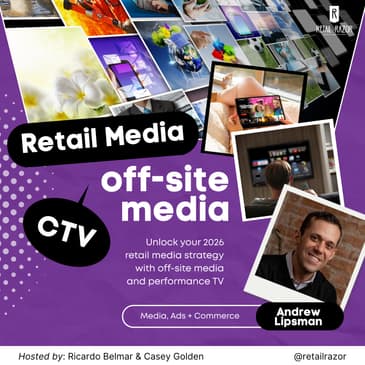



S6E4 The rise of performance TV & off-site retail media - what it means for retailers and brands.
Retail media is evolving fast, and if you're still stuck in 2022, you're already behind. In this episode of The Retail Razor Show, hosts Ricardo Belmar and Casey Golden sit down with retail media expert Andrew Lipsman. They explore how Retail Media Networks (RMNs) are expanding into Connected TV (CTV) and off-site retail media to drive growth in 2026 and beyond.
From Amazon and Walmart’s bold moves into performance TV to the rise of off-site retail media as a full-funnel strategy, this episode is packed with insights for retailers and brands navigating the next wave of retail media strategy. Andrew breaks down the challenges of measurement, the myth of ROAS, and why CMOs and agencies need to rethink their approach to retail media.
What You’ll Learn in This Episode:
Why connected TV is the next frontier for retail media networks
How off-site retail media is growing 3x faster than on-site
The real story behind ROAS and why it’s often misleading
How Amazon and Walmart are dominating performance TV
What smaller RMNs can do to compete through partnerships
Why CMOs and agencies must evolve their retail media strategy
How to build a full-funnel retail media approach that works
Whether you're building a retail media network or buying ad space for your next brand campaign, this episode is packed with the sharp insights you need to stay ahead.
Subscribe & Follow
If you enjoyed this episode, please give us a 5‑star rating and review on Apple Podcasts, Spotify, or Goodpods. Subscribe on YouTube so you never miss an episode. Check out the other shows in the Retail Razor Podcast Network: Retail Transformers, Blade to Greatness, and Data Blades.
Subscribe to the Retail Razor Podcast Network: https://retailrazor.com/
Subscribe to our Newsletter: https://retailrazor.substack.com
Subscribe to our YouTube channel: https://go.retailrazor.com/utube
About our Guest
Andrew Lipsman. https://www.linkedin.com/in/andrew-lipsman-10b2162/
Analyst, Consultant, and Founder - Media, Ads + Commerce.
Andrew Lipsman is an independent analyst and principal consultant at Media, Ads + Commerce. His industry coverage specializes in retail media and other areas of the digital media, advertising, and commerce ecosystem. He is known for anointing retail media as “digital advertising’s third big wave.” He has published articles in the Journal of Advertising Research and is frequently quoted in The New York Times, The Wall Street Journal, The Economist, The Financial Times, and Advertising Age.
Media, Ads + Commerce. https://mediaadsandcommerce.substack.com
Media, Ads + Commerce is a consultancy providing strategy and insights for companies in retail media and the broader media, advertising, and commerce ecosystem.
Chapters
00:00 Teaser Open
00:51 Show Intro
04:19 Welcome Back Andrew Lipsman!
06:12 How Retail Media Evolved
07:56 Closed Loop And ROAS Limits
10:57 Retail Media Connective Tissue
15:24 CTV Goes Performance
21:19 Partnership Paths To CTV
24:53 Trade Desk And Agency Gap
27:32 Offsite Media Growth Drivers
29:27 Onsite Relevance First
30:40 Connected TV Landscape
31:46 Inventory Quality and Fraud
33:02 Target and Nordstrom Playbook
35:34 Full Funnel Measurement
36:33 CMO Perception Gap
38:09 Brands and Merchant Alignment
41:49 CTV Attribution Reality
44:06 Rethinking ROAS Metrics
46:17 Last Touch Misleads
47:59 Inefficiency as Opportunity
50:15 Talent and Org Alignment
53:21 2026 Priorities and Mindset
57:13 Where to Follow Andrew
58:00 Show Close
Meet your hosts
Helping you cut through the clutter in retail & retail tech:
Ricardo Belmar is an NRF Top Retail Voice for 2025 and a RETHINK Retail Top Retail Expert from 2021 – 2026. Thinkers 360 has named him a Top 10 Thought Leader in Retail, a Top 25 Thought Leader in AGI and Careers, a Top 50 Thought Leader in Agentic AIand Management, and a Top 100 Thought Leader in Digital Transformation and Transformation. Thinkers 360 also named him a Top Digital Voice for 2024 and 2025. He is an advisory council member at George Mason University’s Center for Retail Transformationand the Retail Cloud Alliance. He was most recently the partner marketing leader for retail & consumer goods in the Americas at Microsoft.
Casey Golden, is the North America Leader for Retail & Consumer Goods at CI&T, and CEO of Luxlock. She is a RETHINK Retail Top Retail Expert from 2023 - 2026, and Retail Cloud Alliance advisory council member. After a career on the fashion and supply chain technology side of the business, Casey is obsessed with the customer relationship between the brand and the consumer and is slaying franken-stacks and building retail tech!
Music
Includes music provided by imunobeats.com, featuring Overclocked, and E-Motive from the album Beat Hype, written by Heston Mimms, published by Imuno.
Transcript
S6E4 CTV and Off-Site Retail Media - Andrew Lipsman
[00:00:00] Teaser Open
[00:00:00]
[00:00:01] Casey Golden: Retail media is having a glow up moment, but are you still stuck in 2022?
[00:00:08] Ricardo Belmar: Connected TV is crashing the party. Offsite media is running wild and stealing the spotlight. And if you're still measuring success by last touch ROAS, ugh, we definitely need to talk. That's like giving the waiter who brings your meal credit for cooking.
[00:00:22] Casey Golden: And when you weren't looking, Amazon and Walmart rewrote the playbook. They're playing chess while everyone else is still learning checkers. So where does that leave all the brands?
[00:00:35] Ricardo Belmar: We're breaking it all down with retail media's sharpest mind, Andrew Lipsman. No fluff. Just real talk on what's working, what's broken, and how not to get left behind. If you wanna know how to win in the new era of retail media, stick around. You won't want to miss this.
[00:00:51]
[00:00:51] Show Intro
[00:01:02] Ricardo Belmar: Welcome back to another episode in Season Six of the Retail Razor Show. Recently ranked the Number One Management Podcast of the Week and the Number One Marketing Indie Podcast of the Week and Month on the Goodpods top podcast charts.
[00:01:16] I'm Ricardo Belmar.
[00:01:17] Casey Golden: And I am Casey Golden.
[00:01:19] Welcome back Retail Razor fans to retail's favorite podcast where we cut through the clutter to bring you sharp insights on what's happening in retail today and tomorrow and where we get real about what's driving the future of commerce.
[00:01:33] Today we're diving into one of the hottest and maybe most misunderstood topics in retail media right now, connected TV and offsite media.
[00:01:44] And yes, this once again means it's my job to hold Ricardo back from making this a four hour podcast.
[00:01:51] Ricardo Belmar: Is so right on both counts, Casey. I think one of these days we're gonna surprise everyone with like a live stream, the four hours long, just on, on [00:02:00] retail media to make me happy.
[00:02:01] yeah, right, exactly.
[00:02:07] Well, listeners obviously know this is one of my favorite retail topics.
[00:02:10] So the retail media game is totally changing now, and we saw this in our season opening episode on the state of retail media in 2026.
[00:02:19] The easy growth phase? Yeah, it's officially over and now the big players are looking for new ways to scale. So enter connected TV and offsite media.
[00:02:27] Casey Golden: But here's the thing. CTV and offsite aren't just shiny new toys. They're essentially tools for retailers and brands looking to reach customers beyond their own website or app while still leveraging their first party data. So the big question is, are RMNs ready to play in the big leagues of national media to capture those big media brand dollars?
[00:02:53] Ricardo Belmar: Yeah, that is the question for today. And to help us unpack all of this, we are thrilled to welcome back a [00:03:00] returning guest and probably one of the most respected voices in retail media, Andrew Lipman, independent analyst, consultant, founder of Media Ads and Commerce. He's the leading analyst in media advertising and commerce, and he's been tracking the evolution of retail media since, well, honestly, since before most anybody even knew to call it retail media.
[00:03:17] Casey Golden: So whether you're a retailer trying to build and expand your RMN. Or a brand wondering where to place your next ad dollars or just trying to make sense of all the buzz around performance TV and offsite media. This episode is for you.
[00:03:33] But before we jump in, a couple things. First, quick favor. If you're enjoying season six, and I hope you are, if you've come back to this episode, I feel like that means you're loving it. So why not give us a five star rating and review on Apple Podcasts, Spotify, or Good pods. And don't forget to like and subscribe on our YouTube channel so you never miss an episode. We'd also love it if [00:04:00] you check out our other shows in the Retail Razor Podcast Network. If you haven't already subscribed, we've got Retail Transformers, Blade to Greatness and Data Blades.
[00:04:09] Ricardo Belmar: All right. With that out of the way, let's get into it. Here's our deep dive into connected TV and offsite media in the world of retail media networks with Andrew Lipsman.
[00:04:19] Welcome Back Andrew Lipsman!
[00:04:25] Casey Golden: Welcome back to the Retail Razor Show, Andrew. It's always a treat to have you on the show. We'll be talking about Ricardo's favorite topic this afternoon, retail media.
[00:04:35] Andrew Lipsman: Thank you for having me. Great to be back.
[00:04:38] Ricardo Belmar: Yeah, I think last time you were on the show, Andrew, let's see, we talked about in-store media I think is, at the time the next evolution in retail media. And of course one of the, the big challenges there that we covered was measurements, right? And how do you measure that, the effectiveness of that in-store. And we talked about, you know, what technology was involved in making that happen. I think that was back in, wow, that was back in season four, [00:05:00] episode five, I think it was late 2024. So a lot's happened in retail media since then I think, so to a lot talk
[00:05:06] Andrew Lipsman: Just a bit.
[00:05:07] Ricardo Belmar: Yeah. So a couple new areas that I think are really coming into focus for, for retail media uh, connected TV and offsite media. You know, I think That's what we're gonna focus on today. And, and of course we, we've been chatting off right, that there are uh, I guess let's say some people out in the industry sounding a lot of alarm bells for retail media because of agentic AI and, and how agentic commerce is gonna upend everything, but we're gonna save that discussion for another day. 'cause it, it's always developing and lots of super interesting things coming out in the news every day it seems on that. So we'll see how works out.
[00:05:40] But fact, we're, as we're recording this in March, you have a session coming up at Shop Talk later this month where you're gonna be head to head with some other industry experts to challenge that whole notion of what that impact of agentic commerce will be. So by the time this episode releases, you'll have already had that session. So we're gonna look forward to having you back on the show and tell us how it went with and give us your [00:06:00] hot take on it.
[00:06:00] Andrew Lipsman: Yes, hope, hopefully Sarah Marzano and I will be doing a victory lap, we've, we've got competition.
[00:06:06] Ricardo Belmar: That's right. Yeah.
[00:06:07] Casey Golden: So let's get into connected TV, or CTV for short, and offsite media.
[00:06:12] How Retail Media Evolved
[00:06:16] Casey Golden: For some in our audience, it might be helpful to start with a bit of history lesson in retail media on how we got here and why it took so long.
[00:06:22] Ricardo Belmar: Yeah, Yeah, I mean, I, I remember like just, a decade ago, which normally, doesn't seem like a long time, but I guess in tech years that's like forever, retail media was barely a thing. And I even remember back in the 2010s pitching in-store digital signage technology to retailers.
[00:06:36] And it was a tough sell in those days, to be honest. Of course we were usually talking to CIOs and not CMOs, and it was more of a tech sale than it was a media play. So maybe was, what led to that challenge. But if you fast forward to today, it seems like every major retailer has a full-fledged retail media network now. In-store screens are become a hot commodity. Cap CapEx cost for screens is obviously much better than it was in the 2010s, and we talked about that, like I said, last time you were here. So tell us, you know, walk us through Andrew, what's changed over the years to really [00:07:00]transform those old clunky early digital signage days into today's sophisticated RMNs that really, go across stores, websites, and now even our TVs at home are, are part of the play.
[00:07:11] So what, what makes retail media this new superstar.
[00:07:14] Andrew Lipsman: Yeah. Well, so first off I'll rewind the tape a little bit. When it first started to come into my cross hairs was 2018. At eMarketer it was just the realization that Amazon already had almost a $10 billion business. So. It wasn't a non-existent thing, it was just flying under the radar. And then when I looked around, you know, Walmart had their version, Target had their version Kroger, so every, all the major players were already bubbling up things.
[00:07:39] But they had to find their way. So it's not like these things got off the ground really quickly. But you know, the, then. 2020 came, the pandemic. All these dollars flooded online for e-commerce. And I think the way that most people, most marketers started to encounter retail media was as this e-commerce channel.
[00:07:55] Ricardo Belmar: Mm-hmm.
[00:07:56] Closed Loop And ROAS Limits
[00:07:56] Andrew Lipsman: And since then, I would say it's largely been pigeonholed as an e-commerce [00:08:00] channel, but the real evolution that's happening is that it's both a channel and a layer. And the layer that it is, is if you think about when you strip everything else away from retail media, the foundations of it are: better targeting, right? I can target or put ads in front of the right people based on their purchase behavior and not just their random online behaviors, so better targeting data and then closed loop attribution. And that closed loop attribution, ROAS, like these are the single biggest levers that drive ad budgets.
[00:08:31] So those foundations are there for retail media across all the channels. And it's just now, or in recent years that we've started to see that closed loop apparatus start to underpin all of these upper funnel channels, whether that's offsite media. You know ,that, that's open web, programmatic or social.
[00:08:50] And then CTV and, and then now we're, we're getting into the in-store digital era as well. But there's, there's kind of, there's a lot of common threads through all of those.
[00:08:59] Ricardo Belmar: Yeah. I think [00:09:00] for me the closed loop attribution has to be one of the big, big reasons, why we see so many dollars flowing that way versus what the traditional channels we used to see.
[00:09:08] Andrew Lipsman: Yeah, it's, I mean, sometimes it is that simple like decisions get made in spreadsheets, right? It doesn't matter if, if whatever's being quantified is like that great of a representation. We know that ROAS is a very flawed metric. Nobody really believes that if they put a dollar in, they're getting $4 or $6 outta that investment.
[00:09:27] And, and yet we use it. It's a blunt instrument. And so, one of the kind of ironies of when I first started to do some thought leadership around retail media, it was this illustration of calling it the third wave after search and social. And the premise of the thesis behind it was that closed loop measurement is what drives dollars online in a big way. So Google and search did it first. Then you had social start to become a bigger thing, but it wasn't till it really became a performance medium around 2015 that that business rocketed [00:10:00] up. And then, you know, the closed loop in, in retail media is, is pretty obvious.
[00:10:05] But, I guess early on it seemed like the third wave was, was a way of hyping the opportunity. And to some extent it is. But the other side of it, the other side of the coin was, it was also kind of like a, a critique of how the digital ad industry works, which is that dollars follow this measurement, and if the measurement was gonna be there in retail media, it just seemed very evident that the dollars were gonna chase it.
[00:10:29] And so just like any other medium. I believe in the substance of retail media. I think when it's executed well, it's really, really performant. But a lot of dollars do chase lower quality parts of, of retail media. So you know, there's still a lot of retargeting or chasing branded search, which not saying those shouldn't be part of the, the toolkit but that's also the sort of the exact sort of activations that look good from a ROAS perspective but aren't really driving incremental sales.
[00:10:56] Ricardo Belmar: Yeah.
[00:10:57] Retail Media Connective Tissue
[00:10:57] Casey Golden: I've heard you say that retail [00:11:00] media is becoming the connective tissue of the entire advertising marketplace. Powering from online display ads to social media, CTV by leveraging that first party data what we all want. Right. For our listeners, can you put that into a little bit more perspective?
[00:11:18] Like just how big a deal is retail media revolution in the grand scheme of things.
[00:11:23] Andrew Lipsman: Yeah so this is getting back to that premise of the, the closed loop apparatus, right? And, and so again, the foundation of better data, right? Targeting the right audiences is always gonna be super important. And we're getting better and better audience targeting than, than we've ever had before. But again, that, those audiences can be activated across several other major pools of ad spend, right?
[00:11:47] The biggest ones, display advertising or social. So it really kind of touches everything. Tv, right? TV's becoming CTV, and CTV is becoming performance tv. So basically every pool [00:12:00] of digital ad spend today is going or moving in the direction of that retailer data.
[00:12:05] Doesn't mean that first party purchase data is always the best data source, but I would say like eight or nine times outta 10, it probably is.
[00:12:13] So that, that is the revolution that's, that's happening. And then again, you know, the measurement piece is so important and you have all of that retail data to show the extent to which it's working, even if it's not a complete picture of, of the impact. You do get that validation that , you can actually link ad exposure to sales.
[00:12:32] Ricardo Belmar: One of the things I always find interesting with, with this too, is when you look back at, before we had these retail media networks and these retail media solutions where the dollars did go and, I mean, what was the alternative, that is being displaced by retail media. It, I, I guess this really became important because there was this realization, and maybe Amazon is the one who surfaced this, right?
[00:12:53] That this first party data existed? That you had access to this data and if you knew how to use it, you could actually build [00:13:00] layers on top of it and then offer that to brands as a targeting tool, which didn't exist before with that, I'll use the word accuracy, in a sense, because you have a new lever you could use to really reach the people you wanted to reach for your product.
[00:13:11] Where before it was, it seems like most of the other sources you had were just more hope than anything else.
[00:13:17] Andrew Lipsman: Yeah, it, it, it's weird that it, it kind of took the industry so long to crystallize the realization of how valuable the data is. I, I can remember going back to working with some CPG brands in digital ad measurement. This was probably about 2010 May, 2010, 2011, and, and back then we were starting to talk about purchase based targeting.
[00:13:40] Right, that it started to become a thing then. And I was like, at the time I was like, oh yeah, that's really a good way to target users if you can actually connect the brand buyers, category buyers to, to different ad units. That's super powerful. So it was already bubbling up. We just didn't really grab the reins on it until, probably a decade later
[00:13:59] Ricardo Belmar: [00:14:00] Yeah. Yeah. And, and like I was alluding to before, when, when I remember marketing digital signage solutions to retail, in that same era, we would talk about, as part of the pitch, oh, you can work with your brand partners and, and use these screens for in-store advertising, and that could be a revenue source for you to do that.
[00:14:17] But the piece that everybody lacked, was how are they connecting that to the customer data they had to really give the brand a tool to measure it. So see, I, I think it's, it's fascinating that it took this long to get to where we are with that.
[00:14:28] Andrew Lipsman: Yeah, and, and measurement's always a progression. Right. I think there are ways right now, maybe not to tie every single ad impression, one-to-one, to a purchase, but you still can get that person level attribution that's needed, at least from a measurement standpoint to know that something's working.
[00:14:44] But actually, when we last jumped on I, I was on with James Bauer from Venvee, which is a company that, that's actually kind of solving that that problem of being able to close the loop from individual exposure in a privacy compliant way, but basically being able to tie the fact that somebody.[00:15:00]
[00:15:00] Is in front of a screen and then goes and eventually purchases the brand. You get that nice tight, closed loop. And again, that's what the dollars, that's what's gonna help drive the dollars into in store, which right now is still a rounding error in digital ad spec. But you know, I have every reason to believe this, this will be tens of billions of dollars in the coming years. As a question of how long does it take that that market
[00:15:22] Ricardo Belmar: Yeah. to get to Right. right.
[00:15:24] CTV Goes Performance
[00:15:27] Ricardo Belmar: Well, so it seems like connected TV, CTV is, this new shiny toy in the retail media toolbox. You've noted how this expansion is, could be a mega story for, for this year. We've seen Amazon kind extend their ad business from Amazon Prime video into partnerships with like Netflix, Hulu, I think NBCUniversal too. Giving them access to a, a huge number of streaming TV viewers as part of their ad network.
[00:15:49] I think obviously Walmart, another one making headlines, by acquiring Vizio. So they gained an entire surface area that way to supercharge their own [00:16:00] connected TV reach. So why, why do we see Amazon and Walmart betting so big on reaching us through our TV screens? For their ad network. What do they have, like an inherent advantage, you think, in, in turning television to that performance media channel? And how do you think that might change what TV advertising looks like for brands in general?
[00:16:17] Andrew Lipsman: Yeah, I mean, I think both companies are almost perfectly well suited for this opportunity. And it's because they have such a big footprint of data to have very advanced targeting and then also be able to close the loop on the backend. Why hasn't this become a thing sooner?
[00:16:35] Because these types of partnerships take time, usually I would say in a major retail media and media partnership. You know, year one is you just make the, the announcement, it can. Year two is like connecting the pipes and then year by year three it's maybe finally operational. And most of those efforts with, unless you have commercial alignment between both sides, those things, a lot of them die in the vine.
[00:16:59] [00:17:00] Now if you're Amazon and Walmart, you can, you have the resources to accelerate that. So I would say for both of them. Last year was the year of operationalizing and making announcements. This is the year 2026 where it becomes real.
[00:17:14] Ricardo Belmar: Hmm.
[00:17:15] Andrew Lipsman: And the dollars start to flow. It doesn't mean those dollars like flow immediately, but you're gonna start to see it ramp.
[00:17:21] You're gonna see there's enough interest from the CMO and from brands broadly, that they're gonna be testing into it with the idea probably of starting to scale things more significantly in 27. What's so powerful? First off, these are TV ads, right? We all know the value of a TV ad. It can, it can be incredibly impactful but it's always been known as the least measurable medium.
[00:17:42] And now it's not, right. You can get narrower with your targeting and you can see the effectiveness in sales based on that. Now, my concern is that as we often do, we get performance myopia once we have this sort of measurement. And so very quickly we can start [00:18:00] to impose ROAS and other performance measurement on this medium that's always been known for brand building.
[00:18:07] Well, guess what? The brand building doesn't go away. This, this is still super important. We can also start trying to target too narrowly just to reach those audiences that, have the highest propensity to convert. And so I actually worry that. If, if we're not careful as marketers, that, that it can actually disrupt much of the value of the medium.
[00:18:26] So we need to be able to walk and chew gum at the same time as performance TV emerges. And, and that means we have to keep doing all of the measurement. We've always done media plan across broader audiences in addition to some of those really high value, narrower segments. Understand campaign delivery against those audiences.
[00:18:45] And then also understand as best you can the sales effectiveness. But you gotta be able to account for that branding effectiveness too. Because if you're just looking at the sales effectiveness on what is usually gonna be pretty high CPM media, [00:19:00] I promise you it will not pencil
[00:19:02] out
[00:19:02] Ricardo Belmar: Yeah.
[00:19:03] Andrew Lipsman: higher cost media makes ROAS look like crap.
[00:19:07] And so happening early on? Is, well, oh, we have to make ROAS work. Well, how do you make ROAS work? You basically start doing a bunch of retargeting. You just retarget audiences to put the, the ad in front of those ones who are already further down the funnel. That's the only way to make ROAS pencil out.
[00:19:27] But guess what? You're, you're probably not getting incrementality most of the time. So, I want the industry to be okay with ROAS looking bad. Think of ways to incorporate branding into whatever your performance metric is. Focus more on incrementality, but also be okay with the fact that the primary goal still should be that longer term brand building the performance is, is a secondary effect.
[00:19:51] And that if, if you, if you just, again, get that myopia on just the performance effect you're gonna, you're gonna steer away from the medium even though it actually [00:20:00] gives you more opportunity than you've ever had in TV
[00:20:02] Ricardo Belmar: Yeah.
[00:20:03] Casey Golden: I think it's interesting too, like brand building. There's obviously the traditional like awareness of a brand and a product. Some of my favorite brand building where I've learned about a product and actually have been like, huh, I'm, thank you. Is when they don't have the commercial and they just take the blank space and say this, you know, moment of silence is brought to you by
[00:20:32] Ricardo Belmar: Yeah.
[00:20:33] Casey Golden: which I find like, it's like the, an the anti commercial commercial. But I can't say that I've ever looked at that and been annoyed because I'm like, oh, thanks.
[00:20:43] Andrew Lipsman: Yeah, well, it's kind of like a flex, right? And this is what good brand building does, is that you don't always have to tell somebody how good you are, right? That it's like sometimes you just show how good you are
[00:20:54] Ricardo Belmar: Yeah. and, let people realize, yeah,
[00:20:56] Andrew Lipsman: where. it's like, oh, well what does this brand have going for them? That they can do [00:21:00] that? It's a signal, and then it drives that interest. You actually create a gravitational
[00:21:03] Casey Golden: Yeah. And I think there's a lot more that we can, that can be done on tv, whether or not it's engaging, whether it's entertaining, whether it's brand building, whether it's a moment of silence to like not annoy you. But I do think it's very it's a great, it's an interesting channel, right.
[00:21:19] Partnership Paths To CTV
[00:21:19] Casey Golden: And it seems like Amazon and Walmart have a head start. Obviously Amazon has Prime streaming. Walmart went and bought a TV manufacturer. But if you don't have, if you're not a retailer and you have a built-in streaming service or a TV platform, like you still have to compete, you still have to enter. And there's nothing worse than a newer brand or a smaller brand than a behemoth as Walmart, and Amazon, the two largest retailers. We're gonna get used to it looking like, our ROAS looking, you know, terrible. How long is terrible gonna look? So that these other brands entering don't leave [00:22:00] right away.
[00:22:00] How do you see other retail media networks finding, creating ways to get into connected tv, maybe through partnerships and be able to compete and carve out a space for them and still be able to say, Hey, ROAS sucks, but it sucks for them too, but we're gonna keep doing this and we're gonna. Find new ways to measure or collaborate. I think Best Buy is working with CNET Instacart, with New York Times cooking. What do you think about these like partnership models and maybe third party integrations?
[00:22:38] Andrew Lipsman: Yeah, well, so on on the TV piece first, I think it's critical that the RMNs start to act like a media company first. And, and that's why if you have to choose between performance and traditional media measurement, I'd say go traditional media measurement. Stop trying to impose ROAS measurement on, on these types of [00:23:00] activations because you are gonna steer brands away.
[00:23:02] And by the way, the brands who are gonna be making these buys, it's gonna be their, national media teams. It's gonna be CMO who's paying attention to this, and so they speak this other language speak that to them and then help them also learn the language of performance in this medium and, and be, very deliberate and, and calculated in terms of how you roll that out.
[00:23:23] Amazon, Walmart, right? Very unique in a number of ways. Obviously the scale, the targeting and the measurement data, but also they have owned and operated inventory. That's something that maybe no other retailers or very few will be able to do. And so the path for them to, to play in this space is through partnership.
[00:23:44] And we've seen a lot of partnerships. Roku has pretty much gone down the line and partnered with every leading specialty retailer, Instacart, Best Buy, dozens of others. And NBCU and a lot of them have gone through partnering with, with a lot of the key retail media networks.
[00:23:59] Now [00:24:00] the, the key there is if Best Buy is a really important RMN for you as a consumer electronics retailer, right, it's worth going through the front door for your buys from Best Buy, but then you also wanna activate across as many relevant platforms as you can. So a partnership with CNET is really useful to get in front of those technology enthusiasts or maybe people who are lower in the funnel on a consumer electronics buy and you also wanna reach them through their TVs. So that's the key. And the way that it works and the way that all these other RMNs basically can carve out their own slice of the CTV market is by virtue of that, it's really the integrated buy, and that that full value proposition. If it's just about doing a performance TV buy right, a Amazon, Walmart are, are probably gonna be tough to compete with on just that dimension.
[00:24:52] Ricardo Belmar: Yeah.
[00:24:53] Trade Desk And Agency Gap
[00:24:54] Ricardo Belmar: Where, where do you see players like Trade Desk fitting into all this? And, and then from the RMNs [00:25:00] perspective, like how, how do you see them engaging with the agencies that represent all of these big brands? Who are the ones guiding their buys, right?
[00:25:08] Andrew Lipsman: Yeah, so two good questions. So first off, Trade Desk ,right they're, most of the large RMNs are plugged into The Trade Desk and that gets you access to, the biggest swath of open web display and video inventory. And also a huge chunk of CTV inventory. So they're a huge, huge player in CTV in aggregating the market.
[00:25:29] The bigger unknown there is, there's a lot of lower quality inventory in, in CTV today. So I think buyer beware and make sure. Trade Desk tends to be really good about at least with respect to other DSPs in, in terms of keeping higher quality inventory. But you still need to be careful when you're, doing that more aggregated buy.
[00:25:50] Sorry, the, the second question on that was.
[00:25:52] Ricardo Belmar: Yeah, how are rms playing nicely with agencies?
[00:25:55] Andrew Lipsman: Oh, agency. So this is so interesting to me. I, I, I can't believe that [00:26:00] agencies frankly seem to be asleep at the wheel on retail media. It's, it's, it's, it's mind boggling to me. Now they've, a lot of them have, have amassed assets in the space. They've made acquisitions, they've got technology. So I'm not saying that they're not doing anything.
[00:26:16] But what you don't really see yet is heavy engagement from the media agencies. Right. And those are the ones who are working at the behest of the CMO and national media teams. And that's what's missing right now. And, you know, I'll, I'll give them a little bit of an excuse and say, well, if the CMO isn't pushing them on this, then they're probably not gonna do that.
[00:26:36] So I, I actually kind of look at the CMO is having the most responsibility to, to start making this shift, but we're at a moment where the media agencies and the CMOs can't ignore retail media as it's getting activated today. Performance TV is the one that they really can't ignore. They also care a lot about social, and social is evolving with, with the use of this data.[00:27:00]
[00:27:00] And then, you know, I would argue in-store media, it's very easy to put it into the shopper marketing bucket and think of it just as that sales channel. No, it's a media channel. It's a really effective media channel. It has a lot of the same value that that television does in terms of high quality inventory, scarcity, scale, all the things that big brands should want.
[00:27:19] So guess what? CMO you're not doing your job if you're not paying attention to these, these media anymore, and media agencies. You need to play a leadership role on this as well, even if the CMO isn't quite there yet.
[00:27:31] Ricardo Belmar: Yeah.
[00:27:32] Offsite Media Growth Drivers
[00:27:32] Casey Golden: Yeah, striking stat for the first time, last year, retailers spent more offsite retail media ads than on their own sites. Offsite retail, including like ads on social media, search engines and, and other websites using the retailer's data is growing three times the rate of onsite media. I saw that like one forecast showed offsite media spend to [00:28:00] be 42% in 2025 versus 15% for onsite. I think that was what e e-marketer data,
[00:28:07] Andrew Lipsman: Yep.
[00:28:08] Casey Golden: if offsite marketing or retail media is projected to like nearly double from like 13 billion to 25 billion by 2028. What's driving this, this explosive growth offsite? Is it mainly just retailers having maxed out the ad inventory on their own sites? Or making external channels like the next frontier?
[00:28:31] Andrew Lipsman: Yeah, so let me start with the idea of maxing out inventory on their own sites. This is talked about all the time, and it is largely not true. I'll say that with some exception.
[00:28:44] Retailers are always very concerned about that, but it's usually because it's so hard to fight the merch teams for additional slots of, of sponsored product space.
[00:28:55] The, the problem for a lot of them is that they're way under monetized. They're not using [00:29:00] enough inventory available. And part of the, the inhibitor there is if you're not doing high quality executions on site, if you're not, adhering to really high search ad relevant standards, then it can detract from cx.
[00:29:17] But there's a reason why Amazon and Walmart can load up the page with ads and consumers don't really seem to care. It's because the search ad relevance is high.
[00:29:27] Onsite Relevance First
[00:29:38] Andrew Lipsman: So that's the key thing I would say is like every retailer needs to figure out how they have the best possible search, advertising relevance, and if you check that box, then you can start to roll out more ads.
[00:29:39] And frankly they should do some more higher quality ad units like video. A lot of them are very behind on video above the fold. Like that's super valuable. So there's a lot of runway for, for most RMNs. Amazon and Walmart, those are the ones that are maybe getting closer to saturation.
[00:29:54] And so they have to move offsite. Amazon has seen this for years and they have been moving offsite, so that's driving the [00:30:00] market. But in other parts of retail, specialty retailers have always been heavily offsite because their advertisers are big brand advertisers, lifestyle categories, and they really value that offsite activation.
[00:30:13] So if you go down the list, most of those specialty retailers are already doing at least 40 and oftentimes 50, 60% of their revenue is coming from offsite. So that tells you two things. One, the offsite is, is more mature than you might think. And there's still, the vast open space of the open web and, and social to do more of it.
[00:30:34] But also it reflects the fact that they're probably under monetized with their onsite experience.
[00:30:38] Casey Golden: Okay.
[00:30:39] Ricardo Belmar: Yeah.
[00:30:40] Connected TV Landscape
[00:30:45] Ricardo Belmar: So what, you know, one question I think about there too, especially around connected tv. So there's so many different ways to, to go there in my mind. So you've got all the streaming services, and they're all getting into advertising. Streaming came out when it was the anti advertising, but they all hit that ceiling in subscriber growth. So they needed to get advertising brought in so they could lower some [00:31:00] subscription levels to get more, more subscribers. And I guess, RMNs have the option, they could work out partnerships directly with those streaming guys. They can go through third parties that already have the connect connectivity to those networks.
[00:31:11] And then you brought up the point earlier about sometimes you have to watch the quality of what's available But, but then you have all the FAST networks that are just, I see them doing really well from what I read in the, in the news reports. They're these free services, there's Tubi, Pluto, there, there's more and more of them.
[00:31:27] And most of them are owned by another studio or another media company. That has their free version that they can put content through. I think Paramount runs Pluto, for example, and they have their own ad units, right? So are RMNs hitting on across all of these?
[00:31:41] Is there, do you see like a strategic pattern, is one more valuable than the other for them to get connected to?
[00:31:46] Inventory Quality and Fraud
[00:31:46] Andrew Lipsman: No, I mean, I think in, in TV world content and networks that are of a certain quality or prestige have more value, and that's where the highest quality inventory, where the high CPMs are. And so a [00:32:00] lot of the partnerships are happening there, right, with the NBCUs of the world. Credit to Roku, who they get, a slice of everyone's content, but, but also they have their owned and operated channels as well.
[00:32:12] So it's kind of a, a mix of inventory quality. They had the smartest execution strategy. In terms of partnering, they did it early and they've really gone and, and covered all the ground. And then you have these, the FAST networks, which I will say they run the gamut. There's a few of them that were surprise hits in terms of like getting content, acquiring content that consumers wanted to go back into the back catalog and watch. So some of them are, are driving some real value. Like you, you and I grew up, you know, watching the, the reruns like this generation doesn't really have that in the same way. And it's almost like that's the need that it's, it's fulfilling.
[00:32:49] But there's also a lot of junk when you get into that tail fast networks that's also where it's like you need to really be sure about the inventory quality. 'cause that's also where a lot of the ad fraud lives, [00:33:00] unfortunately.
[00:33:00] Ricardo Belmar: yeah. yeah.
[00:33:02] Target and Nordstrom Playbook
[00:33:02] Ricardo Belmar: So so let's dig into to how retailers are, are activating on these offsite channel. I wanna talk a little bit of like Target's, media, arm, Roundel because they, they just had recently, at the time of recordings, they recently had their Q4 financial reporting done, and it seemed like Roundel was probably one of the few bright spots in what Target had to talk about. But I think that they have in the past said that, 30% of their, their retail media investment is now going to offsite, compared to what I've seen, an industry average of maybe 21 percent. They have partnerships with Pinterest, with Google and Meta, so they're, they're hitting social feeds, they're hitting search results , as well as, streaming tV shows. So I think they referred to it as frictionless commerce experiences off of Target's owned properties. And then another example I've seen Nordstrom talked about, where they recently merged retail and e-commerce media teams in area to kind of present a unified offering across their website and stores and external media.
[00:33:52] But another one where they're really focused on, on offsite. So are these, do you see these as good, strong examples of that blending of onsite [00:34:00] and offsite media to improve the overall experience, both customer experience, but also the advertiser results? And are there things like that, I use those two examples and maybe you have others that are, are there things that other retailers that haven't gotten into that yet should be learning from this and how they go and expand into offsite?
[00:34:15] Andrew Lipsman: I think those are both good examples and for, for slightly different reasons. So Target one of the things, so first of all, a partnership like Target and Pinterest there's just a real brand synergy there that works. I'm a huge fan of, of Pinterest. I think it's probably the most undervalued media company out there.
[00:34:33] It, it's, so it works really well with, with a retail media network like Target. But one of the things that Target, I think, has done smartly is they've gone for a very curated partnership experience with, with publishers. And so even when it's not a platform like a Pinterest, they've got partnerships I think with like Hearst and New York Times where they're going for premium quality media and, and not just the vast open web. So I [00:35:00] think that works and I think that plays well for, for their advertisers.
[00:35:03] Nordstrom, so actually Nordstrom I interviewed at NRF, I wanna say now, three years ago. And on stage there, they admitted, Aaron, Aaron Dunford that I think he said ,60% of of their revenue at the time was offsite.
[00:35:17] Ricardo Belmar: Hmm.
[00:35:18] Andrew Lipsman: So this is very, very typical, very typical of lifestyle categories that, you know, what you, you would see with department stores, but also in, in, some of the other categories.
[00:35:29] And it makes sense to integrate it there when, when the offsite is such a big piece of it.
[00:35:34] Full Funnel Measurement
[00:35:47] Andrew Lipsman: And I guess where I'd like to see all of this continue evolving is to get better and better, not just in having integrated activations, but in understanding the effectiveness of the campaigns. Not through measurement silos, but through an integrated measurement.
[00:35:52] And the reason being that I've done a lot of research over the years, and it almost always seems to be true. When you activate a campaign at the [00:36:00] upper funnel and lower funnel simultaneously, the upper funnel media helps the bottom funnel work a lot harder. So you'll see things like conversion rates go up, you'll see a lot of performance KPIs work better.
[00:36:12] And so that's really the strongest case that can be made for doing more offsite. And until you have those things integrated, sometimes you don't see it. And I, I think ultimately that will help drive more investment into the upper funnel media once you realize, wow, this is really helping those, those conversions drop through the bottom of the funnel much more easily.
[00:36:33] CMO Perception Gap
[00:36:33] Casey Golden: Retail media was, has like historically lived at the bottom of the funnel with sponsored product ads for a quick sales boost, but with offsite and CTV in the mix. It seems like retail media is moving up the funnel to more premium brand territory. Are you seeing CMOs to start to treat retail media as a full funnel play rather than just a tactical performance level lever?
[00:36:59] Andrew Lipsman: I, [00:37:00] I would love if that were the case or if I had seen strong evidence. I, I have not seen that yet. I would, I would say what's more likely is that retail media buys are because they're moving up the funnel are, are maybe more in the purview of what the CMO and the brand marketers are thinking about.
[00:37:20] So it's entering their world. I still haven't been convinced that the, the requisite attention and kind of full throttle investment that probably should be happening is happening. And I have not seen CMOs vocally out there talking about this. So I don't know if it's that they're trying to keep their trade secrets or more likely they still have, like retail media has a reputation problem with CMOs. Like, I'll just blunt about it. I still see it as an e-commerce channel that, okay, I'm responsible for, for performance, but it's not what I care about. I'm a, I'm a branding person, I'm a creative, I care about TV and social. So I, I do think that [00:38:00] there's an opportunity here to give the branding around retail media a bit of a refresh so that it does get the attention it deserves from the CMO.
[00:38:08] Ricardo Belmar: Yeah.
[00:38:09] Brands and Merchant Alignment
[00:38:19] Ricardo Belmar: Well, I guess may maybe on that point, let's flip a little bit to that advertiser's perspective on, on all of this. So, how are brands kinda reacting to, to these offsite CTV offerings? And, you just mentioned how there's a little bit of a reputational issue for retail media networks being perceived as just that e-commerce performance play.
[00:38:26] But now with you add on these offsite and the CTV offerings, how are advertisers really perceiving that? I mean, are they. We've seen reports, you know, we had Skai on earlier in, in the season , with their 2026 state of retail media report and they focused a lot on the brand side of it. And we saw in there, 50% of the marketers that say they're planning to move ad dollars from areas like open web display into retail media powered DSPs. And they wanna take more advantage of the purchase data retailers have. The closed loop measurement. But you know, how do you weigh that with, what you were just saying about how the, this perception issue, I guess [00:39:00] I'll call it, of where retail media plays. And maybe the other part to that is I've seen Costco talk about their retail media offering is how they're really laser focused on the purpose of their retail media is really to drive sales. So they're almost like saying, forget the metrics, like ROAS, right?
[00:39:15] It's about if, if the retail media is not driving sales purchases in the store, then it hasn't accomplished anything. And what's the point of focusing on is almost kind of the message I hear them say, even if they're not using those words exactly. But how, how do you see that?
[00:39:30] Andrew Lipsman: So there, there's maybe two, two separate issues at play. On the, on the Costco piece, you know, part of how I heard that discussion was really about how you get media and merchandising alignment, which is, which is can always be a problem, right? It's part of why you don't get inventory open up if you're from the RMN team because it's potentially infringing on, on the merchant's turf.
[00:39:54] What I like about what Mark Williamson is saying at Costco is he's like, listen, this is all [00:40:00] about driving sales. So he's speaking the merchant's language and he's saying. That is first and foremost, which culturally, I love this because I think retail media networks should be doing more of this and they all part of that message should be and because we care about moving the needle on sales first, CX is paramount. We are not gonna do anything to infringe on, on the CX and getting in way of the customer journey. And really, we should be doing everything possible to elevate that. The beauty of this is that it actually creates alignment because the, the media merch teams have the same incentive at the, at the end of the day. They both wanna increase receipts, right? You get more investment from, as a media network if you're increasing sales. So you need to be mindful of that.
[00:40:41] As far as brands saying, and I think I know the, the question from the Skai report that you're talking about, and there's basically a shift in investment, growing investment across multiple types of video and retail media. Sponsored brand video, they're gonna invest more in that. [00:41:00] CTV. And so I, I think that's a really positive trend and I think it's where dollars should be going. In general, the proposition of retail media is strongest when you have the highest quality media possible and the most adjacent to purchase.
[00:41:13] So video is a big part of that. So I do think that, that the smart players and, and typically at. Maybe the, the middle and, and lower levels of, of the organization are the ones who are seeing that because they know that sponsored products are pretty saturated at this point. So the smarter strategy is to start to move up the funnel.
[00:41:32] Has it worked its way all the way up to the CMO? Not quite, but maybe they're, you know, listen, they, they pulled the strings on the budget at the end of the day. So if, if there is a sense that more investment is going in that direction, that, then at some level, they're probably sponsoring that shift.
[00:41:49] CTV Attribution Reality
[00:41:49] Casey Golden: So when it comes to measurement, I mean, I kinda left the retail side before retail media was like a big moment. It was, it's very easy to tie an [00:42:00] impression into a purchase and track conversion. How do RMN Ns measure the impact of an ad that runs on a streaming service? What's normal and what's really good. Just for our audience on like how this is being tracked. I'd just be curious on what level is that at, even at right now that's considered normal for conversion and measurement.
[00:42:24] Andrew Lipsman: So basic mechanics of it would be right, you identify a user, set of users, but let's just talk about one consumer for the sake of argument who's in a specified target that you're trying to reach. You deliver that ad to them. And then over the attribution window, 14 days, 28 days, whatever the case may be, and you see, did they buy that brand, the advertised brand through you, and then you can calculate the return on ad spend on that.
[00:42:51] The issue, well, part of it is one, like the closed loop is much tighter if you're on the site showing intent when you're searching [00:43:00] already. So it tends to, that that ROAS will naturally look better than if you just expose somebody to a brand and kind of hope that they convert downstream within that period of time.
[00:43:10] So already the ROAS isn't gonna weigh as much in your favor, and then you, you factor in the price of very premium media and the numbers look worse. So what's reality? A lot of times that ROAS number is gonna be sub one, right? Which tells you don't, don't keep investing there. Now. What, what what those who are are investing in the medium will quickly learn is, well, well, why don't we get those buyers who are already searching on the brand or searching in the category at least.
[00:43:40] And so then you start to get what is effectively retargeting on people who are at the bottom of the funnel. All of a sudden now you can start to push that ROAS number up over one. Which, which might encourage more investment. But again, that to me it's, it's kind of a way of gaming attribution to get more investment rather than [00:44:00] taking a more holistic view of the performance that a brand is actually driving.
[00:44:04] Casey Golden: Well, I mean, I think that that's great. Yeah.
[00:44:06] Rethinking ROAS Metrics
[00:44:09] Casey Golden: What is the average, like ROAS for retail media? Like what numbers are good. What numbers are bad? I feel like, a lot of times, I always suggest like when you're working with a media buyer or an agency, they have the purview of what's going on everywhere else.
[00:44:22] And when you're a brand and you can only see your own performance, you can't see everybody else's to make those decisions it's an advantage. So, I mean, if you would've told me like, Hey, if you're getting, you know, one. Pat yourself on the back, you, that would've shocked me. Kind of just did.
[00:44:42] Andrew Lipsman: Yeah. Which is, you know, part, part of the conception I have in my mind is that we need to build in almost like a, a brand ROAS that you can kind of place on top of the sales ROAS, because ignore it in, in your measurement, then [00:45:00] it's gonna totally undervalue, right? So I think a much more realistic thing is you, you activate something, you maybe get a one ROAS, but the branding impact is, is the equivalent of another one. And all of a sudden you get, you know, a, a two, $2 ROAS, which is something that you can invest behind a little bit more easily. The other thing is like, we should really be looking at incremental ROAS here. And the calculus is very different there.
[00:45:29] And I think the numbers on average, like an average ROAS in CPG for, for retail media can be a three or a four. For, for onsite, that's not the return you're really getting. Like a, a good return, incremental return, on something like that might be a dollar 50
[00:45:49] Ricardo Belmar: Mm-hmm.
[00:45:50] Andrew Lipsman: And that's a 50% true return on investment. Assuming that the calculation is sound. And that's what we should be aspiring to. But people kind of get scared off [00:46:00] by the fact that they're used to seeing these much gawdier.
[00:46:02] Ricardo Belmar: Mm-hmm.
[00:46:03] Andrew Lipsman: ROAS numbers in that, that incremental ROAS number looks so much lower, but it's real. I'd much have have a lower number that's real than a total faked
[00:46:11] Ricardo Belmar: that's not real. Yeah. Yeah.
[00:46:13] Casey Golden: Always chasing six x right?
[00:46:17] Last Touch Misleads
[00:46:17] Ricardo Belmar: Well, and and, and it's also like, I mean, I know I, I've seen you talk about, why, why are people looking at last touch ROAS, as a, as a metric, which, which I, I always kinda look at that one too and think, well, I mean, I can come up with so many analogies of why the last touch in anything is never representative of the actual process and the performance you went through. Um, So why would you focus on that?
[00:46:38] Andrew Lipsman: Yeah, it's just, it's harvesting most of the time. And yeah, I mean this is a big, big reason why, for example, sponsored brand and sponsored brand video units are undervalued is because a lot of times they actually introduce you to a brand for the first time when you're doing a category search and you may not even buy that time.
[00:46:57] But down the line, you may actually try that brand [00:47:00] because of the process that was started and they were able to find a qualified audience that it was worth getting the brand in front of. And people aren't as brand loyal as you think. They'll, they'll try new and interesting brands that, that meet their needs, but that value, that incremental value plays out over time.
[00:47:16] And so it's, it's, and it's not attributed to the last click almost ever. So what ends up happening is the clicks that you buy end up looking super expensive and the ROAS doesn't look good. Meanwhile, all the value that you're actually getting is incremental. So there's just a, a to, like ROAS will lead you not just in the imperfect direction, oftentimes in the exact wrong direction of where your investment should be.
[00:47:42] Ricardo Belmar: Yeah.
[00:47:43] Casey Golden: So glad I didn't listen to my high school counselor that suggested I go into marketing. I didn't end up pre-med either, but.
[00:47:59] Inefficiency as Opportunity
[00:47:59] Andrew Lipsman: The good [00:48:00] news in all this that nobody wants to hear, I'm sure, is that. All of this inefficiency across this, the system is opportunity. I mean, like brands are always like, I can't squeeze anything more out of my marketing budget. I max. I'm like, no, you're not. You're misspending half of it easily. If you reallocated it to where the value actually exists you would, you would lap the competition very quickly.
[00:48:24] Ricardo Belmar: Yeah. I mean every mark,
[00:48:25] Andrew Lipsman: organizations aren't built for that. The the, the defenses aren't there, right? I have to hit a cost efficiency metric because of procurement. So I'll actively go out and buy crappy inventory just so I can hit that KPI. It's nonsensical
[00:48:40] Casey Golden: and there's so much fear if I, if I take money away from a channel and move it elsewhere for a budget, all of these channels with being directly related to revenue. It's just well, if I move money, I'm gonna lose revenue and I'm not gonna, I have to ramp this other channel up [00:49:00]and I'm not gonna replace that. Whereas before we were able to attach those sales, it was just like, oh, I'm spending money 'cause it'll work. But it wasn't attached to a, a specific number of orders,
[00:49:14] Andrew Lipsman: Well, we've also seen a bunch of pretty high profile experiments over the years where all of a sudden major advertisers started to see that there was some funny stuff going on, or inefficiency in their ad buys, and they went dark.
[00:49:27] And guess what? They didn't lose the revenue. They didn't lose the conversions, right?
[00:49:31] Uber, Uber famously did that. Turned out they were buying a bunch of fraudulent inventory. P and G, what was that? Almost 10 years ago now, I think they cut like 200 million in their programmatic spend and saw no negative
[00:49:43] Ricardo Belmar: no impact.
[00:49:45] Casey Golden: Yeah.
[00:49:46] Ricardo Belmar: Yeah. Yeah. No, I mean, it's like every marketer's dream, right? Is to have that absolute causality relationship between, I spent X and it, and I saw Y happen, but I, I also two X over here and one and a half x on this, and I don't know [00:50:00] which one caused Y to happen, right? And everyone wants to be able to solve to solve that one. So I think.
[00:50:05] Casey Golden: Yeah, I almost feel like sometimes it's easier to come up with a case that we need to allocate X amount of dollars into a new emerging channel than it is to rearrange the money with your existing lens.
[00:50:15] Ricardo Belmar: Yeah.
[00:50:15] Talent and Org Alignment
[00:50:15] Casey Golden: So that kind of comes into discussing like what's the capability and talent required to execute these new media programs. Whether or not that's like internally, what are your thoughts on, you know, agencies and media running media buys and channel strategy? Retailers are just great at selling to consumers and manufacturing product, but selling to advertisers is kind of a different ball game.
[00:50:45] Andrew Lipsman: Yeah, what, what's needed talent wise? So I, I'll address the, the sell side with retailers and the buy side. So with the retailers they need to continue to staff up with media talent. They need to evolve into media companies. The bigger ones are [00:51:00] much further along in this process, but even then, I would say there are some institutionalized practices that still very much adhere to the e-commerce version of retail media, and they haven't fully evolved into true upper funnel media.
[00:51:15] One, one of the companies that I'm watching closely and I'm curious to see how they evolve is Best Buy Ads because they're led by Lisa Valentino, who comes from Disney and lots of major, traditional media companies. So she understands. What makes it a CMO tick and how to get that investment, how to work with media agencies. And you look at how they're kind of revamping their offering around large scale activations in store, they're creating that cultural relevance, they're bringing scale. They're making it hospitable to non-endemic brands, entertainment brands, and things of that nature.
[00:51:52] And so all of a sudden, like they are starting to really embrace being a media company. And that's cool. And I think others should start to follow [00:52:00] that lead. As far as the, the buy side. Advertisers and agencies, what do they need to do? They need alignment. I think the big opportunity now is this stuff is happening and getting activated in the individual silos, but the real opportunity is in leveraging an RMN on a cross platform basis.
[00:52:18] And that requires the organizational silos to be removed. Now CPGs are once again, through going through a lot of reorgs. And so all of these are sort of necessary and productive and moving them them towards better alignment. So I'm encouraged, but I also recognize that these things take some time to fully get the alignment or also sometimes you need to not just have teams talking together, but you need to have shared KPIs if you want some of these things to, to really take off. And then again, I think they need full energy and engagement from the media agencies, which as of yet I haven't quite seen it. So we'll see what [00:53:00] happens in the next couple of years.
[00:53:01] But we're, we're probably still a couple years off before we start to realize the full vision of, of what we can get to.
[00:53:07] Ricardo Belmar: Yeah.
[00:53:07] Casey Golden: It sounds like the M and CMO is gonna be moving to media versus marketing.
[00:53:16] Ricardo Belmar: Might be the CMMO. Yeah. Yeah.
[00:53:21] 2026 Priorities and Mindset
[00:53:26] Ricardo Belmar: Well, Andrew, let, let's close this out, maybe with any additional kind of forward looking takeaways. You've dropped a lot of really useful insights in our discussion here. And I, I'm kudos to the restraint on not really referring to anything AI related in the discussion, because I know it's almost impossible to do that these days in a retail podcast. But I think that's, that's quite skillful in and of itself to, to keep the conversation focused. But you know, apart from what we were just talking about, any other things that you would say to any retailers listening about, here's what you should be doing, particularly around CTV and offsite, if based on what you might not have done yet, or should be doing, what you'd recommend they do this year. To help get [00:54:00] them to that next level. And likewise, anything you would say to the, the brands side of it, what you should be looking for in RMNs, to meet your needs in the these areas? 'Cause I, I think it, it feels like we're saying, the future retail media, right, it's not just on your website anymore, it's all these different areas, right? It's web, it's in store, connected tv, offsite, all all of these different areas are gonna combine to build out a robust , RMN. So what, what are your top priorities you would tell someone for, for the rest of 2026?
[00:54:28] Andrew Lipsman: I would say for both of them, see the opportunity that's in front of you right now. Don't get distracted by a lot of the nonsense that's out there. And figure out the key ways to realize the opportunity. So what does that mean specifically for a retail media network? It means start acting like a media company.
[00:54:47] Don't act like a retailer who's gonna strong arm their suppliers into spending money because that money runs out. It means you need to bring your value proposition to more suppliers. Open up a long tail [00:55:00] through marketplace. Things of that nature can really help grow the retail media business and make more data available.
[00:55:06] Don't be so stingy. Data actually enables advertising buys. It's the lifeblood of, of media. And so. It's just a, a flipping of the mindset than they've always had. And then they really need to get that talent that will help enable the buys in some of these upper funnel media. And I think a lot of them aren't quite there yet with, with the talent.
[00:55:25] From the brands, stop complaining. They love to complain about the retailers and, you know, call retail media attacks. And I'm like, well, when you keep doing that, you, you're, you're losing sight of the fact this is one of the greatest marketing opportunities you've ever had.
[00:55:40] Ricardo Belmar: Right.
[00:55:41] Andrew Lipsman: So like you have better data, you have better ability to measure, you have new channels, you have new ways of integration.
[00:55:51] So as a marketer, this is, it's almost like a holy grail of what, it's everything you've ever wanted. And then you can't. Get out of your own way because you still have so [00:56:00] much deep seated antipathy with the retailers because they've strong armed you. So listen, both sides need to concede a
[00:56:06] Ricardo Belmar: Yeah. Right. Yeah,
[00:56:07] Andrew Lipsman: but they both like this is a grow the pie moment.
[00:56:09] And, and they both you know, can get out of their own way. They can grow the pie and both will do much, much better as, as, as a result of it.
[00:56:17] Ricardo Belmar: right.
[00:56:18] Casey Golden: Well, I know that there's only so much we can cover here, but this has been amazing. If I don't pull the plug, you'll never make it back to work today, Andrew, because this is Ricardo's favorite, favorite subject to dive into. 2026 is shaping up to be an exciting year to see how retail media develops between brands and retailers. And I am especially excited to see how CTV and offsite media take off and, and shape this year.
[00:56:50] Thank you so much for joining us and sharing all of these great insights.
[00:56:54] Andrew Lipsman: Thanks as always for having me.
[00:56:56] Ricardo Belmar: Yeah, I, I Casey's a hundred percent right. Thanks again, Andrew. I mean, I would be more [00:57:00] than happy to keep talking about this for another four hours if we all had the time. Because I always learn so much from these conversations. Your expertise in this area is just such a pleasure to walk through and, and dig into.
[00:57:09] So thanks again for joining us. I'm already looking forward to next time we have you back on the show.
[00:57:13] Where to Follow Andrew
[00:57:13] Ricardo Belmar: Before we close , do you have any upcoming research you want to make the audience aware of or if anyone wants to reach out and learn more from you, you know what's the best way for them to contact you?
[00:57:21] Andrew Lipsman: You can follow me on LinkedIn and check out my Substack, it's Media Ads and Commerce, all spelled out, dot substack.com. That's where I publish on a lot of different topics here. But, predominantly retail media. What do I have coming up? Lots of spring speaking season. So I'm gonna be covering a lot of these topics in more depth.
[00:57:40] And I would say expect a key through line for the rest of my, this year, my coverage will focus more on engaging the CMO, engaging media agencies, in particular on the opportunities with performance TV and in-store retail media.
[00:57:55] Ricardo Belmar: Fantastic.
[00:57:56] Casey Golden: Well with that, I think we're gonna call this episode a wrap.
[00:57:59] Andrew Lipsman: Thanks [00:58:00] again.
[00:58:00] Show Close
[00:58:05] Casey Golden: Loved this episode. Drop us a five star rating and review on Apple Podcasts, Spotify, or Goodpods. Hit that subscribe button so you'll never miss an update. If you're watching us on YouTube, like and subscribe before you go.
[00:58:19] I'm Casey Golden.
[00:58:20] Ricardo Belmar: Follow Retail Razor on LinkedIn, Bluesky, Threads, and Instagram. And subscribe to our Substack for highlights and bonus content in your inbox. For transcripts and detailed guest info, head to retailrazor.com.
[00:58:32] The Retail Razor Show is the original show in the Retail Razor Podcast Network.
[00:58:38] I'm Ricardo Belmar.
[00:58:39] Casey Golden: Thanks for joining us.
[00:58:40] Ricardo Belmar: Until next time, Stay sharp, Stay human. And Stay ahead.
[00:58:44] This is The Retail Razor Show.
[00:58:46]