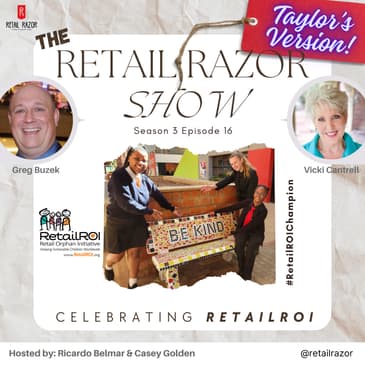





In this episode of the Retail Razor Show, hosts Ricardo Belmar and Casey Golden discuss their partnership with Retail ROI. The episode is dedicated to how the retail industry can make a difference in the lives of children in need around the world. Highlights of the episode include discussions with Greg Buzek, president of IHL Group and Vicki Cantrell, CEO of Vendors in Partnership, detailing the history of RetailROI, a unique charity supported by the retail industry. Together they discuss different initiatives that have been undertaken by Retail ROI, including providing technology resources to children in Liberia during the Ebola crisis and supporting schools lacking necessary utilities for education. Greg and Vicki share highlights of the upcoming Super Saturday event during NRF in January including the special guest keynote! Join us to learn how everyone can make a difference for so many children by supporting this amazing organization! Retailers that attend Super Saturday help bring clean water to 100 children just by showing up! Learn more about RetailROI and the Super Sturday event, including how to register at RetailROI.org!
WOW! As we zoom past our 2-year anniversary on the show, we’re honored and humbled to have hit the top of the charts on the Goodpods podcast platform!
We can’t thank our Goodpods listeners enough! We love your support! Please continue giving us those 5-star ratings and send us your comments!
Meet your hosts, helping you cut through the clutter in retail & retail tech:
Ricardo Belmar, a RETHINK Retail Top Retail Influencer for 2023, 2022 & 2021, RIS News Top Movers and Shakers in Retail for 2021, advisory council member at George Mason University’s Center for Retail Transformation, and director partner marketing for retail & consumer goods at Microsoft.
Casey Golden, CEO of Luxlock, and RETHINK Retail Top Retail Influencer for 2023. Obsessed with the customer relationship between the brand and the consumer. After a career on the fashion and supply chain technology side of the business, now slaying franken-stacks and building retail tech!
Includes music provided by imunobeats.com, featuring Overclocked and E-Motive, from the album Beat Hype, written by Hestron Mimms, published by Imuno.
The Retail Razor Show
Follow us on Goodpods: https://bit.ly/TRRSgoodpods
Follow us on Instagram: https://bit.ly/TRRSinsta
Follow us on Threads: https://bit.ly/TRRSthreads
Follow us on Twitter: https://bit.ly/TwRRazor
Connect with us on LinkedIn: https://bit.ly/LI-RRazor
Subscribe on YouTube: https://bit.ly/RRShowYouTube
Subscribe on Apple Podcasts: https://bit.ly/RetailRazorShow
Retail Razor Show Episode Page: https://bit.ly/RRShowPod
Host → Ricardo Belmar,
Follow on Twitter - https://bit.ly/twRBelmar
Connect on LinkedIn - https://bit.ly/LIRBelmar
Co-host → Casey Golden,
Follow on Twitter - https://bit.ly/twCasey
Connect on LinkedIn - https://bit.ly/LICasey
[00:00:00] You're listening to The Retail Razor Show, where your expert hosts and big guests cast through the classroom retail and retail tech to shape the future of retail. Hello, and welcome to Season 3, Episode 16 of The Retail Razor Show. I'm your host, Ricardo Belmar. And I'm your co-host, Casey Golden.
[00:00:28] Welcome to Retail's favorite podcast for product junkies, commerce technologists, and everyone else in retail and retail tech alike. And this episode is not only special as so many of our episodes are, but it's also unique
[00:00:42] in that this is an episode that's all about how the retail industry can do something to make a difference in the lives of children in need everywhere in the world. It's a very powerful episode, one that has so much deep meaning for so many people.
[00:00:57] It's a rare moment when we get to use our platform to really make a difference by supporting an incredibly impactful charity. It really is Tech Enters. Yes, and if you're wondering, we are of course talking about Retail ROI.
[00:01:13] Way back in Season 1, our third episode of the podcast, in fact, we had two special guests on the show to talk about the history of Retail ROI, a unique charity that is supported by the retail industry and the entire ecosystem of vendors, analysts, consultants,
[00:01:28] and tech providers in retail. Greg Buzek, president of IHL Group, and Vicky Cantrell, CEO of Enders in Partnership, and both fellow retail top-retail influencers joined the show to share the history of this charity. And for those listening who are not familiar with Retail ROI, it's an organization that
[00:01:46] helps vulnerable children around the world, whether orphans, foster kids, adoptions, or just helping schoolers that lack running water and electricity to really just have a better chance at education and bringing them food to their table when needed.
[00:02:00] Retail ROI works with so many other charities to bring these missions to life, and they've helped hundreds of thousands of kids around the world over the past 15 years. I first became involved with them about seven years ago or so in a project they supported
[00:02:13] in Liberia during the Ebola crisis, and also doing a simple webinar to school kids in Honduras about career paths that they could look forward to. I'll save those stories for the replay of our Season 1 episode, which is what we'll be doing later this episode.
[00:02:28] I'm so glad we're replaying this episode from Season 1. Listening to Greg and Vicky's story, you can't help but celebrate their massive accomplishments. And we're also fortunate that our favorite guest host on the show, Jeff Roster,
[00:02:42] is also in the replay telling his story and involvement and support for Retail ROI. In fact, the only thing I can think of that would be better than just listening to the
[00:02:54] replay of that episode would be to have Greg and Vicky back on the show today to give us an update on what 2024 has in store for Retail ROI and share with us what will be happening in their annual NRF Week fundraiser event, Super Saturday. I 100% agree.
[00:03:15] So it's a good thing we do have Greg and Vicky with us today for just such an update. So let's jump right into our quick chat with Greg Buzek, president of IHL Group and president of Retail ROI, plus Vicky Cantrell,
[00:03:28] CEO of Vendors in Partnership and co-founder of the VIP Awards and Retail ROI board member. I'm so happy to have with us today, Greg Buzek and Vicky Cantrell, two great friends and fellow top retail influencers. Great to have you with us today, Greg Vicky.
[00:03:48] Well, it's great to be with you guys. Thanks for having me. Hi, Ricardo. Hi, Casey. Lovely to see you guys in this post Thanksgiving time. Yeah. We've been looking forward to having you both on the show again to talk about
[00:04:02] all the incredible things that you've been accomplishing with Retail ROI. Since we last had you here and also hear about 2024, what do you have in store for us? In the replay, our listeners will hear all about the history of Retail ROI.
[00:04:20] But this year is a special anniversary, isn't it? Our 15th. Wow. Our 15th Super Saturday. It's hard to believe. I remember the very first one. Yeah. Yeah. We started, we had our first discussion the day the Lehman Brothers went under.
[00:04:41] And then our first Super Saturday was in January of 2010. Wow. So here we are 15, 15 Super Saturdays later coming up. So can you tell us a little bit more about what's planned for this special 15th Super Saturday event? Sure. Yeah. Things we're bringing things home.
[00:04:57] So we've been blessed with helping I think over 325,000 kids by partnering with great charities through Super Saturday over these 15 years. This year we're bringing it back home in the United States. Foster children are the most vulnerable kids that we have in our society.
[00:05:14] And we have a system that's incredibly broken. And at the core of that, and the most impactful aspect of that is our social workers that work with children and foster care system. In fact, data shows that children who have one social worker find permanence over 74% of the time.
[00:05:34] However, if there's any turnover of those social workers that drops to under 18% of the time and with devastating impacts, basically a male that exits the foster care system that doesn't get permanent has an 85% chance
[00:05:52] of being in jail, homeless or dead by the time they're 19 and a half years old. The average girl that exits foster care has two children by the age of 21 on social services there as well. In fact, when you pull prison inmates today, 25% of our prison inmates
[00:06:13] spent time in foster care at one point in time. And it's about the breakup of the families. And our focus this year is on impacting that. One of our partners came up with a program that saw a 73% drop in social worker turnover in one year.
[00:06:30] And we are working to bring that nationally through what we're doing with Super Saturday to empower the skills and the people in our industry to make a difference and to help elevate the role in the view of the minds
[00:06:44] of people of what social workers do and how impactful they are. Those are just amazing statistics. So I know it's not the first time I've heard you go through this, but I'm always every time I hear those numbers, I'm just shocked at what an impact that can make.
[00:06:58] Yeah, quite surprising. It's just nothing. It's what makes such a difference. And when we look back over the years and over the the charities, you know that all the work that we do, all the trips that we take,
[00:07:12] all the the impact that we have is by partnering and going alongside people in country or, you know, finding ways to not only go alongside great partners, but also to go back up the chain
[00:07:31] and figure out where the problem is and see if you can have an impact before somebody becomes an orphan or has another issue to deal with. And I think this year in what Greg just talked about
[00:07:47] and why we're so passionate about it is we've gone back up the chain to try to stop or impact something from happening in the first place. And the numbers are so compelling. It just makes it's going to make people feel so good to be part of this movement.
[00:08:09] You know, people are always looking to make an impact. How do I make a difference? How do I get involved? How do I get back? I think that they're just going to feel it and know it that they have stopped something bad from happening.
[00:08:24] And I think that's going to that's a really important message this year. Yeah, absolutely. So you know, one of the things that we always talk about is how retailers support what retail ROI does. So for our retailers that are listening to this episode,
[00:08:45] what would you say is the best way for them to get involved? Support what our eyes doing, join Super Saturday. What should they do? Well, in a nutshell, our ask of retailers is just show up and be there. Be there for the content, be there for the networking.
[00:09:01] We make all of our money through sponsorships from the vendors. It is the most unique day you will ever see in a retail conference. You guys going to test to it. So it's not just my words there, but you show up that day. You attend the networking meetings.
[00:09:18] You listen to the content on AI and the state of the store and great emotional speakers and just be there. That's the biggest thing. You help 250 children by just being there. You being there helps us raise the funds that we need to do this work.
[00:09:36] And that's that's our ask, just show up. And I would say, you know, look, let's let's be honest, let's talk about that. We're saying just be there. And the reason we want you there is because the sponsors give us money.
[00:09:52] OK, and we know this industry and we know how it works. And sponsors are saying what retailers will be there. But also understand that what that day is like, you know, I always talk about partnership, the day is so impactful, what Greg just said
[00:10:09] about what you're going to hear first of all, great content, OK, from your peers and colleagues, great impact content. And then we'll talk about our special keynote speaker. But don't think that you're you're going in your presence there helps us get
[00:10:25] sponsorship, but don't think that this is a situation where you are going to be bombarded. This is these are people that come to this event that have a heart for all the work that we do. And these are good, amazing friends and colleagues in this industry,
[00:10:44] regardless of which side of the table you sit on. This is not a hard sell event. It's just a wonderful networking partner event. And just being in the room with like minded people. This is the only fundraiser you'll ever go to where there is no financial
[00:11:02] ask of you personally. There's absolutely none there other than you participating in the day and talking to people. That's very true. So speaking of partners, how can our listeners that are also retail technology providers become a sponsor? That's easy. They they really it's easy to do.
[00:11:24] You just go right to the website retail Roli.org and right on, you know, obviously we're featuring Super Saturday now so you can get to it right from the home page or through events and clicking on Super Saturday. And you'll see the link for sponsorship opportunities.
[00:11:42] I will say that we are running up against a deadline. And so we only have about two weeks. December 15th, this is the deadline for all of us to understand who's going to be in the room and how we can execute on what you need.
[00:11:58] And, you know, retail Roli.org home page sponsorship opportunities. Perfect. Greg Vicki, thank you so much for being with us today. These updates on retail Roli and Super Saturday. I can't tell you how important it is to just be able to make sure
[00:12:18] everybody's getting involved, you know, our retail crew and families and listeners were all connected. We have all been, you know, working together on so many things. Now, I just think that this is just imperative that we also get together to do something just wonderful.
[00:12:35] We want to ask all of our listeners and viewers to please reach out to any of us to learn more about how you can help raise awareness and gain support for Super Saturday. Yeah, and especially after having heard how much impact there is for each
[00:12:47] and every retailer that just shows up, as Greg said, just for showing up at Super Saturday, what impact that can have and how many kids you can help just by being there because that directly translates into the funding and support
[00:13:00] from sponsors. And Greg, I guess we should real quick mention of who's the special speaker. Sure, this year. Yeah, this year for our keynote, we have the one and only Daryl McDaniels of Run DMC, who spent time in the foster system himself.
[00:13:16] He is going to be with us to share his story and motivate us that day. You'll be up close and personal, and it might get a little tricky. Who knows? That's going to be exciting. It's going to be exciting.
[00:13:29] I think and pretty emotional at the same time, which if we haven't said it enough, that's probably the hallmark of this event is how the combination of the technical thought leadership you'll hear, the networking and just the emotional exchange that will happen from hearing about all these
[00:13:46] incredible stories of how children are being helped through what Retail ROI does. So I guess one more time, Greg, for the retailers in the audience. How do they register? Just the same place as you find the sponsorships there. It's just retailroi.org and you'll see a registration link.
[00:14:01] And that's it. All right, excellent. Thank you so much, Greg. Thank you, Vicki. But both of you, thanks so much for sharing a little bit of insights on what's coming up for this 15th anniversary, Super Saturday coming up.
[00:14:14] I can't wait to be there and to see everybody in person and to hear all these amazing, amazing emotional stories we're going to hear. And thank you guys for always taking, you know, for being such champions
[00:14:26] and helping us get the message out and getting the message out yourselves. And doing all that you can with all of your resources and your reach to really push this, you guys are amazing advocates. We really appreciate it. Now let's dive into our special replay.
[00:14:44] Think of it as Taylor's version because it's Taylor's world and we're all just living in it. Part replay of the celebration of Retail ROI episode with Greg Uzak, Vicki Cantal and Jeff Roster. Welcome everybody to another session in the Retail Razor Club room.
[00:15:08] We've got a special one today where we're doing a celebration of one of what I feel is one of the most important organizations in retail today. And that's Retail ROI. And some of you in the audience are very familiar with Retail ROI
[00:15:24] and what it's accomplished and what it's done in the past. And maybe others in the audience might not be quite as familiar. You'll get to learn quite a bit about it through the course of today's session. We've got a couple of special guests with us today,
[00:15:37] Greg Buzak and Vicki Cantrell, who I probably can't think of anyone else who can do a better job of telling us everything there is to know about Retail ROI. And as I say that, I'm sure Jeff is ready to jump in and raise his hand as well,
[00:15:50] being the person that introduced me to Retail ROI many years ago. So with that, why don't I ask Greg and Vicki to give a brief introduction to yourselves? Vicki, why don't you go first? Hi everybody. It's great to be here on a Friday afternoon at five o'clock.
[00:16:03] I won't give Ricardo any grief, because everybody does. But this is a topic that's worth a Friday at five o'clock. And I've been involved with Retail ROI since the beginning, and I'm pleased to be working alongside
[00:16:18] Greg and Randy to figure out how we increase our help and how we make a great experience and divide the money and make the biggest impact. So I started in 11, 12 years, are we 11 years? And have many great experiences, not only traveling myself to various countries,
[00:16:42] but also taking both my children there. And the impact has been on our life and our hearts pretty impactful. And happy to tell you more about it. I've been in Retail for ever and ever in all sides of Retail.
[00:16:58] So I guess that's how I got involved, because it's my fellow cohort in Retail that brought this to bear. Greg? And I'm Greg Music. I guess my day job or my first day job is being president of IHL Group, or a retail analyst firm.
[00:17:14] Gosh, this started because I had started a orphan care ministry at our church, and we were at Oracle Open World. And it was the day that Lehman Brothers went under, September 15th of 2008. And Paul Singer of Super Value and Previously With Target was there.
[00:17:33] And I knew he was an adoption advocate. So we had a meeting and said, you know, hey, maybe we could do something in the industry. And we could talk, you know, at that time, there was a lot of murders and acquisitions and everything was focused on efficiency.
[00:17:47] And we just call it, we'll call it ROI, a play on words, which ends up being the world's geekiest name for a charity, Retail ROI. Then we just said, we call it the Retail Orphan Initiative. And that's how we get our acronym there.
[00:18:00] And that day, with the help of Rose Spicer from Oracle, Paul Singer basically did his Open World presentation about 10 minutes on target and the rest on adoption. And we were all astounded. And we came out of that meeting and said, you know, let's do something together.
[00:18:19] And I know Jeff was there, Rose was there, Kathy Hotka, Mark Milstein. And I think Kathy Martyr were there. And we said, yeah, let's do something together. Instead of just competing with each other, we all know each other. We see each other all the time.
[00:18:33] It'd be fun to do something together in the industry. So that's the start of Retail ROI. And we had everybody assume that Paul would be the guy to lead it. Paul had been the guy that took over for Dave Thomas, a Wendy's,
[00:18:46] lobbying Congress for funds for foster kids and adoption. But in fact, he has started a group called the Congressional Coalition on Adoption Institute that he helped fund initially. That is the only thing in Washington that has over 350 members of Congress,
[00:19:01] I think in total that are on the caucus together and agree on something. Paul was a giant for that. So we all assumed he would run it. There were three of us, myself, Paul and Mark that put up the initial seed money to get started.
[00:19:14] And we signed the paperwork. And three days after we signed the paperwork, Paul called me and said, Greg, I just got a call from the neurosurgeon. I have a tumor and I have to have surgery next Monday.
[00:19:28] And unfortunately, Paul, when he had surgery, never regained the ability to speak clearly and reason and stuff. So it kind of fell to me to take the leadership role for Retail ROI. So that's how we started in 2008. Thanks for the quick description for that, Greg.
[00:19:47] Jeff, you've got a pretty long history with Retail ROI as well and to give a quick introduction. Hi, Jeff Roster. I see what am I? Co-host of, I guess this week, an innovation on some advisory boards and try to keep Ricardo out of trouble.
[00:20:01] It's the Center for Retail Transformation, which we're both doing a very poor job at. So lots of trouble coming down the road. We're working on that. So Greg and Vicky, let me ask you maybe a couple of questions.
[00:20:14] So with that history that Greg just gave on how things started with Retail ROI, we'll give us a quick overview on how Retail ROI works. I always describe this to everyone as a charity group that's basically built by the retail industry,
[00:20:29] run by people in the retail industry, and that it works with other charities to do a lot of great work around the world helping children in need, whether it's orphan children's foster care. Sure.
[00:20:40] Yeah, just to begin with, the first step we had to make is we needed to raise, hey, we got a charity. We got to raise money. So we said, how do we raise money? And we looked around the room and said, gosh, we know events.
[00:20:53] We know who all the best speakers are. And let's put on an event aligned with the timing of the NRF show. We'll call it Super Saturday and we'll invite all the retailers to come for free and we'll charge vendors that want to sell to retailers a fee,
[00:21:10] a sponsorship fee to get access. So we just basically said, ladies night at a bar, so to speak was the approach. And that became our fundraiser. In terms of the initial charities that we did, the first initial charities were people
[00:21:23] that I had already started working with through some other experience. And then after that, it started to blossom as other people got involved. And so we have really three criteria when it comes to working with charities. Obviously it's got to be a 501c3 based in the United States.
[00:21:41] They are involved with vulnerable children, orphan foster care, clean water, something to do with vulnerable children in some manner. Number two, it can't be a church or a synagogue or a faith. It's got to be a separate entity altogether.
[00:21:57] So they can have a faith based component to it, but it's not something that's part of a community of faith in and of itself. And then the third piece of it is somebody in the industry has to be personally involved in the charity themselves and vouch for
[00:22:12] the integrity of that charity. And then we start really small with grants as low as $5,000. And we go up from there, we present that back to the board with the results, and then we grow from there.
[00:22:24] So in total, I think we've teamed up with over 55 charities to date with different varieties of grants. And they work in 27 different countries. Thanks for that overview, Greg. I want to read some stats that you've given me before just for to kind of
[00:22:39] set the stage a bit for everyone here on what some of the accomplishments are. And to let everyone know, we recently at Microsoft had a special giving event held to try to raise some funds for retail ROI. And Greg and Vicky were kind enough to join that session.
[00:22:52] And Greg presented a little bit of background for the employees that were attending that event. And I just want to read some of those and see if anybody on the stage has some reactions wants to share some other info from that.
[00:23:03] So the one that kind of grabbed me a lot that you mentioned, Greg, was if orphans were a country, they would be the eighth largest country in the world. And for the other one was that for foster kids that age out of the US system within 18 months,
[00:23:16] 85% of the boys are homeless or in prison and over 70% of the girls are pregnant, homeless or in prison. Those stats are just astounding to me. And I never had thought about just how significant this really is.
[00:23:31] Yeah. And so it's a huge issue and that's part of our role. We see our role as three parts. One is the knowledge of this problem that you just outlined. Two is leveraging our skill sets, our networks, who we know what we know to make a difference
[00:23:47] and come alongside different organizations that are doing great work where we can double, triple, or quadruple the impact. And then third is funding for projects. So you just gave some of the core stats out there for things.
[00:24:00] And then I want to go ahead and share some of the accomplishment stats that you shared with me before. So this is since 2010, RetailRise funded over 206 projects in 27 countries, installed 26 computer labs. I think those were all in schools, correct?
[00:24:17] Schools. Yeah. Well, there's been a couple that have been like in after school programs as well. Okay. And then also on the list of what you had provided before, built a remodeled 21 school buildings or homes and helped rescue over 1400 women and children from sex trafficking through border monitoring,
[00:24:35] helped support over 1500 adoptions and built 14 wells and clean water projects. I think overall you calculated and estimated that over 252,000 children have been helped by the people of Retail ROI since 2010, which I think is an amazing accomplishment worth celebrating. Yeah. And to be just to be perfectly transparent,
[00:24:56] it's our charity partners that have done this work. We've kind of played matchmaker at times and lending some funding for things, but it's the real benefits of Retail ROI is when we take really successful people in the retail industry and connect them with these charities
[00:25:15] and then let them go. Just make the introduction turn, I say turn the light bulb on. If I can turn the light bulb on and just point people in the right direction, amazing things happen. So I'll give you an example. Can you give us some examples of those?
[00:25:28] So this makes it all clear. So we had a need in Honduras, we had a school of 650 kids that literally could, they had enough money to feed the kids or to pay the teachers. They couldn't do both. So they reached out to us and we said,
[00:25:43] well what do you need? He says, well we need corn because we make 4,300 tortillas a day by hand of there to feed the kids. And so we looked at it and said, well where can we get corn? And we said, who's the biggest buyer of corn?
[00:25:58] Well it happened to be Cargill. So we placed a call to Cargill. Cargill ended up donating the two containers of corn. There was only one problem. It came in individual pieces and they were literally, comes out of the grain silo into the train car
[00:26:13] and that's how they deliver it. Well we needed to figure out how to get it to Honduras in some sort of package. So somebody at Cargill then took it upon themselves and said, you know what, I know somebody that's got a seed packing plan.
[00:26:24] Let me call them and see if they're willing to pack it for us. And so they did. They agreed, Fisher Seeds agreed to pack it into 50 pound bags. And then there was another lady who does shipping and logistics for a living.
[00:26:35] She ships containers all over the world every day. She came on board and she scheduled the FDA inspection, the shipping and we had a year supply of food delivered for $7,500 for 650 people. That's just one example of a project that was there.
[00:26:52] You know, Ricardo, that's a great one that Greg talks about. But when we talk about bringing retailers or bringing people in the industry alongside these charities, it could be in any number of ways. And it's largely based on, as his example shows, what's already in their sweet spot,
[00:27:14] how they're job every day and just suddenly applying what they do every day to a new situation. We had a guy, Bob Monkree, who developed an entire curriculum around kind of how kids could build their business.
[00:27:33] And what we, you know, when Greg talked about that we go alongside our charity partners, these are people that are on the ground and understand how to get things where they need to be.
[00:27:45] But they also, what we're trying to do is give these charities or people we work with the ability to sustain themselves, whether it be growing crops or whatever. And so this was a situation where these kids, when they graduate,
[00:28:01] they needed to have a skill, start a business, go to college, etc. And so he developed an entire curriculum. I think he was with Accenture at the time, Greg. And so we had this startup shark tank competition where we, on our trip to Honduras,
[00:28:20] Jeff, me, Laurie Mitchell Keller, you know, several other heavy hitters in the industry were able to judge these and listen to their pitch as is after they had been through the whole curriculum. So I guess, you know, it really is, and that has continued every year
[00:28:39] and has now expanded into Jamaica. Jamaica, South Africa, maybe? Yeah, so four different countries that's gone. In fact, just recently in Jamaica, Parker Avery Group, to shout out to them, they've taken it to a whole new level with the entrepreneurial program.
[00:28:57] And we had six students go through an eight-week course. And I'm telling you, the winning presentation there, I've seen 40-year-old MBAs not do as well as this 18-year-old did in sharing their vision for the cosmetics business they wanted to create.
[00:29:15] Basically, it's a cosmetics for African or dark skin people that have acne. And how do you provide cosmetics that heals the skin as well as provides beauty and makeup on top of it? And it was just fabulous.
[00:29:32] And they invested, Parker Avery invested, I think it was close to $6,000 U.S. into seed funding to help get that launched there as a result. So it's really special when, like I said, when we can get people connected and go. And there's so many examples of it.
[00:29:53] Sometimes it's just funding. So like in a country of Liberia, the heart over there was, hey, you got 85% unemployment. So you've got kids in schools. We need to get them job skills. Well, one of the great things that happened is we started funding a vocational training program
[00:30:12] there in both construction, computers, computer learning. We had interior design, cosmetology. And this week we got noticed that 54 kids graduated from those programs and had the opportunity to get jobs. But here's where it's really exciting. Through the funding of Intel and HP, we built a school there.
[00:30:34] We paid for a school to be built. It cost about $35,000 to for a K through 6 school. The kids in the construction almost supervised by the engineers over there that were teaching them, they built their duplicate of that school for middle school for $10,000.
[00:30:54] As a result of that and they learned along the way and they've since built the dorm for the girls side. And so that's one there. So those are the kind of projects that we take on where we can really impact things.
[00:31:08] And I would think of it the way that you think about it is it's a hand up, not a hand out. Right. Right. Right. And it's how do you change family trees? How do you give in South Africa is a perfect example of it.
[00:31:21] Because in South Africa is the only place where we have a continuity of care from three years old all the way up through getting jobs through college. We have there's a school there in for little three to five year old preschool kids that are
[00:31:36] kids from the townships that are there. We actually help pay for kids to go to English speaking school for about 15 to 20 kids there. And then 14 of those kids to go into a leadership high school there, which is the only mixed gender mixed race school in that area.
[00:31:56] And it's like a US it's just high quality as a US private school. So we have 14 there. We seed funded a small college fund. And we just two years ago had our first student come from the township and graduate from college.
[00:32:11] And I got word today that we have five more that are graduating this week in South Africa as a result of that opportunity. So that continuity of care. And then what so when we go there, you know, on a trip, the small kids we felt build the school.
[00:32:27] We essentially just make sure that our money is being used properly play with the kids and have fun there. But when we go to that high school, we teach classes. We literally share our career trajectory.
[00:32:38] We give forecast Dave Finnegan from Orvis and myself, we taught about leading what the impact of AI and machine learning is how graphing can transform the world for things. He shared how they've got fishing rides with graphing now that have accelerometers in there.
[00:32:55] And you can benchmark yourselves on the fishing ride compared to the best fisherman in the world with doing things. So as to spur on these things, I think Vicki's done a call. You've done a call down there right with the students. Did you know? Yeah. Yeah. You did.
[00:33:12] And we taught marketing classes when we were in Honduras also. Right. You know, there's one thing that I know we're going to probably talk about trips, but I was going to go there next year.
[00:33:25] They are the heart of how we see what we can do and how we get our reward kind of just seeing these things. But it's directly related to what Greg is talking about. So we've had the great fortune to take our children,
[00:33:43] to many of us have taken our children on these trips. And Vicki, can you kind of describe referring to how the trips take form? And when we say we're talking about these retail or wide trips, what does that really mean? So I'll use Honduras as an example.
[00:33:59] We have somebody in our kind of group that kind of is the leader for a particular country. And again, remember that we're working with on-the-ground charities. So they help us with the logistics. We don't have to figure a ton of this out ourselves.
[00:34:17] But we arrange to all get to the airport at about the same time. Flying from various and sundry places across the US. And we try to get there around the same time. And we have transportation that gets us to our final destination.
[00:34:32] Many times the hotels that we stay are, they're certainly absolutely fine and sometimes very nice. Greg had a very great experience with almost a resort. And then we spend the time at wherever we are, whether it's at the school or in my case in Honduras.
[00:34:57] This was the place with the 600 kids of various ages. And so our meals are handled, et cetera. And so again, you're working with a partner on the ground. So we always feel safe. And our children, we say, you know, 13 is about the youngest, maybe 12, depending upon the child.
[00:35:20] But I took, I started taking my son when he was 15, I believe. He's been on six trips and my daughter's been on two or three trips. You know, just to dovetail what Greg talked about.
[00:35:33] So here we had a panel on the stage talking to the, I guess, technically the juniors and seniors about interviewing techniques. And we did role-playing and we did some mock interviews. And we talked about each person's business, whether it was SAP or Gartner or IJEL or whatever.
[00:35:54] We talked about the businesses and we talked about how they can, what, how they should be in a corporate environment and all of this. And I will tell you, because kids, all of you who have kids don't listen to their parents,
[00:36:08] it was, our kids got as much of an education as all of the children at that school. And I would honestly say that we've gotten tremendous benefit for our retail children who have listened to the people that are in our industry while they're in a foreign country.
[00:36:28] It's just one of those little side benefits. Yeah, well, Jeff, Jeff's got lots of, yeah. Yeah, I can't emphasize what Vicki just said more. Probably the single best amount of money I've ever spent in my life was taking my two twins to Honduras four times.
[00:36:45] I don't know, what was it? Probably 10, 12 grand for all those, all those, for all three of us for those four times. They got a better business education than they probably did at the UC system that they both went through.
[00:36:56] I mean, when you think about, you know, Vicki, when you think about what our kids heard in Honduras, when they heard, when they got to hear business executives talk and they listened, but then they also got to see what happens.
[00:37:10] You know, if things don't work well in the country, and so they just came back better people. They just flat out ain't that better people. And it just, it was a great, great investment.
[00:37:18] The most fun I have in retail ROI is going on a trip where we take our teens and I get to watch my friends being at the things that their teens are doing. We were the handing out the Tom's shoes instead of buying the Tom's shoes.
[00:37:37] And to watch the kids thrive and to watch the parents and the pride in their parents of watching their children get back was really, really special. When we do trips, we have some minor projects, but we're not, it's not like you would say
[00:37:52] with a church mission trip or somewhere, hey, we're going to go build something or we're going to do something. I mean, that's a waste of time for most of us.
[00:38:00] Some of us may have a skill set there, but what we do have is a lot of knowledge and a lot of networking. And so when we ask people to go on trips, if we've got our students with us, certainly we got to keep them busy.
[00:38:13] But for the most part, for the adults in the industry, we want you to see the work. Just come experience the work, see the impact because there's literally 30 things a day that
[00:38:25] we do and take for granted that we don't even think about because we're so proficient at it that the charities we work in, it's a real struggle. And they may not know how to do that.
[00:38:35] So most charities, for instance, they live month to month, are we going to get enough money here to make it through the month? And then you bring somebody down and says, hey, what's your five-year plan? Where would you like to be in five years?
[00:38:47] Let me walk you through that and put together a plan for how you can move forward and reach the goals you want to look for. Because most times you're too busy doing the work to think through the plan of how you might get there.
[00:39:02] And so that becomes really advantageous to them. So every trip we have a brainstorming session, every single night at what we saw and how we can help and whose network we can tap in to help solve that issue. And that's where the real value comes in.
[00:39:18] It's not that we go build a building or things there. Yes, we teach classes. Yes, we provide some things there. But the real value is when we come back after seeing the projects and put our networks and our knowledge together. John Guirman, the perfect example.
[00:39:36] John went down there, saw the kitchen situation, and he was Vice President of Schlotzky's, a branch-ized operations. He went back to Schlotzky's and asked all the suppliers to donate the equipment. Anyway, he put a million dollar kitchen into that school for about $65,000 total cost.
[00:39:56] But he didn't stop there because he was so touched by the kids that he was serving. He said these kids can benefit through certification. So he took the food safety course of Schlotzky's, translated it into Spanish,
[00:40:09] taught that class down there on a next trip and then gave certification to the kids so they could go get jobs at hotels, etc. That was all his idea. After being down there, seeing it and working it. And those are the kind of things that have a,
[00:40:22] Mark Haney, another one. He was installing Chromebooks with an SD card for us down in Dominican Republic. He said, there's a better way of doing this. And he came up with this concept of internet in a box using a Raspberry Pi.
[00:40:36] And now they've created their own charity called Control Alt-Delete Poverty, which may be a geekier name than Ristilh Raui. But they have now put computer labs in 27 countries. And it's literally a carry-on bag that can provide first world education
[00:40:53] in three different languages anywhere in the world at a moment's notice. And because it creates its own little Wi-Fi network, battery powered. And those are the kind of things that happen when people go on trips and say there's a better way of doing this.
[00:41:06] And it's been so special to watch the deep art. That seems just like in such an amazing process when you get the knowledge and skill sets from all the folks who are coming on the trip and you come up with all these new ideas.
[00:41:20] And the other thing I wanted to ask, so one way from the trips, how else do you have retailers? And I shouldn't just say retailers because I know there's plenty of engagement from people throughout the industry, not just from retailers,
[00:41:33] but how do people get involved to begin with? The inroads that how do you reach people and how do they first get involved typically? Typically, the first start for most people is the Super Saturday event and simply coming to Super Saturday. For every retailer that attends Super Saturday,
[00:41:52] we generally can raise about $5,000 in sponsorship money from vendors. And that's usually the first step. Now, when you think about $5,000, what does that mean? Well, that means first world education for about 400 kids. That means clean water for community of 500 by just and just attending the event.
[00:42:13] So that's the first step. The next thing is just joining your colleagues on a trip. And Jeff can attest to this, I'll let Jeff share this story, just the impact of the community that's built on the trip in the breakdown of barriers
[00:42:27] when it comes to business relationships as a result. It's a lot better than golf. So Jeff, you want to share your story with Lori about Lori and how when you were a gardener, the challenges of getting her on a call.
[00:42:40] Well, probably the most effective, let's see, in 20 plus years of being an analyst, probably the single most effective time I ever spent was that those two hour bus rides in Honduras. And Vicky was on those. I mean, we literally had a who's who on that bus.
[00:42:54] And as an analyst, they trapped with leaders from all the software companies, which is phenomenal. And so what was neat about that is, especially as an analyst and the vendor analyst relationship can be kind of loving like a linebacker and a running back.
[00:43:08] But when you're actually working and sweating and out of your business attire, it was just phenomenal. I mean, it just was absolutely phenomenal. Now that doesn't mean there was any, I pulled back on any of the analysis I would do with any vendor,
[00:43:20] but it's just nice to be able to have that sort of underlying relationship. And it really cool. I mean, it was really probably easily, I think the best money I've ever spent. And I don't say that loosely. It just was a grand slam on every single level.
[00:43:35] Jeff, you brought up a good point about the vendor community and supplier community in retail and how their participation is. And that's the side of the industry that I come from. And that's how I got involved with Retail ROI.
[00:43:46] But this all makes it an open question for you, Jeff, Vicky, Greg, really, for any of you. How do you engage with the vendor community on this? Apart from just is it the sponsorship at the Super Saturday event
[00:43:56] that typically is what gets that part of the community engaged in supporting the charities or are there other things that happen based on your experience? I would say there's two aspects of it. The reason that Greg talks about Super Saturday is just the exposure.
[00:44:12] Okay, it may be treated as a sponsorship, but what the real benefit is the content that happens that day and the exposure. The other thing where solution providers get involved is when people understand the need, okay, and let's say it happens to be a retailer
[00:44:31] and they're dealing with a project or see a need, they have an entire ecosystem of solution providers that they deal with in their everyday life and they will reach out to them to get involved or to help.
[00:44:47] So those are two ways that I would think I'm sure Greg can add on to that. Well, the vendors have also leveraged what they do for part of this. So we've had situations where people want to donate their cloud business first things.
[00:45:03] We've had an offer from a vendor before to handle the mobile devices. One of our charities has a strawberry business in Zambia and right now it's still a paper-based business with delivery drivers and other things,
[00:45:18] but to set up a full-on accounting system that is just like you would have for any vendor here calling on your local Kroger or Walmart associated with that and offering their solutions that way. The other thing that is funding related is often incorporating retail ROI in their
[00:45:38] customer events when they've done things like for SAP we did a food packing project. Jeff was involved in that one where they filled a container where it says protein-rich meals for orphans and vulnerable kids in the afternoon instead of playing golf.
[00:45:53] That was a fantastic event. Actually that was Lori again because she got so motivated from being an Honduras. She actually built that into one of the SAP conferences. We literally took over a full-bought forum or something like that.
[00:46:06] Yeah, something it was it might have been bigger than that Greg, but it was a big conference and they brought in teams of what happened was like SAP sales teams from regions would come
[00:46:15] in and would compete with each other. You've got a bunch of engineers in there so these guys are all recreating the processes while they're filling and alluring. I mean it was gosh,
[00:46:26] it was probably the most fun I've had in a business event in an awful long time because and it was it was you know I don't know how many hundreds of boxes we produced but it was a ton
[00:46:35] literally a ton more than a ton. I think it's close to 25,000 meals that you guys provided through that. Wow. So there's ways of just I guess the point of ROI is just how do we
[00:46:49] do something impactful but fun and support business and I would argue I'm sure more business was done inside that room than out in the golf course because you know salespeople would bring their
[00:47:01] clients and it just was a blast. We got I mean dusty and all that stuff but just a phenomenal thing and there's probably 15 other examples where the other executives have adapted different different processes inside their own business processes and that's really the kind of the magic.
[00:47:17] Yeah and I can't overestimate or underestimate how valuable it is when a company joins a trip and says you know what we want to make this part of our core belief system for our company
[00:47:29] and that's what happened with Aptos when they got involved. They started going to a variety of different places and decided hey we would really like to adopt the program with Lifesong and Haiti and they've done I think nine different trips now and helped build a school
[00:47:47] at community center like this which is like a hotel I guess there's like a hotel type thing. They brought in people from Marriott to teach you know hospitality training there then Verlin got involved when he was with Verizon and got satellite communications there but the company
[00:48:04] is behind it and has made it part of everything that they do for customer events and continues to invest and Parker Avery is now taking over Jamaica for us which is really the next place where we
[00:48:15] plan on taking a lot of our youth because we don't have the language barrier and we have a huge opportunity in the middle of Jamaica there so it's a nice weekend trip, a long weekend where
[00:48:29] we can take our kids as well as other executives and really start to have an impact on a community providing job opportunities, providing insight training etc. Greg let me ask you with all the examples that everyone's brought up here today how do you come across the different charities?
[00:48:46] Do they come to you? Do the retailers for example who want to get involved say Greg I'm working with this charity and I think they'd be a great candidate for RetailRI? How does
[00:48:55] that happen? Yeah that has happened and that's where we love to have that where it's not all on Greg, Vicki and Randy to pick the charity so we've had several charities like Jeff has been involved
[00:49:06] with Sierra with the Senegal and they created a charity to reach out there but it's usually somebody who's passionately involved with the charity so Gary Craig in Canada has been involved with a group called Sunrise Homes and it's the actual work is in Myanmar which obviously
[00:49:24] has been through a lot in the past year but it's an orphan home in Myanmar and that's the start because they're personally involved with this charity and I didn't know anything about it
[00:49:35] when it started but we started with a very small project we get the video back, we get the story back, we let Gary share about the impact and then we decide whether or not we want to invest
[00:49:46] more into that. We've done that with some charities quite a bit because so many people have gone on trips with them that it's just kind of like a no-brainer same thing with like Free For
[00:49:57] Life International. John Guirman and I mentioned earlier got introduced to Free For Life through Super Saturday after doing that work in Honduras and he's now chairman of the board of that charity and they're the ones that did the rescue of over 1500 women I think now and children
[00:50:16] on the border of Nepal and India as a result of that so there are things that you know where you bring the results back and say $10,000 helped rescue 1500 women this year you know that's no
[00:50:30] brainer to do things. The best way is that way and then I've had others that I've just been fortunate as I've gone through my learning curve to say man this really has a huge return
[00:50:43] so I'll give you an example of two here in the United States. One's called safe families, the other one is called together for good. What we found out through that process is over half
[00:50:55] the kids that go into foster care in the United States are not there because of neglect or abuse in any way it just meant at a point of crisis there was no safety net for the kids that
[00:51:07] crisis could be escaping an abusive relationship that could be drug abuse short-term prison send somebody that has an accident has to have a surgery and there's no safe place for the kids but in tragic once those kids go into the foster system they not only cost $92,000 a year
[00:51:27] for that the average time is three years in the system so you're talking $270,000 there well if that happens to you or me we usually have family members or somebody else that can watch our children so what safe families and together for good is they basically provide
[00:51:45] that safety net for that short-term care so a family steps up and said you know what I'll watch these children for 45 days 60 days mom and dad still have they still have legal responsibility for them but in this point of crisis we're going to come alongside and be that
[00:52:01] safety net for this family and that cost about a thousand dollars per family so that thousand dollars covers all the things related to social workers transportation medical care all that stuff for the children that saves the family saves the the government $270,000 on average for
[00:52:24] thousand dollars so we look at that ROI and say that makes sense to do so we've had over 22,000 kids now 22,000 families that have been preserved through those programs as a result of this and so
[00:52:38] those are things that you know through my education I just personally found and said this makes sense for what we're doing in this this needs to increase because it has a big societal impact one of the things that I've always been both surprised and impressed with when I
[00:52:55] listened to all the different charities at Super Saturday is how effective what seems on the surface like a relatively small amount of funding but the amount of impact that can have you know one
[00:53:07] example I always remember because it was I think one of the first ones that got involved in that first year that we sponsored Super Saturday and it was with the more than me in Liberia
[00:53:16] and I think this was when they through some of the sponsorship dollars right they bought the first ambulance in that area I remember and I remember you telling me afterwards that the impact was and this for everyone listening was during the Ebola crisis at that time right
[00:53:31] if you remember when the year the time magazine labeled the Ebola warriors their person of the year it was that timeframe and I remember you telling me the impact of the ambulance meant that doctors visits in that town went from what otherwise could take
[00:53:45] a day's trip just to get to a or days for days or four days but it went down to like 45 minutes right right which is just such a massive impact yeah with Ebola first day you feel like you got
[00:53:57] the cold or the flu second day it gets a little more serious but it still feels like malaria or the flu things that you don't have but the third day is when the really bad stuff happens
[00:54:10] and by day four you're dead so when you can imagine that in the largest slum in Liberia which is an area about the size of your normal large mall in the United States and 100,000 people live there
[00:54:24] Ebola is in the middle of it and if you touch a person that's infected with Ebola you get Ebola then that's how many people are in that area and it was taking four days for an ambulance to
[00:54:36] come and so when Katie she when she asked me for money for an ambulance it was pretty much a no-brainer for me and so and then here was the other part there were only four ambulances in the entire
[00:54:47] country which is the size of New Jersey yeah so you can imagine how tough that would be but yeah they were able to get the call rate down to less than an hour yeah that was just an
[00:55:01] amazing impact for what ultimately is not that great a span right just to pay for that ambulance compared to what I think the expectation that a lot of people probably have before they learn about
[00:55:11] what you're doing and what all the charities are doing is that you know how can I raise enough money to have an impact and I think yeah the biggest takeaway from all the work that Taroi does
[00:55:21] is that any amount can be put to good use yeah I would really an example yeah I'm sorry I just want to say that's an example where all we did was provide money period and it had that
[00:55:32] impact go ahead you know let's talk about the money for a minute because as we all reach a point in our lives where we really feel like we want to be doing more giving back and I remember when
[00:55:44] it felt that way and there's always this strange feeling when you hit that point in your life of well how can I make an impact yes I could write a check to something and but it didn't have
[00:55:59] it didn't feel like it was something I was connected to because you really do want to make an impact beyond being able to donate and so I have learned a hundred times over that it and you think whatever
[00:56:15] I as a single person would do is not going to have enough of an impact and what I've learned and seen a hundred times is all you have to do is impact one person literally one person
[00:56:28] because that person gets such a benefit it is such a circle of it just ripples out from there you help one person they got a leg up or they if you meant something to them at that moment in
[00:56:47] their life they help somebody else they help somebody else your impact is astounding just by helping one person and we help a lot of people and we help a lot of you know just the interaction
[00:57:03] of listening to these kids stories and sponsoring them which is a minimal money impact but it makes a huge difference to their life so you will make a huge difference with just the smallest amount of effort because of the ripple effect that you will create
[00:57:26] yeah and I'll give you an example I'm sorry I'll go ahead Greg I give you one example with a real live person when we went in 2016 to Liberia we met a young lady named Grace
[00:57:40] who was going into the 12th grade and this is prior to Mark creating these raspberry pi computer labs she was in the 11th grade she lost both of her parents to Ebola and she got placed in this orphanage
[00:57:53] and she had potential and we gave her a Chromebook a $250 Chromebook and she not only graduated from high school she went on to graduate college and is now a school teacher because we were
[00:58:08] able to give her a Chromebook with Khan Academy to help her learn and finish her education for $250 that's fantastic I remember at each year at each Super Saturday event you've always got one
[00:58:21] at least one of those stories of how the impact has affected that one person they've been on stage at Super Saturday and told their story from everything about their story from where the
[00:58:33] low point was how everything's changed for them once these what you might otherwise think are very small impacts but they have such a major change in someone's life when it happens I think these are
[00:58:45] just amazing stories yeah we have a special reprised edition of a young man named Demetrius Napolitano yeah Demetrius is coming back to share an update on his life and for the listeners
[00:58:58] here Demetrius is a young man who grew up in 32 different foster homes in Harlem growing up and he had one social worker that believed in him he should have been a statistic he should have been
[00:59:11] dead and he was on that path and that social worker believed in him and he has since graduated from NYU he was an intern in Congress there he got to work through the Robin Hood Foundation
[00:59:26] in New York City with John Paul Tudor Jones and he's now impacting youth in his region there but I don't want to give the whole story but he's an amazing young man who happened to get adopted
[00:59:37] when he was 24 by a 32 year old couple there and then so now he has the name Demetrius Napolitano so he's a young black man that looks like Eddie Murphy with an Italian last name
[00:59:51] and it's a really special story and we're going to be catching up with him at Super Saturday that's fantastic it's fantastic so Greg and Vicki let me ask you and we've kind of talked
[01:00:01] about how some of the retailers get involved we talked about how solution providers in retail have helped both from their sponsorship and resources how do other people you know let's broaden kind of the retail ecosystem if you will and how do other people get
[01:00:17] involved maybe they're not a retailer they may not work for a tech company providing retail solutions but how would one get involved with retail ROI well I guess an attending coming to
[01:00:27] Super Saturday being a part of that we also have a fundraiser each year related to the March Madness we call it March Gladness where we do small things where people donate gift cards
[01:00:39] that we have as prizes and we play brackets and so we built a school in Haiti that by playing brackets and winning prizes so that's that's a real simple way broader than that is just joining a trip
[01:00:52] get involved join a trip I will tell you one way you can impact it has nothing to do with retail ROI but has an amazing impact go to our youtube channel retail ROI youtube channel and
[01:01:04] look up Nicole Taylor in the socialite program that is right in your community what Nicole found out is that social workers are some of the people with the highest turnover in the country because
[01:01:17] of the burnout and the emotional impact of that what they found is children that go into the foster care system if they have one social worker 74 percent of the time they fight permanence
[01:01:28] and find a family to live in 74 percent of the time when that social worker changes it's only 26 percent of the time so they created a program called socialite which was just adopting a social
[01:01:42] worker encouraging a social worker providing a gift card and notice thank you flowers on their birthday inviting them to lunch and just telling them that they mattered in their one county they dropped the turnover rate from 69 percent to 29 percent in one year just by people being
[01:02:03] appreciated for what they do and that's something we can do in every one of our communities is find out a lot of local foster care can we get a list of folks and leverage our networks in our area
[01:02:14] maybe it's your your community of faith that wants to come and be a part of that but just adopting those folks encouraging those folks telling them that they matter they're making a difference in that hence such a dramatic impact on the potential for children that they serve
[01:02:32] it's just it's hard to quantify it because it's so impactful that one is just amazing to me the level of impact and effect it can have just by doing something so simple right to just
[01:02:45] thank someone for what they're doing right and there's a saying in this this foster care adoptive community is is not everybody's called to adopt not every person is called to be a foster
[01:02:56] care but we can all do something to assist that can be a respite care for an adopted family that can be just providing a dinner they are providing a night out for a foster family but just coming
[01:03:08] alongside of those folks in that community to make a difference so one question for you and given the different charities you're you're working with today are there any of those that maybe we haven't touched on yet that you want to highlight that maybe anybody listening
[01:03:23] or someone that catches on the replay might want to get involved with well gosh i don't want to i don't want to pick favorites there i've mentioned several i think there's opportunities with
[01:03:32] control to lead poverty if you want to sponsor a tutor lab and first world education there's one called the furthest simpson foundation that we're working with in jamaica that is really a grassroots just getting started there but an opportunity to completely impact the cave
[01:03:51] chopleton in jamaica with job opportunities and with you know one of the things that happens is that you have a give a man a fish versus teach a man to fish well what happens if there's no
[01:04:03] pond and that's what we're doing is helping create a pond in that part of jamaica i will give you actually one it's a for-profit company that i think retailers and anybody on this call
[01:04:15] may be interested in then there's a group called tide rise if you look up tide rise i think it's tide rise dot co but look it up behind it is the organization that created the app called flip
[01:04:28] that is digitizes retail circulars so you can see deals they the ceo of that company went to malawi and was working with an orphanage and came up with that same problem how do you if there's no
[01:04:41] pond how do you teach a man to fish so they created a technology business incubator there that cleans data for artificial intelligence and they took their lead sales guy for flip and he's now leading this organization and they're looking for projects from retailers
[01:04:59] and companies that want to have clean data and tag data for artificial intelligence and that's what the folks there do in this community now and it's building up jobs in that community as a result so tide rise furgus and foundation control all delete poverty are some of those
[01:05:17] there's also casita coupon and honduras which is a different place than we used to go there and they have been able to purchase a big section of property during very recently in the last six
[01:05:32] months and so they are going to be able to serve many more kids and have them have a family environment and so they that's another kind of enclosed thing that people can really see the impact
[01:05:47] of their involvement and one last one comes to mind for impact in the united states as well as dominican republic the thrive and joy nifanyano foundation was started by mary fagnano who used
[01:06:00] to be with chain store age magazine jay and mary tragically lost their son nick when he was 19 years old by a freak lightning strike in southern california he was washing his feet off in the
[01:06:12] ocean and got struck by lightning we encourage him he had a passion for dominican republic for some reason then they started going down there and that's been kind of life mission for them they started a us-based version called c11 that's underneath them which is 11 character traits
[01:06:32] and they're teaching them in public high schools here in the united states and it's become clubs so just like you have the the singing club and the chess club or the fellowship of christian
[01:06:43] athletes or whatever they now have a club called c11 that's now in the la county schools where the kids meet with jay and mary and other folks that become leaders to teach character qualities that
[01:06:57] they may not be getting in home or or at school and they're about two years into that one so that's uh that's a charity as well that i would encourage people to get involved with all of
[01:07:08] those are absolutely wonderful ones thanks for sharing all those greg before we close out the room as we're coming to the top of the hour here any last thing you want to mention about the upcoming
[01:07:20] super saturday event well it's it's the the saturday before nrf january 15 it's going to be right in time square you can find out more information the agenda at retailroi.org and there'll be a link right on the homepage there we have former special agents of the fbi sharing
[01:07:40] the latest ransomware techniques and things coming in and sharing how to protect yourself and your family and your companies as a result of that we have andy ladado is going to talk about his new book and share some things on how to build a world-class it organization
[01:07:56] and how to build innovation even during a point of crisis and then we're going to share our latest data from consumer studies what's going on with all these digital journeys and then
[01:08:06] finally our annual store study that we do with rs news so that's all part of the content that day and then you get to meet a lot of the charities right there this is always the best event during
[01:08:17] nrf week thank you vicky any final comments you want to share just in general about r y or about the super saturday or how everyone can support no i you know i think that we covered
[01:08:29] all the different aspects again there is no substitute for seeing it feeling it we always say and it's true in super saturday too a little bit but when you go on a trip you experience
[01:08:43] everything with all five senses and that's what really makes the impact wonderful i know i haven't been fortunate enough to go on one of the trips but i hope that at some point
[01:08:53] i'll have a chance to do that but i always make a point of getting super saturday on my agenda because i wouldn't miss that for anything both for the content and just to learn about what
[01:09:01] all the charities are doing and do anything i can to help with that jeff any final thoughts from you gosh it's just such an amazing thing when you can put your business skills to work
[01:09:11] i think we've said it again and again again when you get into sinagall or congo or hondur or something in places i've been it doesn't take much it's just any anybody that's an
[01:09:21] assistant manager 22 year old assistant manager in a store can just crush it when you go into into emerging economies our skills are our ability to schedule or just absorb information those are
[01:09:34] all just the skills these are all that we're all crying for and by the way a lot of the charities could use that skill just as much gosh said the charities folks are you know the hearts two
[01:09:43] sizes too big but sometimes their business experience is two sizes too small and that is a perfect match for what any retailer could do it's really really worth the effort take your kids
[01:09:53] get them involved you'll never you'll never regret it it's just a huge huge opportunity that you think you're doing good and guess what you end up getting more than you'll ever give guaranteed
[01:10:02] night that's a great point and great point so i think on that note we will go ahead and close out the room i know i recognize a lot of names down there and a lot of great supporters for
[01:10:12] retail ROI and hope to see some of you at Super Saturday and thanks everyone for joining us i'm gonna thank Greg veke it's been wonderful hearing all the stories today i always enjoy talking about
[01:10:23] retail ROI and trying to find new ways to support all the great work that's being done so thank you so much for for joining us today thank you and we hope to see you next time thanks everyone bye see
[01:10:34] ya bye thanks you if you enjoyed our show please consider giving us a five star rating and review on apple podcast remember to smash that subscribe button in your favorite podcast player or watch
[01:10:51] us on youtube so you don't miss a minute and have you tried the good pods player yet give them a spin and follow our show we recently hit the top of the charts in indie management
[01:11:02] and marketing podcasts we love hearing feedback from our good pods fans if you want to know more about what we talked about today take a look at the show notes for handy links and more deeds
[01:11:14] i'm your co-host kasey golden if you'd like to connect with us and share your feedback follow us and the show on twitter at kcc golden rickardo underscore belmar and at retail razor
[01:11:25] or find us on linkedin and if you want even more from us be sure and subscribe to our sub-stack newsletter for full episode transcripts and bonus content i'm your host rickardo belmar thanks for joining us and remember there's never been a better time to be in retail if
[01:11:43] you cut through the clutter until next time this is the retail razor show