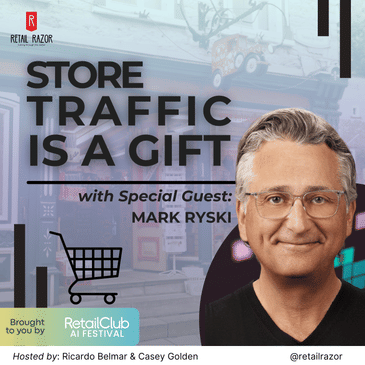



Mark Ryski on why stores convert up to 70% of store traffic while online only converts 3% and Amazon only 10%.
Mark Ryski explains why store traffic is a critical retail metric and how in‑store environments convert far higher than online. Hear data comparisons (in‑store up to 70% vs online 3% and Amazon 10%) and why 77% of shoppers left big‑box stores despite intending to buy (no help, long lines). Practical insights for retail leaders to boost in‑store conversion and checkout experience. This is Season 6, Episode 9.
77% of shoppers who walked out of a big box store without buying told exit interviewers they came in to buy. They couldn't find help, wouldn't wait in line, and left empty-handed. Mark Ryski has spent almost 3 decades measuring that gap. His new book gives it a name: Store Traffic Is A Gift, and most retailers waste it.
This episode, Ricardo and Casey sit down with Mark Ryski, founder and CEO of HeadCount Corporation. Together they dig into retail's most misunderstood metric: in-store conversion. Physical stores convert 20% to 70%+ of their store traffic. Typical online sites convert under 3%, and Amazon converts about 10%. The store converts several times better than any other channel. Yet 84% of retail sales (US Census Bureau, March 2026) still get managed as if online were winning. And so in-store conversion gets treated as a vibe at the end of the day.
In This Episode, You'll Learn.
Why a store can get more traffic and sell less, and what conversion data reveals.
The exit survey result that changed a big box operator's mind about service.
The single fastest conversion win, and why most chains schedule it backwards.
How super converting stores hit 75% while sister stores in the same chain sit at 30%.
The CFO conversation: what 100 basis points of conversion is worth in top-line sales.
What BOPIS, curbside, and Amazon returns really do to store traffic and conversion.
Why accurate store traffic data is the demand signal AI needs before anything else.
Support our sponsors.
This Episode is Brought to You By RetailClub.
Join 2,000 retail leaders at RetailClub AI Festival, September 22–24 in Huntington Beach. Dive deep into how AI is reshaping retail while soaking up the sun at a fully outdoor, beachside venue. Decision-makers from retailers and brands can attend with free tickets and up to $1,250 in travel reimbursement. Head to retailclub.com to learn more. https://retailclub.com/retail-razor-podcast
Subscribe & Follow.
If you enjoyed this episode, please leave us a 5‑star rating and review on Apple Podcasts, Spotify, or Goodpods. Subscribe on YouTube so you never miss an episode and check out the other shows in the Retail Razor Podcast Network: Retail Transformers, Blade to Greatness, and Data Blades.
Subscribe to the Retail Razor Podcast Network: https://retailrazor.com/
Subscribe to our Newsletter: https://retailrazor.substack.com
Subscribe to our YouTube channel: https://go.retailrazor.com/utube
Featured guest.
Mark Ryski. https://www.linkedin.com/in/mark-ryski-8826601/
CEO, HeadCount Corporation. https://headcount.com
Author, Store Traffic Is A Gift. https://a.co/d/00VI3Uuj
Mark Ryski is the founder and CEO of HeadCount Corporation and one of the retail industry's leading authorities on store traffic and shopper conversion. For more than 20 years, he has helped retailers—from independent stores to large national chains in over 20 countries—convert more store visits into sales and make better operating decisions. He is the author of three books on retail performance, including Store Traffic Is a Gift: The Retailer's Guide to Converting Visits into Sales, Conversion: The Last Great Retail Metric, and When Retail Customers Count, the first book dedicated to the study of store traffic. Mark is a longtime BrainTrust contributor on RetailWire and has been recognized as a Rethink Retail Top Retail Expert in 2025 and 2026.
Chapters.
00:00 Teaser
00:32 Show Intro
05:06 Welcome, Mark Ryski!
10:28 Traffic Is a Gift
13:09 Origin Story - Counting Traffic
16:45 Conversion Numbers and Fast Wins
23:16 Exit Surveys Reveal Missed Sales
26:22 Proving Payroll Pays Back
28:08 Inside Super Converting Stores
31:57 BOPIS And Amazon Traffic Trap
38:23 AI Needs Clean Traffic Data
44:52 Optimism For Physical Retail
48:03 Show Close
Meet your hosts.
Helping you cut through the clutter in retail & retail tech:
Ricardo Belmar is an NRF Top Retail Voice for 2025 and a RETHINK Retail Top Retail Expert from 2021 – 2026. Thinkers 360 has named him a Top 10 Thought Leader in Retail, a Top 25 Thought Leader in AGI and Careers, a Top 50 Thought Leader in Agentic AIand Management, and a Top 100 Thought Leader in Digital Transformation and Transformation. Thinkers 360 also named him a Top Digital Voice for 2024 and 2025. He is an advisory council member at George Mason University’s Center for Retail Transformationand the Retail Cloud Alliance. He was most recently the partner marketing leader for retail & consumer goods in the Americas at Microsoft.
Casey Golden, is the North America Leader for Retail & Consumer Goods at CI&T, and CEO of Luxlock. She is a RETHINK Retail Top Retail Expert from 2023 - 2026, and Retail Cloud Alliance advisory council member. After a career on the fashion and supply chain technology side of the business, Casey is obsessed with the customer relationship between the brand and the consumer and is slaying franken-stacks and building retail tech!
Music in This Episode.
Includes music provided by imunobeats.com, featuring Overclocked, and E-Motive from the album Beat Hype, written by Heston Mimms, published by Imuno.
Transcript.
S6E9 Mark Ryski - Store Traffic Is A Gift
[00:00:00] Teaser
[00:00:00]
[00:00:01] Casey Golden: A store can get more traffic and sell less, and we've got the data to prove it.
[00:00:06] Ricardo Belmar: Everybody chases foot traffic. Almost nobody knows what to do with it once they have it.
[00:00:11] Casey Golden: Online converts 2 to 3%. Amazon, 10%. Physical stores, up to 70-plus percent. The store is the best converting channel in retail, and most retailers are giving it away.
[00:00:24] Ricardo Belmar: This episode, Mark Ryski joins us on why store traffic is a gift and how to stop wasting it. You do not wanna miss this one!
[00:00:32]
[00:00:32] Show Intro
[00:00:44] Ricardo Belmar: Welcome back to season six of The Retail Razor Show, the top-ranked indie business, management, and marketing podcast on Goodpods, and the original show in the number one indie podcast network for retail.
[00:00:55] I'm Ricardo Belmar.
[00:00:56] Casey Golden: And I'm Casey Golden.
[00:00:58] Welcome back, Retail Razor fans, [00:01:00] to retail's favorite podcast where we cut through the clutter to give you sharp insights on what's happening in retail today, tomorrow, and where we get real about what's driving the future of commerce, agentic, and people.
[00:01:14] Ricardo Belmar: Here's a number that shouldn't surprise any retailer, but often does. So today, 84% of all core retail sales is still happening inside a physical store. Uh, even by 2030, that's projected to stay well above 75%. So why is it that so many retailers treat the people walking through their front door like an afterthought?
[00:01:37] That's what today's show is all about.
[00:01:39] Casey Golden: That's right. Today we're talking about something every retailer has. Almost none of them fully use it, and far too many give it away for free. Store traffic.
[00:01:52] Ricardo Belmar: Our guest today is Mark Ryski, founder and CEO of HeadCount Corporation, and quite possibly the person [00:02:00] who's spent more time staring at store traffic data than anyone alive. He's the author of three books on the subject, and his newest is called Store Traffic is a Gift.
[00:02:10] Casey Golden: And Ricardo, one of the things I love most about Mark's argument is how counterintuitive it is. We all assume more foot traffic equals more sales, and Mark has the data to show that it's just not true. A store can be busier and sell less. The real game isn't getting people in the door, it's what you do with them once they're there.
[00:02:33] Ricardo Belmar: Exactly. It is all about conversion. And here's a stat from the book that puts it all in perspective, and I bet most retailers aren't, necessarily thinking about. Online retail converts about 2% to 3% of their traffic. Amazon, you know, give them extra credit, around 10%. But physical stores could be anywhere from 20% to 70-plus percent, depending on the category and the segment.
[00:02:56] The store is the best converting channel any retailer has, [00:03:00] and most retailers are just leaving that advantage on the table.
[00:03:03] Casey Golden: So in this episode, we really get into why traffic is a gift, how to convert more of it, why your store team is your superpower, and maybe most importantly, why the future of physical retail is a lot brighter than the headlines would have you believe.
[00:03:21] Ricardo Belmar: That's right.
[00:03:22] So before we bring Mark in, a quick word about the folks who make this show and the Retail Razor Podcast Network possible: Retail Club. Join 2,000 retail leaders at the Retail Club AI Festival, September 22nd to 24th in Huntington Beach, where you'll dive deep into how AI is reshaping retail, all while soaking up the sun at a fully outdoor beachside venue.
[00:03:44] Decision-makers from retailers and brands can attend with free tickets and up to $1,250 in travel reimbursement. Head to retailclub.com/retail-razor-podcast to learn more and get your ticket today. So be sure to join me [00:04:00] and Casey this fall at Retail Club for the best conversations on how AI intersects with the customer experience and every operational part of your retail business.
[00:04:09] Casey, I think this is a perfect lead-in actually, because making the most of every shopper's experience is exactly what today's conversation's gonna be all about
[00:04:17] Casey Golden: Right? And before we dive in, two quick favors.
[00:04:21] If you're getting value from the show, we love recording it, but we, we really do it for you. I'd like to think we know who you are, but please hit this like and subscribe in your favorite podcast player and on our YouTube channel so you never miss an episode and we get that extra boost of motivation in the morning. And if you really wanna help us out, leave us a five-star rating and review on Apple Podcasts, Spotify, or Goodpods. It genuinely helps more retailers find the show, and it means the world to us.
[00:04:56] Ricardo Belmar: All right. With that said, let's get into our [00:05:00] conversation about store traffic and conversion with Mark Ryski, CEO of HeadCount Corporation.
[00:05:06] Welcome, Mark Ryski!
[00:05:11] Ricardo Belmar: Mark Ryski, welcome to the Retail Razor Show. We are genuinely excited to have you with us today after we've been planning this for, God, I, I don't know, how many months has it been?
[00:05:23] Mark Ryski: No idea. No idea. Decades in the making, Ricardo and Casey
[00:05:28] Ricardo Belmar: Exactly
[00:05:29] Casey Golden: Right. Mark, for anyone meeting you for the first time, you've spent more than two decades doing something that almost no one else does, analyzing what actually happens when a customer walks through a store's front door. You're the founder and CEO of HeadCount Corporation. You've written that many consider the foundational books on retail traffic and conversion, and your newest, Store Traffic is a Gift, is something we've got to dig into.[00:06:00]
[00:06:00] Mark Ryski: Well, I'm excited to be here and, and chat about it with you all. And, and I'll just say this, I think I'm officially into the obsessed category after, almost three decades and three books into it. So yeah, delighted to have the conversation.
[00:06:13] Ricardo Belmar: Yeah, well, that, that is like a perfect place to start because it- it's also something that I, I think at some level, right, sounds simple, but the idea underneath it might just change how every retailer in our audience is gonna think about their stores. So I'm looking forward to getting into this.
[00:06:28] so with that said, let's just dive in. Mark, you open the book with a claim a lot of retailers, I think, might call, total heresy, that a store can get more traffic and sell less, and can actually sell more when traffic is down. So walk us through that. Why isn't just a, a simple statement of more people in the door the whole story?
[00:06:50] Mark Ryski: Yeah, well, it, it, it sounds utterly counterintuitive, doesn't it? Because store traffic i- is what does drive sales. No traffic, no [00:07:00] sales. I mean, it, it, it's obvious. But the reality is when you measure store visitation and in-store conversion rates, that's where the answer really lies. And so stores can become too busy.
[00:07:13] it's hard to find an associate. Checkout lines get clogged up. You can't get any assistance, and people just leave the store without buying. And so, the reality is these retailers don't even know that that shopper came to the store. They merely look in the till at the end of the day, count the money, and say, "Hey, was it a good day or not a good day?"
[00:07:32] And so when you look at this data, what you discover is that there are stores that have high traffic, but conversion rates sag, therefore their sales don't increase. And other stores that may not have as much traffic, they improve their in-store conversion rates, and lo and behold, deliver positive sales growth.
[00:07:50] And so it's really all about two parts. Part A is you gotta get traffic in the store. No question about that. But the more important part, part is [00:08:00] what you do with that traffic when it, when it enters the store. And that's really what I'm trying to shine a bright light on and have been doing for the last several decades.
[00:08:09] Ricardo Belmar: Yeah. So it's fair to say in this, again, it's like one of these things that should be obvious to every retailer, but maybe it, it, it gets overlooked. I mean, it's not really about the total store traffic you get through, to your point. It's, it's what you do with it and how that affects your conversion rate, right?
[00:08:25] Mark Ryski: Exactly right. And many retailers still rely on transaction counts as a proxy for traffic. And, the, the trick with that is you're only looking at the people that bought, and you're missing all those people that may, may have visited the store and left without buying. And that is the opportunity that I think many retailers, have yet to really, seize upon
[00:08:48] Casey Golden: I agree, and I think that that's something that just classically wasn't able to be measured. it was a vibe at the end of the day.
[00:08:57] Mark Ryski: It was a vibe, you
[00:08:59] Casey Golden: I was a [00:09:00] vibe.
[00:09:00] Mark Ryski: It was a vibe.
[00:09:01] Casey Golden: like, "I feel like we need like two more people tomorrow."
[00:09:06] Mark Ryski: Yeah. Well, and there's something to be said for the int- there is something to be said for the intuition of what a store leader can, can determine, but it can also be quantified. just juxtaposition the physical, physical retail versus online. From the earliest days of online and e-commerce, traffic and conversion rates were the foundational metrics,
[00:09:28] Right.
[00:09:30] Casey Golden: I always say if our in-store conversion rate was 2% and we let 98 people out of every 100 that walked into our physical store walk out without a hello, we would close the store and fire everyone know, just like value-wise, like, oh my gosh, that is just horrendous value methodology of saying that it's okay that only two out of every hundred buy something.
[00:09:58] I'm like, "No, it's
[00:09:59] Ricardo Belmar: No, it's [00:10:00] not.
[00:10:01] Mark Ryski: No,
[00:10:02] Casey Golden: really not okay
[00:10:03] Mark Ryski: And you keep doing that, you won't have 100 people visiting either. So this, you know, th-
[00:10:08] Ricardo Belmar: that too. Yeah. Yeah
[00:10:10] Mark Ryski: B- but again, still to this day, executives, retail executives will obsess over their online traffic and conversion numbers. And yet when it comes to the physical store, the goal is just get traffic into the store and the rest will take care of itself.
[00:10:23] And, and again, no. I'm here to tell you that's not the case.
[00:10:28] Traffic Is a Gift
[00:10:28] Casey Golden: So the book is called Store Traffic is a Gift. I love that you use the word gift because shopping I feel, is about hospitality. There should be gifts involved back and forth, right? And you say that the gift gets squandered every hour of every day. Where did this phrase come from, and what exactly do you mean by it? And how is this, how is this something that you've spent, most of your career now building, a company around [00:11:00] when retailers, don't even measure this?
[00:11:02] Mark Ryski: Right. It, you know what? I, I heard the phrase from a store manager who mentioned it to me in passing. And w- when this store manager just mentioned it, store traffic is like a gift, it just... A thousand watt light bulb went on over my head. And I just said, "Kid, you just captured the essence of really what this is all about."
[00:11:22] And that if retailers treated those visits like true gifts, then they would think very differently. Retailers talk all the time about putting the customer at the center of everything and all the rest of it. Well, one of the first things you ought to do is measure how much of it you have. So store traffic is a gift, but the corollary to that is to unwrap that gift, you need to convert that traffic into a sale.
[00:11:46] And it, it's not about being aggressive or overly assertive. It's about delivering a great s- store experience that results in a sale. And that's what it's all about. And I just thought gift captured really the [00:12:00] reality of, of, of what that store visit represents today.
[00:12:04] Casey Golden: Well, I think there's a quote in your book that I really liked. "Store traffic is precious, and it's a non-renewable resource."
[00:12:11] Mark Ryski: It's true. And i- it's... So it's precious in that that person made the conscious effort to get off the couch, get into their vehicle in, in most cases, and drive somewhere and physically visit your store. That's a huge commitment. And so that makes it precious. and it's non-renewable when you don't deliver a great store experience.
[00:12:37] They came to buy, waited in checkout line, got frustrated because they couldn't even give you their money. They dropped their basket and walked out. it's non-renewable because there's a good chance they may never come back. There are so many places and ways to buy any, every product in this day and age.
[00:12:55] No retailer can take this for granted. And so when I hear retailers say, [00:13:00] "We have a destination store," u- unless you're on Mars, I don't believe that to be true.
[00:13:09] Origin Story - Counting Traffic
[00:13:09] Ricardo Belmar: Marc, tell us a little bit about your retail background and, and how you got to be as, as you put so obsessed with this particular concept that's so important.
[00:13:18] Mark Ryski: Gladly. l- like many of us, I worked in retail stores. I was a, an associate, a store manager, and ultimately I became the marketing manager of a computer and software store in the early 1990s. Okay, so f- for those i- in your, in your audience that may not remember these days, you used to have to go into a physical store and buy software off the...
[00:13:39] Ricardo, you're, I, I know that you still, you might, you might remember it. Casey, you're pro- too, too young for this. But you, you would buy software off the shelf and, and PCs would cost 3, 4, $5,000. So it was a high involvement purchase decision.
[00:13:53] Casey Golden: Highest
[00:13:54] Mark Ryski: I was the mar-
[00:13:54] Casey Golden: risks?
[00:13:56] Mark Ryski: Really? Were they truly floppy or were they already [00:14:00] the hard ones?
[00:14:01] Casey Golden: were floppy.
[00:14:05] Mark Ryski: Okay. Well, I stand corrected, Casey. Thank you for that. Okay. So we ran this great... It was an independent single location retail store, and it was a, a pretty big operation for a single location store. I was the marketing manager. My job was to generate traffic that connect- connected to sales. And so we would do newspaper advertising, on-site radio remotes, a little bit of television, et cetera.
[00:14:30] We, we would have a lineup of people outside our doors, and this happened on one particular occasion. Major promotional event. The store was overrun with visitors. It was great. We had 25 sales associates that were really capable, professional, really trying to serve these customers. As the marketing manager, I'm standing there watching people come into the store, wander, not get served, and leave without buying.
[00:14:55] At the end of the day, the store owner counts the money in the till and says, " Eh, Risky, [00:15:00] that promotion was just, eh, it was okay." The sales fell short of expectations. And honestly, that bugged me. That really bugged me because I thought, "What more is marketing supposed to do than to create opportunities in the store?"
[00:15:14] And so that's when I realized I needed, I need to count and measure this traffic. That's gonna be indicative, uh, of the success signal. So back in the day, I was trying to find a traffic counter, and electronic p- traffic counters have been around since the '70s, by the way. And some used the hand clickers, okay?
[00:15:33] infra-
[00:15:34] Casey Golden: I had a hand clicker, somebody up front to greet everybody, and I'm
[00:15:36] Ricardo Belmar: Yep. You can click it. Yeah.
[00:15:39] Casey Golden: "Click it."
[00:15:39] Mark Ryski: At that time, infrared beams were the, And, oh, by the way, I was intrigued by your pod with, uh, Kim Campoy and her experience as a front line and people doing the limbo under the infrared beam to not get counted. So it was that era.
[00:15:55] Ricardo Belmar: Yeah.
[00:15:56] Mark Ryski: Any- anyway, so I, I finally found a [00:16:00] company that sold one of these things.
[00:16:01] It was about 2,500 bucks. And I went to the owner of the store and I said, "Hey, look, I'd like to buy this traffic counter so we can understand marketing impact." And he said, "What? 2,500 for that gizmo? You could do another radio remote for that." And I think that response is really still indicative of the way some retailers think today.
[00:16:19] Nonetheless, and undeterred, I went to a couple of the engineering students who happened to also work part-time in the store, and I said, "Hey, can you guys build me a traffic counter? Infrared beam, dump the data to an, into Excel, and then I can analyze it from there?" They said sure. $300 in parts from RadioShack, and I was in the traffic counting business in
[00:16:39] Ricardo Belmar: There you go. There you
[00:16:41] Mark Ryski: how it all started
[00:16:42] Ricardo Belmar: Wow
[00:16:43] Casey Golden: Wow. this gets me all the time.
[00:16:45] Conversion Numbers and Fast Wins
[00:16:49] Casey Golden: Like, physical retail does over 50% of the business, a lot of times we can say, like, it's like in the 60s and 70s. I don't know if we're at the 80s anymore. But it's no surprise that, physical stores [00:17:00] convert dramatically better than online, even better than an Amazon. But give us the numbers and, and tell us why th- why is this narrative always buried? And all the narra- all the... Everybody's always talking about online search, online conversion rate, online this, ROAS. Like, it's always about e-com, and it's always about digital, and that's not what's paying the bills.
[00:17:26] Mark Ryski: Exactly
[00:17:27] Casey Golden: time it costs more
[00:17:28] Mark Ryski: exactly, Casey. And look, let me give you some updated facts, okay? According to the US Census Bureau quarterly e-commerce sales report March 10, 2026, physical stores represented 84% of sales
[00:17:44] Casey Golden: are still in the '80s
[00:17:45] Mark Ryski: Okay? Let that sit for a moment. 84-- 83 point something to be exact. And it does depend on the category. Some categories have higher and lower.
[00:17:55] let's go back to the online versus brick-and-mortar conversion stats. So the [00:18:00] typical online site will convert less than 3% of traffic. Amazon, excluding Prime members, converts around 10%. They are the undisputed champ, obviously, in, in online retail. In physical stores, depending on the category, you'll see conversion rates of 20, 30, 50, as high as 60 or 70% in general merch stores.
[00:18:20] So as you can imagine, in a jewelry store with very exclusive merchandise, you're gonna have much lower conversion rates, but you're gonna have extraordinarily higher, higher average ticket values. specialty stores, sporting goods stores, mer- apparel can have conversion rates in the 20, 30, 40% range. So it is profoundly higher conversion, and it comes down to-- here's the reason why: intentionality.
[00:18:45] Remember when I said, the effort it takes to get off the couch, get in your vehicle, drive over to a physical store? And many of these store visits are, the precursor is an online visit, so you gotta do both well. It's not an either/or, and it never [00:19:00] really has been. but the point of the matter is, when that person crosses the threshold of the store, store operators need to treat those visits, they are people coming looking to buy.
[00:19:13] Now, that's not to say there's not incidental traffic, and again, back to, Kim's comments about you get families coming together or don't visit. Again, I, I do think, that gets overplayed. You do get some noise in the data. But when you look at this data over time, it becomes very clear of just the-- how profound the conversion advantage is in physical stores
[00:19:34] Casey Golden: So if the in-store conversion advantage is, is like that big, which truthfully it doesn't surprise me, it just-- it's a nice reminder because why are so many retailers still manage as if online is winning?
[00:19:50] Mark Ryski: Well, you tell me, Casey, because y- I mean, this is the bane of my existence. this is what has in part motivated me all these [00:20:00] years. You know? It's like, uh, and I know it's become cliche to say shiny object syndrome and focusing on new. I think that s- still to this day, too many retail decision makers and leaders take that store visit and their stores for granted.
[00:20:17] and, I, I think they do so at their own peril
[00:20:20] Ricardo Belmar: Yeah. Yeah. No, I, I, I completely agree with you. And, going back to the stat you just referenced, right, which that's like 84%, right, of those sales happening in store. And I think you're, and you're right that there's influence on both sides, right? Because most shopper journeys don't just start in one channel and stay there anymore.
[00:20:37] Online influences in store, in store can influence online and, and back and forth. So let's, let's make this a little more usable. You, you have so many great, tactics and, and, and strategies in, in the book. for any of, any of the operators listening in the audience now, you, you have five tips for converting more visitors in one chapter of the book.
[00:20:55] What, what would you say are the moves that, really move the needle the fastest?
[00:20:59] Mark Ryski: [00:21:00] Right. And you know what? I put those tips early o- early on in the book, excuse me, because, I get asked this question all the time. "Hey, Mark, what are the, what do I need to do to improve conversion rates?" And I don't wanna overly simplify it because it's not that simple, but in some ways it is.
[00:21:18] First and foremost, and this seems like a profound statement of the obvious, you need to align your staff resources to when people are actually visiting your store, God's sake.
[00:21:29] Ricardo Belmar: right. You'd, you'd think that would be the no-brainer, right?
[00:21:32] Mark Ryski: Yeah, you'd think that would be the no-brainer, but it is the, the single biggest lever that I recommend to any retailer of any size or category, and that is just aligning those precious resources.
[00:21:43] And we know the challenges retailers have in recruiting and retaining. The turnover rates in retail are extraordinary. and so these precious resources need to be placed where they c- they have the greatest potential to, to convert, and that is just being there when the [00:22:00] shopper's there. And that's what traffic informs.
[00:22:02] Ricardo Belmar: I, I totally have to agree with that. I guess the challenge, I imagine you're finding the challenge with a lot of retailers is that assumes that they're accurately measuring traffic, right? V- versus just keeping track of the sales because I, I think it's an easy trap to fall into to say, "Well, I know this is my peak sales time of day, so that's when I want to be staffed for it."
[00:22:23] But that doesn't necessarily directly correlate to when your peak traffic is.
[00:22:28] Mark Ryski: Exactly. And that problem, tends to bubble up for retailers that don't track traffic at all and merely look at transaction counts as a proxy for traffic. And, I always very gleefully like to present to retailers that have never seen traffic data before when I do collect some data in their store and compare it to their transaction counts.
[00:22:50] And they see the dramatic difference between visits and transactions. and then realize that, "Yeah, hey, we may be missing a huge [00:23:00] opportunity." And that's when the light bulbs start to go on and, that- that's when they ask for the tips on how do I convert more?
[00:23:06] Ricardo Belmar: Right. ,
[00:23:08] Casey Golden: Store labor is the physical retailer's secret weapon. You've mentioned that in your book. and you argue that most retailers schedule it backwards.
[00:23:16] Exit Surveys Reveal Missed Sales
[00:23:16] Casey Golden: What are they getting wrong?
[00:23:18] Mark Ryski: Well, let's start, with the question or the idea of labor being a conversion secret weapon. I've worked with g- countless retailers and, some of them, believe that staff are important but they have a self-help or a low-assist service model. And I was working with one such retailer.
[00:23:40] They're a big, big box store, 60,000 square feet, lots of staff. And they were intrigued by trafficking conversion but said, "Look, everyone who comes buys and, I don't think we're missing many opportunities." And so what we did to explore this idea is we conducted a series of exit surveys in [00:24:00] front of their store of people leaving without making a purchase.
[00:24:03] Casey Golden: Oh, how embarrassing
[00:24:04] Mark Ryski: we r- okay, so we did this by identifying people that walked out without a shopping bag. We did an, intercept interview. And we, we asked only two simple questions. Number one, "Did you intend to make a purchase today?" Okay, this is only of non-buyers.
[00:24:19] Response, 77% intended to buy. Okay, well that's a bit of a
[00:24:27] Ricardo Belmar: That's a big number.
[00:24:28] Mark Ryski: W- why didn't you buy? And when you, when you compiled all the responses, and we just took them verbatim, we didn't, probe further, it was remarkable how many responses came down to, "Couldn't find anyone to help. Didn't wanna wait in line. Couldn't get my questions answered," even in what is deemed to be a low-service environment.
[00:24:48] And this was quite a revelation to that store operator. And, consequently, it changed their view. B- back to the question. That engagement with that frontline employee, Casey, is [00:25:00]profoundly valuable in conversion. And w- whether it's... I- and it's not just merely greeting, but understanding that when that shopper crosses the line, uh, the, the lease line and enters the store, they're there to buy something.
[00:25:14] And that frontline person's job is to engage that shopper, deliver a great experience, and ultimately facilitate the transaction. And when you go in with that kind of intentionality, both the shopper and the retailer, then conversion rates improve. You can't improve conversion rates from head office. You cannot algorithm your way to success in a physical store.
[00:25:36] It's people that make the difference
[00:25:39] Casey Golden: Yeah. I mean, I come from luxury, so I mean, it's just like every single person that walks through the door is just, like, very, very, very important. there's just, like, so much of an expectation that you have to, meet. but if somebody did walk out without a bag... 'Cause I think everybody was just like, "I had no intention of spending this much [00:26:00] money.
[00:26:00] I came in here for a pair of shoes, and you sold me a whole new wardrobe." And I'm like, "Yeah, I know. I'm dangerous." But at least if somebody came in and they, they didn't buy anything, I think so much of it was like they still left with, a hug. know? literally. And I think that there's so much to kinda take away from that, that methodology.
[00:26:22] Proving Payroll Pays Back
[00:26:22] Casey Golden: but when a CFO says, "Hey, payroll's too high," how do you use this traffic data to provide, to prove that, understaffing is actually costing them more in more lost sales?
[00:26:34] Mark Ryski: Yeah, that's an important topic. And i- what you described is what frequently occurs. retail still by and large is about cost minimization versus sales maximization no matter what they say. And you know what? Look, I, I, I don't wanna be hard on retail, retailers and the way they think about this.
[00:26:50] Labor is a huge cost, one of the largest expenses, and, it, it often gets wasted or, or misdeployed. And so it starts with [00:27:00] making that CEO see what the traffic opportunity is. And we go through a little exercise where we show them what 100 basis point or one full point of conversion improvement could actually mean in top line sales.
[00:27:12] And that usually gets the at- the attention. to a large extent, most retailers vastly underestimate how much traffic opportunity their stores get. And, I presented to retailers where we've shown them that we estimate their annual traffic in hundreds of millions of counts. And so moving that conversion needle even a little bit, 50 basis points, 25 basis points, can translate into tens or even hundreds of millions of dollars in top line sales.
[00:27:41] And so that's the language, that's the way to engage a CFO. And furthermore, I would say it's not just about saying just blindly trust, but experiment. Okay, so now that we understand your traffic and conversion, let's see how you can move the needle. And if you can do some [00:28:00] experimentation around traffic conversion in test and control stores and move that conversion needle, then you have proof positive that you can influence those outcomes.
[00:28:08] Inside Super Converting Stores
[00:28:08] Casey Golden: You introduce this idea of super converting stores within the same chain on, on the same brand. Conversion can vary widely from store to store. What separates these standouts? Are they just always top doors?
[00:28:22] Mark Ryski: No, they're not. And that's what's really amazing about this. That's what you would believe to be true. But, I- I've done this countless times, and that is mapping the conversion performance across a large fleet of stores. And, so commonly retailers will say, "Well, what's, what's the conversion average for my category?"
[00:28:42] Forget that. Within your own chain, the conversion rates can vary from 30 to 75%. So the question is: What are your stores that are converting at this high level doing that your other stores are not? And I would argue that your own store conversion rates across your fleet are more important than the [00:29:00] external numbers because your stores all have similar products, systems, training, et cetera, et cetera.
[00:29:06] They're more comparable. When you start to break down... So to your question about which stores tend to be those, they can be old stores, new stores, the big stores, the small stores. So much has to do with the store team, the store leader, and how they're operating. Now, there may be some that are structural circumstances.
[00:29:27] A particular store, sells low-ticket items, and they're located by the theater, and they always get a certain amount of activity. You can find those anomalies and put them to the side. We use, an approach we call quadrant analysis to show if the store is high traffic and high conversion or low traffic and high conversion.
[00:29:44] And the low traffic, high conversion stores are some of the very best performing stores, but they're low, low sales volume because they have low traffic visitation. And so these are some of your best performing stores that don't look that interesting 'cause they just [00:30:00] don't generate enough volume. Anyway, when you start to map this out using store traffic and conversion data, these stores bubble to the top, and then what we do is we say, "Now, let's study your super converting stores. Let's start with how much labor you're putting in the stores." Remember, labor tends to follow sales, so stores that have higher sales get more labor. We show them stores that have high traffic and low conversion. We say, "Hey, these are opportunity stores." Well, if they sell more, we'll give them more labor. Classic chicken and egg
[00:30:32] Ricardo Belmar: Yeah. Right. It, it become-- It goes backwards
[00:30:35] Mark Ryski: Exactly. So that's what I'm referring to when I, when I mean they're s- still staffing to sales outcomes and not the traffic opportunity
[00:30:44] Casey Golden: Can a struggling store be coached into a super converter? Do you think it has a lot to do with like just format or location or like do you think, you know, any store can be coached into a super converter?
[00:30:57] Mark Ryski: Well, I, I think every store has [00:31:00] the potential. If we accept the fact that the retailer put that store in that location and they made good sound location decisions in the
[00:31:08] Casey Golden: Yes, let's say that it's not in the middle of a tomato field, you know, 200 miles away from any town.
[00:31:14] Mark Ryski: Unless you're selling ketchup, then it might
[00:31:16] Ricardo Belmar: then maybe, yeah, or tomatoes.
[00:31:19] Mark Ryski: Yeah, right Uh, so look, I think that every store organization leadership should take the approach, if we're gonna open a store, why can't it be a super converter? And that's sort of the, the... I theorize that in the book and say, "Well, why can't every store?"
[00:31:38] And i- i- it's not likely that every store is gonna be a super converter, but it shouldn't... Every store can improve their conversion rates, and I think that's the more important message I'm trying to make. And the way you improve conversion rates across your entire fleet is by studying what your super converting stores are doing.
[00:31:55] Ricardo Belmar: No, that's a great point.
[00:31:57] BOPIS And Amazon Traffic Trap
[00:31:58] Ricardo Belmar: So how about, when retailers have, o-over the [00:32:00] recent years especially, they've been adding services like buy online, pickup in store, and these kind of help blur that line between digital and, and physical. But how have these kinds of services, whether it's the, the BOPIS or there's just curbside pickup or, bringing online sales and those returns into the store, how has that changed or reshaped what store traffic and conversion mean for a retailer?
[00:32:22] a-and I'm, 'cause I, I think even in that context, right, most retailers see Amazon as a competitor, but how does Amazon actually influence their own physical store traffic?
[00:32:32] Mark Ryski: Okay. I'm gonna break this into two. There's two parts to this 'cause there's the whole Amazon thing, and we, we ... I'm glad you raised that question. let's go back to your first part about BOPIS, curbside, and these other services. So these services have been around for a while, but it was really the impact of the COVID-19 pandemic that really accelerated things, that tremendously changed shopping patterns, behaviors, and intentionality.
[00:32:59] And [00:33:00] so some thought that, well, it makes conversion meaningless because not every visit is intended to convert into a sale. I'm here to pick up an online order. But I would a- argue that it's made traffic, data even more valuable. A traffic data contextualizes the operational demand on a physical store.
[00:33:19] That operational demand includes BOPIS pickups curbside activity. And so during the pandemic, what we started to do with some clients that were seeing a lot of BOPUS activity is we would measure how many BOPIS transactions or orders they were processing relative to the traffic their store was receiving so that they could better apply their resources.
[00:33:40] Two stores may get, may have 20 BOPIS, transactions to process in a day, but one, if one store gets only 100 visits, that's 20% of the visitation. In another store, it may be 1,000 visits, but it's only 2%. So that added further clarity. and so it's more relevant, not less relevant. That would be my argument [00:34:00] on, the impact of these things.
[00:34:02] Oh, Amazon. Oh, Amazon. So- If you consider, let's ... So Amazon. Okay. So Amazon today has tens of thousands of physical access points by the virtue of pickup lockers, returns desks, and even store within store, kiosks. And it's almost as if retailers have made this Faustian bargain, trading floor space for traffic.
[00:34:30] Again, it goes back to this underlying belief that store tra- if I can get more traffic, the sales will follow. And we've studied this with a number of retailers that we work with, looking at their store traffic and conversion rates. And what you will often find, is that tr- indeed, traffic goes up.
[00:34:46] Converting those Amazon returns is a whole entirely different proposition. And what retailers are finding out is that not only is it very challenging to convert an Amazon drop-off customer [00:35:00]into a, a regular intentional customer, but there's a downside to it, that it ... Distracting for store teams. it takes them away from serving the intentional shoppers, and it, it consumes floor space and effort, time, and attention.
[00:35:14] And so I think retailers are really grappling with, "I want the traffic, but I need the sales, and why aren't I getting those?" And when you look at the data, it, it literally jumps off, the page, to see the change in traffic and conversion trends.
[00:35:30] Casey Golden: I think an interesting thing on that is who, who's not frustrated just a little bit, a little annoyed when they go to make a return and drop it off?
[00:35:42] Ricardo Belmar: Hmm.
[00:35:43] Casey Golden: I'm not really walking in that store in the-- necessarily in the right frame of mind 'cause I'm slightly annoyed, slightly frustrated. I'm just reminded that I even have to do this to return this item.
[00:35:57] And [00:36:00] whatever I'm returning most likely isn't a direct reflection of like whatever's being carried where I am. Like, I have no desire to like go grocery shopping when I do a Whole Foods like Amazon return. It's like not happening. I'm not buying something perishable. I'm on my way to a meeting. I'm doing like other things to drop that thing off slightly annoyed that like I even bought the thing 'cause I have to return it, and I'm like frustrated with the quality or size or whatever.
[00:36:27] And so they're not-- you're paying for customers that need to be extra customer serviced because they're walking in in a different frame of mind than a general customer that's walking in with maybe 70% intention of buying something, slightly excited, looking to be inspired, is ready to shop.
[00:36:47] Mark Ryski: I, Casey, I think you've hit it on the head. And in fact, what you're describing is actually even a, a, I think an, a more important nuance, and that is the mindset of that person doing that Amazon [00:37:00] return. You're pissed. You're frustrated. You're, you're inconvenienced at least, okay? And so that's a different frame of mind.
[00:37:08] And so now when I approach you and say, "Oh, hey, thanks for visiting our store. I have a $10 off coupon if you wanna come and buy," and you go, "I, I've
[00:37:18] Casey Golden: bucks
[00:37:18] Mark Ryski: enough of my
[00:37:19] Casey Golden: in line for me.
[00:37:23] Mark Ryski: And so therein lies the conundrum. But you know what? That gets lost when at the head office on the whiteboard they go, "But we can get more traffic in the store."
[00:37:32] Ricardo Belmar: More traffic, yeah. Yeah, yeah. H- how does that compare to how you think about that, BOPIS customer who's just there, who, who did make a purchase online, they're just coming to pick up the item, so they're, they're not quite the same frame of mind as the return customer, but... And, and sure, it increases the traffic count number, but now how do you treat that differently?
[00:37:56] How do you account for that when you just have a dashboard that says, "Here's your [00:38:00] store traffic"?
[00:38:00] Mark Ryski: Yeah. I, I mean, I thi-- Well, that's a different experience altogether. This is likely gonna be a happier customer, and I think your ability to influence... I, I think if you take the position that as a store team, anyone who crosses the threshold can be served in a way that can result in a sale, that's a good pl- that's a good starting point, regardless of what the original intention of the visit was in the first place.
[00:38:22] Ricardo Belmar: Yeah, no, that's a good, good perspective.
[00:38:23] AI Needs Clean Traffic Data
[00:38:23] Ricardo Belmar: Well, I, I think especially since, the fact is, right, it's 2026, we're, we're all surrounded by endless dashboards and managing all of these metrics and KPIs in retail. And now we're all trying to find ways to layer AI onto these dashboards to give us better interpretation of the data, and analytics of it.
[00:38:42] And yet, you've pointed out that there are still many retailers not truly counting the store traffic, that they're relying on other data points as a proxy for that. And, and then there are still some who are collecting that data, but they're not really using it in, in the way that you're talking about to impact [00:39:00] conversion.
[00:39:00] So how is it that it's 2026 and this is still happening? Um, y- y- where... I- if you're one of those retailers, where do you start to, to correct this?
[00:39:10] Mark Ryski: Yeah. I, I mean, I couldn't agree with you more. AI is moving so fast and in so many directions, it's hard to get your, your hands around it. I, I find it truly int- interesting that when I r- read the... And often the organizations that are promoting AI services and platforms and solutions will talk about use cases like staff optimization.
[00:39:32] And i- in these cases, in the things they talk about, they say, using traffic data. Yet a lot of retailers don't even have traffic data. So it's selling the aspiration, and I get that. But here's what I know for a fact, and that is regardless of how you're gonna use AI or, or em- employ, deploy it, you need good, reliable, foundational data.
[00:39:57] Let's be honest. A big barrier [00:40:00] to AI adoption and the use of, of analytics and deci- data-based decision-making is bad data. It still is to this day. And so, the first step is you gotta collect the data, and it's gotta be accurate. A lot of retailers, and especially the biggest brands, the most successful brands, they track traffic in their stores, but many still do struggle with data accuracy.
[00:40:22] And so if there's a believability problem, they won't action it, they won't schedule labor to it. So it starts with you need the data, traffic, really important. It needs to be accurate. You need to treat it... I think, I think it belongs in the, the, the CFO's office. Just like they audit their financial statements, they should be auditing their traffic data for its veracity and accuracy so that they can properly make decisions based on it.
[00:40:47] So these are some of the barriers. The aspirations are great, but you need foundational data. And, traffic data is, is one of those things.
[00:40:55] Casey Golden: In your final chapter, imagines AL, as in [00:41:00] like a, an algorithm, the AI store asso- associate of the future. if you could give an AI driven store one prime directive Is that supposed to say AL or is it AI?
[00:41:14] Ricardo Belmar: It's, it's
[00:41:15] Mark Ryski: Okay. It's actually Al.
[00:41:17] Casey Golden: It is "AL".
[00:41:17] Ricardo Belmar: Al.
[00:41:18] Mark Ryski: Al i- is the name of the sales associate's name badge. My name is Al as in "Al Gorithm"
[00:41:25] Casey Golden: Oh
[00:41:27] Ricardo Belmar: Yeah.
[00:41:27] Mark Ryski: thought I was being clever there, Casey. I'm gonna have to work on that a bit.
[00:41:31] But anyway, yes, "Al" is the associate of the future and his prime directive should be to convert traffic into a sale.
[00:41:42] Ricardo Belmar: Yeah
[00:41:42] Casey Golden: Easier said than done. I mean, I think it's hard for a human to do that. Is, do we really have a recipe that we could give an AI, uh, sales associate, like that level of that playbook.
[00:41:58] Ricardo Belmar: Well, to be clear, I'm [00:42:00] not advocating for it. I'm just really reflecting back what I'm seeing in, in the domain of what's being promised. And, b- but let's also be, candid about the realities. when I worked in a computer retail store, and for a while I was an associate, just having product knowledge about every l- Right
[00:42:19] Mark Ryski: uh, all the s- all the features and benefits of different products, it was really hard to get your, your head around at times.
[00:42:25] And so there's great promise in what these kinds of tools can do. And in fact, automated stores are starting to happen, primarily in Asia and other places.
[00:42:35] Look, I still believe that shopping is still a, a human experience, and that's why I do believe in the future of it. and that I don't think it's gonna go away anytime soon, regardless of how automation, robotics, and other tools and, and, and, methods are gonna be employed in physical stores.
[00:42:52] Casey Golden: Do you think AI will make store traffic data more valuable or less? Is there something specific that [00:43:00] you really see as a huge benefit or value add for AI as a use case that would have any of our audience members that is currently not counting to go ahead and do that right away because of?
[00:43:19] Mark Ryski: Yeah. A- and I think that the because of, and that it's a great way to frame, frame the question, is it is store traffic is the most reliable and most accurate demand signal that you can have for a physical store. And so if you have an accurate, reliable demand signal, that's what AI needs to ingest so that you can do all these other remarkable things with it.
[00:43:47] So I think that store traffic is becoming the c- it's the cornflakes of analytics is, the way I like to call it in the retail domain. And, I think people are rediscovering it all over again. [00:44:00] And I'll, I'll leave you with this, this, comment that Jeff Bezos, founder and former CEO of Amazon, made in a Harvard Business Review, interview that he did years ago.
[00:44:09] He was asked, "Jeff, what do you see coming in, in the future?" And he s- he said, "You know what? I get asked that question quite a lot, and we, we, we speculate about these things at Amazon. But the question, a more important question that I almost never get ans- asked is, 'What won't change in the next 5 or 10 years?'
[00:44:29] Because at Amazon, we can spin up some pretty big flywheels around those things that don't change." And for, from my perspective, I think store traffic is one of those things. People, as far as we wanna look into the future, are gonna visit physical stores. And so to that extent, I think traffic is, is gonna remain relevant for, for a very long time.
[00:44:50] Ricardo Belmar: Yeah. No, I completely agree.
[00:44:52] Optimism For Physical Retail
[00:44:52] Ricardo Belmar: i-i-is that, is that probably what, what you're most optimistic about the future of physical stores? That the store traffic isn't going [00:45:00] away, it's gonna remain and be-- and most important?
[00:45:04] Mark Ryski: Yes. That certainly underpins my, obsession.
[00:45:07] Ricardo Belmar: Yeah. What, what do you tell retailers that they should do with this optimism?
[00:45:12] Es- especially with my, one of my biggest pet peeves is every time you see in press and things, this headlines about a retail apocalypse coming back. That was like, we-- it's the one story we can't get to die once and for all, despite what all the, the, the data tells us. But you know what, what, what I really love about what you've, talked about in the book, and it really presents an optimistic picture for stores and, and I think justifiably so.
[00:45:38] So what, what would you tell retailers that they should be doing with this level of optimism?
[00:45:42] Mark Ryski: not taking it for granted to truly treating it for what it is. I did a national TV interview with a business correspondent a few weeks back. National business correspondent. And her first question was, "Isn't everybody just shopping online today?" And so i- this is such [00:46:00] an unhelpful belief, that persists, and I think that in part informs retail execs and decision-makers'
[00:46:06] Ricardo Belmar: Mm-hmm.
[00:46:06] Mark Ryski: obsession with online, believing that's all incremental business and the store takes care of itself.
[00:46:11] And I simply say this: follow the money. And the money is in the store, and that's where the traffic is.
[00:46:18] Ricardo Belmar: Yeah. Yeah, I think that- that's, that's well said. Very well said. Well, Mark, this has been, an, such an amazing treat, for, for me, for our audience and to talk with you about both what's in your latest book, the way you see store traffic, and this optimistic view of stores, which again, I, I'm all in, in favor of that, 100% agree with you on that.
[00:46:36] Stores aren't going away.
[00:46:38] I think we'll, we'll kind of go back to that 84% number we started out at the, at the beginning of the conversation with. So I, I, I'm sure everyone has learned a lot just l- listening to this conversation today. Hopefully everybody's been feverishly taking notes throughout this episode, and I just wanna thank you so much for joining us today.
[00:46:54] Mark Ryski: It's been my pleasure. Ricardo, Casey, it's great to connect with people that I've known and admired for a [00:47:00] long time, so thank you!
[00:47:01] Casey Golden: Oh, right back at you. you've definitely given everyone something to think about, especially when they're looking at staffing for summer. And they're thinking about in-store traffic, increases and how to capture those conversion rates.
[00:47:16] Appreciate you joining us here today. so for our audience, everyone go out there, get a copy of Mark's book, Store Traffic is a Gift.
[00:47:25] Maybe remind yourself before you start your day, store traffic is a gift. So go out and get it today. You'll, definitely thank us. I'm still middle of pages. It's good. It's good, good. If anyone in our audience wants to go deeper and get in touch with you, what's the best way for them to reach out?
[00:47:43] Mark Ryski: headcount.com. It's really simple.
[00:47:48] Casey Golden: Awesome.
[00:47:49] Mark Ryski: we count people, we count heads.
[00:47:55] Casey Golden: Thank you. And we'll be sure to include, that in the show notes as well.
[00:47:58] I'd say this episode is [00:48:00] a wrap, Ricardo
[00:48:01] Ricardo Belmar: It is
[00:48:02] Mark Ryski: Thank you
[00:48:03] Show Close
[00:48:08] Casey Golden: If you've loved this episode, drop us a five-star rating and review on Apple Podcasts, Spotify, or Goodpods. And if you're watching us on YouTube, like and subscribe before you go. I'm Casey Golden.
[00:48:19] Ricardo Belmar: Follow us on LinkedIn, Bluesky, Threads, and Instagram and subscribe to our Substack newsletter for highlights and bonus content. For transcripts and guest info, visit retailrazor.com. I'm Ricardo Belmar.
[00:48:31] Casey Golden: Thanks for joining us on the Retail Razor Show, part of the Retail Razor Podcast Network.
[00:48:36] Ricardo Belmar: Until next time, stay sharp, stay human, and stay ahead.
[00:48:40] This is The Retail Razor Show!
[00:48:43]