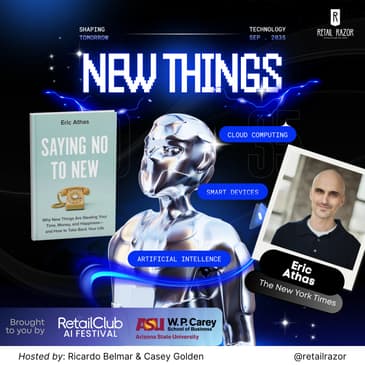


The New Thing Gap - What retail took away when it took away the friction, with NYT editor Eric Athas.
In 1995, buying a pair of sneakers cost you 30 minutes and five miles of driving. Today it takes about four seconds. New York Times editor Eric Athas spent four years reporting on what that trade did to people, and he has a name for the thing retail deleted: the new thing gap.
Eric's book, Saying No to New, is out now. He interviewed Ricardo in 2024 for the consumer research behind it, and Ricardo shows up on page 41 explaining why off-price stores keep shipping in fresh inventory to keep shoppers hunting. This episode puts that quote back in front of the industry that inspired it.
Ricardo and Casey take Eric through the uncomfortable version of the question. If the gap between wanting something and owning it was where the customer used to think, what happens to shoppers now that frictionless shopping has closed it? And what happens when agentic commerce deletes the last click? Eric's answer about AI shopping assistants is the line that sticks: we may have built the perfect motivated reasoning machine.
This is not an anti-retail hour. Eric says plainly that the goal was never to say no to every new thing. He walks through the Iron Man method for deciding what to let in, the case for useful friction, why Ed O'Brien's research shows we are wrong about familiar things in a predictable direction, and the curb cut test that separates real innovation from innovation theater. Casey pushes him on whether there is a business on the other side of this, built on rediscovery instead of replacement.
If you are building for agentic commerce this year or defending a frictionless shopping roadmap to someone who signs the checks, this hour will give you better questions than the ones you walked in with.
In This Episode, You'll Learn.
• Why the distance between seeing something new and owning it collapsed from 30 minutes and five miles to about four seconds, and what the industry removed along with it
• Where useful friction belongs, plus the audit Eric uses to find the access points worth slowing down
• Who an agentic commerce agent is optimizing for: the shopper, the retailer, or the company that built the agent
• Why an AI shopping assistant that agrees with you is the magic pill effect with a bigger engine
• The Iron Man method in three steps: name what matters, refuse what conflicts with it, accept what supports it
• What Ed O'Brien's repeat-experience research means for brands that want to sell quality instead of replacement
• How the Diderot effect turns one new desk into a new dining table, and what retailers owe people on the failure side of a purchase
• The curb cut test for telling genuine innovation from innovation theater, and why Eric changed his mind about AI glasses
• Ricardo's story about the UK retailer that cut buyer's-remorse returns in half by asking better questions at the shelf, and why frictionless shopping in reverse is the part retail keeps skipping
Support our sponsors.
There’s still time to join us at RetailClub AI Festival next week.
From the founders of Shoptalk and Groceryshop, RetailClub AI Festival brings together 2,000 industry leaders from September 22 to 24 for three days fully outdoors in Huntington Beach focused entirely on how AI is transforming retail. Hear from 150 leaders shaping how AI is being used across the industry, explore the technologies changing how retail works, and connect with senior leaders from across retail, brands, technology and investment. Late registration is available at retailclub.com/retail-razor-podcast.We’ll see you in Huntington Beach!
W. P. Carey School of Business, Arizona State University.
ASU is a leading public research university and its W. P. Carey School of Business is the largest in the United States. AI-Enabled Supply Chain Strategy is a 3-day executive program running October 5-7, built by the #2-ranked Supply Chain Management department. The program is designed for senior leaders setting AI strategy across procurement, logistics, and operations.
Register at https://specialevents.asu.edu/878064 with ID Code retailrazorasu for $1,500 off.
Subscribe & Follow.
How much did you love this episode? Drop us a 5‑star rating and review on Apple Podcasts, Spotify, or Goodpods. Subscribe on YouTube so you never miss an episode and check out the other shows in the Retail Razor Podcast Network: Retail Transformers, Blade to Greatness, and Data Blades.
Subscribe to the Retail Razor Podcast Network: https://retailrazor.com/
Subscribe to our Newsletter: https://retailrazor.substack.com
Subscribe to our YouTube channel: https://go.retailrazor.com/utube
Featured guest.
Eric Athas. https://www.linkedin.com/in/ericathas/
Deputy Editor, Newsroom Development & Support. The New York Times. https://www.nytimes.com
“Saying No to New: Why New Things Are Stealing Your Time, Money, and Happiness―and How to Take Back Your Life.”https://sayingnotonew.com
Eric Athas is an editor at the New York Times, where he helps journalists learn new tools and skills they can use to tell stories. Before joining the Times in 2016, he worked at NPR and the Washington Post. His work has been published in the New York Times, the Washington Post, Fast Company, Harvard Business Review, and the Nieman Journalism Lab. Athas lives with his wife and two children in Brooklyn.
Chapters.
00:00 Teaser
00:43 Show Intro
05:30 Welcome to the Retail Razor Show, Eric Athas!
06:25 The Painter's Lie: Why We Believe New Is Always Better
09:14 When Does Upgrading Stop Feeling Like a Win?
13:50 The Beetle Trap: Why Our Brains Are Wired for Novelty
16:50 How Retailers Engineer You Into Buying More
22:10 The Vanishing Gap Between Wanting and Buying
33:38 The Magic Pill Effect: Why AI Tells You What You Want to Hear
41:04 The Iron Man Method: Finding Your Anchor in a World of New
45:05 Rediscovering the Familiar: Why Old Things Still Work
58:03 The Diderot Effect: How One New Purchase Ruins Everything Else
01:04:11 The Curb Cut Test: How to Know What's Worth Saying Yes To
01:12:21 Show Close
Meet your hosts.
Helping you cut through the clutter in retail & retail tech:
Ricardo Belmar is an NRF Top Retail Voice for 2025 and a RETHINK Retail Top Retail Expert from 2021 – 2026. Thinkers 360 has named him a Top 10 Thought Leader in Retail and eCommerce, a Top 25 Thought Leader in Careers, a Top 50 Thought Leader in Agentic AI, AGI and Management, and a Top 100 Thought Leader in AI Ethics, Marketing, Digital Transformation andTransformation. Thinkers 360 also awarded him an Elite Expert Certification in Retail, a Master Expert Certification in Management, and named him a Certified Expert in AI, Marketing, and Digital Transformation. Thinkers 360 also named him a Top Digital Voice for 2024 and 2025. He is an advisory council member at George Mason University’s Center for Retail Transformationand the Retail Cloud Alliance. He was most recently the partner marketing leader for retail & consumer goods in the Americas at Microsoft.
Casey Golden, is the North America Leader for Retail & Consumer Goods at CI&T, and CEO of Luxlock. She is a RETHINK Retail Top Retail Expert from 2023 - 2026, and Retail Cloud Alliance advisory council member. After a career on the fashion and supply chain technology side of the business, Casey is obsessed with the customer relationship between the brand and the consumer and is slaying franken-stacks and building retail tech!
Episode Music.
Includes music provided by imunobeats.com, featuring Overclocked, and E-Motive from the album Beat Hype, written by Heston Mimms, published by Imuno.