
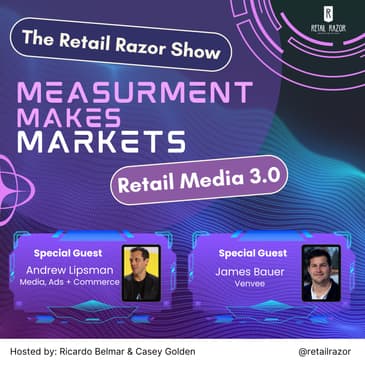



S4:E5 Unlocking Retail Media: Measurement, Innovation, and Customer Engagement
In this episode of The Retail Razor Show, hosts Ricardo Belmar and Casey Golden explore the evolving landscape of retail media with expert insights from Andrew Lipsman, analyst and founder of Media, Ads + Commerce, and James Bauer, CEO and founder of Venvee. They discuss the progression of retail media 1.0 with online ads to retail media 2.0 - in-store media, highlighting key metrics like closed-loop attribution and incrementality. The conversation moves into innovative technologies such as spatial AI, the importance of first-party data, and privacy concerns. They also emphasize the collaborative efforts needed to integrate these advancements effectively for full funnel customer conversion and attribution in retail media 3.0. This episode delivers a comprehensive overview of how retailers and brands can use modern technology to bring the same level of measurement currently enjoyed in the 15% of retail sales happening in ecommerce, to the larger 85% of sales happening in stores!
About Andrew Lipsman:
Andrew Lipsman is an independent analyst and consultant at Media, Ads + Commerce. His industry coverage specializes in retail media—which he is known for anointing as “digital advertising’s third big wave”—and other areas of the digital media, advertising, and commerce ecosystem. He has published more than a half dozen articles in the Journal of Advertising Research and is frequently quoted in The New York Times, The Wall Street Journal, The Economist, The Financial Times, and Advertising Age.
About James Bauer:
James Bauer is the Founder and CEO of Venvee, a retail media technology company that is closing the loop on in-store measurement and attribution. Venvee leverages AI-generated digital twins of physical stores, combined with computer vision running on existing cameras, to enable precise measurement of impressions, interactions, and conversions on a shopper-by-shopper basis. This innovative approach requires no changes to the store and provides comprehensive aggregate measurement for in-store video, audio, fixtures, and products.
Subscribe to our Newsletter: https://retailrazor.substack.com
Subscribe to our YouTube channel: https://bit.ly/RRShowYouTube
00:00 Show Intro
02:50 Exploring Retail Media 3.0 & Measurement
03:29 Evolution of Retail Media
07:08 In-Store Attribution and Measurement
14:44 Challenges and Opportunities in Retail Media
32:37 Future of Retail Media and Final Thoughts
44:43 Show Close
Meet your hosts, helping you cut through the clutter in retail & retail tech:
Ricardo Belmar is a RETHINK Retail Top Retail Expert for 2021 – 2024, and a Thinkers 360 Top 10 Retail Thought Leader, Top 50 Management Thought Leader, and Top 100 Digital Transformation Thought Leader. He is an advisory council member at George Mason University’s Center for Retail Transformation, and director partner marketing for retail & consumer goods at Microsoft.
Casey Golden, CEO of Luxlock, RETHINK Retail Top Retail Expert for 2024 and 2023, and Retail Cloud Alliance advisory council member. Obsessed with the customer relationship between the brand and the consumer. After a career on the fashion and supply chain technology side of the business, now slaying franken-stacks and building retail tech!
Includes music provided by imunobeats.com, featuring Overclocked, and E-Motive from the album Beat Hype, written by Hestron Mimms, published by Imuno.
[00:00:19] Hello and welcome to Season 4, Episode 5 of The Retail Razor Show.
[00:00:25] I'm your host, Ricardo Belmar.
[00:00:26] And I'm your co-host, Casey Golden.
[00:00:28] Welcome to Retail's favorite podcast where we cut through the clutter to give you sharp insights
[00:00:34] on the retail industry and commerce technology.
[00:00:37] It's a show for e-commerce specialists, store operations leaders,
[00:00:41] customer experience officers, and everyone else in retail and retail tech alike.
[00:00:46] Ricardo Belmar And with this episode,
[00:00:48] we'll be adding media managers and ad buyers to that list, hint, hint.
[00:00:51] Casey Golden Well, that's one way to give it away.
[00:00:53] Ricardo Belmar I couldn't help it.
[00:00:54] Because of course today we're hitting on one of my favorite retail topics,
[00:00:58] retail media.
[00:00:59] Casey Golden And I'm excited that we don't have just one,
[00:01:02] but two incredible guests today that will help us focus in on what's become the big mystery
[00:01:08] and biggest hope for retail media.
[00:01:10] Certainly by brands buying all those ads.
[00:01:13] And of course, I'm talking about one of my favorite topics, measurement.
[00:01:18] Ricardo Belmar That is so true.
[00:01:20] It's the little things like closed loop attribution, tracking in-store consumer behavior,
[00:01:24] and mapping back to those crater-led campaigns that every retailer and brand want to activate.
[00:01:29] Casey Golden I'm also looking forward to talking about other
[00:01:31] metrics that advertisers need to make these RMN investments meaningful, especially in store
[00:01:38] where you need new technology to help you track results.
[00:01:41] Ricardo Belmar Yeah, we'll see how we've come a long
[00:01:43] way from those early basic digital signage days that were not too long ago.
[00:01:48] You know, we're talking about technologies around spatial computing, AI, and so many
[00:01:52] other modern tech that we're going to hear about.
[00:01:54] Talk about cutting through the clutter today, right?
[00:01:56] Casey Golden 100%.
[00:01:57] So let's not keep everyone waiting in suspense.
[00:02:01] Today we're talking to Andrew Lipsman, independent analyst and consultant,
[00:02:06] founder of Consultancy Media Ads and Commerce, otherwise known as
[00:02:11] retail's foremost expert on all things retail media.
[00:02:15] Plus James Bauer, CEO and founder of Venvy.
[00:02:19] Venvy is delivering cutting-edge spatial AI for audience enrichment and audience measurement.
[00:02:26] Yes, this time we not only have the benefit of the analysis viewpoint,
[00:02:33] but we've got a retail tech founder who's actually solving for the questions we're asking
[00:02:39] about.
[00:02:39] Andrew Lipsman It's like we have a two-for-one special today.
[00:02:41] Casey Golden I love two-fers.
[00:02:45] Let's just get to the conversation.
[00:02:47] Andrew Lipsman Okay, let's do it.
[00:02:56] James Bauer I can't express just how much I have been
[00:02:58] looking forward to this session today.
[00:03:00] Retail media is evolving in so many ways, expanding in so many areas.
[00:03:04] This is a conversation we knew had to happen sooner rather than later on the show.
[00:03:10] So let's welcome our two guests today, Andrew Lipsman,
[00:03:13] our favorite expert on retail media and James Bauer, CEO and founder of Venvy.
[00:03:20] Welcome, Andrew and James.
[00:03:22] Andrew Lipsman Great to be here.
[00:03:22] Thanks for having us.
[00:03:24] Thank you so much for having us on the show.
[00:03:26] It's really exciting.
[00:03:27] Casey Golden It's really exciting to have you both here
[00:03:28] with us today.
[00:03:29] So let's level set a bit first and talk about where we are today in retail media.
[00:03:35] We've been watching the past, what, 18 to 24 months is the whole explosion
[00:03:39] and creation of so many retail media networks.
[00:03:42] Andrew, you've been on the show multiple times before and we've talked about that.
[00:03:46] Lately, we've seen things like expanding, obviously from online to in-store,
[00:03:50] we'll talk about that, even to outside networks that are getting tied in,
[00:03:54] things like connected TV streaming.
[00:03:56] If we think of today as retail media 2.0 maybe, where do we stand?
[00:04:01] How would we characterize it?
[00:04:03] Andrew, I know you've called this era digital advertising's third big wave.
[00:04:07] So let's start with your perspective on this.
[00:04:10] Andrew Lipsman Yeah, well, one way to just frame
[00:04:12] retail media and its evolution is kind of eras and they're overlapping eras,
[00:04:17] but I've called them retail media 1.0, 2.0 and 3.0.
[00:04:20] 1.0 is most of what we've lived up to this point in time.
[00:04:24] It was online ads, think of your standard Amazon sponsored product ad,
[00:04:29] driving an online sale, nice tight closed loop conversion.
[00:04:33] Things were easy.
[00:04:35] Certainly we're seeing the progression of that to a lot of other retailers online today.
[00:04:40] But now we're quickly progressing into retail media 2.0,
[00:04:45] which is characterized by the ads moving up the funnel and into the store.
[00:04:50] What I mean by that is it's offsite ads, including display and video,
[00:04:55] social ads, streaming TV and in-store ads.
[00:04:59] And now we're also getting better at attribution and being able to attribute sales,
[00:05:02] not just to the online conversion but also in-store conversions.
[00:05:06] And then the last piece of that, and I know we'll unpack this a bit more,
[00:05:09] 3.0 gets to sort of the highest level of media in my opinion,
[00:05:13] experiential media and product samples.
[00:05:15] And we begin to start thinking about attribution, not just online and in-store but over time.
[00:05:21] So going into in-store activations, as we move towards retail media 3.0,
[00:05:29] how important do you think experiential media
[00:05:32] and in-store activations will be for brand engagement?
[00:05:35] I don't think it's essential, but I do think it's important.
[00:05:39] When I think of realizing the full potential of retail media,
[00:05:43] it is the ability to be full funnel in reaching consumers online,
[00:05:48] offline, across all these different touch points.
[00:05:50] And in an ideal world, you can actually lead them to consume the product,
[00:05:56] experience the product by virtue of a product sample.
[00:05:58] That works best in consumer packaged goods and beauty.
[00:06:01] It doesn't necessarily extend to a lot of other categories,
[00:06:04] but other categories do have different types of experiences
[00:06:07] that you may be able to have in a physical store.
[00:06:10] But to me, that's the best form of media that you can have.
[00:06:13] To actually experience the product.
[00:06:15] And if it's a first time use of that product,
[00:06:18] it can actually convert somebody from being a non-consumer to a consumer.
[00:06:23] And if you get them purchasing that with a level of frequency,
[00:06:27] there is that value that exists over time.
[00:06:30] So that really is where the return on ad spend
[00:06:33] or return on marketing spend can really stack up
[00:06:35] and what I think a lot of brands should be aspiring to.
[00:06:38] And James, that's kind of why you got into business, isn't it?
[00:06:43] Yeah, I was going to say just from the things
[00:06:45] that I'm hearing from retailers and brands,
[00:06:48] it seems like the experiential element
[00:06:50] is really catered towards certain strategies.
[00:06:53] So it's not something that you need to get every marketing campaign with.
[00:06:58] But when you're looking at specific strategies
[00:06:59] like product discovery or new product rollouts,
[00:07:02] there's no better thing than having that product tangibly in your hands.
[00:07:06] So I'm with Andrew on that one.
[00:07:08] Are there any particular metrics you're focusing on
[00:07:11] to gauge the effectiveness of these integrated campaigns?
[00:07:14] I mean, everybody's wanted to be really measuring physical experiences
[00:07:19] like we do e-commerce.
[00:07:21] But as it relates to the in-store piece, certainly.
[00:07:24] I think that the premier metric is incrementality.
[00:07:27] And incrementality for me being an outsider to the industry coming in
[00:07:31] and working to bring technology to unlock things
[00:07:34] that people have been working on for a long time.
[00:07:35] I've seen many different measures of incrementality,
[00:07:39] and I tried to make it down to the most simplest form for me,
[00:07:42] which was inside the store.
[00:07:44] It's actually quite simple.
[00:07:45] You can take the people who experience, you know, experience.
[00:07:49] And then you can take the people that didn't
[00:07:50] and you can measure how they interacted in space
[00:07:54] if they saw that product, if they converted that product.
[00:07:58] Ultimately, this will have to be a little added little context
[00:08:00] when we talk about what we do and how it works inside the store.
[00:08:03] But as far as measurement goes, you can really take the group of control,
[00:08:08] which is not experiencing
[00:08:09] because the measurement is now capable of doing a one-to-one level thing
[00:08:14] and take the group that did experience it and measure the delta.
[00:08:17] That's how I've come to understand incrementality,
[00:08:19] although I know it may not match everybody else's view of it.
[00:08:24] We love incremental revenue.
[00:08:28] Everyone's got a different version of incrementality,
[00:08:31] but test versus control is pretty standard.
[00:08:33] And, you know, when I was talking about RetailMedia 1.0,
[00:08:37] it's retail media's value is predicated on closed loop measurement.
[00:08:41] And so that's, I think, a big part of what James and Venve are doing
[00:08:45] is bringing closed loop measurement into the physical store environment,
[00:08:48] something that's never really been executed on in a compelling way to date.
[00:08:53] So that's a big driver
[00:08:54] and obviously being able to do incrementality with those measurements as key.
[00:08:58] The quickest way to get brands to invest more in media
[00:09:01] is to prove sales effectiveness.
[00:09:04] But that's only part of the equation.
[00:09:06] And I'm a big believer that there's also this branding value
[00:09:09] that we can very easily look past and ignore.
[00:09:13] And I think that we need to account for that as well.
[00:09:15] So I kind of go back to the future here
[00:09:18] and I think about traditional media measurement,
[00:09:20] which is really about reach and frequency,
[00:09:24] GRPs, the things that we historically measured in TV,
[00:09:27] impressions, how many people do you reach,
[00:09:29] how many times and kind of understanding that campaign delivery,
[00:09:33] because everyone who you reach in a store might not convert today.
[00:09:38] You will see that performance,
[00:09:39] but some of that value is going to manifest over time,
[00:09:44] over additional trips and over trips in different stores.
[00:09:47] Yeah, I think that's one of the things that there's always been
[00:09:49] a desire to better track measure and therefore monetize that benefit,
[00:09:54] because there's so much traffic, particularly for the larger retailers,
[00:09:58] but so much traffic or as measured as foot traffic in and out of the store,
[00:10:02] even compared to eyes that you have coming to your e-commerce site, right?
[00:10:06] Whereas we know what the tools are there.
[00:10:08] I think everybody has an understanding of how you're going to use that
[00:10:12] in that medium, but how do you translate that?
[00:10:15] I'd like to kind of explore a little bit what have been the missing pieces
[00:10:18] technology wise in the store to help with that.
[00:10:21] And I say that just because I remember in the early days of digital signage in stores
[00:10:26] where the promise was always being given as,
[00:10:30] oh, well you're going to be able to create an ad network and give it
[00:10:32] all of your suppliers and all your brands that are in the store
[00:10:35] and get ad space on those screens.
[00:10:37] But there were never any tools to measure any of that.
[00:10:40] So you were kind of, what were you offering?
[00:10:42] Really all anybody was offering at the time was this blind faith that
[00:10:45] because you put something up a screen,
[00:10:48] all the foot traffic that came to the store was going to see it
[00:10:50] and would somehow be influenced by it.
[00:10:52] And you hoped that you could track that at the point of sale.
[00:10:55] But now I think we have better technology for this, right?
[00:10:58] Yeah. And I can do a little shout out here to Mike Hyatt.
[00:11:02] He's one of our advisory boards.
[00:11:04] He was doing that work at Walmart and at Sam's back in the days when it was kind of
[00:11:08] here's the screen wall, pay that gets here.
[00:11:11] But his vision ultimately, and the reason why he came to work with us
[00:11:15] was that he wanted it all to be connected.
[00:11:17] Screen with the shopping experience with the outcomes,
[00:11:21] ultimately with the loyalty card and then matching into the digital world.
[00:11:24] He had this view of an omnichannel flow that went back and forth.
[00:11:28] So when I spoke about what we were doing, he said,
[00:11:31] this is kind of the piece that was missing for me to accomplish this
[00:11:34] at Walmart and at Sam's.
[00:11:36] So as far as the technology goes,
[00:11:39] we really are at an exciting point in time where you're seeing AI,
[00:11:43] which was like a lot of hype and a lot of energy and a lot of potential
[00:11:47] start to get paired down into what is like functional value propositions.
[00:11:52] You can do almost anything with AI, which is like the coolest thing,
[00:11:55] but also the worst thing about it.
[00:11:57] And so if you don't focus and tear down into something that you know can apply value,
[00:12:02] then you're going to end up chasing 10 rabbits catching zero.
[00:12:06] So for our technology, what we're looking to do is, as Andrew said,
[00:12:10] close the loop on the attribution gap in store as it relates to the video.
[00:12:15] The way we can get that done is in a store change free mix.
[00:12:21] So one of the things that every startup founder does is evaluate the seal.
[00:12:27] They see everything that everybody's done in base to date.
[00:12:31] There's been some marvelous companies and some concepts that really changed the game
[00:12:36] or paved a path for true innovation.
[00:12:39] But one of the limiting factors is that the store is such a curate experience.
[00:12:43] There are people that are very intentional with the way that that space is.
[00:12:47] And when you require complete disruption of that space,
[00:12:51] whether it be through adding sensors, cutting holes, hanging this, hanging that,
[00:12:55] it really breaks that up.
[00:12:56] And there's a barrier to that, not to mention the cost elements.
[00:12:59] So I said when we started this, I said we have to create a thesis
[00:13:03] is we don't change the store.
[00:13:04] And that's a big technological unlock in that we can tape the store as it is
[00:13:10] and map anonymous IDs.
[00:13:13] So when somebody moves into this space to get an anonymous ID,
[00:13:16] as they move through this space, they maintain that anonymous ID moving from camera to camera
[00:13:22] to camera to spaces that don't have camera coverage to the next camera ultimately to the
[00:13:27] checkout all done with what's already in this.
[00:13:31] And that unlocks speed and costs and it unlocks the ability to close the loop
[00:13:37] on any store.
[00:13:38] So when you say anonymous ID five walks in,
[00:13:41] they impressed on screen five that was playing the pizza ad and then anonymous ID five went
[00:13:49] to the pizza after going to the pizza, they checked out and it was in their basket.
[00:13:54] That is the closed loop full funnel of attribution.
[00:13:58] And as I mentioned, I'm not from the industry.
[00:14:01] So my feather was that I took things that looked really familiar.
[00:14:06] I tried and take everything that Andrew told me
[00:14:09] and everything that was standard in other platforms and just apply it to the store.
[00:14:15] There's nothing there's nothing customer prior to her.
[00:14:17] I just wanted to failure.
[00:14:19] Well, I mean, it wasn't that long ago that I had security guards,
[00:14:23] the clicker and counting how many people walked in by every day and just like,
[00:14:26] like click, click, click, click.
[00:14:32] Over the gulf race.
[00:14:34] Yeah, I mean, we've moved pretty fast, I'd say,
[00:14:37] I'd like to say that wasn't that long ago and I'm not that old, but I have seen,
[00:14:41] you know, I haven't seen anybody with a clicker for years.
[00:14:44] How should retailers and brands close the loop on in-store sales with creator led content
[00:14:52] and other digital activations?
[00:14:54] Yeah, I mean, the way that I like to think about it is you have all of these physical
[00:14:58] touch points in the store.
[00:15:00] We're focusing a lot of our conversation around in-store digital media because
[00:15:04] I think we all believe that this is where the future is going and it's,
[00:15:08] I've called it the next major media channel and it's really exciting.
[00:15:11] But you've already got a $25 billion or so industry of shopper marketing.
[00:15:17] So all of these physical installations that are analog today still have value.
[00:15:21] So the ability to bring measurability to anything in the analog physical world is huge
[00:15:26] and you can close the loop on all of that or just measure the activity and the impressions.
[00:15:30] Creator content to me is just an extension of the media.
[00:15:35] I happen to think that it is a more effective and sort of higher form of media.
[00:15:40] Creators are kind of breaking through to audiences in ways that standard media maybe
[00:15:45] doesn't as well anymore.
[00:15:47] So my hypothesis would be that creator content is going to be threaded throughout
[00:15:51] more store experiences.
[00:15:52] It will be effective, but we'll need measurement to prove it.
[00:15:56] And you know, we're not there yet, but I think that's kind of where things are headed.
[00:15:59] So are there any other innovative approaches that I'm thinking of in terms of what retailers
[00:16:05] can do or what the brands who want to leverage retail media networks should think about that
[00:16:10] help them kind of connect the dots, right?
[00:16:12] As you're talking about between both the in-store activations but what other,
[00:16:16] the other digital efforts that they may have as part of that campaign.
[00:16:19] I would call it maybe the vision here from the brand's perspective is they want
[00:16:22] everything connected, right?
[00:16:24] If they can create a campaign that drives people to physical spaces, starting in a
[00:16:30] digital experience, they know that flow is working.
[00:16:32] They know that to your point that the measurement is there to prove that it didn't.
[00:16:36] Are there any, maybe the question is what are we doing right now to get there,
[00:16:40] to help us get there?
[00:16:41] I think that may be a little bit of a parallel here, but I think that when you say
[00:16:45] the brand wants everything to be connected, I think that everything for the retailer's
[00:16:49] perspective has to be focused on the transactional nature and the value of
[00:16:55] the loyalty card because when a shopper opts into that loyalty card, they're
[00:17:00] expecting benefits back to them.
[00:17:02] And when you look at, I read the book on Walmart and the way they brought in
[00:17:07] e-commerce, it was almost two houses and they were in perfect competition.
[00:17:12] And what we're seeing now is quite a far cry from that approach.
[00:17:15] But at the center of those two houses, to bring them together, you need the loyalty
[00:17:20] card because that's sort of the piece that connects fluidly between two mediums.
[00:17:25] And so to that end, the approach is to make that happen.
[00:17:27] You're already seeing it happen at the register and you're seeing it happen
[00:17:31] digitally.
[00:17:32] You need to reverse it backward from the register to the shopper journey inside
[00:17:36] the store to capture that last piece.
[00:17:38] And there's a number of ways you can get that done and there's sort of
[00:17:42] meal data sets that can almost supplement that.
[00:17:45] And if you look at an example would be like put a single camera on a single
[00:17:49] screen, you can count the password by in front of that screen.
[00:17:53] That's a piece of information that can see that story at the transaction
[00:17:58] level, like the loyalty level.
[00:18:00] But the way I see it, we're in an awesome opportunity here to use retail
[00:18:06] media to build a platform for innovation for a lot of time.
[00:18:09] Retail media has created a different level of revenue and margin profit for
[00:18:16] these retailers in that they can put the innovate in that space.
[00:18:21] And so when I say looking to digitize the physical store, we can do a lot.
[00:18:26] And that foundation is built on digitizing the entire space, collecting
[00:18:30] the data on the entire journey, connecting them to the register,
[00:18:34] connecting that to the internet.
[00:18:35] That's how it all can come together.
[00:18:37] And just to build on James point about the loyalty card data, right?
[00:18:41] Every great retail media network has that first party data foundation.
[00:18:47] So that loyalty card is essential.
[00:18:49] And if you think again about this idea of full funnel marketing
[00:18:53] for retail media, you ideally are trying to reach consumers across as
[00:18:58] many touch points as possible to persuade them, create awareness about
[00:19:02] the brand, create affinity.
[00:19:04] But eventually once you've got them in the store, move them down to the
[00:19:08] bottom of the funnel and get them to convert.
[00:19:10] But you don't just want that one time purchase, right?
[00:19:12] You want that purchase over time.
[00:19:15] So what are the ways now that they've converted that you can connect to
[00:19:18] them after the fact as well and reinforce the value of the brand.
[00:19:22] So if everything is connecting back to that loyalty card, you can actually do
[00:19:26] this full funnel on the front end and on the back end.
[00:19:29] And I think that becomes a really powerful mechanism to create that
[00:19:34] repeat purchase.
[00:19:36] So just to set a little bit of a baseline when we're talking about
[00:19:39] conversion, because that is 100% the key here is being able to track
[00:19:44] that conversion.
[00:19:45] What are some general stats from my world?
[00:19:50] You're lucky if your e-commerce store is doing 2.3% conversion rate
[00:19:55] online, you can dislocate your shoulder to pat yourself on the back for that.
[00:19:59] But in store, we're very used to 30-35% conversion rate goals being hit every
[00:20:06] single day in a physical store.
[00:20:08] So there's a huge contrast between e-com conversion and digital or
[00:20:13] in physical conversion.
[00:20:15] But the intention to buy is much higher for the physical because you
[00:20:20] actually had to go and walk through the door.
[00:20:22] And I would think it's very easy to say that maybe so many ad dollars
[00:20:27] have been spent trying to get that 2.3% to 10 or to 15, rather than trying
[00:20:34] to move that 30 to 35 or to 40.
[00:20:38] But this kind of changes that.
[00:20:40] And I know when I was at a brand, I didn't have a lot of insights
[00:20:45] to other people's KPIs.
[00:20:47] It was a lot of dinners.
[00:20:48] We've gone a couple years without a lot of dinners.
[00:20:52] What are some of these KPIs and see these baseline metrics from
[00:20:56] that we're looking at to start saying, do I need this?
[00:21:02] Is this worth me chasing with this new type of tracking?
[00:21:06] How much lift are these brands should be looking at as an
[00:21:11] opportunity for incremental?
[00:21:12] Are we talking, are we looking at, are people getting double digit increases?
[00:21:17] Is this where 2% is a ton of incremental revenue?
[00:21:23] Just kind of curious.
[00:21:24] You know, where's the baseline on in general?
[00:21:29] Because I come from a very specific silo.
[00:21:34] I would start by saying, you know, if you're seeing 2.3% online at 35% in store
[00:21:41] and the investment still goes online, I think that's a signal of there's no trust there.
[00:21:47] People see that number and they say, well, I can't validate that.
[00:21:51] And I see that number.
[00:21:52] I don't know what was the root cause of that.
[00:21:55] And therefore they don't invest there.
[00:21:56] And I think that that's a symptom of not having the proper fidelity
[00:22:00] measure is what we're trying to bring to this so that there is trust.
[00:22:04] This is something that I've talked with retailers, brands and media
[00:22:08] platform with screen providers about ones that if you put $10 in to the internet,
[00:22:13] you're going to know exactly what you get out of it.
[00:22:16] Put $10 into the store, you're not going to know.
[00:22:19] And even if it can be painted as a picture, if there's no trust there,
[00:22:24] then the investment is not going to be there.
[00:22:26] Yeah.
[00:22:26] The, I mean, e-commerce is so heavily optimized, right?
[00:22:31] Everything is about metrics and when we're in the conversion funnel,
[00:22:34] that's 15% of retail today.
[00:22:36] What about the other 85%?
[00:22:39] Yeah.
[00:22:39] There's a lot more leverage.
[00:22:40] We haven't had the analytics to support that.
[00:22:44] The moment that we do, and that's what James is helping do,
[00:22:48] is I think becomes transformative.
[00:22:51] One of the things I think about a lot in this space is three of the top 10
[00:22:56] biggest companies in the world by market cap, Facebook, Google and Amazon,
[00:23:01] at this point are primarily digital advertising or e-commerce companies.
[00:23:06] Their value is predicated on that 15%.
[00:23:09] How much value is there out there when you have companies that can provide
[00:23:13] that sort of assurance and certainty around measurement for the other 85%?
[00:23:18] It's enormous.
[00:23:19] Like you said, Casey, if I go from 2.8 to 3.7% in e-commerce, that's huge, right?
[00:23:26] That's like a 25% increase in conversion rate.
[00:23:30] That's going from 35 to 35.7% in store and it's the same amount.
[00:23:36] That seems pretty easy off of that baseline.
[00:23:38] I think there's a ton of potential.
[00:23:41] You also asked about what is the impact that we're seeing.
[00:23:44] I've worked with some other folks in the industry,
[00:23:46] done some measurement sales list studies on in-store media.
[00:23:50] One of them with Grocery TV where we looked at a meta analysis
[00:23:53] of a bunch of campaigns that they've run.
[00:23:56] These campaigns are primarily near checkout,
[00:23:58] so this isn't necessarily universal to every digital screen in the store.
[00:24:03] But the campaigns had an average of a 14% sales lift for the brands being advertised.
[00:24:08] One of the things that was really interesting,
[00:24:10] they varied from about a 6% lift to a 33% lift.
[00:24:15] More than half of them were between 10% and 14%.
[00:24:19] I actually really like that consistency.
[00:24:21] Yeah, you're always going to have some outliers on the top and bottom.
[00:24:24] It's always going to depend on things like creative and other stuff.
[00:24:27] But if you see that consistency and reliability,
[00:24:30] if you are advertising in-store, it will drive incremental sales.
[00:24:34] That's a great thing.
[00:24:35] Not just for the brand, by the way,
[00:24:37] it also can be a great thing for the retailer
[00:24:39] because it's about potentially increasing basket size
[00:24:43] and driving that purchase in the store that wouldn't have happened otherwise.
[00:24:47] That's great. Thank you for sharing that.
[00:24:50] It seems like a pretty, in my mind, easy case to make,
[00:24:54] to invest more in the in-store networks that way from a brand advertiser's perspective.
[00:25:00] I see a lot of things written in media about where brands are investing their ad dollars.
[00:25:07] We're seeing a shift.
[00:25:08] I think there's a good document, good stats out there that show
[00:25:11] how much is shifting to these retail media networks.
[00:25:14] But if you just take what you just described as a motivator
[00:25:17] for why there should be more investment,
[00:25:19] what do you think is holding anyone back?
[00:25:22] What's holding brands back from doing that today?
[00:25:24] Because we see lots of forecasts at what point will retail media overtake
[00:25:28] pick your category of advertising in terms of spend.
[00:25:32] But why isn't it happening faster, for example?
[00:25:35] The easy answer is lack of measurement and it's all forms of measurement.
[00:25:38] The secondary answer I think is organizations are siloed and they literally don't have people
[00:25:45] at a lot of companies, brands and retailers who are focused on in-store retail media.
[00:25:50] It's this jump ball because it seems like it should be the domain of the merchandising teams,
[00:25:56] what budgets from a marketing standpoint does it come out of?
[00:25:58] Is it shopper marketing or national media?
[00:26:00] I'm a big believer in Chicana national media budgets.
[00:26:03] So it's just that.
[00:26:05] It is that you have these long-standing companies,
[00:26:10] traditional organizations that are not built for it.
[00:26:13] So they do need to get more integrated in and have more organizational focus around
[00:26:18] the opportunity if they're going to get the most out of it.
[00:26:20] And they both have a lot to gain by the way.
[00:26:22] Retailers, this is the path for a lot of retailers
[00:26:25] to be able to get incremental high margin revenue.
[00:26:29] And this is the chance for a lot of brands to market
[00:26:32] in what I believe is one of the best and most impactful ways that they can market.
[00:26:37] High quality creative experiences, close to the point of purchase.
[00:26:41] Isn't that the holy grail?
[00:26:42] Isn't that what we should be trying to do?
[00:26:44] And one of the things that I've been talking with one of our customers about
[00:26:48] and it was their idea not mine is that they want to unify the sale of
[00:26:56] real estate inside the store against measurement.
[00:26:59] So they have screens, they want to sell their screens against measurement.
[00:27:03] But also they have their end cabs.
[00:27:04] They have traditional product placement on the shelf.
[00:27:07] When you think about it, the way those things operate with media being heavy on
[00:27:12] measurement and traditional merchandising and end cabs, heavy on the transactional
[00:27:17] nature of retail and brand that's been there forever, they don't look quite alike.
[00:27:22] And to put them right next to each other makes the contrast stand out even more.
[00:27:27] So when they're saying, hey, you're going to digitize the whole space,
[00:27:31] which is what we're aiming to do in all of the customer journeys.
[00:27:34] And we sell our end cabs against measurement just like we intend to sell our screens.
[00:27:39] So yes, and that's kind of the goal is when you digitize the space,
[00:27:44] create transparency fidelity, a lot of space can be unlocked.
[00:27:48] It's thought of as merchandising today, but it's also media.
[00:27:51] Right.
[00:27:51] This is the intersection of media and merchandising.
[00:27:53] That's why one of the things I say to my guidance on how to think about
[00:27:58] in-store retail media is think about it in terms of reach, quality and performance in that order.
[00:28:05] The instinct which I totally get is to go straight to performance.
[00:28:08] The performance is going to be there.
[00:28:10] You're going to measure that without a doubt.
[00:28:12] But the reach and the quality, those are the components of media
[00:28:15] that until we start adopting that lens, I don't think we're going to
[00:28:19] realize the full potential of everything I can do.
[00:28:21] Yeah. And when you think about the arriving of retail media, it came in first digitally.
[00:28:29] And so the second mover advantage was to all the map that was already carved down,
[00:28:33] which was a digital map.
[00:28:35] And these retailers now make the shift into the physical store.
[00:28:39] And there's almost there's a bit of hurdles that need to be jumped between the merchant
[00:28:43] and the retail media team inside the store because store is the ultimate operation.
[00:28:49] There are so many moving pieces.
[00:28:51] And we've been able to create an olive branch between these two groups
[00:28:55] by providing the measurement that shows value of the merchandising team and the things that they do
[00:29:02] and pairs in measurement for the retail media.
[00:29:05] So it can almost be a unifying force when you have an asset that helps both.
[00:29:10] Speaking of a lot of moving parts,
[00:29:13] the actual consumers that are entering these stores,
[00:29:16] what role does anonymization play in your approach to tracking that in-store behavior
[00:29:22] and linking it to digital campaigns?
[00:29:25] I think data, the use of data and ethics is definitely in the conversation when it comes to
[00:29:33] any of our ad companies here.
[00:29:35] How do you ensure that you're respecting consumer privacy
[00:29:39] while still being able to deliver on the value to retailers?
[00:29:43] Yeah, I'm glad we get here because this is always the first question.
[00:29:47] And I love answering the question actually, because this company when I started,
[00:29:52] privacy was at the very first step.
[00:29:55] I said we will never leave ground if that's not taken very seriously and very intentionally.
[00:30:01] And the way we got that done it's by first of all,
[00:30:05] no biometrics inside of anything that we do.
[00:30:08] Biometrics are essentially defined by immutable parts of a body that can persist.
[00:30:16] So you can't change your face.
[00:30:18] You create a data set around somebody's face,
[00:30:19] then you can match it when you come in later.
[00:30:21] Same thing with iris, fingerprints and prints.
[00:30:24] Gate has been included in things like beep up.
[00:30:27] But you can't have that in there because then you're identifying somebody on their appearance.
[00:30:31] So we have no biometrics to wear in our data set.
[00:30:34] Additionally, when you look at the data that we collect,
[00:30:39] there's no information about an individual.
[00:30:43] In fact, the way I describe it is you could spend a lifetime with our data set trying to
[00:30:50] find someone in the data to possibly.
[00:30:54] There is no way to take our data by itself and say that was James Bauer in the store.
[00:31:01] There's no way.
[00:31:01] The connection point at the register.
[00:31:05] So when you take our shopper journey that is totally de-identified, totally anonymous
[00:31:10] and connected to the register,
[00:31:13] we do that connection without any identifying information with T-log register.
[00:31:19] And then we give it all back to the retailer.
[00:31:22] So if you look at our entire stack, our database,
[00:31:26] in our pipeline, there is no way to identify people to collect.
[00:31:31] Now when the retailer has it with their loyalty card,
[00:31:34] they can make a loyalty card, a transaction, a journey.
[00:31:36] But these are relationships that are really established.
[00:31:39] So we didn't want to get into that game very intentionally
[00:31:42] and we have done a nice job of completely staying at it.
[00:31:46] And the privacy things, right?
[00:31:47] They usually it's about trying to identify that person in order to target them.
[00:31:52] I fought these battles coming from the measurement world for years.
[00:31:56] When you're trying to provide aggregate measurement, that's the business model.
[00:31:59] So it is really about taking all of the people, anonymized individuals
[00:32:04] that just get reduced to an ID who are exposed
[00:32:07] and then their aggregate transaction data as a result of exposure.
[00:32:11] So that is the information that's needed to understand if it's working
[00:32:15] and it just doesn't require knowing who that person is.
[00:32:19] How do you see the future of in-store attribution evolving,
[00:32:22] especially with just the advancements in technology and data integration?
[00:32:27] What's kind of on your guys's radars right now on where this is going?
[00:32:32] And if there's any new methods that you're currently exploring that excite you?
[00:32:38] As far as the future here, I think that physical store belongs
[00:32:43] firmly at the center of many retail data strategies.
[00:32:48] Like look at assets that a lot of these retail networks have.
[00:32:52] You can take the digital traffic and you can compare it to the in-store traffic
[00:32:56] and it's going to be quite different, quite staggered in favor of in-store.
[00:33:02] So these stores should be at the heart of the strategy.
[00:33:06] And when that's accomplishable is when that space is digitized,
[00:33:11] measured, understood fidelity that the internet is.
[00:33:14] So when you can take those internet strategies and implement them in your store,
[00:33:19] but that's all contingent on having the data that powers the engine of advertising.
[00:33:25] So unless it's if we're like putting retail back, right?
[00:33:29] Like everybody I see a huge opportunity for merchandise planning and product forecasting,
[00:33:36] pricing. We planned our online business.
[00:33:39] We have always been planning our online business based off of
[00:33:42] what was purchased in physical stores with very little data, consumer data.
[00:33:47] And then as all of these ads have provided these consistent 6X, 10X,
[00:33:56] 4X returns ROAS measurements online that were not able to be done non-digitally.
[00:34:03] E-commerce and all of the things that were able to be measured there started dictating more
[00:34:07] of what was going to be made and what was being forecasted for stores.
[00:34:12] And with it still doing physical stores, still doing 85%, it's almost like we're
[00:34:16] validating and putting retail back where it was supposed to be.
[00:34:19] Like if we could just measure what's happening at 85% of the business,
[00:34:24] the whole business would probably be in a better position to know
[00:34:27] what's interesting, what's selling, what you need more of.
[00:34:30] Can I just share one thought that this gave me?
[00:34:34] Today, a conversion rate in store for a specific brand might be the total amount
[00:34:39] of traffic, right? You have some traffic counting technology when you walk in the store
[00:34:43] and strong percent of people convert for a brand, right?
[00:34:46] Probably a pretty low number in the average brand.
[00:34:49] What does it look like if you have an end cap for that brand
[00:34:53] and now you actually know how many people of the ones who came into the store to subset?
[00:34:59] Maybe 20% of people were actually within proximity of that end cap.
[00:35:03] That now provides the denominator for your conversion metric.
[00:35:08] How much more meaningful is that?
[00:35:10] Now you have all these different parts of the store theoretically.
[00:35:13] You have conversion metrics whether that media ultimately helped influence
[00:35:17] and merchandising helped influence the sale.
[00:35:20] That's right, this is to me where the e-commerce-ization, that's a terrible word,
[00:35:28] control the store starts to come into play.
[00:35:31] Never had those metrics.
[00:35:33] There's so much you can theoretically do with that.
[00:35:36] Yeah, and to create a little tale on that, think about what that means for logistics
[00:35:39] as Casey Klein too, which is if you're putting something on an end cap,
[00:35:45] how much more exposure are you going to get?
[00:35:47] Right now it's just a question mark.
[00:35:50] You put some data behind that and you say, well, how many units should we add there?
[00:35:54] Or even end cap is not equally as valuable from store to store to store to store.
[00:35:59] So if you say I'm going to give an extra 20 units to my end cap stores,
[00:36:03] you're going to end up with lots cited.
[00:36:05] There's going to be extra supply in one and under supplied in another.
[00:36:10] This is the fidelity that we bring that I believe will create the foundation
[00:36:15] of a new intelligence layer for those physical stores that,
[00:36:18] you know, I'm going to take a sound bite of which said, because it was awesome.
[00:36:22] It will see many things in the future, beautiful things that we can start in a very
[00:36:27] simple and easy way, which is measurement for retail media and make money off of it
[00:36:33] and let that be the springboard for innovation for a long time.
[00:36:37] Yeah, I mean there's so much potential from everything that we're talking about here.
[00:36:40] It is really all just based on how and when and in what detail you can define
[00:36:45] the measurements and the attribution to really keep track of everything
[00:36:48] because that's like we said before, what everyone
[00:36:50] really wants to show the effectiveness of that.
[00:36:52] I mean, are there who do you think is ahead in this or maybe soon will be ahead?
[00:36:57] Any thoughts as to any particular, if you want to name names or don't want to name names,
[00:37:02] either way that you're more excited about where they're headed in terms of enabling
[00:37:06] all of this in their store activation.
[00:37:08] Like who's going to be the first to win this battle and win brands over?
[00:37:12] I'll still on behalf of James for a moment.
[00:37:14] I'm not sure who he can talk about, but I will say is I like, first up,
[00:37:22] I think the U.S. needs to look to Europe.
[00:37:24] There's a lot more innovation in Europe.
[00:37:26] First up, more attempts to try and measure some of these things,
[00:37:29] although a lot of the technologies have some of the pitfalls that we've mentioned.
[00:37:33] But in terms of the actual retailers themselves, Tesco is as far as a big retailer
[00:37:38] starting to introduce digital signage at the end caps,
[00:37:42] at different parts of the store, doing it in a high quality way.
[00:37:46] So I think I point to them regularly as a retailer that other large retailers
[00:37:51] over here should start to emulate because I think there are a few steps ahead in this process.
[00:37:56] And as far as retailers, I can't point to any of our customers,
[00:38:01] which really kills me because I just want to sing their song
[00:38:04] or believe in what we're doing and believing in the vision of adding fidelity,
[00:38:09] vision and add fidelity into the stores.
[00:38:11] So I will, I promise that that is an inevitability.
[00:38:15] We're going to get into that.
[00:38:16] We're going to have some really cool sites coming out relatively soon.
[00:38:19] It's really those, I guess there's a few different ways you could look at it for
[00:38:23] retailers. You've got first movers, which everybody's kind of already identified as
[00:38:27] people were carving the path. A lot of that being digital.
[00:38:31] You've got the second movers that like see that and repeat it.
[00:38:35] But then you've got this whole group that are saying,
[00:38:38] okay, we may not add the size of the first movers,
[00:38:43] Walmart's how do we stand out?
[00:38:47] Well, if Walmart is focused on their digital and their 3P platform and their logistics now
[00:38:53] we can stand out by focusing on our physical spaces.
[00:38:57] The shoppers that we create a really deep relationship with.
[00:39:00] I'm from Houston and I love HUB.
[00:39:03] And so going there and those stores weekly,
[00:39:07] that's the deep relationships that some retailers are looking to innovate on.
[00:39:12] So I think that there's a group of retailers that have a mentality in saying
[00:39:16] we can leapfrog the status quo and differentiate
[00:39:19] by using our in-store footprint of shoppers that we've created relationships with.
[00:39:25] I think those are all great points.
[00:39:29] And while I'm talking about all of these and where we're headed,
[00:39:31] I mean any last thoughts either you guys have on
[00:39:35] excites you the most about where retail media is going?
[00:39:38] I'll add just sort of my future vision for where all this goes and what
[00:39:42] is exciting as we get closer and closer to realizing this potential.
[00:39:45] In the initial framing of the conversation retail media 1.0, 2.0 and 3.0.
[00:39:50] The rendering that I have of that is really looking at the evolution of retail media across
[00:39:55] two axes.
[00:39:57] The first one is the media or advertising format.
[00:40:00] And that's going from bottom funnel up the funnel.
[00:40:03] And then we have the other dimension is the method of attribution.
[00:40:08] And that starts with online, then online to offline,
[00:40:11] and then online, offline and lifetime value.
[00:40:14] So over time I see the potential through cleanroom technology to start to bring
[00:40:20] all of these pieces together.
[00:40:22] So there will be a clean room at the center.
[00:40:24] You have these disparate media touch points.
[00:40:26] You have these disparate forms of attribution and you'll be able to
[00:40:29] ingest all of it and make sense of a truly full funnel campaign across time
[00:40:36] and be able to understand the outcome metrics of sales
[00:40:39] and be able to optimize against those things.
[00:40:41] And I think that's going to be really exciting.
[00:40:43] And this is what we're talking about today,
[00:40:46] maybe the biggest individual piece of that holistic equation,
[00:40:50] which is that 85% of in-store sales and all the marketing touch points that are happening
[00:40:55] within that context.
[00:40:57] And then obviously to be able to understand that over time as well.
[00:41:00] That's the big missing piece today is what we're finally on the precipice of solving.
[00:41:04] Yeah, and I couldn't try to follow that.
[00:41:08] I think Andrew understands landscape so clearly.
[00:41:12] But one thing that I am excited about is the collaboration.
[00:41:16] I think that when you look at me, I'm not from the industry.
[00:41:20] I'm here bringing hopefully tools to people who have been in the space for a long time
[00:41:25] that are trying to unlock capabilities.
[00:41:26] I met Andrew after he spoke at NRF, I think in 2022, by cold DMing him in LinkedIn.
[00:41:36] And not often do you find people who respond to that and engage here with you all today.
[00:41:44] And a lot of the learnings that have gone into the product came from Andrew.
[00:41:48] But you have to have an industry and a group of people that are fostering progress.
[00:41:55] And when I talk to people, it could be very easy to disregard what we're bringing
[00:42:01] because we're not from this, we haven't been doing this.
[00:42:04] But people are so hungry to move this forward because they see what Andrew just described.
[00:42:09] They're looking to collaborate, to innovate, to share, to swap notes.
[00:42:16] And so I'm super grateful for people like Andrew, people like the two of you
[00:42:20] to have me on this and all the people that have helped me along the way.
[00:42:24] Because it's a symptom of a healthy industry that wants to move forward.
[00:42:29] It's a really exciting time because the technology is getting there,
[00:42:32] the space is ready to move forward.
[00:42:35] And what we're moving towards is incredibly exciting.
[00:42:41] So just it's a fun time to be in it.
[00:42:44] Well, I'm so glad you've been welcomed with open arms.
[00:42:48] All the rumors are lies.
[00:42:50] We're all like the nicest people in the world.
[00:42:52] Exactly.
[00:42:52] But I think it does come down to the fact that these Frankenstacks are so big
[00:43:00] that we all know that no one person will ever solve the evolution of commerce and retail.
[00:43:08] And it takes everybody to kind of come in and start plugging in new software,
[00:43:13] having these conversations to really find where we can make those changes
[00:43:19] that make the biggest impact and the swiftest return for these insane supply chains
[00:43:27] and customer journeys.
[00:43:30] So thank you so much, both of you, for joining us today.
[00:43:33] Thank you for having us.
[00:43:35] Thank you for having us.
[00:43:36] This has been a fantastic discussion.
[00:43:38] And thank you for also reminding everyone and bringing it back to
[00:43:42] whatever aspect of commerce we're talking about.
[00:43:44] It still comes down to people at the end.
[00:43:46] I think that's a great note to end on on the collaboration, James,
[00:43:49] that you brought up because that's so true.
[00:43:51] We find that in so many of the topics that we bring in on the show
[00:43:54] that it really does come down to that human engagement
[00:43:56] and the impact it has on across all the different things
[00:43:59] that are just supported by the technology
[00:44:01] because ultimately it's not about the tech itself,
[00:44:03] it's about how we use it and those things.
[00:44:06] But this certainly could be one of those discussions
[00:44:08] that we would just carry on for hours on end and never stop
[00:44:11] because there's so many different places and paths we could go down
[00:44:14] to really dig into it.
[00:44:16] Thanks again, James, Andrew.
[00:44:17] This has been a fantastic discussion.
[00:44:20] Thank you.
[00:44:21] Yeah, I hope that our listeners found a few gems
[00:44:23] that they can use to polish up some of their strategies
[00:44:27] and really be the cheerleaders inside
[00:44:29] to bring more of these types of strategies
[00:44:32] and convert digital campaigns into their own businesses.
[00:44:36] Awesome.
[00:44:36] Look forward to staying in touch.
[00:44:38] Absolutely.
[00:44:39] Well, Ricardo, I'd say that this show is a wrap.
[00:44:42] Yes, it is.
[00:44:49] If you enjoyed our show, please consider giving us
[00:44:51] a five-star rating and review on Apple Podcasts, Spotify or Good Pods.
[00:44:57] Remember to smash that subscribe button in your favorite podcast player
[00:45:00] and tune in on YouTube so you don't miss a minute.
[00:45:04] A big thank you out to Good Pods listeners
[00:45:06] for helping us continue to stay in the top three spots
[00:45:09] of the indie management and marketing charts.
[00:45:12] I'm your co-host, Casey Golden.
[00:45:14] Please connect with us and share your feedback on Twitter
[00:45:16] at kccgolden, ricardo underscore belmar and at RetailRazor
[00:45:20] or find us on LinkedIn, threads, Facebook and Instagram.
[00:45:24] And if you want to preview the best highlights from each episode
[00:45:26] right in your email inbox, subscribe to our Substack newsletter
[00:45:29] for full episode transcripts and bonus content.
[00:45:32] I'm your host, Ricardo Belmar.
[00:45:34] Thanks for joining us.
[00:45:35] Until next time, keep cutting through the clutter and stay sharp.
[00:45:39] This is The Retail Razor Show.