


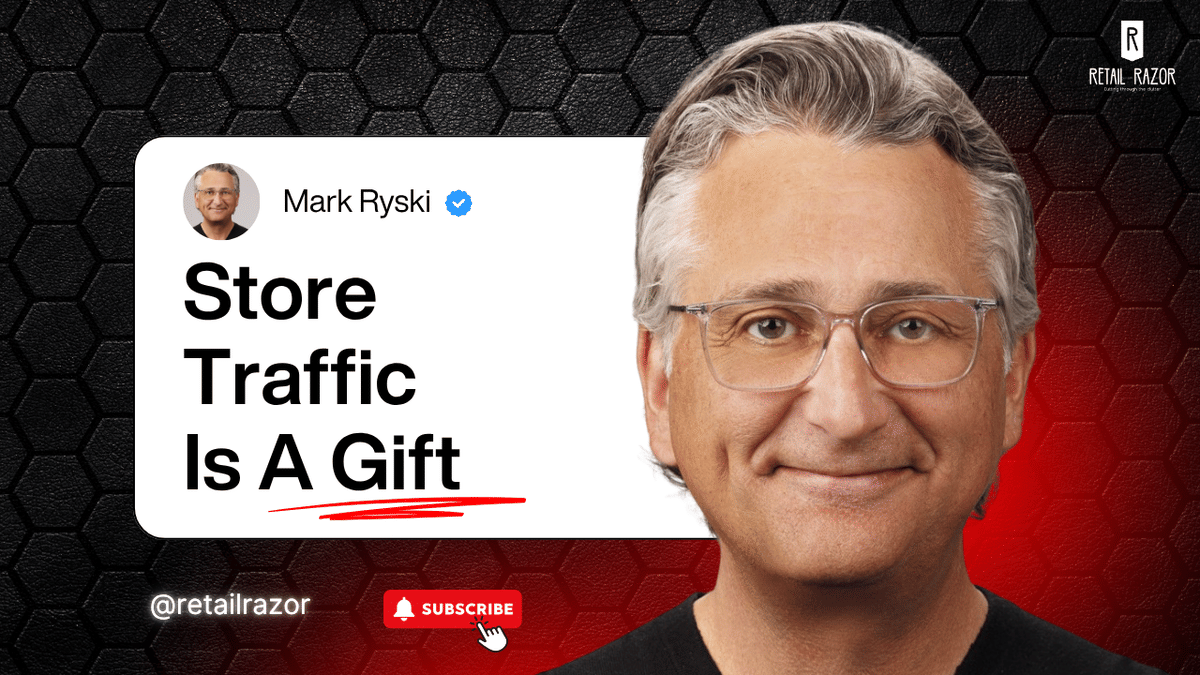
In-store conversion is misunderstood because most retailers never measure the shoppers who don't buy. Physical stores convert 20% to 70% of visitors, several times better than e-commerce, yet many chains track only transactions, so missed sales stay invisible. Mark Ryski, CEO of HeadCount Corporation, explains the fix on The Retail Razor Show.
Mark has analyzed store traffic for almost 3 decades and written three books on it. His newest, Store Traffic Is a Gift, argues that every store visit is precious, non-renewable, and routinely squandered. We invited him on the show to walk through the data.
How much better do stores convert than online?
A typical e-commerce site converts under 3% of its traffic. Amazon converts around 10%, excluding Prime members.
Physical stores range from 20% in specialty categories to 70%+ in general merchandise.
The US Census Bureau's March 2026 report puts 84% of retail sales inside physical stores. The store is the best converting channel a retailer has; the advantage is intentionality, since a shopper who drives to your store came to buy.
Why can a busy store sell less?
Stores get too busy to serve. Associates disappear, checkout lines clog, questions go unanswered, and shoppers leave without buying. Retailers who only count the till never see it happen.
In HeadCount's exit surveys outside one 60,000 sq ft big box store, 77% of shoppers leaving without a bag said they intended to buy.
Their verbatim reasons: couldn't find anyone to help, didn't want to wait in line, couldn't get questions answered.
What is a super converting store?
Within a single chain, HeadCount's fleet mapping finds in-store conversion rates from 30% to 75%, with identical products, systems, and training.
The standouts aren't necessarily the top-volume doors. Low-traffic, high-conversion stores are often a chain's best performers hiding in plain sight. Mark's quadrant analysis separates them, then the chain studies what those teams do differently and coaches the rest toward it.
Should staff schedules follow sales or traffic?
Traffic. Labor tends to follow sales, which is circular. Stores that sell more get more staff, while high-traffic stores with sagging in-store conversion stay understaffed and keep sagging.
Aligning staff hours to when shoppers actually visit is the single biggest conversion lever Mark recommends for any retailer of any size.
To win the CFO over, he shows what 100 basis points of in-store conversion improvement means in top-line sales (for large chains, tens of millions of dollars), then proves it with test-and-control stores.
Do BOPIS and Amazon returns help or hurt?
BOPIS and curbside make traffic data more valuable, since it contextualizes the operational demand on each store. 20 pickups against 100 visits is a different day than 20 against 1,000.
Amazon returns desks are the trap. Traffic goes up, but converting a frustrated returns customer rarely works, and the activity pulls associates away from shoppers who came to buy.
Mark calls it a Faustian bargain: floor space traded for traffic that doesn't convert.
Where does AI fit?
AI staffing and analytics tools assume traffic data exists, and at many retailers it doesn't, or it's too inaccurate to trust.
Mark's advice: treat traffic data like financial data, audited for accuracy in the CFO's office, because store traffic is the most reliable demand signal a physical store has.
Clean data first, algorithms second. Or as Mark puts it, you can't algorithm your way to success in a physical store.
FAQ
What is a good conversion rate for a physical store?
It depends on category: jewelry runs lower with high ticket values, apparel and specialty run 20-40%, and general merchandise can hit 60-70%. Mark advises benchmarking against your own fleet's best stores rather than industry averages.
How do retailers measure store traffic?
Electronic traffic counters have existed since the 1970s, from infrared beams to modern camera-based sensors. Accuracy matters more than technology; audit the counts before acting on them.
Is foot traffic declining in retail?
Store visits remain the majority of retail activity, with 84% of sales happening in stores as of the Census Bureau's March 2026 report and projections above 75% through 2030.
Hear the whole story.
🎧 Hear the full conversation with Mark Ryski on The Retail Razor Show podcast. His book, Store Traffic Is a Gift, is available now; find it and HeadCount Corporation at headcount.com.
Follow the show on Apple Podcasts, Spotify, or Goodpods, or watch on YouTube, so you never miss an episode. If you feel the series earns it, leave us a 5-star rating and a short review. It genuinely grows the show. Then explore the rest of the Retail Razor Podcast Network: Retail Transformers, Data Blades, and Blade to Greatness.
Stay sharp, stay human, and stay ahead.
ABOUT THE AUTHOR
Ricardo Belmar is a retail tech analyst, top industry influencer and host of The Retail Razor Show podcast, part of the Retail Razor Podcast Network, the #1 indie podcast network for retail. He writes and speaks on retail technology, AI in retail, retail media, and the leadership behind real retail transformation.
ABOUT THE PODCAST GUEST
Mark Ryski is the founder and CEO of HeadCount Corporation and one of the retail industry's leading authorities on store traffic and shopper conversion. For more than 20 years, he has helped retailers—from independent stores to large national chains in over 20 countries—convert more store visits into sales and make better operating decisions. He is the author of three books on retail performance, including Store Traffic Is a Gift: The Retailer's Guide to Converting Visits into Sales, Conversion: The Last Great Retail Metric, and When Retail Customers Count, the first book dedicated to the study of store traffic. Mark is a longtime BrainTrust contributor on RetailWire and has been recognized as a Rethink Retail Top Retail Expert in 2025 and 2026.