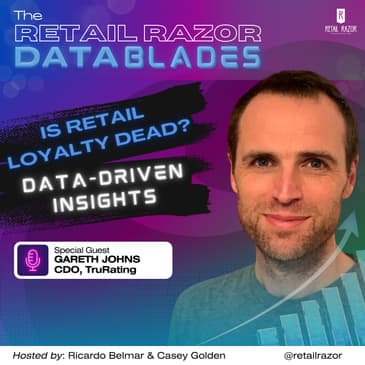



S2:E2 Retail Loyalty Unveiled: Epic Insights from Gareth Johns and TruRating
Retail loyalty is no longer about points and discounts. It’s about experience, personalization, and values. In this episode of The Retail Razor: Data Blades, hosts Ricardo Belmar and Casey Golden welcome back Gareth Johns, Chief Data Officer at TruRating, to explore the new retail loyalty playbook for retailers.
Key Topics Covered:
Why retail has one of the lowest customer retention rates across industries
The myth of “owning” customers vs. being part of their shopping repertoire
How 59% of customers return simply because of friendly service
The hidden impact of staff interactions on repeat visits and long-term loyalty
Why retail loyalty programs must evolve beyond discounts and focus on data-driven personalization
The growing role of sustainability, ethics, and community values in retail loyalty strategies
Real-world case studies of retailers using TruRating’s real-time feedback tools to uncover friction points and boost retention
Why focusing on lifetime value (LTV) beats chasing lower customer acquisition costs (CAC)
Gareth shares actionable insights from nearly a billion points of retail data analysis, showing how brands can shift from transactional thinking to building authentic, long-term customer relationships.
Whether you’re in grocery, fashion, or specialty retail, this episode delivers sharp, actionable insights to help you future proof your retail loyalty strategy.
Subscribe to the Retail Razor Podcast Network: https://retailrazor.com
Subscribe to our Newsletter: https://retailrazor.substack.com
Subscribe to our YouTube channel: https://go.retailrazor.com/utube
Guest Info:
Gareth Johns, Chief Strategy Officer, TruRating - https://www.linkedin.com/in/gareth-johns-7166524/
Gareth Johns is an internationally experienced product and data development leader with 20+ years of expertise in using big data and technology to drive business growth for major retailers. He played a key role in scaling dunnhumby, a global leader in customer data science, from a 30-person startup to an international powerhouse in marketing analytics and customer insights for Tier 1 retailers. After leading strategic initiatives across the US and Europe, he went on to Starcount before joining the TruRating team. Gareth is passionate about transforming the way retailers collect and use customer feedback. At TruRating, he’s helping businesses access real-time, transaction-tied consumer data at an unprecedented scale; revolutionizing how retailers measure and improve business performance.
More from TruRating about building loyalty:
https://trurating.com/events/customer-retention-in-retail/
Chapters:
(00:00) Preview
(01:10) Show Intro
(04:10) Welcome Gareth Johns
(04:24) Challenges in Retail Loyalty
(07:14) Importance of Store Staff
(10:24) Evolving Loyalty Programs
(13:12) Ethics and Sustainability in Loyalty
(16:26) Real-Time Feedback and Loyalty
(22:21) Final Thoughts and Recommendations
(26:11) Show Close
Meet your hosts, helping you cut through the clutter in retail data insights:
Ricardo Belmar is an NRF Top Retail Voices for 2025 & a RETHINK Retail Top Retail Expert from 2021 – 2025. Thinkers 360 has named him a Top 10 Retail & AGI Thought Leader, a Top 50 Management, Transformation, & Careers Thought Leader, a Top 100 Digital Transformation & Agentic AI Thought Leader, and named him one of the Top Voices for 2024 and 2025. He is an advisory council member at George Mason University’s Center for Retail Transformation, and the Retail Cloud Alliance. He was most recently the director partner marketing for retail & consumer goods in the Americas at Microsoft.
Casey Golden, is CEO of Luxlock, a RETHINK Retail Top Retail Expert from 2023 - 2025, and a Retail Cloud Alliance advisory council member. Obsessed with the customer relationship between the brand and the consumer. After a career on the fashion and supply chain technology side of the business, now slaying franken-stacks and building retail tech! Currently, Casey is the North America Leader for Retail & Consumer Goods at CI&T.
Includes music provided by imunobeats.com, featuring Tech Lore from the album Beat Hype, written by Heston Mimms, published by Imuno.
Highlight Clips
[00:10:16] - I think as this data shows, is that at some point that cost cutting hurts the experience and that's what keeps customers away…
[00:12:37] - I feel like the customer's definition of a loyalty program and the retailer's definition of a loyalty program is on opposite…
[00:08:22] - What we found, actually, was that if you're looking at, in any one visit, what's the thing that most impacts my likelihood to…
Transcript
Retail Loyalty Unveiled: Epic Insights from Gareth Johns and TruRating
[00:00:00]
[00:00:00] Preview
[00:00:01] Gareth Johns: Yeah, so I think I had a boss once that said if you want loyalty, get a dog. And his point was that like.
[00:00:09] Casey Golden: He sure didn't work in the luxury industry!
[00:00:12] Gareth Johns: Every customer that you have is a customer of your competitor as well.
[00:00:16] Ricardo Belmar: I think as this data shows is that, at some point that cost cutting hurts the experience, and that's what keeps customers away long term.
[00:00:24] Gareth Johns: I think if you really can use it to understand that customer and give them something that's relevant to them that's amazing and really surprised and delight them, then there is potential that. You could influence loyalty, but I think the best way to influence loyalty is actually to say, I've used the data to understand my customer base as a whole and understand where my opportunities are and I've changed something in the store or the pricing or the range or whatever else.
[00:00:48] Casey Golden: If I'm loyal, I want perks and experience, and they want to be able to forecast predictable sales. You [00:01:00] know, I'm like, I don't want you coming at me just to buy something. I want you to come at me with gifts and service and being special not just, coming after my pocketbook.
[00:01:10] Show Intro
[00:01:18] Ricardo Belmar: Welcome to Season two Retail Leaders. This is the Retail Razor data blades, the podcast that slices through complex retail research to deliver sharp, actionable insights you can use today.
[00:01:29] I'm Ricardo Belmar.
[00:01:31] Casey Golden: And I am Casey Golden.
[00:01:33] In our last episode, we tackled the great conversion mystery with Gareth Johns from TruRating, uncovering what really stops shoppers from buying and how data can be missed opportunities into revenue wins.
[00:01:48] Ricardo Belmar: Today, Gareth's back with us to explore the next big challenge, loyalty, because let's be honest, winning a sale is no longer the finish line. It's really just the beginning. Retail has one of the lowest [00:02:00] customer retention rates across industries. And in a world of endless choice, shifting expectations, and rising acquisition costs, loyalty is harder to earn and easier to lose than ever before.
[00:02:11] Casey Golden: So how do you turn a one-time shopper into a lifelong loyalist? It's not just about points and discounts anymore. It's about experience, personalization, employee engagement, and purpose-driven messaging.
[00:02:26] Ricardo Belmar: Gareth will share how TruRating's real-time feedback tools are helping retailers measure and refine loyalty strategies down to the store level. We'll hear how 59% of customers return to one retailer simply because of. Wait for it. Friendly service. That's not a program. It's a person.
[00:02:46] Casey Golden: We will also challenge conventional thinking around loyalty programs, explore why traditional email marketing is falling short, and look at how values like sustainability and community are [00:03:00] driving repeat business.
[00:03:01] Ricardo Belmar: Plus Gareth brings us a real world example of how one retailer used shopper feedback to solve a friction point that was quietly eroding retention and turned it into a loyalty win.
[00:03:12] Casey Golden: So if you're a retail executive looking to build deeper relationships, drive repeat visits, and future proof your brand's loyalty strategy, this episode is for you.
[00:03:22] Before we dive in, a quick favor. If you're enjoying the show, hit us with a five star rating and drop a short review on Apple Podcasts, Spotify, Goodpods or wherever you're listening.
[00:03:36] Ricardo Belmar: And don't forget to like and subscribe on our YouTube channel, so you never miss an episode.
[00:03:41] Casey Golden: Plus check out the other shows in the Retail Razor Podcast Network, The Retail Razor Show, Retail Transformers, and Blade to Greatness. You'll find them all in your favorite podcast app or together on our YouTube channel.
[00:03:56] Ricardo Belmar: So let's get into it and raise our Data blades and dive into the [00:04:00]loyalty playbook with Gareth Johns, Chief Data Officer of TruRating.
[00:04:04]
[00:04:10] Welcome Gareth Johns
[00:04:10] Ricardo Belmar: Welcome back to The Retail Razor Data Blades. Gareth, it's a pleasure to have you back to share more incredible insights from all of your massive consumer data that you and the team at TruRating have pulled together for this three part series that we are continuing today.
[00:04:23] Gareth Johns: Great to be back,
[00:04:24] Challenges in Retail Loyalty
[00:04:24] Casey Golden: So Gareth, today we're talking about a favorite topic of ours on the show, loyalty. And of course, loyalty is not just about winning the sale with the consumer, but after that sale, you wanna convert that customer into a lifelong fan of the brand. However, the data tells us that retail has one of the lowest retention rates across industries. So what's going on here? How have shifting customer expectations made loyalty harder to earn, and a lot easier to lose?
[00:04:56] Gareth Johns: Yeah, so I think I had a boss once that said if you want loyalty, get a [00:05:00] dog. And his point was that like.
[00:05:03] Casey Golden: He sure didn't work in the luxury industry!
[00:05:06] Ricardo Belmar: That's for.
[00:05:09] Gareth Johns: yeah, I think from a retail point of view, if you think about most retailers as a consumer, if you think about most retailers, there are very few retailers that you are actually loyal to that, you, you use them and use them exclusivity. So I think this idea of exclusivity has got wrapped up in loyalty.
[00:05:25] And I think that the expectation is probably a bit high. I think most customers would say if they do go to a single retailer for something, it's probably more a convenience play. Or there's one or two out there that you know are your favorite brand that you're always gonna use and you'd go with.
[00:05:41] But for most of the retailers that we especially work with, so you know, you're talking grocery, big box retail even specialty fashion and footwear. The most you can hope for is to be part of a repertoire of a couple of different brands. So I think the fact that retailers talk [00:06:00] about their customers as if they own them is one of the issues at the beginning, right?
[00:06:05] Every customer that you have is a customer of your competitor as well. Right. And what I think we've seen over the last, definitely over the last, I was gonna say a couple of years, I've been doing this for like 30 years now. So, um, over the last decade maybe, is, especially if you take grocery for an example, customers are shopping more, more places.
[00:06:28] The, the idea of that kind of, I go to the same, I am a whatever shopper. I go there once a week or once a month, and I do a really big shop, and that's the only place I go has just fallen by the wayside. And what our retailers are seeing is actually, I am a part of a repertoire of brands that my customer uses.
[00:06:45] And my aim is to get as big a part of the pie as I can. So that would be a kind of grocery challenge if you're in the more kind of fashion footwear, it's, well, I've, I've got the sale, but yeah, how do I get the next sale? And the next sale might [00:07:00] not be for another six months. So it's more about how many visits can I get in a year rather than is my customer loyal or not loyal?
[00:07:09] Ricardo Belmar: Yeah, no, that's a good point. It's a good point to very, very dependent on product and category.
[00:07:14] Importance of Staff
[00:07:14] Ricardo Belmar: So I wanna share an interesting data point that I'm sure some people may be shocked by this, by, I suspect many of our regular listeners and viewers are going to say, well, of course based on past conversations we've had on the show. But , you have data shows that 59% of customers return to one retailer because of friendly service. So why do staff interactions weigh so heavily in this loyalty discussion? What are some of the small behaviors or touch points that store teams can really master to create that emotional connection that gets people to come back?
[00:07:46] Gareth Johns: Yeah, I mean, I think this is an interesting one 'cause this is actually a grocery retailer.
[00:07:49] So, yeah,
[00:07:52] You'd think in the days of, self-checkout, self scanning, fewer members of staff on the shop floor, like the whole concept, it's become a very [00:08:00] depersonalized kind of experience.
[00:08:02] What this grocery retailer actually does is they measure seven or eight different things that they want to be true for every single customer. One of which is staff friendliness. There's a whole bunch of others that are the things that you'd always expect a grocery retailer to worry about, products on the shelves, queue times at till, all those kind of things.
[00:08:18] Cleanliness, store quality of fruit and veggie. There's a lot out there. What we found actually was that if you are looking at, in any one visit, what's the thing that most impacts my likelihood to come back for the next year and how many visits I'll make in the next year? Staff readiness was the most important factor.
[00:08:36] So it, it, all things matter, but it matters most to customers. That's the thing that drives the majority of, the, so if you're gonna focus on one thing, that's a really important thing to focus on. And what we found for, this retailer, like a lot of others are focusing on efficiency, right?
[00:08:51] So how do I cut the number of staff that I've got out there? What's the impact of that? How do I save a dollar every time if I can just shave this, shave that. And what the, what I think what this [00:09:00] gave them was at least a counterpoint to that, which is, if I shave too far, if I go too efficient, what impact does that have on the long term?
[00:09:08] It may not impact in the moment groceries. I'm not gonna go home to my wife and say somebody was rude to me in the store, so we're not eating tonight. Or, you know, I have only bought half the things you sent me out for. I think what you will see is that, yeah, I might not come back next time
[00:09:26] Ricardo Belmar: Right. You may go somewhere else.
[00:09:28] Yeah.
[00:09:28] Gareth Johns: might start to split my shop a bit more. So, yeah, so, um, I think this was a, it was an interesting insight into what matters for repeat visit and loyalty. And sometimes that's not the same thing that matters for spend in the moment, average basket size, getting that additional item. So, yeah, I think, and I think sometimes retailers get too focused on one and not the other.
[00:09:48] And repeat visits is harder to measure and it takes longer and you've gotta track it for longer. So I think it falls by the wayside sometimes, and that's
[00:09:55] Ricardo Belmar: that's a great
[00:09:56] Gareth Johns: I'd make the, I'd make the point for that additional visit [00:10:00] in a year is worth much more than one additional item.
[00:10:02] Ricardo Belmar: Yeah, exactly. Exactly. Yeah. Yeah. You want to focus on that lifetime value. And I think we've said on the show before, and one of our other shows before that, you can't cut cost cut your way to success by just being extremely efficient. I think as this data shows is that, at some point that cost cutting hurts the experience, and that's what keeps customers away long term.
[00:10:24] Evolving Loyalty Programs
[00:10:24] Ricardo Belmar: So let's talk a little bit about loyalty programs. I've heard you say in other places that, loyalty programs shouldn't and really just can't replace that great customer experience. What are some of the ways you see loyalty programs need to evolve beyond just discounts, which always seems to be the default for so many loyalty programs.
[00:10:41] Gareth Johns: I mean, loyalty programs is an interesting one because what is the point of a loyalty program? Is it actually to try and drive loyalty or is it to capture the data that enables you to understand the customer in more detail and therefore deliver them a better experience? So I would say that most loyalty programs are just trying to capture [00:11:00] data.
[00:11:00] They're just trying to understand the customer and then you can use that data to deliver a better service to customer. And potentially it is a means of communication where you can offer customers, relevant rewards and all the rest of it. If you're just thinking that I'm gonna use this loyalty program to offer the standard, reward to every single customer and every single customer's gonna like that reward and because I offer this reward, they're actually gonna be more loyal.
[00:11:25] Then you're not. It's just not a differentiator. Everybody's got roughly the same loyalty program. I think if you really can use it to understand that customer and give them something that's relevant to them that's amazing and really surprised and delight them, then there is potential that. You could influence loyalty, but I think the best way to influence loyalty is actually to say, I've used the data to understand my customer base as a whole and understand where my opportunities are and I've changed something in the store or the pricing or the range or whatever else.
[00:11:54] And that's what's driven loyalty. I don't think loyalty programs actually in most cases deliver [00:12:00] loyalty. And if you ask customers what they want from a loyalty program, they'll just say discounts. That that's what they, that's what they want most. So yeah. So I guess, I dunno, my view would be if you don't use the data that you get from it, then you can't really expect it to deliver loyalty.
[00:12:12] And I think too many retailers focus on the fact that their loyal customers spend more, and that's because people who spend more get more benefits out of a loyalty program, therefore they sign up.
[00:12:20] Ricardo Belmar: So that's, yeah. It's kind of a circular logic there from, for that. Yeah. Yeah. I think that the, maybe the right answer that that speaks to is that retailers should really be leveraging the data from their loyalty program to understand what might their customer want, that their customer doesn't realize they want, because they're not going to intrinsically ask for it.
[00:12:37] Casey Golden: Yeah, I feel like the customer's definition of a loyalty program and the retailer's definition of a loyalty program is on opposite sides of the spectrum. There are two different things.
[00:12:50] If I'm loyal, I want perks and experience, and they want to be able to forecast predictable sales. [00:13:00] You know, I'm like, I don't want you coming at me just to buy something. I want you to come at me with gifts and service and being special not just, coming after my pocketbook.
[00:13:12] Gareth Johns: Definitely..
[00:13:12] Ethics and Sustainability in Loyalty
[00:13:12] Casey Golden: So storytelling is an important for brands to make that emotional connection with consumers. Increasingly align the values with what they want their retail brands to be and stand for and align with those values. How can brands weave ethics, sustainability, and community into their loyalty narrative and tell that story?
[00:13:34] Gareth Johns: Well, I think, I think generally just the idea of differentiating yourself, not by just what you sell or how you sell, but actually what you stand for as a brand can be a differentiator. That can be a reason why people choose you over somebody else. And I think what we see from some of our data is that customers do care about things like sustainability.
[00:13:56] They do care about the ethics of where products come [00:14:00] from or at least they say they do. And I think in some cases it does actually lead to a difference in performance, of, you, know, where somebody would buy. So, I think, the more you can do that in a really, in a way that is consistent with actual values are. I think, going out and saying you're something when you're not or your, all you, the evidence would point to you not being that I think you have to be very authentic about this type of stuff, but I think that is a way in which you could offer benefits from a loyalty program that are linked to and fit with those values.
[00:14:30] And that is a reason why people choose you, whether you need a loyalty program to do that, or whether you can just stand very strongly for something and make that your differentiator, I guess is another issue. But yeah we definitely see some of some of the footwear retailers, definitely more kind of Australia, New Zealand that we've got.
[00:14:46] They've got a very clear kind of, this is what we stand for, this is what we do. And it seems to work really well for them. So yeah, I think, uh, putting your values there.
[00:14:54] Casey Golden: just having the brand ask the customer is a big differentiator, [00:15:00]right? I mean, I'm willing to answer a few questions if a brand reaches out or even ask the question at checkout.
[00:15:06] Could we done better?
[00:15:08] Did you get what you needed?
[00:15:10] Versus a company that doesn't ask because at least I feel like my experience is important to them.
[00:15:16] They care about me. They're interested in learn, in being better, so I'm gonna help 'em.
[00:15:21] Gareth Johns: Yep.
[00:15:21] Casey Golden: Versus companies that don't. I think that's just, that's a, that can go back to a value structure all on its own that differentiates right before I walk out the door.
[00:15:30] Gareth Johns: Yeah, I mean, I think some of the, actually the questions that we ask, we obviously ask lots of questions that are around kind of staff and store
[00:15:36] Casey Golden: I made mine up
[00:15:38] Gareth Johns: Yeah.
[00:15:38] But, but even the, even the ones you make that you talked about, one thing you're kind of learning. Does it impact on repeat visits?
[00:15:45] Does it impact on spend? Am I doing it well? Have I got opportunities to improve it? That's all great. From a retailer point of view, I think there is an interesting point that actually by asking the customer about that you are signaling that it's important to you that the customer experience is [00:16:00] important to you, and you're also signaling to staff that I'm gonna ask customers about this, therefore, it is important to this brand.
[00:16:07] You've gotta live up to it afterwards. You can't just say I only do this 20% of the time and I only did 20% of the time last so I ask you about it, but I don't really care, or I'm not I think if you're gonna go out there and make a statement about something like that, you've gotta back it up.
[00:16:21] Ricardo Belmar: Right. Yeah. You have to take some action as a result of learning this information, right? Yeah.
[00:16:26] Real-Time Feedback and Loyalty
[00:16:26] Casey Golden: So let's map out the new loyalty playbook for retailers. In what, 15 seconds. How does TruRating enable realtime feedback collection that helps improve loyalty strategies? Can you give us, and our audience an example of how a retailer uses feedback to solve a specific friction point that was hurting retention?
[00:16:48] Gareth Johns: So the way with,
[00:16:49] Casey Golden: the spot
[00:16:49] Gareth Johns: yep, the, the way that we do it, we obviously ask a single question at the point of payment. We are really clear that as a customer, you'll never be treated [00:17:00] differently based on how you answer that question, and nobody will know who you are. So customer's really important to us. Customer privacy is really important to us. We're not trying to use questioning as a means to then sell you something in addition. So what we can do though, with the help of the payment partners, is payment partners can see if the single customer has come back again. So I can tell that when a customer has a friendly experience, how long is it before they return?
[00:17:26] But I dunno who that customer is. I dunno anything about them. I can't contact them, I can't do anything with them. So we're very focused on the, I guess the understanding the drivers of loyalty and understanding the opportunities, as in the locations, the situations, the categories, the shopping missions, where those things can be improved.
[00:17:44] What we're not into is if I can find out why you didn't have a great experience, I can send you a $5 coupon and hopefully you'll come back. Because that's just, that's one, it's not sustainable. You're trying to buy loyalty. Two, it's customers play it. They know [00:18:00] what's going on after a bit and Yeah, it doesn't,
[00:18:02] Casey Golden: Yeah, you could just click and get
[00:18:04] Ricardo Belmar: Right. You just assume you'll get
[00:18:05] it.
[00:18:05] every time you click that. Yeah.
[00:18:07] Gareth Johns: And you're hearing from such a, everything we do is with a sample of customers, so you know, at best you're gonna what influence 10% the customer base.
[00:18:14] Ricardo Belmar: Mm-hmm.
[00:18:14] Gareth Johns: yeah, from our point of view it's much more important to understand the underlying factors and deal with those. It's not about trying to rescue the situation for one or two customers.
[00:18:26] In terms of examples, I think there was the, obviously the one earlier about friend friendliness is probably the most pertinent in terms of something that maybe that retailer would not have known otherwise and would not have focused on otherwise. I'm just trying to think of some others that we've had more recently, I think for one retailer recently, what we've actually uncovered is how that brand is perceived, really has an impact on loyalty. So if the customer is very interested in fashion, they will be much more loyal to that brand than if they're not. Now that's a harder thing. You can't suddenly make somebody interested in fashion, [00:19:00] but you can understand the differences between different stores in the same retailer as to what's their customer base look like, and therefore why is it that one's managing to get such a good set of loyal customers.
[00:19:12] And another one has got such a transient base and seem to lose, that people are making two visits a year versus four visits a year. So that retailer, sometimes it's not anything to do with the store, it's not anything that the store manager could have done differently, it's just they happen to be in an area where they've attracted a different type of customer base and that customer base is either loyal or not loyal.
[00:19:30] So, I think there's a lot that you can uncover about customers that helped you. Know your, your headroom is to improve and kind of what the levers are that you can kind of pull to,
[00:19:40] Ricardo Belmar: Mm-hmm.
[00:19:40] Gareth Johns: To make that improvement.
[00:19:42] Ricardo Belmar: Yeah. Yeah.
[00:19:43] Casey Golden: Yeah, there's,
[00:19:44] Ricardo Belmar: oh, go ahead, Casey.
[00:19:45] Casey Golden: oh, sorry. I was just saying there's gotta be a lot of very interesting data when you're taking a, a standalone brick and mortar versus a strip mall versus a mall. Like, so I, from my mall days, whatever movie was [00:20:00] playing or launching, dramatically impacted store sales
[00:20:05] Ricardo Belmar: Yeah.
[00:20:05] Gareth Johns: right?
[00:20:06] Casey Golden: they were wasting time before the movie started.
[00:20:09] Ricardo Belmar: Yeah. A totally different foot traffic perspective. Yeah.
[00:20:12] Casey Golden: Hollywood's release schedule had a retail impact for every single store in the mall.
[00:20:18] Ricardo Belmar: Yeah.
[00:20:20] Casey Golden: But, you know, going to like brick and mor, a standalone brick and mortar versus a strip mall, like really understanding that ecosystem and the customer base and those habits,
[00:20:30] Gareth Johns: Yeah.
[00:20:30] Casey Golden: think I'd love to, be diving into your data and slicing and dicing it.
[00:20:34] Ricardo Belmar: Yeah. absolutely.
[00:20:37] Gareth Johns: Well, I think the more that we can get, as we start to get rolled out to more and more retailers, I think the idea of understanding spend across different retailers could be really interesting as well. Because
[00:20:47] Ricardo Belmar: Yeah. Yeah.
[00:20:47] Gareth Johns: the signals that you can get from what a customer does in a fashion retailer aren't huge.
[00:20:53] You only go a couple of times a year. You buy, I buy a white t-shirt, what does it tell you about me? Not very much. But if you can link the fact that [00:21:00] I buy these types of, in, in fashion with this is what I buy in the grocery store, you probably can get a pretty good understanding of my view on you know, ethical foods,
[00:21:10] Ricardo Belmar: Mm-hmm. Right.
[00:21:13] Gareth Johns: price sensitivity.
[00:21:15] There's a lot of things. I think grocery can, grocery just is an, is a really rich area for understanding customers and the more you could use that to then link and say, I can see customer behavior elsewhere and just even if you had a couple of attributes that would, that would be really
[00:21:29] Ricardo Belmar: yeah.
[00:21:29] You could get a lot of new fresh validation on certain behaviors that you can, you can't really necessarily validate otherwise, but which is the, those single data
[00:21:37] Casey Golden: Yeah. There's an aesthetic that goes between your refrigerator, your living room, and your closet.
[00:21:42] Ricardo Belmar: that's right. That really
[00:21:45] Casey Golden: is so true.
[00:21:46] You know, like I can open up a refrigerator and have a good idea and know what's in the closet, walk into somebody's living room. I have a pretty good idea what I can expect for dinner. Or what their, what their closet looks like.
[00:21:58] I think it's very interesting [00:22:00] as a lot of tho those three retailer retail categories generally separated. Generally different companies. Same customer base. So I think it's really interesting as TruRating can see a customer across and understand those personas. Yeah.
[00:22:18] Ricardo Belmar: Yeah. Yeah. Yep. Gareth,
[00:22:20] Casey Golden: fun stuff.
[00:22:21] Final Thoughts and Recommendations
[00:22:21] Ricardo Belmar: Gareth, if a retailer wants to improve their loyalty position starting tomorrow what would you recommend their first move be?
[00:22:29] Gareth Johns: I think stopping thinking about customers as their customers and either they win the customer or they lose the customer is probably the first point Your customer is everybody else's customer. Everybody else's customer is your customer. So it's an ongoing. You are constantly trying to get a slightly bigger piece of the pie, basically.
[00:22:46] So that's good and bad, right? Like you can lose more of that customer at any point in time. But likewise, you can also gain, gain them back or gain more of their spend back gain. So I don't think loyalty's really a, I have loyal customers and I don't have [00:23:00] loyal customers. I have customers that do a bigger percentage of their share of spend with me than with others.
[00:23:04] And I have some that are much more of an opportunity to grow. So I think there's a kind of a mind thing that's the starting point, and then really it's what, you've really gotta then understand what are the drivers of why somebody chooses you over somebody else.
[00:23:16] And that could be the point we've raised we're talking about around values. It could be just a convenience play it could be a price issue. There's all those things that could impact it. And then I think having a, just even having a, a realistic sense of how many visits are you aiming at for a year? How many items are you expecting somebody to buy?
[00:23:35] What, how much, how many dollars do you expect a customer to spend with you in a year? A lot of the retailers we talk to, they just, it's almost like they haven't thought that. They don't have that idea. They don't, they don't know, they haven't thought about it or they have thought about it, and they've set something that's just massively unrealistic from where they're right now.
[00:23:51] You know, I want every single customer to spend three hundred dollars a year with me, and I want them coming in every month. It's so I think, I think getting to a point of [00:24:00] understanding where you are now and knowing what's a realistic goal to aim at, and then how you get there yeah, would probably be my two things.
[00:24:08] Casey Golden: growing LTV and lowering CAC are two completely different things, and I feel like the last five years, minimum, everything has been around cac, customer acquisition costs, and I've all, I mean just like sitting there, I'm like, if you can't take care of what you got, why are you going to go get more to underserve? Just focus on the customers that you have and grow that pocket share, then bring more in 'cause you'll know what to do with them.
[00:24:37] But you're right. A lot of brands, a lot of retailers just have put that LTV discussion and those KPIs on the back burner, when in in many cases over the last five years, we've had a lot of companies trying to get out of the red.
[00:24:55] And I know I've been a broken record. I know a lot of our guests have been a broken record [00:25:00] is you can't cut costs into the green. You can just customer your service, you're way out of it,
[00:25:06] Ricardo Belmar: Right. Exactly.
[00:25:08] Gareth Johns: Yeah.
[00:25:08] Casey Golden: you know?
[00:25:09] Ricardo Belmar: Exactly.
[00:25:10] Gareth Johns: I think, to the point about the loyalty, the loyalty programs. Loyalty programs can give you the data to understand
[00:25:16] Ricardo Belmar: Mm-hmm.
[00:25:17] Gareth Johns: the LTV, right? Like that is, that is the, if there was one thing of loyalty programs, that's the one thing they can do. They can tell you, now, you've just gotta make sure that almost every single customer is a loyalty member and that you're not.
[00:25:27] Kind of kidding yourself because you are, you're focused on this small group of customers that visit you so often that they've taken your loyalty card and they use it regularly. And therefore you think the loyalty program is the reason that they come and all you've gotta do is sign up more customers.
[00:25:41] But I think if you can use the loyalty program or other methods to really understand your LTV then, yeah, you can, you can figure out what to do to kind of grow it as well.
[00:25:51] Casey Golden: Well, Gareth, this has been such a great discussion and I always love diving into loyalty. So much impactful data-driven insights that you've [00:26:00] shared with us today.
[00:26:01] Ricardo Belmar: Yeah, it's really been a pleasure chatting with you on this topic. I know. I'm looking forward to the next one.
[00:26:05] Gareth Johns: Looking forward to it, too!
[00:26:06] Casey Golden: Awesome. Well, Ricardo, I'd say that this episode is a wrap.
[00:26:09] Ricardo Belmar: Yes, I think it is.
[00:26:11] Show Close
[00:26:11]
[00:26:17] Casey Golden: If you enjoyed today's episode, please give us a five star rating and review on Apple Podcasts, Spotify, or Goodpods And don't forget to hit subscribe on your favorite podcast app or on YouTube so you never miss an episode. I'm Casey Golden.
[00:26:34] Ricardo Belmar: We'd love to hear from you. Follow us and share your feedback at Retail Razor on LinkedIn, Bluesky Threads and Instagram. You can also subscribe to our substack newsletter for highlights from every episode, and visit retailrazor.com for transcripts and more details about our guests.
[00:26:50] Data Blades is part of the Retail Razor Podcast network.
[00:26:54] I'm Ricardo Belmar.
[00:26:56] Casey Golden: Thanks for joining us.
[00:26:57] Ricardo Belmar: Until next time, Stay Sharp, Be Data-driven [00:27:00] and Harness AI.
[00:27:00] This is the Retail Razor Data Blades.