
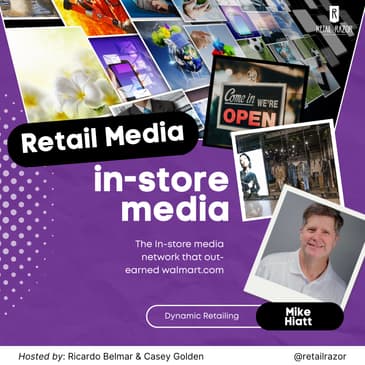



The rise, death, and return of in-store retail media as lived by Mike Hiatt.
Around 2010, the in-store retail media screens inside Walmart's stores were bringing in more revenue than Walmart.com. By 2015 the network was gone.
Mike Hiatt, Founder & President of Dynamic Retailing, built it. He came to Bentonville to take over Walmart TV, which at the time meant 27-inch screens bolted up in the rafters playing audio that fought with Walmart Radio and lost. He rebuilt it as the Smart Network: eye-level screens, category channels, and five media endcaps that sold out every time they went to market. At its peak it had the reach of a Super Bowl each week. It was a retail media network before the industry coined the phrase.
Then it came apart. Marketing owned the network, merchants owned the space, and nobody had built a way to cut the merchants in. Walmart pulled it out around 2015.
Ricardo Belmar and Casey Golden get Mike to walk through what really happened, why in-store retail media is working now when it stalled then, and what his book Timing the Desert says about being right too early. Ricardo spent that same era at Hughes delivering managed digital signage to retailers, so this one gets personal and specific fast.
This is a story of what was, what could have been, and the lessons every retail media network leader today should learn from the original in-store media network.
In This Episode, You'll Learn.
Why a retail media network inside Walmart's stores out-earned Walmart.com and still got deinstalled.
How the fight over trade funds, national ad dollars, and shopper marketing budgets stalled in-store retail media for a decade, and what Amazon did to end it.
Why DSIQ, an ex-Microsoft team out of Seattle, built an ad server for store screens before the industry had the term, and why the company never scaled past Walmart.
The difference between a salesperson and a business development person, and why sending the wrong one into a retailer kills the deal.
Mike's five A's of in-store content: accessible, appropriate, adaptable, attractive, assembled.
Why he argues for localization over personalization, and what it means to treat 2,000 stores as 2,000 super customers.
Who he thinks reaches the in-store retail media cereal moment first.
Why in-store retail media will never be as lucrative as online, and why every retail media network is heading there anyway.
Support our sponsors.
This Episode is Brought to You By RetailClub.
From the founders of Shoptalk and Groceryshop, RetailClub AI Festival brings together 2,000 industry leaders from September 22 to 24 for three days fully outdoors in Huntington Beach focused entirely on how AI is transforming retail. Through the Breakthruprogram, you can shape your experience before you even arrive. Request 15-minute, double opt-in meetings with the people you want to meet, join small-group conversations on the biggest questions in AI and retail, choose from more than 100 experiences, and connect over curated networking dinners. Retail and brand leaders can attend free, plus receive up to $1,750 toward travel and hotel. The Breakthru registration deadline has been extended to September 2. Register now at retailclub.com/retail-razor-podcast.
W. P. Carey School of Business, Arizona State University.
ASU is a leading public research university and its W. P. Carey School of Business is the largest in the United States. AI-Enabled Supply Chain Strategy is a 3-day executive program running October 5-7, built by the #2-ranked Supply Chain Management department. The program is designed for senior leaders setting AI strategy across procurement, logistics, and operations.
Register at https://specialevents.asu.edu/878064 with ID Code retailrazorasu for $1,500 off.
Subscribe & Follow.
How much did you love this episode? Drop us a 5‑star rating and review on Apple Podcasts, Spotify, or Goodpods. Subscribe on YouTube so you never miss an episode and check out the other shows in the Retail Razor Podcast Network: Retail Transformers, Blade to Greatness, and Data Blades.
Subscribe to the Retail Razor Podcast Network: https://retailrazor.com/
Subscribe to our Newsletter: https://retailrazor.substack.com
Subscribe to our YouTube channel: https://go.retailrazor.com/utube
Featured guest.
Mike Hiatt. https://www.linkedin.com/in/mikehiatt/
Founder & President of Dynamic Retailing. https://dynamic-retailing.com
Author. Timing the Desert. https://a.co/d/07IJTQQS.
Mike Hiatt is the president of Dynamic Retailing. A retail media consultancy focused on helping technology solutions providers work more effectively with retailers and assisting retailers better execute retail media strategies inside their stores. He is on the advisory boards at Venvee and Blue Zoo; he recently authored the business book Timing the Desert: A Front-Line perspective on Retail Media, Readiness, and Scale, which focuses on Hiatt’s experiences working at Walmart, Triad Retail Media, and Sam’s Club as well as key insights about where in-store retail media will land in the future of retail. Hiatt graduated from Brigham Young University with a degree in Advertising Management.
Chapters.
00:00 Teaser
00:40 Intro
05:29 Welcome & Introduction
06:36 Early In-Store Media & Walmart TV
08:38 Building the Smart Network
12:22 Merchants vs. Marketers Friction
17:54 Timing the Desert: The Book
24:39 Being Early: DSIQ and the Ad Server Story
31:08 Business Development vs. Sales
38:27 The Retail Media Cereal Moment
44:54 In-Store vs. Online Media Philosophy
46:52 The Five A's, Localization & AI's Future
56:47 Show Close
Meet your hosts.
Helping you cut through the clutter in retail & retail tech:
Ricardo Belmar is an NRF Top Retail Voice for 2025 and a RETHINK Retail Top Retail Expert from 2021 – 2026. Thinkers 360 has named him a Top 10 Thought Leader in Retail, a Top 25 Thought Leader in AGI and Careers, a Top 50 Thought Leader in Agentic AIand Management, and a Top 100 Thought Leader in Digital Transformation and Transformation. Thinkers 360 also named him a Top Digital Voice for 2024 and 2025. He is an advisory council member at George Mason University’s Center for Retail Transformationand the Retail Cloud Alliance. He was most recently the partner marketing leader for retail & consumer goods in the Americas at Microsoft.
Casey Golden, is the North America Leader for Retail & Consumer Goods at CI&T, and CEO of Luxlock. She is a RETHINK Retail Top Retail Expert from 2023 - 2026, and Retail Cloud Alliance advisory council member. After a career on the fashion and supply chain technology side of the business, Casey is obsessed with the customer relationship between the brand and the consumer and is slaying franken-stacks and building retail tech!
Episode Music.
Includes music provided by imunobeats.com, featuring Overclocked, and E-Motive from the album Beat Hype, written by Heston Mimms, published by Imuno.
Transcript.
S6E11 Mike Hiatt – In-store Retail Media
[00:00:00]
[00:00:01] Teaser
[00:00:01] Ricardo Belmar: Back in the early 2000s, Walmart had a network of screens inside its stores that was pulling in more revenue than walmart.com
[00:00:08] Casey Golden: And by 2015, they ripped the whole thing out
[00:00:11] Ricardo Belmar: Not because it stopped working, because nobody inside HQ could agree on who owned it
[00:00:15] Casey Golden: So today we're talking to the guy who built it
[00:00:18] Ricardo Belmar: Mike Hiatt ran in-store media networks at Walmart and later Sam's Club, among others. He's got the receipts, the scars, and now a book about the whole experience. Let's get into it
[00:00:29]
[00:00:40] Intro
[00:00:40] Ricardo Belmar: Welcome back to season six of the Retail Razor Show, the top-ranked indie business management and marketing podcast on Goodpods and the original show in the number one indie podcast network for retail.
[00:00:51] I'm Ricardo Belmar.
[00:00:53] Casey Golden: And I'm Casey Golden.
[00:00:54] Welcome back, Retail Razor fans, to retail's favorite podcast, where we cut through the clutter to give [00:01:00] you sharp insights on what's happening in retail today and tomorrow, where we get real about what's driving the future of commerce.
[00:01:07] Ricardo, I think this one's a little personal to you.
[00:01:13] Ricardo Belmar: It is. So 10, 12, okay, maybe more, but I'll leave the exact number out of it. Now honestly, I was leading product teams at a managed service provider, Hughes, delivering digital signage to retailers, and our guest today was kind of on the other side of the table at Walmart while we were doing that, building the thing everybody in our industry was watching. So we've got some shared history there. I'm sure we'll, talk about the shared bruises too as, this discussion gets on.
[00:01:40] Casey Golden: And here's why it matters now. In-store media is the hottest line item in retail and retail media right now, at least when you're not talking about AI
[00:01:54] Every retailer with a media network is trying to figure out how to extend it onto the sales floor. [00:02:00] But almost nobody talks about the fact that this has already been tried at massive scale nearly two decades ago. There's a whole graveyard of lessons out there, and most of the people building today have never heard them.
[00:02:17] Ricardo Belmar: And that's exactly where we're going today.
[00:02:20] But first, let me tell you about our sponsor, RetailClub.
[00:02:22] There's still time to join RetailClub's AI Festival Breakthrough program. From the founders of Shop Talk and Grocery Shop, RetailClub AI Festival brings together 2,000 industry leaders from September 22nd to 24th for three days fully outdoors in Huntington Beach, focused entirely on how AI is transforming retail.
[00:02:39] Through the Breakthrough program, you can shape your experience before you even arrive. Request 15-minute double opt-in meetings with the people you wanna meet. Join small group conversations on the biggest questions in AI and retail. Choose from more than 100 experiences and connect over curated networking dinners.
[00:02:54] It's all designed to help you meet the right people, explore the questions that matter to you, and still leave room for the unexpected. [00:03:00] Retail and brand leaders can attend free, plus receive up to $1,750 toward travel and hotel. The breakthrough registration deadline has been extended to September 2nd.
[00:03:09] Register now at retailclub.com/retail-razor-podcasta big thanks to RetailClub for helping us bring you this podcast and all the other shows in the Retail Razor Podcast Network.
[00:03:20] Okay, supply chain leaders, this one's for you. The W. P. Carey School of Business at Arizona State University is running a three-day executive program October 5th through 7th called AI-Enabled Supply Chain Strategy. It comes out of their supply chain department ranked number two in the country, and it's built for senior leaders who need a real AI strategy across procurement, logistics, and operations.
[00:03:42] You'll leave with frameworks for evaluating AI opportunities, a clear read on where companies are getting genuine competitive advantage, and a room full of peers working the same problem. Seats are going fast, so don't wait. Register using the link and the special ID code RETAILRAZORASU shown in our [00:04:00] show notes for $1,500 off.
[00:04:02] And catch our three-part Data Blades miniseries in September with Professor Brett Duarte for a preview. Now on to the episode.
[00:04:09] Casey Golden: All right, our guest today is Mike Hiatt. Mike is the president of Dynamic Retailing, a media, a retail media consultancy out of Bentonville that helps retailers activate in-store media and helps technology providers get in the door with those retailers in the first place.
[00:04:28] Ricardo Belmar: Mike's resume is basically the history of this category. He was Walmart's director of in-store media networks, where he led the Walmart Smart Network. He went on to Triad Retail Media and to Sam's Club, and he's consulted for Lowe's, Walgreens, BJ's Wholesale, GameStop, and a long list of technology providers. He also sits on the advisory boards at Venvee, who's been on the show before, and Blue Zoo.
[00:04:51] Casey Golden: There's no wonder why he's written a book about it.
[00:04:55] Ricardo Belmar: Exactly.
[00:04:56] Casey Golden: Timing the Desert, a Frontline Perspective on Retail [00:05:00] Media Readiness and Scale. The forward is by Andrew Lipsman, which tells you something about the company Mike keeps, and of course, a great friend of the show, too, who's been with us on many of our retail media episodes.
[00:05:14] We'll drop the link to the book in the show notes. Don't you worry!
[00:05:19] Ricardo Belmar: Perfect. Now let's welcome to the Retail Razor Show, Mike Hiatt
[00:05:29] Welcome & Introduction
[00:05:29] Ricardo Belmar: Mike, welcome to the Retail Razor Show. This is a, a real treat for us to have you here as a, a true OG of retail media from honestly before anyone even knew to call it retail media.
[00:05:40] Mike Hiatt: Yeah, it's true. Thanks for having me. it's a pleasure
[00:05:43] Casey Golden: I can tell this is going to be an episode where I'm gonna have to keep Ricardo from totally geeking out on retail media with you, given the history the two of you have as well
[00:05:54] Ricardo Belmar: No doubt about that
[00:05:55] Mike Hiatt: I'm sure we'll talk about... Hopefully we don't do too much inside baseball, but, a, have a [00:06:00] good collective conversation,
[00:06:01] Ricardo Belmar: Yeah, exactly. Exactly. Well, let's dive in. and I guess we might as well start right at the, at the beginning o- of it all in a sense. you know, Mike, y- you and I, I think were both in this business, what, nearly two decades ago in different places. again, before anyone really called this retail media, you, you were at Walmart building the, the Walmart Smart Network. I was actually at a, a managed service provider, Hughes, delivering managed digital signage, to retailers, which we didn't necessarily think of as a media solution m- most of the time that we were delivering that. But if we take listeners back to that era, I...
[00:06:36] Early In-Store Media & Walmart TV
[00:06:36] Ricardo Belmar: What did in-store media generally look like in those early days?
[00:06:40] And this, this would be pre-2010, right? So early 2000s even, right? and what is, what does it tell you that a network of screens i- inside stores was for? I mean, at its peak it was, you've said it in, in your book even, it was generating more revenue than walmart.com in that era
[00:06:56] Mike Hiatt: Yeah, at the very end, around twenty ten, it was when we fully [00:07:00]engaged the smart network. But before that, what I inherited was what they called Walmart TV.
[00:07:06] Ricardo Belmar: Mm-hmm.
[00:07:07] Mike Hiatt: Walmart TV... And it-- we thought about in terms of television and television networks.
[00:07:11] Ricardo Belmar: Yeah
[00:07:11] Mike Hiatt: and so a company called PRN had gone through and worked with, Walmart and Costco and Target and the major players in, in the retail space, and had actually created a nice service for them because it allowed to put content on, their networks, on screens that they were merchandising in their electronics department. So they had, before that, you would just pull up a local TV station, or you might have a DVD playing or a, a vid- even a videotape playing, and it wasn't a great user, customer experience. And so PRN came in and had a solution for that What their goal was ultimately is they wanted to create kind of an Uber network TV networks across all of retail. And actually at, at one point, I think in the mid-aughts, they had gotten pretty big doing that. And in [00:08:00] fact, they even attracted the attention of CBS and ABC. They had come out with their Outernet
[00:08:05] Ricardo Belmar: That's right, yeah
[00:08:06] Mike Hiatt: and you had the Signstory and,
[00:08:08] Ricardo Belmar: Mm-hmm.
[00:08:09] Mike Hiatt: ABC InStore. And, but when I came-- when I came in, I inherited the PRN relationship with- from Walmart. But the idea that they had brought me into, and the reason I relocated my family from Salt Lake City to Bentonville, Arkansas, was the promise that we could remake it. We could re-envision what, TVs or media in the store would look like. that's when I went to work, and we started figuring out how to move basically twenty-seven-inch screens that were up in the
[00:08:38] Building the Smart Network
[00:08:38] Mike Hiatt: rafters that you really couldn't see, that were trying to play audio and trying to entertain,
[00:08:43] Ricardo Belmar: Yeah, yeah
[00:08:45] Mike Hiatt: to a much more eye level, more integrated with the products, more integrated with the, the, the store itself type of contextually relevant content streams, with different media channels running those and, and just kinda take it to that next
[00:08:59] Ricardo Belmar: Yeah[00:09:00]
[00:09:00] Mike Hiatt: And so I don't, I really don't know how much money... We don't want really... PR-- Walmart at the time didn't really know how much money PRN was making. We
[00:09:06] Ricardo Belmar: Hm.
[00:09:06] Mike Hiatt: a check, from... But we were paying for the system, and, they were selling advertising. And so they were-- We didn't have any visibility into that.
[00:09:15] Ricardo Belmar: Wow
[00:09:15] Mike Hiatt: And so that changed. That changed with the Smart Network
[00:09:18] Ricardo Belmar: Mm-hmm,
[00:09:19] but to PRN's credit, they navigated with us. They didn't wanna lose, obviously, Walmart as a customer, Right
[00:09:25] Mike Hiatt: and we worked with them, and they had new ideas too and fresh thinking. They wanted to evolve this space as well. But, what we didn't want, Walmart did not want to be just another node on their network. We didn't want just the, same experience that you were getting at Target
[00:09:40] Casey Golden: Right
[00:09:40] Mike Hiatt: or
[00:09:41] Ricardo Belmar: Yeah.
[00:09:41] Mike Hiatt: any of these other,
[00:09:42] Ricardo Belmar: Right.
[00:09:42] Mike Hiatt: We wanted to have it for
[00:09:44] Ricardo Belmar: Right, something that was uniquely Walmart. Yeah
[00:09:45] Mike Hiatt: up with... why we came up with the Walmart's Network, the Smart Network.
[00:09:48] And so to answer your question, by twenty ten, when we had multiple channels running, at eye level, really engaging the customer and their journey through the store, and we had screens on end caps delivering [00:10:00] product, on those end caps that was relevant to the message that was on that screen, yeah, we were making-- we were bringing in more revenue than Walmart.com. and that continued until, until programmatic was invented, so to
[00:10:12] Ricardo Belmar: Yeah
[00:10:13] Mike Hiatt: And that, that changed the trajectory for all,
[00:10:15] Ricardo Belmar: Yeah. Yeah.
[00:10:16] Mike Hiatt: or
[00:10:16] Ricardo Belmar: What, what was when you brought like the, because you mentioned when you inherited Walmart TV, and I remember seeing this i- in stores i- in the time. Like, the screens were way up high, above everything. They were honestly, as a consumer, they, they were not large, I, I would say gigantic screens, but they were smaller and they were tr- You could tell there was some audio, but I think there was also regular like Walmart audio in the store competing with it, right?
[00:10:39] Mike Hiatt: and we've done research. you... And, there's well-established research that our brains can some- for some reason handle lots of video, visual
[00:10:45] Ricardo Belmar: Mm-hmm
[00:10:46] Mike Hiatt: We can have tons of, we can go to a Times Square and think it's amazing. But if you had the equivalent of Times Square with an audio feed, but you couldn't, your
[00:10:54] Casey Golden: brains
[00:10:54] Mike Hiatt: can't
[00:10:55] Ricardo Belmar: you can't handle it. Yeah. Yeah
[00:10:56] Mike Hiatt: we had Walmart Radio, and then when you're trying to run sound on these [00:11:00] screens to story tell or tell about what's going on the screens it's, customers just can't deal with
[00:11:06] Ricardo Belmar: Yeah.
[00:11:06] Mike Hiatt: want to deal
[00:11:07] Ricardo Belmar: Yeah.
[00:11:07] Mike Hiatt: It's frustrating. It's not a good experience
[00:11:09] Ricardo Belmar: Yeah. But
[00:11:10] Casey Golden: that what was ripped out by like 2015?
[00:11:13] Mike Hiatt: That was the smart network.
[00:11:14] Ricardo Belmar: Mm.
[00:11:14] Casey Golden: That was fun though
[00:11:15] Mike Hiatt: it, upgraded
[00:11:16] Ricardo Belmar: Mm-hmm
[00:11:17] Mike Hiatt: so from about, 2008, I left a little bit after that, but in we had a fully functioning smart network. That's what we called it, and it was a part of that, Walmart changed its logo, it went to the spark. We were, everything was smart, It was save money, live better
[00:11:32] Ricardo Belmar: Mm-hmm.
[00:11:32] Mike Hiatt: That was the new tagline. And so we were calling a lot of things smart. So that's what we came up with was the smart network. And so that's what it was called, and that's what we branded it as.
[00:11:40] And it ran, for about six years. There's a lot of... I don't know if we have other questions.
[00:11:45] I don't want to get ahead of myself
[00:11:46] Ricardo Belmar: No, it's okay. Yeah.
[00:11:47] Mike Hiatt: Yeah
[00:11:48] that was, yeah, for about six years it ran the smart network, and we had deinstalled the Walmart TV. The old TV network was, was gone,
[00:11:55] Ricardo Belmar: Yeah. What, what happened with, So after that time, the Smart Network [00:12:00] lasted, I guess if, if like you were saying, for a few years or after you had left. What caused Walmart to change direction on that? Do- 'cause it didn't, it didn't last past, what, 2015 or so?
[00:12:12] Mike Hiatt: Well, one of the core challenges that I had that we never could resolve at the time was the friction between the merchants and the marketers.
[00:12:22] Merchants vs. Marketers Friction
[00:12:22] Mike Hiatt: And so we were-- I was on the marketing team, and we were driving this, but we were more integrated with the product because we wanted to be, because it made sense for the customer and for us from a media perspective to align those much closer. The problem is that we were stepping on the toes of the merchants. And at Walmart in particular,they never sell, they don't have slotting allowances. They don't sell, shelf space. It's always about product, price, and if you can get the lowest price, we'll give you the end cap, or we'll give you this good slot, and so we-- but then all of a sudden, we introduced the idea that you could contractually take a space.
[00:12:57] Ricardo Belmar: Mm-hmm.
[00:12:57] Mike Hiatt: could own an end cap
[00:12:58] Ricardo Belmar: Mm.
[00:12:59] Mike Hiatt: if you're doing the
[00:12:59] Ricardo Belmar: If [00:13:00] you're doing the media
[00:13:00] Mike Hiatt: we were-- we only had, yeah, we only had five end caps with media on them.
[00:13:04] So, it was very scarce. And we sold out, and it was-- We don't even know if we were doing the math right when it came to how much we were charging. We could have probably charged more.
[00:13:13] We were still trying to figure all that out,
[00:13:15] Ricardo Belmar: Yeah
[00:13:15] Mike Hiatt: would've... And I think by the time, after I left, they got better at it and was able to maximize it. but at the time, we were simply just trying to... you can imagine trying to get the product on an end cap with the, the, with the media, and if you sell out of product on an end cap and, because there's a lot higher product velocity, we're selling more product, the sales lift's increasing, and the fulfillment team doesn't know that there's media on that, and they didn't buy more product that needed to get onto the end cap, then you can't have an empty end cap, so the operator, they're gonna put, yeah, they're gonna put some other product on there, so often I would show up, and it would be disjointed. You'd have a media... And that, then I was worried about the analytics. I'm like, we're ruining our analytics here
[00:13:57] Ricardo Belmar: Yeah. 'Cause you got different product on the shelf [00:14:00] than what you're playing in the media, yeah.
[00:14:01] Mike Hiatt: not available.
[00:14:02] And so yeah, so there was a lot of mess there. It was very messy to start with. and, what changed was, the online world. It was Amazon really that changed it because all of a sudden they started publishing how much money they were
[00:14:14] Ricardo Belmar: Hmm.
[00:14:15] Mike Hiatt: And that got, and all of a sudden that caught Walmart's attention.
[00:14:17] Ricardo Belmar: They're like, "Wow, Yeah.
[00:14:19] Mike Hiatt: this goes from just what I would call couch. at the time, Walmart.com was making as much revenue as one super center, and so just a rounding error
[00:14:29] Ricardo Belmar: Right.
[00:14:29] Mike Hiatt: those
[00:14:29] Casey Golden: Yeah
[00:14:30] Ricardo Belmar: Yeah
[00:14:30] Mike Hiatt: but once all these other products online were developed and designed and they saw what Amazon was doing, they took it seriously, and it starts getting to the billions of dollars of ad revenue. The merchants then are like, "Now let's work together. Let's, we're on, this is, now we're on the same team.
[00:14:45] Ricardo Belmar: Mm-hmm.
[00:14:45] Mike Hiatt: integrate ourselves together, and let's figure out the best way to maximize our revenue, maximize the customer experience." Marketing and merchant, marketing and merchants work together.
[00:14:55] Of course, they, we started building me- retail media teams specifically for this, and so they grew [00:15:00] out of both of those groups. The retail media teams did. And of course, at the time it was all outsourced to people like Triad, who I also worked for, but they brought that in-house because it's just too much money.
[00:15:09] It's too strategic
[00:15:10] Ricardo Belmar: Right.
[00:15:10] Mike Hiatt: a
[00:15:10] Ricardo Belmar: Yeah.
[00:15:11] Mike Hiatt: to, especially a large
[00:15:12] Ricardo Belmar: Yeah.
[00:15:12] Mike Hiatt: to, to have this outsourced.
[00:15:14] Ricardo Belmar: that conflict, like, between, do you still see that with, other retailers between the merchants and, and marketing and how they need to come together to make the retail media work? Is that still a conflict today?
[00:15:24] Mike Hiatt: it is. like I say, it's been mostly resolved in the Wal- at the Walmart, Sam's Club type level. The people I've worked with, they've been doing this for many years, and so they're sophisticated about that integration, and they work together. And, the merchants get, get bonused on retail medium dollars. they're all in.
[00:15:41] They, but yeah, some of your maybe-- some of your kinda tier, your second-tier retailers that are just starting to get into this business, trying to evolve and get into this, they're still a little bit more old school with the merchants and the tension between the merchants and the marketers, but obviously, they can read the tea leaves as well. They can see where this is headed. And as they build their online [00:16:00] practices, it helps to inform them
[00:16:01] Ricardo Belmar: Yeah.
[00:16:02] Mike Hiatt: the best practices that they need
[00:16:03] Ricardo Belmar: Yeah. And we, we may get into this a little later, but I'm always curious, I mean, w- was there a sense of, you know, where the, where the brand dollars were coming from? was there a sense particularly from the merchants that you're, you're, you're kind of, like you're asking brands to shift money that would've gone to them but now is going to this media network thing you're trying to do, so that it almost felt like competition for them internally?
[00:16:27] Mike Hiatt: yeah, it's funny. we've iden- you- everybody's identified the three buckets of money, but it seems like the merchants have a different definition
[00:16:33] Ricardo Belmar: What they are, yeah
[00:16:34] Mike Hiatt: Yeah,they've always owned the trade funds,
[00:16:36] Ricardo Belmar: Mm-hmm.
[00:16:37] Mike Hiatt: you have, the national ad dollars, the branding dollars, at the agencies in Madison Avenue.
[00:16:42] And then, we grew over the last few decades, right? as we've grown up in this business, the shopper marketing budgets have grown and established themselves. So who owns what? The merchants think they own it all, but they can't... They don't really access the national ad dollars
[00:16:54] Ricardo Belmar: Mm-hmm.
[00:16:55] Mike Hiatt: all. And, and but the, the challenge was that a lot in, in early retail media days, they [00:17:00] didn't either.
[00:17:00] They weren't getting those dollars either. And so they were-- there was a little bit of this fighting back and forth as to, who's gonna own what. And, know, the merchants a lot of times alloc- had already allocated that money. They already spent what
[00:17:12] Ricardo Belmar: They even got it.
[00:17:12] their money, They're already allocating it
[00:17:14] Mike Hiatt: w-we were trying to explain to them, we can find a new forms of money. And then all of a sudden they think, that should be my money. Like, why are you
[00:17:19] Ricardo Belmar: Why are you getting it?
[00:17:21] Mike Hiatt: it's just,
[00:17:21] Ricardo Belmar: Yeah,
[00:17:22] Mike Hiatt: of
[00:17:22] Ricardo Belmar: yeah,
[00:17:22] Mike Hiatt: a lot of ways,
[00:17:23] Ricardo Belmar: yeah.
[00:17:24] Mike Hiatt: it's much better, yeah.
[00:17:25] Casey Golden: Marketing, merchandising,, always fighting over budget or product. It's
[00:17:30] Ricardo Belmar: Exactly.
[00:17:31] Mike Hiatt: that's
[00:17:31] Casey Golden: my inventory, not yours.
[00:17:33] Ricardo Belmar: Right.
[00:17:34] Yep, Exactly. Exactly. Well, this might be a good time to kind of talk a little bit about, your book, Mike, called Timing the Desert. w- what does the title mean? and, and then, and I guess I- I'll ask you, what's the argument you're making about ideas that are, are right but early, which is kind of the sense I get from it.
[00:17:49] And, and, obviously have a little bit of a sense of it 'cause I finished reading the book, so I know a little bit where it's going.
[00:17:54] Timing the Desert: The Book
[00:17:56] Ricardo Belmar: But I want to hear you tell us a little bit about, why the book is titled that and what you were going for.
[00:17:58] Mike Hiatt: Yeah, it's interesting. I [00:18:00] found... this is-- I-- So I wrote the book. I didn't really use AI for much of anything, except I had it help me design the cover.
[00:18:07] And I said, "Look, I need..." it was one of the great things about using, a ChatGPT, honestly, I said, "I need an introduction. I wanna name this book something somewhat unique."
[00:18:16] And, I said, "I-- there's probably a parable or
[00:18:19] Casey Golden: some
[00:18:20] Mike Hiatt: allegory or something
[00:18:21] Ricardo Belmar: Mm-hmm.
[00:18:21] Mike Hiatt: the, from the past that maybe we could leverage to the theme of the book." And so it helped me find this Hindu parable from, the second century BC, and, it's actually called The Foolish Merchant. I decided I didn't wanna name my book The Foolish Mer-Merchant, it's just a story about how to time, your tr-journey across the desert.
[00:18:43] And the foolish merchant had-didn't have patience, and he wanted to move in the heat of the day, and it caused a lot of problems. People had died. The, animals, the camels, all these different things were stressed, and it was a problem. And then this wise, avatar or whatever, the wife came in and said, "Look, you need to [00:19:00] time the desert.
[00:19:01] You need to time and go at night." And so that was the idea. You need to be patient. So it's a parable about patience, and that's what I had felt like a lotta times. I had built things in my, throughout my history, throughout my life, where I was always early to the party, and I had given up on it and left and gone and done something else before the party really came to fruition.
[00:19:19] So I had... I was a media director at an adage-agency in Salt Lake City, and I had a media blog before there was a term blog. And I was doing a bunch of stuff with, in the early days of the on-online world, and I thought, man, if I had just kept doing that," even, it was even before advertising was a thing on the internet.
[00:19:36] And I'm like... So I couldn't make any money at it. It didn't make sense for me to stay in it. I just kinda moved on. But I was like, "Man, if I had just stuck with that, maybe it would've turned into something serious
[00:19:46] Ricardo Belmar: Yeah
[00:19:46] Mike Hiatt: you know, online." But, that was my theme in my life, was just being too early and then not sticking through with something
[00:19:52] Ricardo Belmar: Mm-hmm.
[00:19:53] Mike Hiatt: So in this case, I'm saying now is the time for in-store media, that was the whole idea, is the ins- [00:20:00] the retail media has maximized what they can do online. They've squeezed as, as much as they can out of
[00:20:05] Ricardo Belmar: Mm-hmm.
[00:20:06] Mike Hiatt: And now, there's this great opportunity called stores that can continue this conversation, continue the growth of retail media. and it's really gonna be the physical locations that do that
[00:20:16] Ricardo Belmar: Yeah. Yeah. And you have, Andrew Lipsman I think agrees with you. 'cause Andrew's been on, on the show here a number of times. But I think he, he did the forward for your book, and I know he kind of refers, refers to, I, I think this is the right quote, as, as a great iconoclast simply ahead of his time, to your point, that, you're maybe just a little early, the time is n- is definitely now, for in-store.
[00:20:37] Mike Hiatt: Yes. Yes, be- and it's, and a lot of it's because, I really, my, my brothers, my online brothers have solved so many of these problems that I was wrestling with the first time. And so a lot of these problems have been solved with technology and the tech stacks that they use. We can take those, same technology stacks and adapt them to in-store, take full advantage of that. We had built a lot of [00:21:00] this before it was time, and it was still a little clunky, but now I think we've refined this to the point it would be, it will be different, and we can talk a little bit about that, the differences between online and in-store, but the tech can work largely the same way. like with Andrew, he's very much thinking that, can become ma-major media channels. And it was funny, at the time when I was at Walmart years ago, we talked about, that we could actually deliver what we called a Super Bowl a week. That was actually one of the pitches that we made
[00:21:31] Ricardo Belmar: That's great.
[00:21:31] Mike Hiatt: we actually brought that audience.
[00:21:33] you look at
[00:21:34] Ricardo Belmar: Acro- Oh, yeah, across all Walmarts for sure. Yeah. Yeah
[00:21:37] Mike Hiatt: the so- when the smart, network was fully activated
[00:21:39] Ricardo Belmar: Mm-hmm.
[00:21:40] Mike Hiatt: and loaded, and we were running welcome screens and category screens and stuff, and you look at the numbers of people that were seeing those ads, it was like a Super Bowl a
[00:21:48] Ricardo Belmar: Hmm.
[00:21:48] Mike Hiatt: but we weren't making Super
[00:21:50] Ricardo Belmar: Yeah.
[00:21:51] Mike Hiatt: Nothing
[00:21:52] Ricardo Belmar: Yeah
[00:21:52] Mike Hiatt: at all. So, that was the thing is like, how do you transition that? How do you get, the brands thinking in terms of, [00:22:00] "Wow, could I have the same kind of reach?" And I think that's what Andrew's really focused on is, is the reach side of it.
[00:22:05] And I think there's some validity to that. I lean more to activating the sales piece of it because I'm always thinking in terms of the retailer and what they're wanting. But absolutely, it... You- if you've got enough people there, for at least the large large retailers, the ones that are really busy and have a lot of people in them, where you can't hardly sit still without getting hit by a car, shopping cart coming from behind you or to the side of you.
[00:22:28] Ricardo Belmar: Yeah.
[00:22:28] Mike Hiatt: A lot of retailers don't have that luxury
[00:22:30] Ricardo Belmar: Right
[00:22:30] Mike Hiatt: A lot of retailers, it's a little sparse, so I'm not sure how the media, the true media, play will work with them. But I know like at the Walmarts, it, it definitely will.
[00:22:39] Ricardo Belmar: Yeah.
[00:22:39] Mike Hiatt: Costcos, the Targets, that kind
[00:22:41] Ricardo Belmar: Right.
[00:22:42] Casey Golden: Well, I love the, you know, being ahead of your time moment, right? I'm, I've been guilty my entire life as well. I think the last time I'm like, "Yep, we were already there, ready." And then I was like, "Have you [00:23:00] learned nothing? You're taking time off for a while. You're not being early this time." Let everybody else get all, deal with all the swords and the
[00:23:11] Mike Hiatt: Yes. There you
[00:23:12] Ricardo Belmar: Yeah
[00:23:12] Mike Hiatt: I like
[00:23:13] Casey Golden: something else.
[00:23:15] If you're already ready, just let everybody else kind of go through that. And, but I do, I do think, you know, a lot of organizations and a lot of people in the retail space, we have these, these, these sprinkles of people who are just simply ahead of their time over and over and over again. And retail is notorious for being a decade late and, to everything.
[00:23:40] You
[00:23:40] Mike Hiatt: Yeah.
[00:23:41] Ricardo Belmar: Yeah.
[00:23:43] Casey Golden: And, you know, because those people that are in there that are ahead, that are thinking ahead, I've found they just don't have the platform to, to turn that ship and to, to get everyone to, to shift this mindset or to experiment in retail, right? It's,
[00:23:58] Mike Hiatt: Yes
[00:23:59] Casey Golden: it's [00:24:00] very, fail and you're fired culture.
[00:24:02] but You know, you like, you bought, you bought DISQ before, like ad servers were, were ad servers. And I think some of
[00:24:09] Mike Hiatt: Right,
[00:24:09] Casey Golden: this is, is really interesting for, for the audience just to... It's okay to be first, but maybe some tips and tricks
[00:24:19] Mike Hiatt: Yes.
[00:24:21] Casey Golden: you know, the learnings of always being early on
[00:24:25] Mike Hiatt: to navigate that within the environment that they work in today.
[00:24:29] 'cause I mean, DISQ, I mean, before anyone even knew what that term was, you guys were already matching stored data to content decisions.
[00:24:38] Yes
[00:24:39] Being Early: DSIQ and the Ad Server Story
[00:24:39] Casey Golden: What did they get right and the industry is just now catching up? I mean, this, this was quite a while ago
[00:24:45] Mike Hiatt: Yeah. No,
[00:24:46] Casey Golden: If you were somebody in an org today that is one of those always early,
[00:24:51] Mike Hiatt: Yes.
[00:24:52] Casey Golden: what one piece of advice would you give?
[00:24:53] Mike Hiatt: I recognized them immediately. Like I was looking for-- we needed a way to have analytics and [00:25:00] optimization and be able to understand what the audiences that were coming into the Walmart, and what we were delivering, so I could basically have a media approach to, to the retailers. It just wasn't just, it wasn't just trust me, here's the data. So we needed a da-a data stream and, that's when I met Tom Opdyke and his partner, William Wu. They had come from Microsoft, and they were in technology, they had built this idea of digital signage intelligence, DSIQ. And so that firm, the problem for them, and the reason they're not a household name today, is that I feel like in hindsight, I looked at what they did.
[00:25:35] They basically built the perfect company for the world's largest retailer. But at the time, it just struggled to downscale.
[00:25:41] Ricardo Belmar: Mm-hmm. Mm-hmm.
[00:25:42] Mike Hiatt: It was hard to go below, Walmart. And when you build something for the largest retailer in the world, that's an important client, right? and so but to have all those eggs in one basket can be difficult, too.
[00:25:52] And but yeah, they were ahead of their time and that-- I recognized that. And they had basically built this ad server before we even had a name for [00:26:00] it. it just-- it was this idea that we were gonna get the right message in the right place at the right time, almost like even before programmatic.
[00:26:07] It was like, it was just this idea that, we're gonna put on these screens exactly what needed to be on the screen at that moment. And, now with, with all these tools, with AI, this is all very achievable
[00:26:18] Ricardo Belmar: Right. Right
[00:26:19] Mike Hiatt: whereas before-- and we were doing it, but it was very controversial, and not everybody was on board, like even internally at Walmart or the brands were like, "Are these, is this data really correct?
[00:26:30] Was this really working?" And we-- only thing we really had to compare it to online was like click-through rates at the time. You
[00:26:36] Ricardo Belmar: Yeah
[00:26:36] Mike Hiatt: and, they weren't doing anything really super sophisticated either. But we were, and, but it was almost so-- almost too, like you say, Casey, too sophisticated for people to really, attach themselves to it.
[00:26:48] And, but they ended up helping us in a lot of ways, even outside of our digital signage practice with, and optimizing for a lot of things online, for our retail media team as it was growing. And they were a valuable asset that we [00:27:00] had, which was good for us to have.
[00:27:01] Ricardo Belmar: Yeah, I guess this would have been pretty early, early days of, of measurement in general for any of this. I mean, I, I remember where I was at the time, and we had a digital signage solution that we would try to position for retail as, and, talk about, you know, this whole idea of using it for media.
[00:27:17] But that was one of the things we didn't have an answer for, was that measurement piece.
[00:27:22] You know, we had the content management piece, so you could position the content, and we had it-- we c- you know, we had players that you could have addressable screens, but there was no way to close the loop, right? To say, "Okay, did it play?" know that it was meant to. We had
[00:27:36] Mike Hiatt: yeah,
[00:27:37] Ricardo Belmar: it to do that, but we didn't know if it had played.
[00:27:38] We didn't know if anybody saw it. We didn't know what had happened. And I know we were always challenged with, kind of what you mentioned earlier, trying to get the different roles and groups in the organization to kind of be on the same page on how this was being used. we always struggled to find who's that in- the internal champion who's gonna really own this. And other than Walmart, right, Wal- retail didn't have a media group that was going [00:28:00] to own this at the time. And so they would say, "Oh, it's technology. That's gonna sit with IT." And, well, you're not gonna launch a media business out of IT. The CIO's not gonna own that.
[00:28:10] Mike Hiatt: no. and you're bringing up, R- Ricardo, you're bringing up one of the key problems with retailers, and I'll tell the, your technology folks that listen
[00:28:17] Ricardo Belmar: Mm-hmm.
[00:28:18] Mike Hiatt: it's like that's one of the most difficult. Retailers are siloed
[00:28:21] Ricardo Belmar: Mm-hmm.
[00:28:22] Mike Hiatt: Like, And my solution, would touch operations, it would touch, store planning, it would touch, all the presentation people, it would touch the marketing people, the merchandising, the IT.
[00:28:31] and you have to get all alignment across all these different departments and silos inside, and it's just very complicated, and it's hard to even... That's why it takes so long to get so much of this stuff pushed
[00:28:40] Ricardo Belmar: Mm-hmm.
[00:28:41] Mike Hiatt: approved and piloted and tested and finally, hopefully, if you're lucky enough, actually rolled out as a channel or as a solution. it's very difficult and, it could be easier, but that's just how retailers have been built and, I don't know if that'll change or
[00:28:54] Ricardo Belmar: Yeah, yeah. I think on the, on the tech side or the
[00:28:56] Mike Hiatt: it's
[00:28:57] Ricardo Belmar: companies have to recognize that to know who [00:29:00] you're talking to and, and how you're talking to them. And I, I think you, you bring up one really interesting point specific to this in your book about salespeople versus business development people. And if you're the tech vendor, like knowing which one of those roles to send to talk to the retailer and to, depending on who you're talking to at the retailer.
[00:29:20] and you've kind of been on all sides of this, I think, throughout your career. Can you talk a little bit more about how you frame that distinction between salesperson and business development, and how does a tech company kind of determine which kind of salesperson... Ultimately these are both sales roles, but how does that tech company determine, you know, who to send to talk to the retailer?
[00:29:39] Mike Hiatt: Yeah, no, that's a great question. I-- The funny thing is that I was just noticing that we had kinda merged those two together to the point where they were like almost indistinguishable. Business development was sales, and so it didn't matter if I was in sales or in business development, it was all one in the same type of thing.
[00:29:54] But in reality, they're very distinct, tool sets. And, and I got all this, though, [00:30:00]from... I was a, my early career, I was, a consultant. W-We had been certified, our agency had been certified as, a, an official Chasm Group consultant, and this is part of Geoffrey Moore. books, they're very big in the tech sector, the tech world, but the retailers didn't know much about them.
[00:30:15] but it's Crossing the Chasm and Inside the Tornado, and it's this idea that there's a gap inside the product life cycle, and you have early adopters on one side, and you have mainstream market on the other, and there's pragmatists and visionaries. And to talk to the visionaries, you're talking about something that's outside the box, so you're trying to explain to them like it...
[00:30:34] You need a business development person whenever you're doing something that's not established and something new. I'm gonna bring in some new technology that's never been done before, or, it's like moving from VHS to DVDs or moving to, MP- M-MP3s or iTunes to Spotify. It's a whole another mindset.
[00:30:52] it's a discontinuous innovation. it's a
[00:30:54] Ricardo Belmar: Mm-hmm.
[00:30:54] Mike Hiatt: change. And you need-- Those are long sales cycles, and it's a lot of work, and it's a [00:31:00] lot more creative, and you gotta sol- you got... You're a problem solver 'cause you're trying to help them solve a problem, and so you need business development people for that role, and they,
[00:31:08] Business Development vs. Sales
[00:31:11] Mike Hiatt: th-they can't be struggling with There, there's no quotas. it's you're literally trying to grow an idea as much as you are a business. Whereas on the other side of that chasm, you're-- it's time to grow. It's time to lock and load. Everybody's agrees this is the new idea, we've got to build as fast as we can. So AI is going through their tornado at the time, They're just growing like crazy. They're building data centers like crazy. All this stuff's happening. And so then you need a salesperson. A business development, the business development person's trying to solve these specific problems, and you don't need that person anymore. You need a salesperson who can make the phone calls, follow up, be tenacious, deliver, be excited about a quota, love their commissions. All that is being driven by a sal- a, this true sales function. so a lot of times I'll be working with a retail- or with a technology company who [00:32:00] is really trying to solve... They're trying to create a whole new idea. they're putting something on a, a grocery cart, It's a whole new idea.
[00:32:05] They're gonna have to convince a lot of people that this is even legitimate. But-- And they'll say something like, yeah, we just got this guy from Oracle that's been selling, these systems forever. He's got a lot of experience. He's a great person to bring into the space." And I'm like, "He's the wrong person because he's a sales guy."
[00:32:21] He was selling, servers or databases to IT people that it was already an established thing. He's just trying to negotiate on price and trying to, know, just help them, take them to dinners, like just really schmooze them and have a good relationship with them and sell. Whereas what you need is a guy that can think outside the box and be very super creative and not worry about those quotas. And, and so it's just a different skill set. So they're two separate, distinct things, but yet seems like we merged them into
[00:32:46] Ricardo Belmar: Yeah
[00:32:46] Mike Hiatt: that my book was just trying to point out that they're actually different.
[00:32:49] Ricardo Belmar: yeah. Yeah, I think if you're more-- A more successful tech provider is probably gonna understand the, the nuanced difference, right, between the two to, to really
[00:32:59] Mike Hiatt: Yeah
[00:32:59] Ricardo Belmar: how [00:33:00] to engage with that, with that particular retailer
[00:33:02] Casey Golden: I mean, I see so often, I think BD is so much of like an entry level these days on this like way of looking at it is like, you know, sales is here, BD kind of reports into sales, and they're like just getting started, right? It's very rare to have the mindset of absolute different functions
[00:33:29] Mike Hiatt: Yes
[00:33:30] Casey Golden: a little bit to where somebody's gotta be building the market and the dream, and getting in front of as many people as possible while sales picks up the pieces and books those appointments and sells the product.
[00:33:44] That like BD is, you know, paving this path, y- so to say. And usually
[00:33:51] Mike Hiatt: inter- yeah
[00:33:52] Casey Golden: kind of like mixed up in a lot of organizations, especially when I
[00:33:56] Mike Hiatt: look at a lot of like, when I looked at everything in like [00:34:00] SaaS over the last few years, like BD's at the bottom of the rung
[00:34:05] it, yeah, I, to me, I don't, I don't see it quite
[00:34:08] Casey Golden: Yeah, no, I think it's a, I think it's a
[00:34:10] Mike Hiatt: but I think it's bottom of the rung as far as a company and
[00:34:13] Casey Golden: Yeah
[00:34:14] Mike Hiatt: a lot of times a smaller company needs the business development piece, 'cause they're trying to develop the actual business, and so sales comes after. until you make it to the mainstream market with your product solution, then you need the sales team to drive that.
[00:34:28] Ricardo Belmar: Mm-hmm.
[00:34:28] Mike Hiatt: and I've always felt like business development should be playing that role of, this is what's possible. And what they need to do is they have to, like in a large company, you gotta have an executive sponsor, you gotta have an SVP or a
[00:34:40] Ricardo Belmar: Mm-hmm.
[00:34:40] Mike Hiatt: person that believes in the
[00:34:42] Ricardo Belmar: Yeah.
[00:34:43] Mike Hiatt: have no time to work on
[00:34:44] Ricardo Belmar: Right.
[00:34:45] Mike Hiatt: all. if they're willing to pick somebody in the organization who can be the evangelist internally, at kind of a mid-level, then that person needs to just have a mind meld with the biz dev guy, from that
[00:34:57] Ricardo Belmar: Mm-hmm.
[00:34:57] Mike Hiatt: they can really start to make the magic happen. A [00:35:00] salesperson doesn't, it's hard for them to do that, 'cause they're too, they're wanna move, they wanna move quickly.
[00:35:04] They wanna,
[00:35:05] Ricardo Belmar: They wanna close.
[00:35:06] Mike Hiatt: things. They're trying
[00:35:06] Ricardo Belmar: They're trying to close. They're trying to close that deal. Yeah. Yeah.
[00:35:09] Mike Hiatt: it's not about closing. You're
[00:35:10] Ricardo Belmar: Mm-hmm
[00:35:11] Mike Hiatt: something that's never been done before, and it takes time and effort and patience. And so a biz dev person should be more attuned to the...
[00:35:18] It's a different, like I say, it's a different skill set.
[00:35:20] Casey Golden: Yeah
[00:35:20] Mike Hiatt: They can
[00:35:21] Ricardo Belmar: Yeah
[00:35:21] Mike Hiatt: same group, but knowing who's good at one thing versus who's good at another, they're really two different skill sets, and that was kinda my
[00:35:29] Casey Golden: Yeah, no
[00:35:29] Mike Hiatt: I don't know, Casey, does that make sense to
[00:35:31] Casey Golden: Yeah, no, I think it's great. I think it's a different way of, of framing it. I think it makes a hell of a lot more sense. I just haven't come across that structure,
[00:35:40] Ricardo Belmar: Yeah.
[00:35:41] Casey Golden: but I think
[00:35:42] Ricardo Belmar: Right.
[00:35:43] Casey Golden: it's definitely somebody should be taking note of, you know?
[00:35:45] Ricardo Belmar: Yeah.
[00:35:46] Mike Hiatt: Yeah. Technology companies who've been successful at it, it's an evolution. So at first their salespeople are really what I would call business development people. But once they get past into the mainstream
[00:35:57] Ricardo Belmar: Mm-hmm.
[00:35:57] Mike Hiatt: and they grow and they become gigantic, they've [00:36:00] move, they've moved those people to s- they've either morphed into salesmen, true salespeople, or they've left the company and gone done other things, or then they hire new people that are more, inclined to be a good
[00:36:10] Ricardo Belmar: Yeah
[00:36:11] Mike Hiatt: but it's an evolution. It's a multi-year evolution. And, and unless you have a company that's gonna start a whole new product line that's never been done before, then they need to go back and find those evangelists to find the
[00:36:20] Ricardo Belmar: Mm-hmm.
[00:36:20] Mike Hiatt: dev people, and
[00:36:21] Ricardo Belmar: Yeah
[00:36:22] Mike Hiatt: growing it again that way, and putting them, quote, "putting themselves out of business," so
[00:36:26] Ricardo Belmar: Yeah, right. Yeah, yeah, essentially, yeah.
[00:36:28] Mike Hiatt: Yeah. Yeah.
[00:36:29] Ricardo Belmar: Yeah. One of the interesting things, and you mentioned this in the book as well, and when we've had Andrew, Andrew Lipsman on, on the show, he's this up as well, particularly for media in general, there's always this serial moment, which is a little bit of a, of playing words, because I think in this case, Andrew really means, like, breakfast cereal moment in, in retail media in store, and that it's, you know, there's a day coming when there's gonna be a major CPG is gonna run a serial ad on a digital end cap that's really gonna make the category real for everybody, because it's gonna be measured, it's gonna, it's gonna show
[00:36:59] Mike Hiatt: Yes[00:37:00]
[00:37:00] Ricardo Belmar: Everybody's gonna fall in love with it. Kroger, Albertsons, I, I think we can say they're, they're doing it. CVS has end cap
[00:37:07] Mike Hiatt: Yeah.
[00:37:07] Ricardo Belmar: displays like this. You introduced it to Walmart. Tesco in the UK has been doing this for years. Who, who in your mind kinda gets to this serial moment first? and, and what do you think, you know, they're, they're really doing that maybe everyone else hasn't there yet or, or needs to get through or, or are being held back for some, for whatever reason?
[00:37:25] Mike Hiatt: Yeah, I, I don't know specifically too much about... I know Tesco and what they're doing and the whole thing, but I'm not intimately involved with that. I've done some, minor consulting work with Co- with Kroger in the
[00:37:34] Ricardo Belmar: Mm-hmm.
[00:37:35] Mike Hiatt: and I feel confident that they'll probably... They're doing, right now at least, it seems like they're the most serious persons
[00:37:42] Ricardo Belmar: Mm-hmm.
[00:37:42] Mike Hiatt: of cereal moment idea that
[00:37:43] Ricardo Belmar: Mm-hmm.
[00:37:44] Mike Hiatt: about, where they have the reach,
[00:37:46] Ricardo Belmar: Mm-hmm.
[00:37:47] Mike Hiatt: and the locations and the ability to deliver on something like that. I think the biggest key point is do we have measurement tactics that we can trust? like there's a lot of great solutions out there, but [00:38:00] think one of our challenges in the in-store media space is that it's very disparate. we have so many different people that supply content management
[00:38:08] Ricardo Belmar: Mm-hmm.
[00:38:08] Mike Hiatt: We have so many network operators and providers. just it seems like anybody that wants to hang up the shingle and sell a CMS can do it. And there's a lot of ad servers in play. There's just a lot of complexity in this space, and, we probably need a little consolidation that would help streamline that. But, I think Kroger is
[00:38:27] The Retail Media Cereal Moment
[00:38:32] Mike Hiatt: well-positioned right now, at least if they continue to grow. I think they're working with Borrowes, if I'm remembering correctly. And, And they're taking this whole space very seriously, in terms of... And they brought in a lot of people from, from the in- retail media side of the business to try to oyster that up and cross the streams, so to speak, if you will.
[00:38:45] 'cause always been two different, the in-store guys and the, in-store promotions teams have always been a little different than the retail media teams, but I s- I see those two groups, merging
[00:38:56] Ricardo Belmar: Yeah, and coming together
[00:38:57] Mike Hiatt: Yeah. Yeah. Yeah. We [00:39:00] did that early. when I was at Sam's Club, working at Triad, working with Mark Williamson, who's now
[00:39:05] Ricardo Belmar: Mm-hmm, at Costco, yeah
[00:39:07] Mike Hiatt: But we were, working together closely on can we do this?
[00:39:10] Because we had a sales team that was doing the in-store stuff with the... In their case, the in-club, media, and we had, Triad handling, the on- all the online stuff. We said, "What if we create a one-stop shop for the brands so they don't have to talk to two different people?" So we were using PRN at- they were using PRN at the time, and Triad. so we put it... We gave the business all to Triad. In another technology firm called Woven Media that helped with, the, all the technology on the in-store piece, but all the sales was being handled by Triad at the time. and that worked except there was one fly in that ointment, is that it seems like when you start to extend more product lines to a salesperson it puts a lot of pressure on her, him or her, in terms of delivering.
[00:39:56] They have to be experts in too much stuff. It's hard to be an [00:40:00] expert in all these products, and so you usually sell what you know,
[00:40:03] Ricardo Belmar: Right
[00:40:03] Mike Hiatt: and so the education piece, and yet at the same time, you can overwhelm them with things to sell, I think that's one of the things that, you can... we can all fall victim to that.
[00:40:13] We just keep, so easy to create online products. We just create more products,
[00:40:18] Ricardo Belmar: Yeah
[00:40:19] Mike Hiatt: sell it. They'll sell it. yeah, they gotta know what to sell, and they don't wanna sound like an idiot going into the brand and trying to explain this new product that They're just not gonna, they're not gonna push
[00:40:28] Ricardo Belmar: Yeah. it just inherently more complex when you come up with a new media product to offer in store? Because it's so different than online, is that one of the things that, that maybe holds back all our resources? Because when they think of online ad units, they're doing it, it's just easy to understand and easy to follow for everyone.
[00:40:45] Is it, is it inherently more complex because it's in store, or is it just that you have more opportunity to be creative in store?
[00:40:51] Mike Hiatt: Not-- Yeah, you're right. It's not inherently more complex. It's just another level of complex.
[00:40:56] It's just another complex that you already are trying to manage with what's in front of you, which [00:41:00] is usually typically online, they have experience selling on the digital side, and then you move them into in-store, and it's like a whole new world. Some get it, some don't. I've had some sellers that were great at, at, at selling in store and some that weren't, and, that's fine. That's just, we're all trying to navigate that and, got to get through it. But, I will say that, know, as we-- And what we've learned is that if you can, with the new technology, with AI in particular, I think it's the promise of AI is gonna be huge in terms of let's just optimize, and we sit down with a brand, and we can just say, look, we have all these tactics.
[00:41:33] We have all these touch points. You have your objectives. You have the audience you're targeting. We can do it." And just let-- it is-- That's the idea that DSIQ had. That was the idea that, that when we were thinking this through, it was like, how can we simplify this so it's just and how can they trust us?
[00:41:49] That's the other thing, how can they trust the measurement
[00:41:51] Ricardo Belmar: Right.
[00:41:51] Mike Hiatt: of
[00:41:52] Ricardo Belmar: There's a lot of trust, yeah, in the data
[00:41:54] Mike Hiatt: to a place to say, "We're going to optimize y- your media for you [00:42:00]across all these different tactics, and it's gonna be the best thing. It's gonna be the absolute best thing for particular product you're advertising and the audience you're trying to reach.
[00:42:09] We will optimize and maximize this for you, and it's gonna cost you X dollars." And then if there's enough trust in the system, all of a sudden the salesperson doesn't have to worry about the intricacies of every little tactic that they're trying to sell. It's just all packaged. a package. So that would be the goal ultimately to get to, is how do we package these things to simplify them and to also have the trust i- that we're delivering the actual value to them, that they can ultimately see in the data?
[00:42:37] Casey Golden: Yeah, I feel like a lot of stuff has to be packaged these days because there's, there's just a lot. There's an absolute lot. And most of retail media conversation is about advertisers and revenue. But from like where you sit, what are people getting wrong about the in-store experience?
[00:42:54] Mike Hiatt: Yeah, the, the biggest challenge is that the retail media teams, they j- they do look at this as just a revenue [00:43:00] play. They look at this... They don't understand that the reason they can, that, let's say, a Walmart or Target or any of these guys can make billions of dollars a year on ad revenue is because of a store that attracts the people, and the store doesn't... They're not going there to look at ads. They're going there to buy products, right?
[00:43:16] Casey Golden: Right
[00:43:17] Mike Hiatt: And so it's so easy for us in the retail media side of the business to lose touch with
[00:43:22] Casey Golden: Could you imagine?
[00:43:23] Mike Hiatt: Could you imagine? My God, who would w- go anywhere because they wanna watch an ad reel?
[00:43:28] That's right.
[00:43:29] Ricardo Belmar: Because every consumer walks around thinking, "I gotta find another ad to watch."
[00:43:34] Casey Golden: Right
[00:43:35] Ricardo Belmar: Right?
[00:43:35] Mike Hiatt: Exactly. Yeah, no one does
[00:43:38] Ricardo Belmar: Yeah
[00:43:39] Mike Hiatt: why do they come to a store? it's to shop
[00:43:41] Ricardo Belmar: Yeah
[00:43:42] Mike Hiatt: have an experience with the products. And so can the advertising help them do that, or can it hurt them to do... they- it does both. I've seen it in both, both cases. it can help and it can hurt. But, obviously the goal of any good retailer, any good retail media organization is to, how can we enhance the shopping experience, for the customer, versus being a [00:44:00] detriment or being just something that interrupts them or causes them, you know, grief.
[00:44:03] And that was, when I was originally in this business, it was, they were trying to run 30-second TV
[00:44:08] Ricardo Belmar: Hmm.
[00:44:09] Mike Hiatt: Like, and I said, "This is, no, this is gonna overwork.
[00:44:11] Ricardo Belmar: Yeah
[00:44:11] Mike Hiatt: it's gotta be quick and to the point. it can't be storytelling
[00:44:14] Ricardo Belmar: Right. Yeah, yeah.
[00:44:15] Mike Hiatt: know?"
[00:44:16] Ricardo Belmar: Yeah
[00:44:16] Mike Hiatt: just 'cause you create it for a TV show, like for someone to watch in their home, it's not...
[00:44:21] Ricardo Belmar: different situation, right? Yeah.
[00:44:23] Mike Hiatt: Yeah, it's a
[00:44:23] Ricardo Belmar: Y-
[00:44:24] Mike Hiatt: a different at- a-
[00:44:25] Ricardo Belmar: yeah.
[00:44:26] Mike Hiatt: They're not, they're in shop mode. They're
[00:44:27] Ricardo Belmar: Right. Right.
[00:44:28] Mike Hiatt: you know,
[00:44:28] Ricardo Belmar: But, you know, no- no one's gonna stand in front of that screen and say, "Oh, look, there's a 30-second commercial. I'm gonna stand here and watch it and, and stop shopping for 30 seconds because this
[00:44:36] Casey Golden: But that's maybe I can't believe it's not butter
[00:44:37] Mike Hiatt: we looked at dwell times a
[00:44:39] Ricardo Belmar: Mm-hmm.
[00:44:39] Mike Hiatt: totally into dwell
[00:44:40] Ricardo Belmar: Yeah
[00:44:41] Mike Hiatt: and, the one area you could maybe get away with that would be on the, what we call the TV wall,
[00:44:45] Ricardo Belmar: Mm-hmm.
[00:44:46] Mike Hiatt: the
[00:44:46] Ricardo Belmar: Oh, in, in the TV department? Yeah.
[00:44:47] Mike Hiatt: are actually trying to buy. Yeah, they're
[00:44:49] Ricardo Belmar: That makes sense, yeah.
[00:44:50] Mike Hiatt: wanting to compare
[00:44:50] Ricardo Belmar: Mm-hmm
[00:44:51] Mike Hiatt: and yeah, you can run ads there, you
[00:44:53] Ricardo Belmar: Mm-hmm.
[00:44:54] Mike Hiatt: But,
[00:44:54] Ricardo Belmar: Ja
[00:44:54] In-Store vs. Online Media Philosophy
[00:44:54] Mike Hiatt: But, the ones... All you need are the screens out with the CPG products, the OTC stuff. it's they're [00:45:00] moving. It's too quick. They... can I deliver them quickly that might help them make a purchase decision
[00:45:06] Ricardo Belmar: Mm-hmm. Yeah.
[00:45:07] Mike Hiatt: type thing.
[00:45:08] Yeah.
[00:45:09] Ricardo Belmar: absolutely
[00:45:09] Mike Hiatt: what that... I think, we don't get that. The technology companies get into their little silo, and the media people get into
[00:45:15] Ricardo Belmar: Yeah
[00:45:15] Mike Hiatt: realize that this whole game is dependent upon, being a popular store that people like to shop at.
[00:45:21] Ricardo Belmar: Right
[00:45:22] Casey Golden: People being like keyword here
[00:45:27] Mike Hiatt: Yeah. There you
[00:45:28] Ricardo Belmar: Yeah. Right
[00:45:29] Mike Hiatt: that's, that's another thing too I'll talk to people about online versus, in store. It's a lot of bots running through the store. The physical store, those people are legit.
[00:45:38] Ricardo Belmar: Right They're real people.
[00:45:40] Mike Hiatt: Whereas the
[00:45:41] Casey Golden: of your in-store
[00:45:42] Ricardo Belmar: Mm-hmm.
[00:45:42] Casey Golden: not a bot.
[00:45:44] Mike Hiatt: yeah. And I was also gonna say, this is an owned and operated channel.
[00:45:47] That's why it's gonna grow. It's why it's gonna be a thing,
[00:45:49] Ricardo Belmar: Mm-hmm.
[00:45:51] Mike Hiatt: have to share a ton of my revenue with Facebook.
[00:45:53] Ricardo Belmar: Oh, yeah.
[00:45:54] Mike Hiatt: You don't need this offsite stuff. You're, the retail media teams are giving up a bunch of money, which is fine because they need to, because they gotta extend their [00:46:00]audience.
[00:46:00] They can only so many people are off their websites.
[00:46:02] Ricardo Belmar: Mm-hmm.
[00:46:03] Mike Hiatt: but they own the stores. it's owned and operated media, and, and they might have partners to help them, and they might pay those partners to execute on things. But they, they're in charge. It's not Facebook or Google that's running the show, which is what the online world they deal with a lot.
[00:46:18] Ricardo Belmar: Yeah. o-one of the things that I, I feel like we, we have to make sure we talk about that I took away from the book is what you call the five As. and, and particularly because, you know, when you think about... A-and you talk to a lot of retailers who are trying to figure out how to design this in-store experience with, with media. A-and I'm sure you've had some folks who say, "Well, I know Walmart has screens, so we need screens." You know, a-and you get that kind of reaction,
[00:46:40] Mike Hiatt: Yes
[00:46:41] Ricardo Belmar: who they don't necessarily know what the reason is, they just know they need it and have to have it. And, and I know you try to bring it back to it, well, it has to be about the right message at the right place at the right time, which is really what advertising's always about, right?
[00:46:52] The Five A's, Localization & AI's Future
[00:46:52] Ricardo Belmar: I think, to me, that's the core philosophy for that. But explain a little bit what you mean by the five As and how you applying that and [00:47:00] how you n- you know, retailers need to look at designing this experience.
[00:47:03] Mike Hiatt: Yeah, I came up with the five A's. It was back in my career was, I felt like I was quite creative, and I'd like to play with these words and try to figure things out, and make it where it's accessible and organizable for an individual to understand. But kept thinking, okay, and this is... And when I did the five A's, it was really about to move away from television, the television format, to a, a true kind of in-store retail media format. And so we said, okay, the five A's of content, and we talked about, I think, accessible, which really means, the first A is accessible, which means... And we've kinda touched on a lot of this already, but it's the idea that I can't, we can't, we gotta make it accessible. We gotta make it quick and to the point. They're
[00:47:40] Ricardo Belmar: Mm-hmm.
[00:47:40] Mike Hiatt: shop mode. They're
[00:47:41] Ricardo Belmar: Right
[00:47:42] Mike Hiatt: How do I do that? I'm not story telling. I'm not trying to, brand them in a certain way, but, with an image or something like that. It's mostly about how do I help them? How do I get quick and to the point? How do I make it accessible to them? The other one is appropriate. that is a word for, a, a word for [00:48:00] relevant.
[00:48:00] Ricardo Belmar: Mm-hmm.
[00:48:01] Mike Hiatt: word for, I would say for relevant,
[00:48:02] Ricardo Belmar: Yeah
[00:48:02] Mike Hiatt: is it... I make it contextually relevant? they're in the store, so let's do something of... But what's that piece of information look like?
[00:48:10] what can we use that with? And and it's also, a, a lot to do with, one of the things I wanted to mention was, the online space, they're focused very much on personalization.
[00:48:20] Ricardo Belmar: Mm-hmm.
[00:48:21] Mike Hiatt: right now, they're working on tools to try to bring personalization to the store level, and I think there's some interesting things about that.
[00:48:28] But there's also some downsides because ultimately, if we were to maximize on personalization, we're gonna end up with, a Minority Report kind of experience. You remember that
[00:48:37] Ricardo Belmar: Mm-hmm. Mm-hmm.
[00:48:41] Mike Hiatt: or
[00:48:42] Ricardo Belmar: Mm-hmm.
[00:48:43] Mike Hiatt: he thought he was Mr. Cheung or whatever.
[00:48:44] And so Tom Cruise is getting messages hitting from w- one side to the other, and everybody else was getting different messages because they have different eyeballs. And, I don't think anybody wants that. I don't think that's
[00:48:54] Casey Golden: Well, and also
[00:48:55] Mike Hiatt: we
[00:48:55] Casey Golden: too, the store is so great for it not being personalized because you [00:49:00]can
[00:49:00] Mike Hiatt: Yeah
[00:49:00] Casey Golden: more products, right? Like
[00:49:02] Mike Hiatt: discovery
[00:49:03] No,
[00:49:04] Casey Golden: products online is like exhausting. It's
[00:49:08] Mike Hiatt: Eh,
[00:49:08] Casey Golden: easy just to keep buying the things that you know that you like.
[00:49:11] Mike Hiatt: Yes,
[00:49:12] Ricardo Belmar: Right
[00:49:13] Casey Golden: But going to the store, it's like, what else is-
[00:49:16] Mike Hiatt: Yeah, I
[00:49:17] Ricardo Belmar: Mm-hmm.
[00:49:17] Mike Hiatt: that, that's the thing. That, that, the, the internet is set up, the web is set up for a one-to-one experience. It's designed
[00:49:24] Ricardo Belmar: Right
[00:49:25] Mike Hiatt: And then you have broadcast TV, that's a one-to-many
[00:49:27] Ricardo Belmar: Mm-hmm.
[00:49:27] Mike Hiatt: and I always put media or in-store media as a one-to-few experience. and so what do you do with that?
[00:49:34] And for me, I focus on localization.
[00:49:37] Ricardo Belmar: Mm-hmm. Okay
[00:49:38] Mike Hiatt: personalization, I focus on localization. So every store at Walmart or Target or H-E-B
[00:49:44] Ricardo Belmar: Mm-hmm.
[00:49:44] Mike Hiatt: Kroger, they all have a heartbeat. They all have a unique thumbprint that's unique to them, to that one location, the people that live around that location, the weather that's affecting that location, the high school teams and the college teams that, that, that support th- that area, [00:50:00]that, the store supporting, sports a community. And so there's a uniqueness to that, and they s- they buy different products, and there's a uniqueness to... You can look at the sales across individual stores, and you can see differences there. So, there's enough, there's the ability to create, if you have say, 2,000 locations, say look at those as like 2,000 super customers. How would you optimize for those 2,000 super customers? And you don't have to worry about individuals as much as you do about the local, the location. And then how do we take the same tools that we've... the great tools that have been built on, for the online digital
[00:50:33] Ricardo Belmar: Mm-hmm.
[00:50:34] Mike Hiatt: now apply them to that localized,
[00:50:36] Ricardo Belmar: Yeah
[00:50:37] Mike Hiatt: you can do it, and now you've
[00:50:38] Ricardo Belmar: Mm-hmm.
[00:50:39] Mike Hiatt: you can start to really... And then with using, new tools like AI, you can start to really dial in some of these As I'm gonna talk
[00:50:45] Ricardo Belmar: Yeah
[00:50:46] Mike Hiatt: what's the other one? Adaptable is
[00:50:48] Ricardo Belmar: Угу
[00:50:50] Mike Hiatt: In order to afford to have all these great pieces of content, you're gonna have to be able to make them adaptable and usable, and pull them from different places, but adapt them so that they [00:51:00] work inside the store environment. And then the fourth A is attractive. It has to be good-looking, 'cause everything has
[00:51:05] Ricardo Belmar: Right. Yeah.
[00:51:06] Mike Hiatt: to be useful, especially when you're dealing with content. And then the fifth A is assembled, which, is the only way that you can afford to do this, if you're not figuring out a way to assemble them. But like I say, in the old days we didn't have AI, but assembled and adaptable now can be AI-driven- So that we can create content on the fly. So
[00:51:26] Ricardo Belmar: Mm-hmm.
[00:51:27] Mike Hiatt: let's say that someone's producing something, Fritos or whatever, for tailgating, and they want to hit the college, team
[00:51:33] Ricardo Belmar: Mm-hmm.
[00:51:34] Mike Hiatt: that
[00:51:34] Ricardo Belmar: Right
[00:51:36] Mike Hiatt: now you can quick- We just have a system now that AI can just say, "Okay, this location is in this ZIP code. they're big Ohio State fans, or these are big Wisconsin
[00:51:45] Ricardo Belmar: Mm-hmm.
[00:51:45] Mike Hiatt: Cal fans." and we're going to have unique con- unique content for each of those. Now, we could never afford to do that
[00:51:52] Ricardo Belmar: Right. Right.
[00:51:54] Mike Hiatt: It's too expensive. But now it's possible to drive something like that. And so imagine going into a store now that [00:52:00] feels like it's talking to you as a person
[00:52:01] Ricardo Belmar: Right.
[00:52:02] Mike Hiatt: Because you live there,
[00:52:03] Ricardo Belmar: Right
[00:52:03] Mike Hiatt: exciting experience I'm having, and I'm engaged with that, and it understands what's going on with the weather.
[00:52:08] Yeah
[00:52:09] Ricardo Belmar: say, "Hey, it's going to be raining tomorrow. You may want this Right
[00:52:11] Mike Hiatt: Or, there's just all kinds of different, things that you can do from a localization standpoint that we haven't really even begin to touch
[00:52:17] Ricardo Belmar: Yeah. like it t-turns it into more of a shared experience, I, I think is the way I kind of see that. So if I'm as the cust- customer coming in, I feel like we're, we're a part of something together in that experience.
[00:52:26] Mike Hiatt: Yes. Yes. And that's what's cool about it now is that the timing of the desert. We're here, we made it, we
[00:52:33] Ricardo Belmar: Yeah
[00:52:34] Mike Hiatt: and the, and this technology's
[00:52:36] Ricardo Belmar: Yeah, yeah.
[00:52:36] Mike Hiatt: We can do it now.
[00:52:37] Ricardo Belmar: Exactly.
[00:52:38] Mike Hiatt: that when I had the idea, it was too
[00:52:40] Ricardo Belmar: Right,
[00:52:40] Mike Hiatt: I couldn't,
[00:52:40] Ricardo Belmar: right
[00:52:41] Mike Hiatt: all this stuff. It was just too complicated and expensive.
[00:52:44] Ricardo Belmar: Well, well, Mike, if there-- if a tech company or brand i- is gonna take away just one lesson from Timing the Desert about where retail media is headed, what do you want that lesson to be?
[00:52:54] Mike Hiatt: Yeah, that it's time. It's, it's... And that's really the biggest part of the book, is that, it- [00:53:00] it's time for these guys to lock in. It's time for the brands to take it seriously. It's time for the retailers to, to write a check. that's the problem. So that's it. One of the things I wanted to say is that in some ways, re- in-store will never be as lucrative as online in some ways because you're having to pay for the device, you're having to pay for the infrastructure and the
[00:53:21] Casey Golden: systems
[00:53:21] Ricardo Belmar: There's more infrastructure cost.
[00:53:23] Mike Hiatt: that puts them
[00:53:23] Ricardo Belmar: Yeah.
[00:53:24] Mike Hiatt: It's just more,
[00:53:25] Ricardo Belmar: Mm-hmm.
[00:53:25] Mike Hiatt: going away. And I tell my clients a lot of times, it's imagine if Google had to buy everybody's laptop for them to access their search engine, their business model
[00:53:33] Ricardo Belmar: Right.
[00:53:34] how different Yeah.
[00:53:35] Mike Hiatt: It, I don't know what would... It would look like something, I don't know,
[00:53:38] Ricardo Belmar: It'd be different all right.
[00:53:39] Mike Hiatt: Yeah.
[00:53:40] be
[00:53:40] Ricardo Belmar: Yeah
[00:53:41] Mike Hiatt: and I don't know if their valuation would be quite as high as it is now, but it's just... That's kind of the world we live in. But now there's some unique things that are important for a retailer to understand. It's like most people still have a non-digital re- most people who shop in your store have a non-digital relationship with
[00:53:56] Ricardo Belmar: Mm-hmm. Yeah.
[00:53:57] Mike Hiatt: You know?
[00:53:58] Ricardo Belmar: Yep.
[00:53:58] Mike Hiatt: They go through the
[00:53:59] Ricardo Belmar: Yeah
[00:53:59] Mike Hiatt: have the [00:54:00] mobile app, they didn't pre-visit the,
[00:54:02] Ricardo Belmar: Mm-hmm.
[00:54:02] Mike Hiatt: the website to
[00:54:03] Ricardo Belmar: Yeah
[00:54:05] Mike Hiatt: organize that. They just showed
[00:54:06] Ricardo Belmar: It just, yeah.
[00:54:07] Mike Hiatt: in, and they put stuff in a cart, and they paid for it, and they
[00:54:10] Ricardo Belmar: Right
[00:54:11] Casey Golden: So many times I see user
[00:54:11] Mike Hiatt: you're not
[00:54:12] Casey Golden: experience maps and I'm like, "These are so unrealistic." I,
[00:54:17] Mike Hiatt: Yeah.
[00:54:17] Casey Golden: it,
[00:54:18] Mike Hiatt: Yes.
[00:54:18] Casey Golden: in theory, but like who's doing this? Like
[00:54:22] Mike Hiatt: Ya,
[00:54:23] Casey Golden: one out of 1,000 maybe, maybe one out of a million. Like
[00:54:27] Mike Hiatt: Yeah,
[00:54:28] Casey Golden: very
[00:54:28] Mike Hiatt: there's a s- percentage of people that do some of it. my wife now uses, Club Pick-- what they call it, Sam's Club Pickup.
[00:54:34] Ricardo Belmar: Mm-hmm.
[00:54:35] Mike Hiatt: she has to get online, and she's organiz- she's shopping online, and then she just will drive to the club, and they'll load it in her car, and she'll
[00:54:41] Ricardo Belmar: Yeah.
[00:54:42] Mike Hiatt: of... Everybody's doing
[00:54:42] Ricardo Belmar: Yeah
[00:54:43] Mike Hiatt: So there is some of that, but it's still, when you look at the percentages of the pie, you realize how many people have the mobile apps, it's still very small. How many people do Club Pickup, it's growing. all these
[00:54:53] Casey Golden: Yeah
[00:54:53] Mike Hiatt: growing,
[00:54:54] Ricardo Belmar: Yeah.
[00:54:55] Mike Hiatt: a minority. you're leaving a lot of people on the ta- you're not acce- you're not [00:55:00] monetizing a lot of
[00:55:00] Ricardo Belmar: Mm-hmm.
[00:55:01] Mike Hiatt: that you could
[00:55:01] Ricardo Belmar: Right.
[00:55:02] Mike Hiatt: And so
[00:55:02] Ricardo Belmar: Right
[00:55:02] Mike Hiatt: of the things about... and that, the time, we talk a little bit about that in the book. And so that's the takeaway is that the time has arrived, the technology is there, and because we've had so much success, because Amazon drove so much of this and really helped retailers, grow up in the space, we don't have those, friction points between, say, merchants and retail media and marketers.
[00:55:26] And so there's a lot better alignment there. And so now we just have to activate across the system in store like we have online, and it's ready to go.
[00:55:35] Casey Golden: So you heard it here. Lock in and we'll go with the purse strings.
[00:55:39] Ricardo Belmar: That's right
[00:55:41] Casey Golden: Mike, I'm gonna...
[00:55:42] Mike Hiatt: That's
[00:55:42] Casey Golden: This conversation's been fantastic and, I'm gonna go ahead and cut Ricardo off right now. Otherwise we will be here for the rest of the afternoon, which I...
[00:55:53] Mike Hiatt: Okay
[00:55:54] Casey Golden: Would be nice. I just, I don't know what our listeners would think of us.
[00:56:00] Mike Hiatt: yeah.
[00:56:00] Casey Golden: like
[00:56:01] Mike Hiatt: You're not trying to do a Joe Rogan
[00:56:03] Ricardo Belmar: That's right.
[00:56:03] Mike Hiatt: take
[00:56:04] Casey Golden: I'm like,
[00:56:04] Ricardo Belmar: right,
[00:56:05] Mike Hiatt: I hit pause, hit pause, hit pause? By the end of the week, you'll get through it. So, Yeah. gotcha. Absolutely. Yeah.
[00:56:15] Casey Golden: but you, we do have this wonderful book, so, everybody can continue down this road, with a shared experience.
[00:56:22] Ricardo Belmar: Yeah, and we'll have links to the book in the show notes for sure
[00:56:25] Mike Hiatt: it'd be great. Yeah, I'd love it if people read it. I'd love to hear their feedback. I'm on LinkedIn. They can reach out anytime and tell me all about it or,
[00:56:32] Casey Golden: Perfect
[00:56:32] Mike Hiatt: or even better, leave an Amazon review.
[00:56:35] Ricardo Belmar: Yeah, there...
[00:56:36] Mike Hiatt: know,
[00:56:37] Ricardo Belmar: Exactly
[00:56:38] Mike Hiatt: that'll be good too. Yeah.
[00:56:40] Casey Golden: Well, super thanks. And well, Ricardo,
[00:56:42] Mike Hiatt: Yep
[00:56:42] Casey Golden: say that this episode is a wrap. Appreciate it, Mike
[00:56:46] Ricardo Belmar: Thanks again
[00:56:47] Show Close
[00:56:52] Casey Golden: I know you loved this episode, so drop us a five-star rating and review on Apple Podcasts, Spotify, or Goodpods. And if [00:57:00] you're watching on YouTube, comment on my hair, like and subscribe before you go.
[00:57:05] I'm Casey Golden.
[00:57:06] Ricardo Belmar: Don't forget to follow us on LinkedIn, Bluesky, Threads, and Instagram, and subscribe to our Substack newsletter for highlights and bonus content. For transcripts and more guest info, visit retailrazor.com.
[00:57:18] I'm Ricardo Belmar.
[00:57:19] Casey Golden: Thanks for joining us on the Retail Razor Show, part of the Retail Razor Podcast Network
[00:57:24] Ricardo Belmar: Until next time... Stay sharp, stay human, and stay ahead.
[00:57:28] This is the Retail Razor Show!
[00:57:30]