


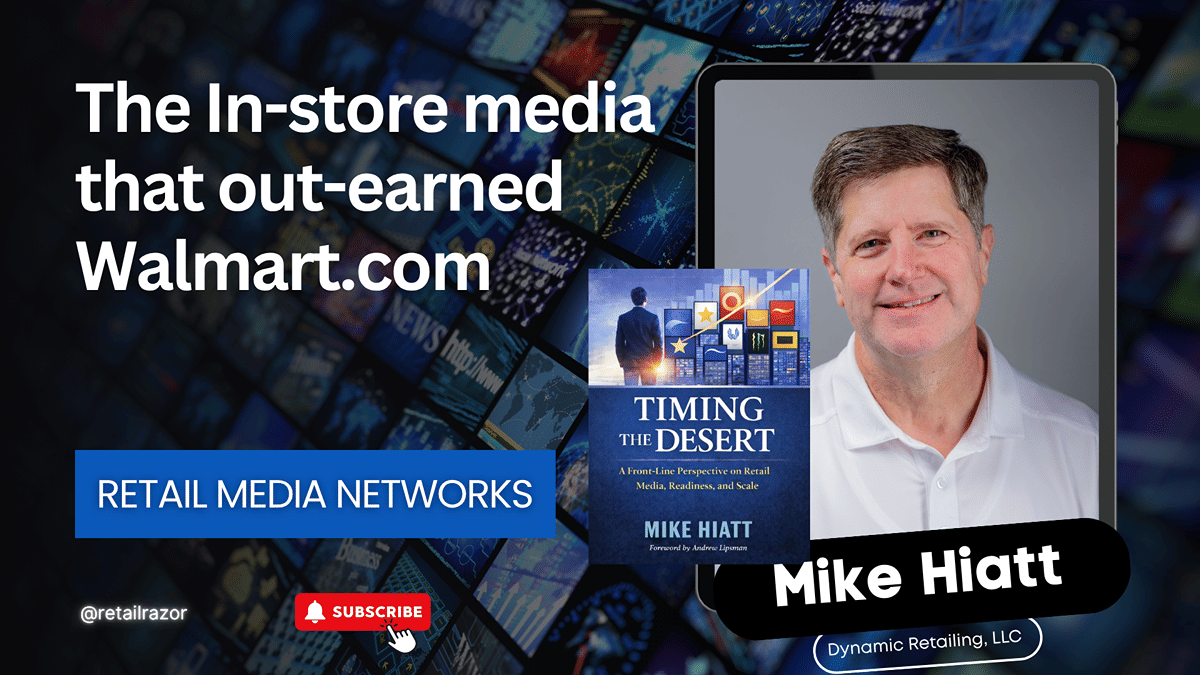
Walmart deinstalled the Smart Network around 2015 because merchants and marketing never settled who owned the revenue. The in-store retail media network worked. At its peak it out-earned Walmart.com and delivered the reach its team pitched as a Super Bowl a week. What it lacked was a way to pay merchants for the space it occupied.
What was the Walmart Smart Network?
Mike Hiatt came to Bentonville to take over Walmart TV, a network run by PRN with 27-inch screens mounted in the rafters, playing audio that competed with Walmart Radio and lost. Walmart paid for the system, PRN sold the advertising, and Walmart had no visibility into what PRN was earning.
Mike rebuilt it as the Smart Network. It had eye-level screens, multiple channels, and content matched to the products around it.
Walmart was renaming everything smart at the time, so the name stuck. It ran for about six years.
Why did Walmart shut it down?
Walmart has never sold shelf space. There are no slotting allowances. A brand earns the endcap on price and product.
The Smart Network introduced a competing idea: a brand could hold an endcap contractually because it was buying the media there.
Only five endcaps carried media, they sold out, and Mike says the team was probably underpricing them. Merchants read the whole arrangement as marketing taking their money, and nothing in the compensation structure gave them a share.
Operations made it worse. When media drove faster product velocity, fulfillment didn't know to restock, endcaps went empty, and store teams filled them with unrelated product while the screen advertised something that wasn't there.
What did DSIQ get right before anyone else?
Mike hired DSIQ, founded by Tom Opdyke and William Wu out of Microsoft, to build measurement and content decisioning for the network.
What they built was effectively an ad server for physical stores: store data in, content instructions out, sales results back.
This was before the industry used the term programmatic. Brands and internal teams questioned whether the data could be trusted, since the only comparison available was online click-through rates. Mike's assessment is that DSIQ built the perfect company for the world's largest retailer and could not scale down to smaller ones.
Why is in-store retail media working now?
Amazon. Once Amazon published ad revenue in the billions, Walmart treated the retail media network as strategic rather than incidental, brought the business in-house from partners like Triad, and started delivering bonuses to merchants on retail media dollars. The internal fight that killed the Smart Network is largely settled at the top tier. Second-tier retailers are still working through it.
The technology arrived from the same direction: online teams solved measurement, targeting, and delivery for their own reasons, and those stacks now transfer to in-store screens.
What are the five A's of in-store content?
Mike developed the five A's to move in-store content away from television format.
Accessible: quick and to the point, because shoppers are in shop mode and won't stand and watch a story.
Appropriate: contextually relevant to that store and that moment.
Adaptable: reusable across environments and store formats.
Attractive: it has to look good.
Assembled: it has to be assemblable at a cost that makes the network affordable.
He notes that adaptable and assembled are the two AI changes most, since content can now be generated per location.
Should retailers personalize or localize in-store media?
Mike argues for localization. The web is a one-to-one medium and broadcast is one-to-many, and he places in-store media as one-to-few. Maximum personalization on a public screen produces the Minority Report problem, where each shopper is targeted individually in a shared space.
Instead he treats a 2,000-store chain as 2,000 super customers, each with its own weather, local teams, demographics, and sales mix.
Casey Golden makes the related point that the store's value is discovery, and personalization narrows what a shopper sees.
Who reaches the "cereal moment" first?
The cereal moment is the day a major CPG runs a mainstream ad on a digital endcap and the category becomes real to national advertisers. Mike names Kroger as the most serious contender right now, based on reach, store count, and the people they've hired from the retail media side.
His caveat is measurement.
In-store media is fragmented across content management systems, network operators, and ad servers, and he expects consolidation before the money moves at scale.
Will in-store media ever be as profitable as online?
No, and Mike is direct about it. Retailers pay for the devices, the infrastructure, and the systems, which online advertising never had to do. His comparison: imagine if Google had to buy everyone's laptop before they could use the search engine. What in-store has instead is ownership. It's an owned and operated channel, the audience is verified human rather than bot traffic, and most shoppers have no digital relationship with the retailer at all. They don't use the app or visit the site. They walk in, fill a cart, and pay.
Right now that audience isn't monetized.
Frequently asked questions.
Q: Who is Mike Hiatt?
A: Mike Hiatt is president of Dynamic Retailing, a retail media network consultancy in Bentonville, Arkansas. He was Walmart's Director of In-Store Media Networks, where he led the Walmart Smart Network, and later worked at Triad Retail Media and Sam's Club. He wrote Timing the Desert: A Front-Line Perspective on Retail Media, Readiness, and Scale.
Q: What does Timing the Desert mean?
A: The title comes from a Hindu parable about a merchant who crosses the desert during the heat of the day and loses his people and animals, when the right move was to travel at night. Hiatt uses it for the pattern in his own career of arriving too early and moving on before the market matured.
Q: When did Walmart remove its in-store media screens?
A: The Smart Network ran roughly from 2008 and was deinstalled around 2015, after about six years of operation.
Q: What is in-store retail media?
A: In-store retail media is advertising sold by a retailer on screens and displays inside its physical stores, sold to brands the same way a retail media network sells placements on its website and app. Digital endcaps, aisle screens, and department displays are the common formats.
Q: Why do merchants and retail media network teams conflict?
A: Merchants control product, price, and space, and they are measured on category performance. Retail media teams sell that space to brands. Without shared incentives, merchants see media revenue as money diverted from their own budgets. Walmart resolved this by delivering bonuses to merchants on retail media dollars.
Hear (or watch) the whole story.
🎧 Hear the full conversation on in-store media and the origin story of the Walmart Smart Network, the pre-cursor to modern retail media networks, on The Retail Razor Show podcast. You can find Mike's book, Timing the Desert, at Amazon or your favorite bookseller. Learn more about the work Mike is doing in retail media today at the Dynamic Retailing website.
We've covered retail media networks extensively in previous episodes including the evolution to in-store media, off-site media, and the development of measurement techniques in retail media networks:
SPECIAL Groceryshop 2022 Part 2 - Lisa Kinney of Albertsons & Dave Steck of Schnuck Markets
SPECIAL Groceryshop 2022 Part 3 – Andrew Lipsman of eMarketer & Krystina Gustafson of ShopTalk
Groceryshop 2023 Recap with Krystina Gustafson & Ben Miller | #GroceryshopLive
State of Retail Media with Andrew Lipsman | #GroceryshopLive
Retail Media 2026 - DSP Shifts, Agentic Commerce & Brand Strategy
Off-site Retail Media & CTV - Andrew Lipsman on Retail Media’s Next Frontier
Follow the show on Apple Podcasts, Spotify, or Goodpods, or watch on YouTube, so you never miss an episode. If you feel the series earns it, leave us a 5-star rating and a short review. It genuinely grows the show. Then explore the rest of the Retail Razor Podcast Network: Retail Transformers, Data Blades, and Blade to Greatness.
Stay sharp, stay human, and stay ahead.
ABOUT THE AUTHOR
Ricardo Belmar is a retail tech analyst, top industry influencer and founder of The Retail Razor Show podcast, part of the Retail Razor Podcast Network, the #1 indie podcast network for retail, where he and Casey Golden help retailers cut through the clutter and the noise in retail. Ricardo writes and speaks on retail technology, AI in retail, retail media networks, marketing, commerce strategy, and the leadership behind real retail transformation. He has spent his career working with retailers and the technology companies that serve them. He is also a supporter of RetailROI and the charities they support helping children in need.
ABOUT THE PODCAST GUESTS
Mike Hiatt is the president of Dynamic Retailing. A retail media consultancy focused on helping technology solutions providers work more effectively with retailers and assisting retailers better execute retail media strategies inside their stores. He is on the advisory boards at Venvee and Blue Zoo; he recently authored the business book Timing the Desert: A Front-Line perspective on Retail Media, Readiness, and Scale, which focuses on Hiatt’s experiences working at Walmart, Triad Retail Media, and Sam’s Club as well as key insights about where in-store retail media will land in the future of retail. Hiatt graduated from Brigham Young University with a degree in Advertising Management.